Learn › Push, pull, slide › A field guide to movement
Step, jump, slide, push: a field guide to how pieces move
Take any board game and strip away the theme, the art, the story. What's left is a handful of verbs — the things a piece is allowed to do on its turn. Those verbs are the game's grammar, and once you learn to read them, you can open any rulebook and predict how the game will feel before you've played a single turn. This is a field guide to the six great movement verbs, with a spotter's checklist at the end.
Movement is a game's grammar
Here's the claim this guide rests on: how pieces move determines how a game thinks. Not the theme. Not the board size. The verbs. A game built on short steps thinks in neighborhoods — slow, patient, territorial. A game built on long slides thinks in geometry — open lanes, sudden strikes from across the board. A game built on pushes thinks in physics — force, resistance, walls.
Players sense this without naming it. It's why chess and checkers feel so different on the same sixty-four squares, and why Go feels different from both despite being deeper than either. Same grid sizes, different verbs, different souls. The verb list is short, too — game design has been running for five thousand years on roughly six of them, plus a shelf of rare hybrids. Learn six words and you can read every game in the store.
The step: one square at a time
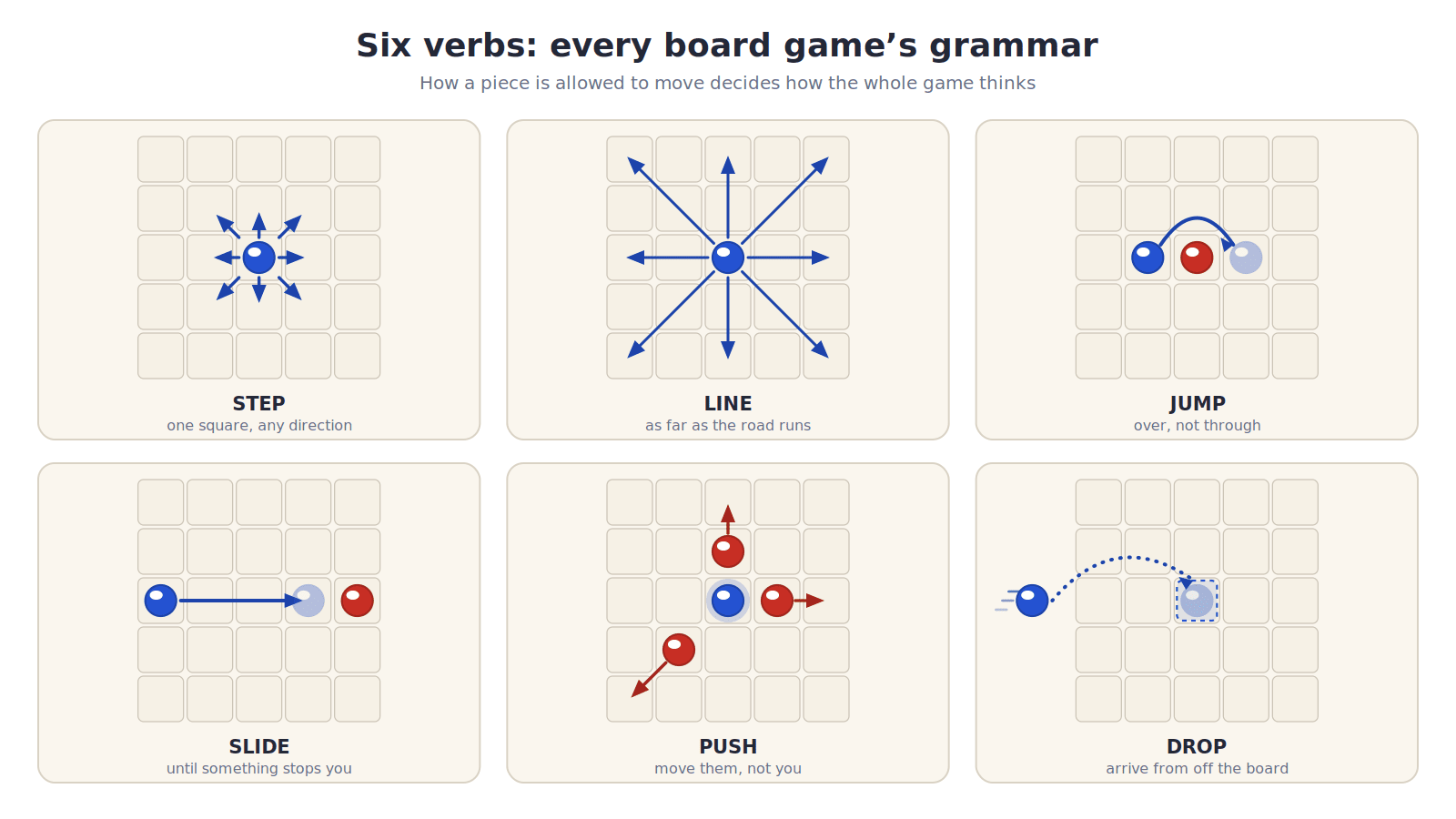
The oldest and humblest verb: move to an adjacent space. The chess king steps. The checkers man steps (diagonally, forward only). The pieces in Nine Men's Morris step along the lines of the board. Most of the generals and golds of shogi step. It's movement at walking pace.
Step games are local. Since nothing travels far, everything that matters happens between neighbors: you can see a threat coming for three turns, and so can your opponent — the drama is a slow tightening, not a lightning bolt. That makes step verbs the great engine of positional play. When escape is slow, terrain is destiny; a step game is always secretly about real estate, because you live where you stand. It also makes the step the most beginner-friendly verb in the family: no surprises, no hidden angles, just ground gained a square at a time. The cost is fireworks. Pure step games rarely produce the gasp — they produce the squeeze, which connoisseurs learn to love but newcomers can mistake for slowness.
The line: as far as the road runs
Second verb: slide any distance along a straight line until something's in the way. The rook, the bishop, the queen — chess's whole aristocracy runs on it. The flying chariots of xiangqi. The Amazons of the elegant pencil-and-paper game named for them. Line movers turn empty space into roads, and roads change everything.
Line games think globally. A bishop on one corner is a live threat to the far corner — so danger stops being a neighborhood affair and becomes board-wide geometry. This is the verb of the pin, the skewer, the long-range fork: tactics where the threat arrives from somewhere your eye wasn't looking. It's also the verb that makes open space dangerous: in a step game an empty square is just an empty square; in a line game it might be a loaded gun barrel. The price is readability. Beginners lose to line verbs constantly and bitterly — the bishop they forgot about, the file that opened two moves ago. If you've ever wondered why chess punishes new players so hard, the line verbs are most of the answer: they demand whole-board vision from move one.
The jump: over, not through
Third verb: ignore the crowd and land beyond it. The knight's L-shaped hop over anything in the way. The checkers capture, bounding over an enemy into the empty square behind — and then, gloriously, doing it again in the same turn. The grasshopper in Hive, vaulting a whole row of tiles. The chained leaps of Chinese checkers, where a well-built ladder flings a piece across the world.
Jumps are discontinuous, and that discontinuity is their whole personality. A line threat can be blocked — put something in the road. A jump ignores the road: walls don't help, crowds don't help, the threat teleports past your defenses. This is why the knight is the piece that forks kings and queens from nowhere, and why the untrained eye simply cannot see knight threats coming — the brain tracks paths, and jumps don't have paths, only destinations. It's also why checkers is so much deeper than its reputation: when jumps are compulsory and chainable, every arrangement of pieces is a potential chain reaction, and feeding your opponent a forced jump to set up a triple harvest is the game's signature pleasure. Jump verbs reward a specific trainable skill — seeing the board as a constellation of landing squares rather than a network of roads. Ten minutes of knight-only puzzles teaches more board vision than a month of casual games.
The slide-until-blocked: aiming at walls
Fourth verb, and the strangest of the classical set: move in a straight line and keep going until something stops you. No choosing your distance — the wall chooses for you. It's the physics of the ice puzzle, of sliding-block games, of several modern duels where pieces glide like pucks. Even Othello carries a cousin of it: the bracketing line that runs flat-out until it hits your own anchor disc, flipping everything between — the reason the whole game is secretly about who owns the stopping points.
Slide-until-blocked inverts how you think about obstacles. In every other verb, blockers are annoyances. Here they're equipment: you can't stop in the open, so the only reachable squares are the ones adjacent to something solid — which means the real board isn't the grid, it's the arrangement of walls, and every piece that moves rearranges everyone else's options. Games built on this verb feel like billiards played with architecture. They also teach a lesson this shelf keeps meeting: the wall is a co-author. When your movement rule ends with "…until blocked," the blockers write half of every plan.
The push: moving them instead of you
Fifth verb — the one this shelf is named for. Everything above moves your own piece through the world. The push moves the world: your action physically displaces other pieces, friend or enemy, and the board rearranges around your decision. Abalone's marble trains shoving enemy marbles toward the rim. Shobu's mirrored boards. Oustwit's radial blast, where a single placement shoves every neighbor outward at once.
The push changes the very subject of the game. Step, line, jump, and slide games are about where you go; push games are about what you do to everyone else — force, resistance, mass, walls. One verb buys a whole physics engine: offense (shove them toward doom), defense (mass behind mass), and drama (the board visibly lurches every turn). It's the most interactive verb in the family and the most instantly legible — a toddler understands a shove. The full anatomy gets two articles of its own: why displacement hooks players, and the sumo school of strategy it produced.
The drop, the crawl, the borrowed move: exotic verbs
Beyond the big five live the rare and wonderful hybrids — and three deserve their field-guide entries.
The drop. The piece doesn't move across the board; it arrives from off it. Go is the purest case — stones drop and never move again. Shogi made the drop legendary by another route: captured pieces switch sides and re-enter as your own, so material never leaves the game and no position ever runs dry. And placement duels like Oustwit run on the drop exclusively — with a twist: the drop is a push. Place a piece and its eight neighbors are shoved outward — a compound verb, drop-plus-blast, which is how a game with exactly one action per turn still gets a full physics engine. Drop games share a signature feeling: the board only ever gains structure, so every game is an act of construction — and the question is whose building stands.
The crawl. Hive's tiles slide around the edge of the swarm, hugging the hive's surface like beetles on a stone — movement constrained not by a grid but by connectivity, since the hive may never split. It's the step verb bent around a shape that the players themselves are building. One game, one verb-variant, and an entire strategy of pins and frozen pieces falls out of it — the full tour is next door.
The borrowed move. Onitama's genius: your pieces have no moves of their own. Movement lives on five shared cards, you hold two, and every card you use rotates to your opponent — so the verb itself changes hands. Playing your best move literally hands the weapon to your rival. It's the family's best proof that even the grammar of a game can be a resource to spend.
Reading a new game by its verbs
Here's the payoff — the spotter's checklist. Next time you meet an unfamiliar game, skip the flavor text and find the movement rules. Five questions will tell you most of what's coming.
One: how many verbs? Count the distinct movement types. One or two means the game is betting everything on depth-from-simplicity — expect elegance or emptiness, nothing between (the ratio that separates them is its own article). Six or more means a vocabulary game: expect a learning curve and a long reward tail, like chess.
Two: what's the range? All-local verbs promise a slow-burn positional game. Any global verb — lines, long jumps — promises sudden death from across the board and demands wider vision. Mixed ranges usually mean the global pieces are the aristocracy and the steppers are the infantry.
Three: do moves touch other pieces? This is the interaction question, and it's the big one. Verbs that only relocate your piece leave the board calm; verbs that flip, capture, or push make every turn a small storm. The more a move disturbs, the faster the game's possibilities multiply — and the more the game will feel alive rather than filed.
Four: is anything irreversible? Pawns that can't retreat, stones that never move, marbles that fall off forever, pieces that return to hand — every game has its own answer to "can this be undone?", and the answer sets the emotional stakes. Irreversible verbs make weighty, committal games; recycling verbs make forgiving, rematch-hungry ones.
Five: who owns which verbs? Symmetric games give both sides the same grammar. Asymmetric ones — the Viking tafl games with their unfair fights, modern duels with variable powers — hand different players different sentences, and balance becomes the designer's tightrope.
Run the checklist in the store aisle and you'll predict a game's personality with unnerving accuracy. It's the same skill the deep-game field guide teaches, zoomed in on the rulebook's first page.
Questions people ask
Which verb is best for a beginner's first deep game? Steps and drops — they're the legible ones. Nothing arrives from off-screen, nothing needs peripheral vision. It's no accident that Go (pure drop) and Oustwit (drop-plus-push) teach in under a minute, while chess (five verbs and an exception) needs a patient afternoon.
Why does chess feel harder than Go when Go is the deeper game? Vocabulary versus sentences. Chess front-loads six movement patterns before you can play at all; Go asks for one word and then spends a lifetime on what you say with it. Verb count sets the entry difficulty; depth lives elsewhere — the two axes get a full article.
What's the rarest verb? Probably the swap and its relatives — moves that exchange or rotate the pieces' own abilities. Onitama's traveling cards are the famous case. Designers use them sparingly because they bend the one thing players want stable: the rules themselves.
Can a game have too many verbs? Easily — verb bloat is the most common disease in ambitious homemade designs. Every added movement type multiplies what both players must track, and past a point the game stops being deep and starts being administrative. The modern classics almost all cut verbs, not added them: one great verb, fully explored, beats six shallow ones every time.