Learn › The classics › Nine Men's Morris
Nine Men's Morris and the mill games
Three-in-a-row with a career plan: place your pieces, then march them around a board carved into cathedral cloisters and Roman stone, forming and re-forming "mills" that grind away the enemy one piece at a time. Nine Men's Morris is the missing link between the child's grid and modern strategy — and it's better than its museum-piece reputation suggests.
The three-in-a-row game with a second act
Everything about morris starts from one design decision that puts it centuries ahead of its ancient peers: the game has phases. Act one, placement: players alternate putting their nine pieces onto the board's twenty-four points. Act two, movement: with hands empty, turns become slides — one piece, one step along a marked line. And for the desperate, act three, flight: a player reduced to three pieces may "fly" — jump anywhere — a comeback mechanic, medieval edition.
The goal throughout is the mill: three of your pieces in a row along a marked line. Form one and you immediately remove an enemy piece of your choice from the board — permanently. Reduce your opponent to two pieces (or no legal moves) and the game is yours.
Notice what the phase structure fixes. Bare three-in-a-row on a static grid dies of permanent defense — the tic-tac-toe autopsy in one line. Morris's answer, centuries before modern design theory: let the pieces move, and a blocked line is only blocked until the blocker gets called away to another job. Lines form, break, and re-form forever; the goal your childhood exhausted becomes renewable. It's the same repair philosophy that the whole family tree keeps rediscovering, and morris got there first — by most of a millennium.
Older than most kingdoms
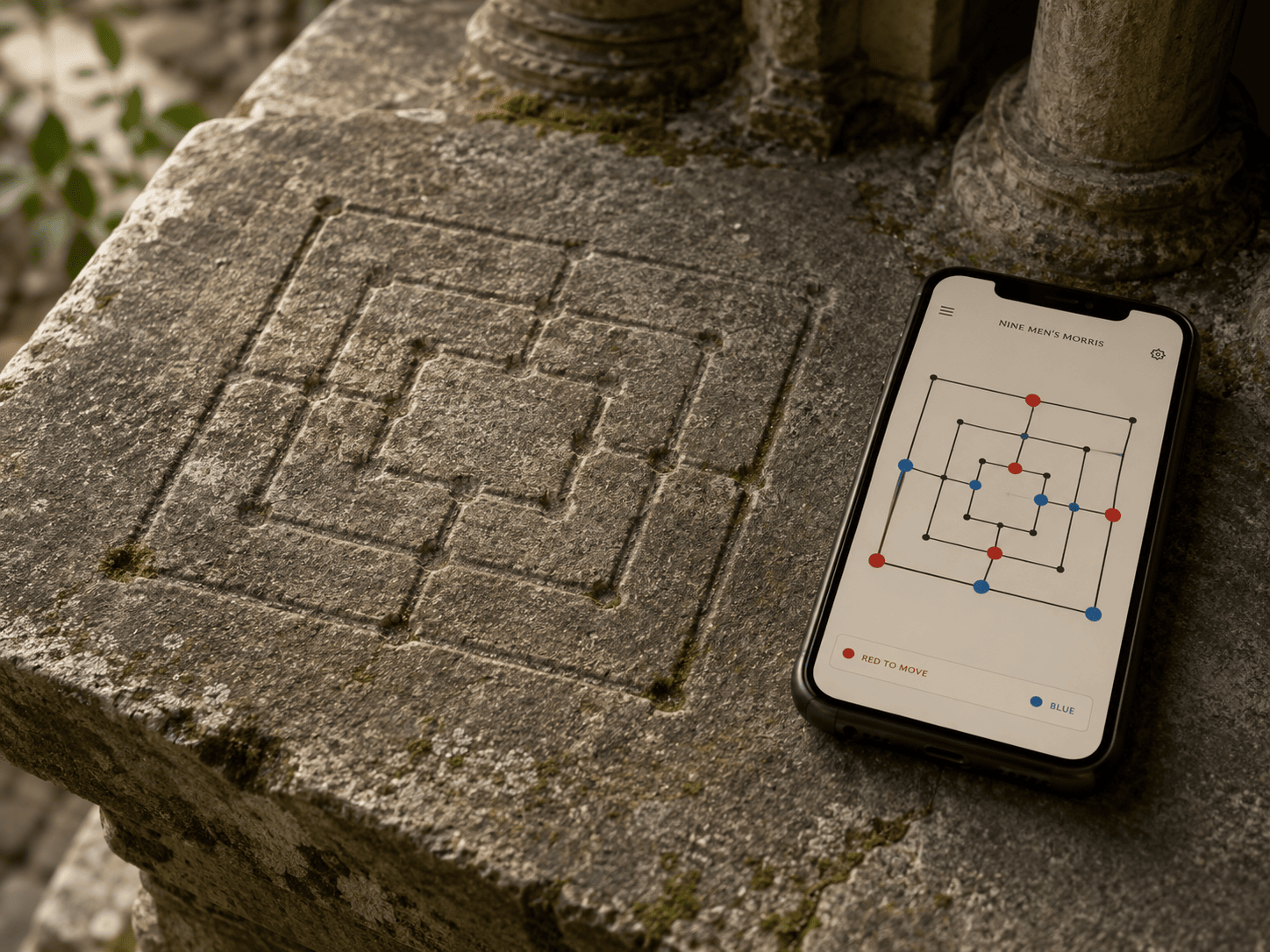
Morris boards are among the most widespread game graffiti on Earth. The distinctive three-nested-squares pattern is carved into Roman-era stonework, scratched into the cloister seats of medieval cathedrals (monks, evidently, between prayers), cut into ship decks, temple steps, and village benches across Europe and well beyond. Shakespeare name-drops the game in A Midsummer Night's Dream — "the nine men's morris is filled up with mud" — as something any audience would know. For centuries, this was simply the board game of ordinary European life, the way its cousins in the mill family (three men's morris, six, twelve) filled the same role elsewhere.
As always with stone-carved boards, reading play from rock requires care — a carved grid may be a game, a mason's doodle, or something else — but morris's case is unusually strong: the same unmistakable pattern, across centuries and continents, often accompanied by written references. When you set up a morris board, you're joining one of the longest unbroken tables in gaming. That the game then fell from ubiquity to near-forgotten is its own instructive story — fashion, chess's rise, the parlor-game era — and its own entry in the survival files: morris didn't die, but it did retire, and the difference matters.
The double mill: the engine every player fears
Morris strategy has a monster at its center, and meeting it is the game's rite of passage. Because mills re-form — swing a piece out of a completed mill and back in, and it counts as new — the game's apex structure is the double mill: two overlapping mills sharing pieces, arranged so that one move closes the first while opening the second, and the return trip closes the second while re-opening the first. Each swing grinds away one enemy piece. Every swing is also a move, so the oscillation runs as long as the geometry holds: a piece-removal machine, built from the same three-in-a-row your childhood declared trivial.
The double mill is this shelf's favorite specimen twice over. It's the fork made renewable — not two threats once, but two threats alternating forever. And building one is pure quiet preparation: the pieces assemble in an innocent scatter, the way all good forks farm, and by the time the shape is visible, the harvesting has begun. Defense, accordingly, happens early or never: watch for enemy pieces that participate in two potential lines, and break the junction before the machine bolts together.
The rules in five short steps
One: the board is three nested squares, their midpoints joined by four lines — twenty-four points where pieces can stand. Each player takes nine pieces. Two, the placement phase: take turns placing one piece on any empty point. Three, mills: any time three of your pieces stand in a row along a marked line, you've made a mill — immediately remove one enemy piece of your choice (pieces inside an enemy mill are protected unless nothing else is available). Four, the movement phase: once all eighteen pieces are placed, turns become moves — slide one of your pieces one step along a line to an empty neighboring point. Mills formed by moving work exactly the same, and a mill broken by moving out can be re-formed by moving back in. Five, the endings: a player reduced to three pieces may fly — move anywhere, not just one step. A player reduced to two pieces loses. So does a player who can't make a legal move.
Read the rules once more and notice how little there is. No piece types. No captures except the mill's harvest. One movement verb. And out of that, seven centuries of play — the depth-per-rule ratio this shelf keeps hunting, hiding in a cathedral doodle.
A double mill, built in slow motion
The monster deserves a slow walkthrough, because seeing it built once inoculates you forever.
Step one. During placement, your opponent puts three pieces in an L-shape around one corner region — two pieces on one line, two on the crossing line, sharing the corner piece. It looks unambitious. You place elsewhere, contesting a cross point.
Step two. Early movement phase. They complete the first mill — three in a row along one arm of the L. You lose a piece. Annoying, but you've seen mills before. You block the line's re-entry point... except you can't block both arms.
Step three. They slide the shared piece out of mill one — directly into mill two, along the crossing arm. That's a new mill. You lose another piece.
Step four. Next turn, they slide the same piece back. Mill one again. Another piece. Slide out: mill two. Another. The machine has a rhythm now — click, clack, click, clack — and every clack is one of your pieces leaving. You are watching a three-in-a-row perpetual motion device, and your remaining moves are spent feeding it.
The inoculation: the machine was visible at step one. An L-shape whose two arms share a piece, with both completion points reachable — that's the blueprint, and one placement of yours on either completion point, back when it cost you nothing, would have condemned the machine to stay a doodle. Junction-watching, one game early: the whole defensive art in a sentence.
How the game actually plays (and where it bites)
The placement phase is the real opening. Beginners treat placement as setup; veterans know it's half the game. Every placement is doing three jobs: threatening mills now (forcing responses — placement-phase mills are rare between decent players, but the threats steer everything), claiming the board's high-traffic geography, and pre-positioning for the movement phase to come. The board's twenty-four points aren't equal — the four cross points in the middle of each side, where three or four lines meet, are morris's center squares: pieces there join more potential mills and reach more destinations. The placement phase is a fight for the crosses wearing a fight about mills as a costume — square-value arithmetic, medieval edition.
The movement phase is a mobility war. With all pieces down, the board is crowded and steps are short — and the game reveals itself as a struggle over who can still breathe. Blocking an enemy piece's every exit is as good as capturing it; sealing a whole region strangles a position slowly; and losing pieces hurts double, since fewer pieces mean fewer possible mills and fewer moves. Games are won here by move-starvation as often as by grinding mills — remember, no legal moves means you lose outright — making morris a surprisingly pure playground for compulsion warfare and safe-move counting.
Flying is the desperation gambit. At three pieces, a player's jumps-anywhere power makes them slippery — able to threaten mill completions across the whole board — but three pieces is also exactly one mill from death, so flight is less a comeback than a dramatic final chapter. It does keep endings tense: careless winners have lost won games to a flying counterattack, which is precisely the job a comeback rule is hired to do.
Solved, and still teaching
Morris joined the solved shelf early: in the 1990s, computer analysis established that Nine Men's Morris, played perfectly, is a draw — placement advantages and mill threats balancing out into mutual fortress play at the summit. The now-familiar caveat applies with full force: between humans, especially humans who learned the game an hour ago, draws are nowhere in sight — the double mill eats somebody most games, and the move-starvation endgames reward whoever counts better. The solved verdict just confirms what the game's centuries of popularity already suggested: the design is balanced, which is more than many ancient games could claim.
The family around it stays lively for exactly this reason. Smaller cousins (three and six men's morris) serve as children's steps; twelve men's morris crowds the same board with more pieces and sharper placement play; and the variant known as Lasker morris — allowing placement and movement to interleave — was proposed by a chess world champion specifically to deepen the classic. The mill mechanism keeps proving renovable, seven-ish centuries in.
Morris as the missing step
Here's the practical case for the old game tonight: morris is the cleanest bridge in existence between children's line games and adult strategy. It keeps the goal a child already understands — three in a row — and adds, one at a time, the concepts the grown-up shelf runs on: phases (plans that mature), movement (defense that decays), material (losses that compound), mobility (the breathing war), and the double mill (the fork, industrialized). Teach a bright eight-year-old morris after tic-tac-toe and you can watch each concept install. Teach yourself morris after a childhood of tic-tac-toe and the same thing happens, just with more grinning.
The board is printable in one minute, any nine-a-side tokens work (coins versus buttons is traditional in the field), apps abound with patient AIs, and the rules above are genuinely the whole rulebook. Among the classics shelf's members, morris asks the least and explains the most — the humble, load-bearing middle child of the entire family.
Three experiments for tonight
Coins versus buttons. Print a board (or draw one — three squares, four connecting lines), grab nine coins and nine buttons, and play the full game twice with someone. The physical version costs nothing and the placement phase's tension — nine decisions each, every one permanent — lands better on a table than a screen.
Placement-only, for a child. With a young opponent, play just the placement phase: nine pieces each, mills capture, most pieces standing wins. It's tic-tac-toe's big sibling — same visible goal, real consequences — and it installs the junction-watching habit that every fork game runs on, at an age when tic-tac-toe has just gone stale.
Hunt the machine. Against an app's easy AI, refuse to win by anything except a double mill. You'll lose games declining easy grinds — and somewhere in the third or fourth game, you'll bolt the oscillator together with your own hands and hear the click-clack from the operator's side. After that, no L-shape on any board will ever look innocent again, which was the entire tuition.
Questions people ask
Is a mill formed during placement worth it? Sometimes — but the threat usually outearns the mill. Forcing your opponent to spend placements blocking while you claim cross points is the stronger harvest; an early mill that costs you shape is the classic newcomer trade the veteran quietly encourages.
Which piece should I remove when I grind a mill? The rule of thumb: take mobility, not menace. The piece whose removal most shrinks their options — a cross-point piece, a double-mill component, the last defender of a region — beats the piece that merely looks threatening. (Standard rules protect pieces inside enemy mills unless nothing else is available.)
Why did morris fade when chess and checkers survived? The honest answer mixes fashion, printing (chess got the literature), and the parlor era's new competition — a case study in how institutions, not just quality, decide survival. The game itself never stopped working; its infrastructure did.
Does morris skill transfer? Unusually well: junction-watching transfers to every fork game, starvation counting to every endgame, and phase-awareness to everything with an opening and a middlegame. Morris is the rare classic that functions almost entirely as curriculum — which may be the truest reason schools that still teach it keep teaching it.