Learn › The language of strategy › Parity
Parity: the even-odd math hiding in your games
Some games are decided by brilliance. A surprising number are decided by arithmetic so simple it hides in plain sight: who moves on the odd turns, who moves on the even ones, and who runs out of useful moves first. This is parity — the counting layer under every alternating-turn game — explained gently, with no equations and several unfair advantages.
Musical chairs, the universal engine
Begin with the children's game that secretly explains half of endgame theory. Musical chairs isn't about speed or grace — it's about a count: ten players, nine chairs. Someone must be standing when the music stops, and the entire drama is arithmetic wearing a party hat.
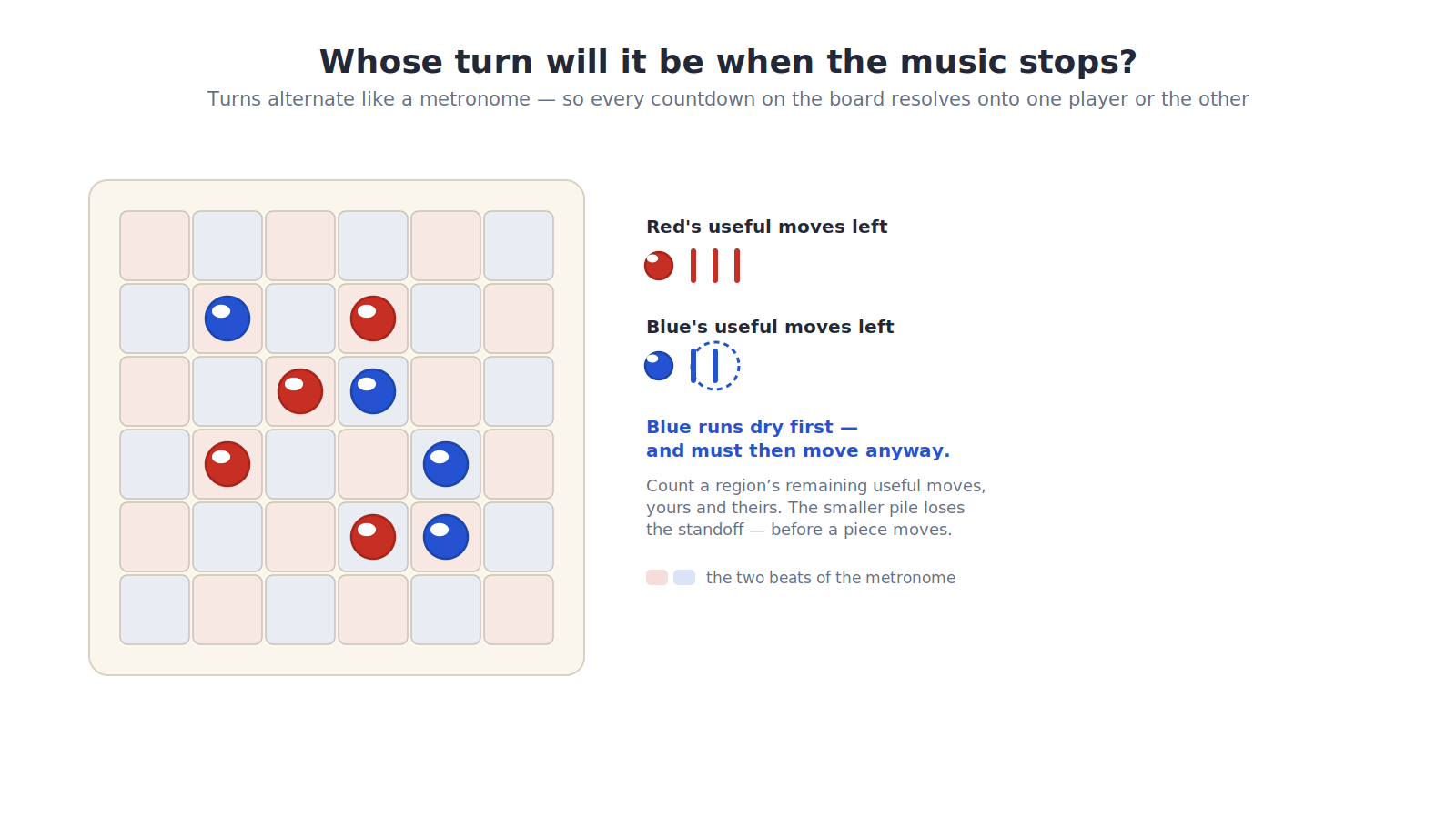
Now look at any turn-based duel through the same lens. Moves alternate: you, them, you, them — a metronome older than every game on this shelf. Whenever some resource is running out — empty squares, safe moves, useful placements — the metronome turns the game into musical chairs: when the resource is gone, whose turn will it be? That single question, answerable by counting, decides more endgames than tactics do. If the resource runs out on your opponent's turn, they're the one standing when the music stops — forced to make the move nobody wants (which is where parity hands the victim over to its sibling concept, zugzwang). Parity is the counting; zugzwang is the consequence.
The word itself just means evenness-or-oddness. You move on turns one, three, five — the odd beats — and your opponent on the even beats, or vice versa. Most of the game, nobody cares. Then the board begins to empty or fill, some countdown becomes visible, and suddenly the players who can count the beats are playing a different, better-informed game than the players who can't. This article is about joining the first group, because membership costs about ten minutes.
The opposition: two kings, one insult
The oldest parity lesson in gaming is a chess standoff so pure it needs no board to follow. Two kings face each other with one empty square between them. Neither may step adjacent to the other (kings can't approach kings), so they stand like duelists at a doorway — and whoever must move first has to step aside, surrendering the doorway to the other. The player not obliged to move holds what chess calls "the opposition": a pure parity trophy. Nothing about the pieces differs; the entire advantage is the count of whose turn arrives at the standoff.
Endgame technique grows straight out of this insult. Kings maneuver toward critical squares trying to arrive with the enemy to move; players count squares and moves, adjusting their path to land on the right beat — occasionally by the delightfully absurd maneuver of walking a triangle to waste one turn and flip the count. The deep habit to extract: strong players don't just ask where pieces should go. They ask on whose beat the arrival lands — because the same square, reached one tempo differently, is a different square entirely.
Connect Four: parity as national territory
For parity at its most visible, nothing beats the yellow plastic frame. In Connect Four, discs alternate into columns, which means each square's height determines the beat on which it tends to get filled — and the game's expert theory divides the entire board into odd rows and even rows, the first player's territory and the second's. A threat banked on your own parity's row matures into a forced win as the columns fill; a threat on the wrong parity is a beautiful decoration. The full mechanism lives in the Connect Four article — here, the point is the pattern: in filling games, space itself acquires parity. Squares belong to beats, and beats belong to players.
Placement duels inherit the idea directly. Any game where pieces accumulate — Go's endgame regions, morris's placement phase, a 6×6 filling toward its final squares — has moments where you can look at a region and ask: counting the forced sequence coming, who places last here? The last placement in a region often collects its prize (the point, the mill, the decisive brace), and which player gets it was often determined by the count several moves earlier, when a single quiet move elsewhere would have flipped it.
Mirror play: parity's tempting fraud
Every player eventually meets the idea: what if I just copy my opponent? Symmetric board, symmetric responses — whatever they do, mirror it. It feels like a parity cheat code: they act, you echo, and the echo seems to guarantee you're never worse off. The scheme even works, briefly, in many games — and its failure is the most instructive collapse in strategy.
Mirroring fails for one deep reason: the center, and the first touch of it, breaks the symmetry. Somewhere there's a move the mirror can't copy — the opponent occupies the central point itself, or launches a sequence that arrives at your mirrored stone one tempo before your echo arrives at theirs. Copying concedes exactly one thing forever: they act on beat one of every exchange, you on beat two — and in any position where the first arrival collects (a capture, a completed line, an oust), beat one wins by definition. The mirror is a machine for guaranteeing you lose every race by exactly half a move. In Oustwit the fraud collapses fastest of all: a mirrored placement doesn't even reproduce the position, because your copy shoves different neighbors — the board itself refuses the symmetry.
Why teach a failed strategy? Because its failure is the lesson: parity says whoever acts first on a contested point owns the tempo of that contest, and no amount of cleverness-by-echo repeals it. Players cured of the mirror fantasy have internalized the beat structure of games — which is the whole subject, learned by vaccination.
Parity with eight pieces: counting an Oustwit endgame
The fill-race win gives Oustwit a parity layer all its own, and it rewards exactly one habit: counting out loud (silently).
Count one: pieces in hand. Each player has eight; the fill win means your eight on the board simultaneously. So at any moment the fill-race scoreboard is just hands: you hold two, they hold three — you're one placement-cycle ahead in the race, if nothing gets ousted. Every oust flips a unit from board back to hand and rewrites the count, which is precisely why well-timed ousting is the fill-race's brake pedal.
Count two: the beats to the finish. Suppose you hold one piece and they hold two, with you to move. Beat one: you place your last — eight on board, and if none of yours can be ousted before the turn resolves… but wait: can they oust? That's count three: vulnerable pieces. A braced structure with zero oustable pieces makes your fill-count unassailable arithmetic; one teetering rim piece makes it a hope. Strong endgame play braids the three counts — hands, beats, vulnerabilities — into one question shaped exactly like musical chairs: on the beat when my eighth piece lands, will any shove exist that unlands it? If no: the game was over several moves ago, and only the counting knew.
Practice by narrating one endgame per session: "I hold two, they hold one; my next placement braces; their oust window is that one diagonal…" It feels mechanical for three games, and then it feels like sight — the same transition every counting skill makes on its way to instinct.
A worked count: the last three beats of a duel
Here's parity deciding a game, narrated slowly. An Oustwit endgame. You hold one piece in hand. Your opponent holds two. It's your move.
Naive read: "I'm ahead — I only need one placement to finish the fill!" Now count the beats. Beat one, yours: you place your eighth piece. Fill complete? Only if it survives the turn — and your new piece sits unbraced near the rim. Beat two, theirs: they place, shoving your eighth piece off the board. Back to your hand it goes. Their count: one in hand now. Beat three, yours: you re-place — somewhere safer this time, but the race has changed. Beat four, theirs: they land their last piece, braced, deep in friendly structure. Their fill is complete, and nothing of yours can shove anything of theirs. Game over — and you were "ahead" the entire time.
Re-run the count from the start and the real question appears at beat one: not "can I finish?" but "can I finish unoustably?" The answer was no — so the correct beat-one move was the boring brace that made beat three's placement safe. One count, three beats deep, worth more than any tactic on the board. This is what "the counting players see a different game" means in practice: the pieces were identical; the schedule was the whole story.
Kitchen-table parity: the twenty-one game
Want the counting instinct in its purest form? Play this with anyone, anywhere: count to twenty-one out loud, alternating turns, each player saying one, two, or three numbers. Whoever says "twenty-one" loses. That's the entire game.
Play it three times and the machinery reveals itself: certain numbers are safe harbors — leave your opponent at twenty, and they must say twenty-one; leave them at sixteen, and whatever they do, you can reach twenty; and backward it unrolls, four by four, to the very first move. The winner is decided by who first grabs the correct rhythm, and once both players know it, the game becomes a pure demonstration: first-mover advantage or bust, decided by arithmetic before anyone speaks. Children can master it. Most adults have never noticed it's exactly the skeleton of every endgame count they've ever lost — regions, fills, and standoffs are the twenty-one game wearing pieces. Ten minutes of it and the phrase "count backward from the end" stops being advice and becomes a reflex.
Three counting habits that travel everywhere
Count the region, not the board. Full-board counting overwhelms; parity almost always lives in one contested region at a time. Fence it mentally — this corner, that column, those four squares — and count beats inside the fence. Small counts, sharp answers.
Count backward from the end. Don't ask "what happens next?" — ask "who makes the last meaningful move here, and step backward?" Endings anchor the arithmetic: the last placement in a filling region, the last safe move before the vise, the last free beat before a banked threat matures. Backward counting turns fog into a countdown.
When the count is against you, change the count. Parity isn't fate — it's the current tally, and tallies can be edited: a spare move burned (or manufactured, triangulation-style), a forcing exchange inserted to flip whose beat lands where, an oust that adds a cycle to a fill race, a sacrificed point that deletes one beat from a region's countdown. Half of advanced play is exactly this — parity repair — and it's why the counting players seem to slither out of lost-looking endings: they saw the bad count early enough to renovate it.
The oldest parity fact of all: moving first
Step far enough back and the most famous advantage in games reveals itself as a parity statement. "First-mover advantage" just means: the odd beats belong to you. You act first in every race, arrive first at every contested point, and in any even-length exchange, yours is the hand that moves last before the dust settles. Chess's White edge, bare Gomoku's proven first-player win, Connect Four's center-column verdict — all of them are the odd-beat ownership, compounding.
Which explains why the great fairness repairs are all, at heart, parity repairs: Go's komi pays the even-beat player points as compensation; the pie rule auctions the odd beats to whoever values them honestly; alternating colors across a match splits the beats evenly over the evening. Once you've seen it this way, the first move stops being a mystical blessing and becomes what it always was — one extra entry in the schedule, priceable like everything else on this shelf. And your practical takeaway is pleasantly concrete: when you do hold the odd beats, spend them where arrival order matters most (the high-traffic squares, the contested region); when you hold the even beats, steer toward positions where the last word matters more than the first — the counts, the fills, the standoffs where the obligation comes due on their clock.
Questions people ask
Do I really need this below expert level? Sooner than you'd think. The first time you win a fill-race because you counted hands, or block the right end of a region because you counted the last move, you're using it — and casual opponents essentially never do, which makes basic parity the cheapest unfair advantage on this entire shelf.
Is parity the same as tempo? Cousins with different jobs. Tempo values each move; parity tracks the schedule of moves — which beats belong to whom as a resource runs out. You can spend tempo brilliantly and still lose the count; the strongest endgames audit both books.
Why odd and even, specifically? Because turns alternate — the deepest structural fact of dueling games. Everything in this article is downstream of "you, them, you, them": a two-beat rhythm makes every countdown resolve onto one of exactly two players. (Games with double-moves or variable turn order scramble the arithmetic — one reason they feel so alien to duel players.)
What's the ten-minute installation? One Connect Four game watching only row parity; one Oustwit endgame narrating hands-beats-vulnerabilities; one chess-style king standoff against any app to feel the opposition once. Three small counts, three different games — after which the metronome under every duel you play will be permanently, usefully audible.