Learn › The language of strategy › Zugzwang
Zugzwang: when every move makes it worse
There's a moment in strategy games stranger than any trap: the position where you'd love to do nothing at all — and the rules won't let you. Every legal move damages you, passing is forbidden, and your turn arrives like a bill. Chess players call it zugzwang, "the compulsion to move," and once you learn to see it, you'll find it hiding in every game you own.
The curse of the mandatory turn
Start with the rule so basic nobody mentions it: you must move. In almost every turn-based game — chess, checkers, Go's endgame squeezes, every placement duel — there is no "pass" button when things get uncomfortable. Your turn comes, and the rules demand an act.
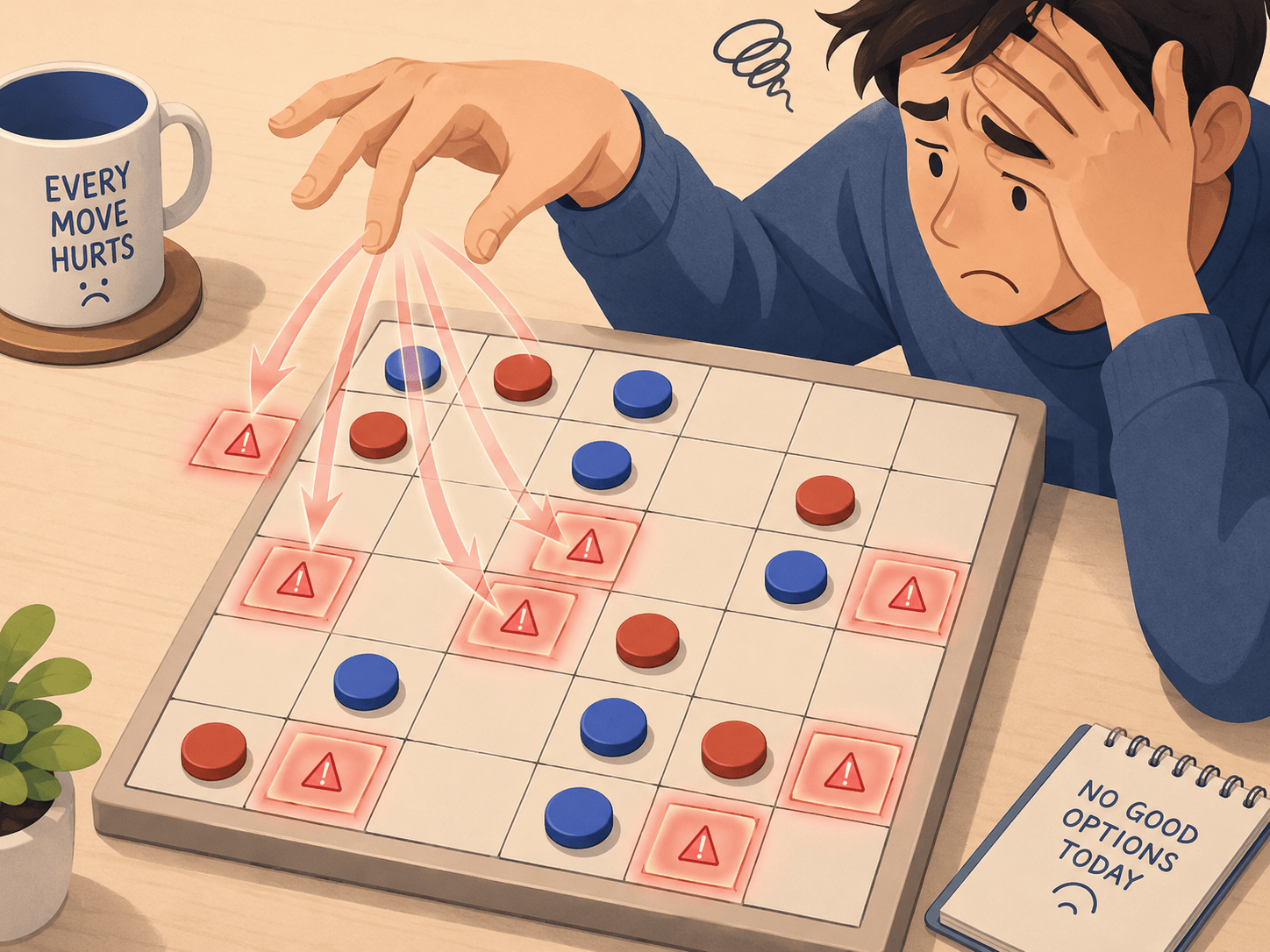
Ninety-nine percent of the time this rule is invisible, because moving is what you want to do. Moves are opportunity; the whole game is the joy of spending them. But flip the lighting and the rule shows its teeth: imagine a position where every square you could go to, every piece you could touch, makes your situation strictly worse. You survey your options — this one drops a piece, that one breaks your own line, the third walks into the fork you've been dodging for five turns. If you could fold your arms and say "no move, thanks," you'd be perfectly safe. You can't. The compulsion is the weapon, and your opponent aimed it.
That's zugzwang. It's not a threat in the usual sense — nothing is attacking you, exactly. The game itself is attacking you, through the rulebook, and your opponent merely arranged for you to be standing where the rulebook fires. Players who encounter it unprepared describe the same disbelief: I'm not losing because of anything on the board. I'm losing because it's my turn. No other idea in strategy so cleanly separates the beginners from the students. Beginners see moves as always-good; students have learned that the right to move is sometimes a debt.
A tiny example you can hold in your head
The classic demonstration needs only three pieces, described in words. Two kings and one pawn, chess endgame. White's pawn is one square from promotion, but its path is blocked by the Black king standing guard directly in front of it. White's king stands directly behind its pawn's diagonal, protecting it. Here's the strange arithmetic: if it's White's turn in certain of these standoffs, White has nothing useful — the pawn can't advance, the king shuffles sideways, Black's king shuffles in mirror, forever. Draw. But if it's Black's turn in the critical position, Black's king must step somewhere — and every legal square abandons the blockade. The pawn strolls through the vacated door and becomes a queen.
Same pieces, same squares. The only variable is whose turn it is, and it decides the entire game. Chess teachers call the standoff "the opposition," and getting your opponent to move first in it is half of elementary endgame technique — a pure, distilled dose of turn-as-poison. (The counting tricks for winning these standoffs belong to parity, the vocabulary shelf's arithmetic department — zugzwang and parity are the two faces of one coin.)
Hold that example and you have the concept entire: zugzwang is any position whose evaluation flips based purely on the obligation to act. Everything else in this article is that seed, grown into different gardens.
Where zugzwang lives, game by game
Chess endgames are its famous home — king-and-pawn standoffs, fortress positions, squeezes where a grandmaster shepherds an opponent into a corral of only-bad-exits. Endgames host it because boards empty out: with few pieces, "some harmless move elsewhere" stops existing, and every move must touch the crisis.
Checkers is soaked in it — arguably more than chess, because captures are compulsory. A checkers player can be made to jump into disaster: your opponent offers a piece, the rules force your capture, and the capture drags you onto a square where a triple-jump awaits. Forced moves are zugzwang's accelerant, and the underestimated old game weaponizes them constantly — entire endgames reduce to who runs out of safe moves first.
Connect Four delivers it in primary colors. As columns fill, players tiptoe around the poisoned squares beneath enemy threats — and eventually the safe columns run out. The loser's last act is placing the disc that hands their opponent the win directly above it, a move they can see, hate, and must make. The solved game's entire endgame theory is engineered zugzwang: banked threats waiting for compulsion to deliver the victim.
Nine Men's Morris squeezes: run a player low on pieces and mobility, and their forced shuffles feed the double mill one crank at a time.
And placement duels? Oustwit has no captures and no passing, and its version is sly: every placement pushes the neighbors, so in a tight late-game every legal placement disturbs something — often something of yours. Positions arise where each empty square either scatters your own forming line, shoves your braced piece off its anchor, or assembles the enemy's line for them (the losing-push rule, remember, is always loaded). You survey the board for a harmless square and find the game has quietly eaten them all. That's zugzwang wearing a push mechanic — nothing attacks you; the geometry does.
Mutual zugzwang and the art of the waiting move
Now the connoisseur's floor. Sometimes a position is poisoned for both players — whoever must move first loses, full stop. Researchers call it mutual zugzwang, and it turns the game inside out: both players suddenly want the same impossible thing, to not be next. The contest stops being about doing and becomes about a strange currency: spare moves.
A spare move — chess players say "a tempo in hand," and here the coin metaphor pays off perfectly — is a move that changes nothing important: a pawn step on the far side of the board, a harmless shuffle, a placement in a dead corner. In ordinary positions, spare moves are the wasted coins that tempo doctrine warns against. In mutual zugzwang, they invert into treasure: each spare move lets you burn a turn without touching the crisis, handing the compulsion back across the table. The player with three spare moves against two wins the standoff — the whole battle becomes an auction of uselessness.
Chess even has a named maneuver for manufacturing a spare move out of nothing: triangulation. The king walks a little three-step triangle — two moves to arrive where one would do — returning to the same square with the other player now to move. Walking in a circle to lose a turn on purpose: it sounds like a joke, and it wins textbook endgames. When you first see triangulation work, the game's relationship to time rearranges itself permanently in your head — moves stop being progress and become position in a rhythm, and rhythm can be danced.
Engineering the squeeze (and escaping it)
To build zugzwang, strong players work three levers. Shrink the opponent's options: trade off their active pieces, seal their open lanes, brace everything they might profitably touch — a player with one legal region is a player nearly in the vise. Keep your own options fat: hoard a spare move or two like emergency rations (in Oustwit terms: leave yourself one genuinely quiet placement, a square touching nothing). Then stop. Don't strike — wait. The squeeze converts by handing them the turn, not by hitting them. It's the least intuitive attack in games: assembled like an ambush, sprung by doing almost nothing.
To escape, the honest news first: true zugzwang, fully closed, has no exit — that's the definition. Real defense happens upstream, and it looks like tempo hygiene: keep a reserve of harmless moves, resist over-committing every piece to load-bearing duty (a board where all your pieces are essential is a board where every move breaks something), and watch for the vise early — the tell is your list of comfortable moves shrinking turn by turn while theirs doesn't. When you feel the walls, spend material to buy air if you must: a sacrificed piece that reopens a region of harmless moves is cheap compared to moving your own foundation. And sometimes the great escape is changing the game's subject entirely — launching a counterattack sharp enough that both players' quiet standoff dissolves into a question-and-answer fight, where compulsion stops mattering because nobody wants to pass anymore.
Feel it at the kitchen table: two five-minute demonstrations
Zugzwang is easier to feel than to read about, and two tiny games deliver it with household objects.
The last-coin game. Put nine coins on the table. Take turns removing one or two. Whoever takes the last coin loses. Play three rounds with anyone. Very quickly, both players discover the poison positions: standing at certain counts on your turn means every option hurts. There it is — the whole concept, in pocket change. You'd love to pass. You can't. (And the winning method is pure counting: leave your opponent a multiple of three, forever. The two vocabulary ideas, demonstrated by nine coins.)
The shrinking-room game. On paper, draw a 4×4 grid. Take turns crossing out any square. Rule: you may never cross out a square adjacent to one you crossed out before. Watch what happens as the room shrinks: safe squares vanish, and someone's turn arrives with nothing but self-damage on the menu. That's the placement-game version — the one Oustwit players meet when the board tightens and every remaining square touches something that matters.
Ten minutes, two demonstrations, and the idea moves from vocabulary word to felt experience. The felt version is the one you'll recognize mid-game.
Four warning signs the vise is closing
Real defense against zugzwang is early detection, and the approach has tells. One: your list of comfortable moves is shrinking each turn — count them; three turns of shrinkage is a trend. Two: every piece you own has become load-bearing — nothing can move without breaking something. Healthy positions keep a little slack. Three: your opponent has stopped attacking — quiet, tidying moves from a strong player near the endgame often mean the trap is being furnished, not that they've run out of ideas. Four: you catch yourself thinking "I'll just wait and see." There is no waiting in a game without passing. If the plan is to do nothing, the plan is already impossible — and someone else may have noticed before you did.
Catch two or more signs and spend a move on air immediately: open a region, free a piece, create the harmless move you'll desperately want in five turns. Insurance against compulsion is cheap early and unbuyable late.
The philosophical footnote
Every deep game idea eventually says something about life if you squint, and zugzwang's remark is sharper than most. The compulsion to move is the board's honesty mechanism: no hiding, no stalling, no waiting for the storm to pass — the game demands your answer now, and demands another one next turn, forever. Zugzwang is what that honesty costs at the extreme: sometimes there is no good answer, and the demand comes anyway.
Which is why the concept, grim as it sounds, tends to delight the players who master it. It's proof that the game is genuinely fair — the same clock that forces your bad move forced every opponent you've ever beaten into theirs — and proof that time on the board isn't a river carrying everyone forward equally, but a resource, a rhythm, a thing one player can own. The vocabulary shelf keeps arriving at the same summit from different trails: tempo taught the coin, initiative taught the pen, and zugzwang teaches the strangest lesson of the three — that there are moments when the winning move is to have arranged, long ago, not to be the one who has to make one.
Questions people ask
Is zugzwang just "having no good moves"? Nearly, with one precision: the position must be fine if you could pass. A player getting crushed has bad moves everywhere too — but they're losing anyway. Zugzwang means the obligation itself is the entire problem: same board, hypothetical pass allowed, and you're safe. That's why it feels so uncanny in play.
Why doesn't Go have it the same way? Because Go allows passing! When no useful moves remain, you pass, and two passes end the game — a rule that quietly amputates most zugzwang. Echoes survive in local fights (being forced to fill your own liberties), but Go's designers, by permitting the fold, traded away the compulsion drama. One rule, entire concept — a nice specimen of how rules shape what a game can even express.
Does it happen in fast digital duels or just grandmaster endgames? Constantly, in miniature. Any Oustwit endgame where you stare at the board hunting a placement that doesn't hurt you — and settle for the least-bad — is the real thing at kitchen scale. The grandmaster version is only purer, not different.
Can I practice spotting it? One drill works: in any endgame against the AI, before each move ask "if I could pass right now, would I?" The first time the honest answer is yes, stop and study the position — you've found the vise. Learn what shrank your options over the previous five moves, and you'll start seeing the walls while there's still a door.