Learn › The language of strategy › The initiative
The initiative: what it means to have the move
Every player knows the two feelings. Some games you spend asking questions — threatening, advancing, choosing where the fight happens. Other games you spend answering — blocking, retreating, reacting to a story someone else is writing. The difference has a name, the oldest one in strategy: the initiative. Here's what it is, how it's won and lost, and how to get it back when you don't have it.
The asker and the answerer
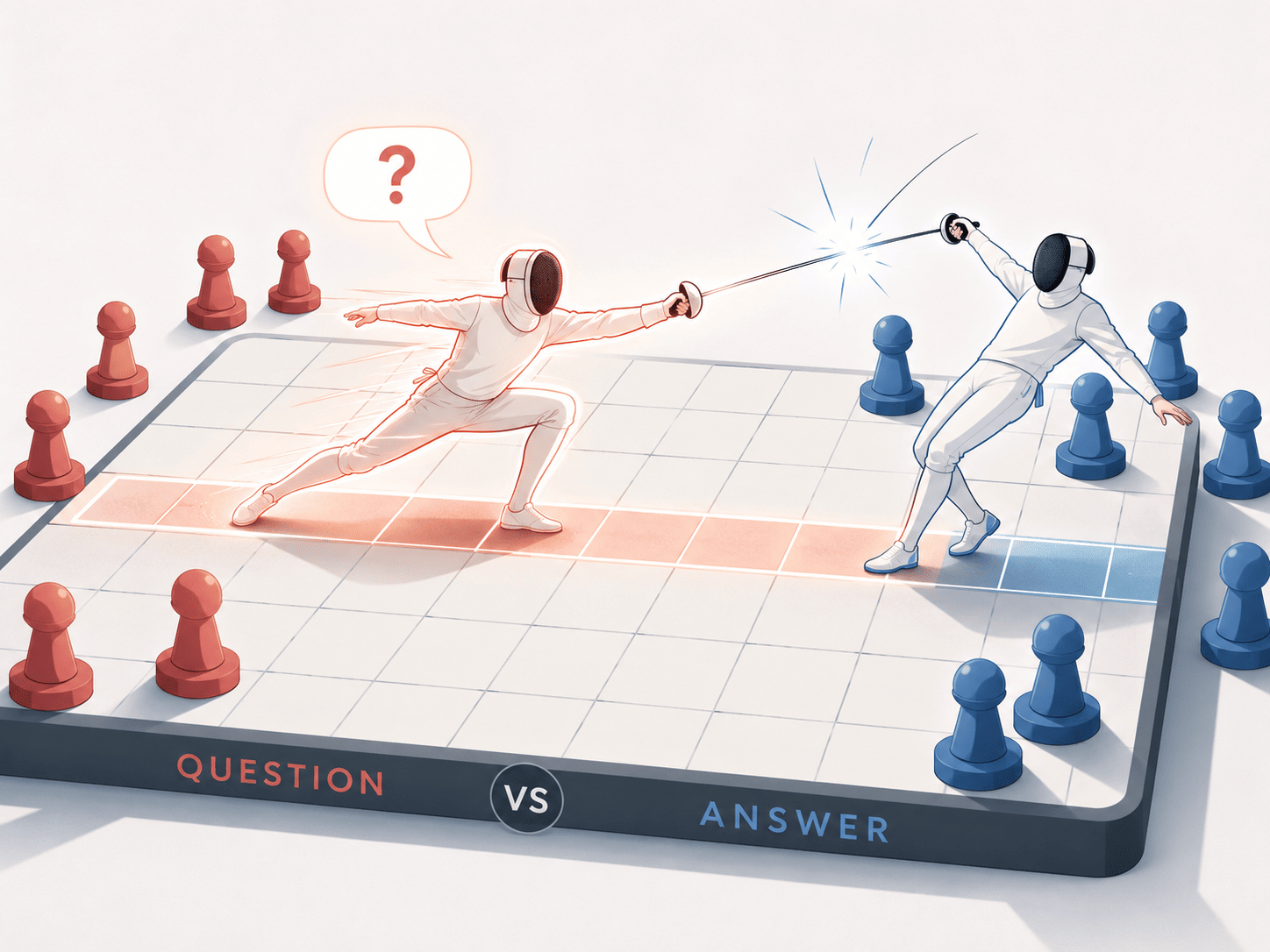
Strip any duel to its rhythm and you'll find a conversation. One player makes a move that poses a question — this threatens something; what will you do about it? — and the other player's move is the answer. Then, crucially: whoever asked gets to ask again, because an answer, by its nature, rarely poses a new question. Block my line and your block defends; it doesn't threaten. So I choose the next topic too. And the next.
That's the initiative: the rolling state of being the one whose moves set the agenda. It isn't a rule — no game awards it formally — and it isn't material; the board can be dead even while one player utterly owns the conversation. It's closer to possession in football: invisible in the score, decisive over time, because the player with the initiative is choosing which futures get explored, and naturally chooses the ones that favor them. If tempo is the coin each turn hands you, initiative is the state of spending your coins on questions while your opponent is forced to spend theirs on answers. Same currency; entirely different shopping.
The feeling is unmistakable from both sides. With it, the game feels wide: options everywhere, threats to choose between, time for small improvements. Without it, the game narrows to a corridor: each turn arrives with homework attached, and your plans live in the gaps between their demands — if any gaps come. Players describe whole games as "I never got to play" — that's a game spent answering, and this article is about never having to say it again.
How the initiative is won
Nobody starts with the initiative — the first move merely gets first bid on it. It's won, and the winning routes are worth knowing by name.
Development races. In the opening, whoever mobilizes purpose faster — pieces working, roads forming, structure braced — earns the right to make the first real threat, and first threats compound: your opponent answers, you improve while asking again. The opening isn't about attacking; it's about becoming able to attack first. This is why every game's opening principles (chess's development rules, Oustwit's early geography) are really initiative-acquisition manuals.
The forcing chain. The mid-game route: a move your opponent must answer, whose answer lets you make another must-answer move. Each link, you're choosing both moves of the round. Chains end — forcing moves run out — but a well-built chain deposits you somewhere better, having spent the whole sequence as the only player with a plan.
The handoff. The subtlest route: your opponent simply gives it away. A slow move at a sharp moment, one greedy grab, one decoration played while a real question hung in the air — and the asking pen changes hands silently. Watch strong players receive such gifts: no celebration, just an immediate question, as if the pen had always been theirs. Most initiative changes in most games aren't seized. They're dropped.
How it's lost (a field guide to your own hand, opening)
Overextension — asking questions your position can't back up. Threats need supply lines; an attack that outruns its support meets one calm defensive move and suddenly you're the one answering, usually for several turns of retreat. In a displacement game the punishment is physical: overextended pieces sit in shove range, and each shove is a question you must answer on the opponent's schedule.
The empty threat. A question your opponent can profitably ignore is worse than silence — they answer with a question of their own and the agenda flips on one move. Before any "threat," the discipline is asking: if they ignore this, do I actually collect?
Greed at the wrong moment. Material and initiative trade against each other constantly, and the classic error is cashing the conversation for a trinket: grabbing the piece, the pawn, the oust, while the asking pen clatters to the floor. Sometimes the grab is right! But it's a sale — you're selling the initiative, and the question is always whether the price was real. Which deserves its own section.
The exchange rate: initiative versus stuff
The deepest initiative skill is pricing it, because games constantly offer you the trade in both directions.
Buying initiative with material is the romantic direction — the gambit, the sacrifice: give up a piece, a pawn, a tempo-costly oust, and in exchange your opponent spends the next several turns answering while you attack. The trade is real and often sound; it's also where romantics go broke. The audit question is concrete: count the questions. How many forced answers does this sacrifice actually buy, and what do I own when the chain runs out? Three forcing moves that end in a won structure: bargain. Two loud checks that end in "…and now I'm just down a piece": donation. (The full art of giving-things-up gets its own page on this shelf.)
Selling initiative for material is the defender's mirror trade: absorb the questions, give ground gracefully, and collect payment — the overextended piece, the weakened structure, the exhausted attack — when the asker's chain runs dry. Whole defensive philosophies amount to selling the initiative at a fair price and never at a panic price.
In Oustwit the exchange rate has a house special: the two win conditions price initiative differently. Line-threats are the asking game — loud, forcing, agenda-setting. The eight-piece fill is the quiet game — it asks nothing turn to turn, but every braced placement banks progress that eventually becomes the cross-condition fork. Strong players toggle: ask with the line game when they hold the pen, bank the fill game when they don't. Two currencies, one wallet.
Getting it back: the counterpuncher's manual
Everyone spends stretches of every close game answering. The skill isn't avoiding that state — it's exiting it deliberately. Four exits, in rising order of nerve.
Exit one: the answer that asks. The gold standard of defense — a block that also threatens, a retreat that uncovers an attack, a shove that parries and herds. Hunt for these before any pure answer; one dual-purpose reply flips the agenda on the spot, and positions contain more of them than tired defenders notice.
Exit two: the cheapest real answer. When only pure defense exists, spend as little as possible — the block that keeps options, not the panicked over-commitment. Answer with a pawn, not the queen; brace with the piece that wanted to be there anyway. Cheap answers keep you solvent for the moment the attack overreaches.
Exit three: call the bluff. Audit the question: is it actually forcing? Defenders under pressure answer phantom threats out of rhythm — pure reflex, pure donated tempo. The moment you ignore an empty threat and play your own question instead, the initiative doesn't shift — it teleports.
Exit four: the counter-sacrifice. The dramatic door: give something back — material, a line you were guarding, a piece to the rim — to break the forcing chain mid-link and start your own. Defenders who master this are the most feared players in any game, because their surrender is indistinguishable from their ambush until one move too late.
One exchange, annotated: the pen changes hands twice
Theory becomes sight with one worked swing, so here's a six-move stretch of a 6×6 duel, narrated from the balcony.
Move 1 — Red asks. A placement extends Red's pieces toward a diagonal while shoving a Blue piece off its lane: threat plus disruption, a genuine question. Move 2 — Blue answers with a pure block, bracing the threatened lane. Correct, necessary — and mute. The pen stays with Red. Move 3 — Red asks again, a second placement bending Blue's shape while opening a new road. Two questions in a row; Blue's game is being lived in the answering corridor now.
Move 4 — the exit. Blue, hunting for the answer-that-asks instead of reflex-blocking, finds it: a placement that blocks Red's new road and shoves Red's key diagonal piece one square toward the rim — where its next disturbance means an oust. Block and threat in one tap. The pen just moved. Move 5 — Red, suddenly answering, must attend to the endangered piece; the reply defends but asks nothing. Move 6 — Blue asks again, herding a second Red piece while quietly landing a sixth piece toward the fill count. Two swings in six moves: Red held the initiative by asking twice, lost it to one dual-purpose defense, and now answers in a game about Blue's questions.
Every close duel contains three or four such hinges. Spectators see "good moves"; players who've read this far see the pen — who holds it, which move moved it, and (the real skill) which reply was available one move before the swing that would have kept it.
The initiative across the classics
Like every idea on this vocabulary shelf, the initiative wears local costume on each classic board — and touring the wardrobe sharpens the concept.
In chess, initiative is the currency of the attack: development races to seize it, gambits pay material for it, and the entire romantic tradition — sacrifices, king hunts — is the art of converting it before it evaporates. Chess also documents its decay best: an attack that stalls returns the pen with interest, which is why the classical rules warn so sternly against premature adventures.
In Go, the concept is so central it got bookkeeping: sente and gote — moves that keep the asking rights versus moves that spend them — with whole endgames calculated by who finishes each exchange holding the pen. Go's contribution is pricing: strong players literally count points for the right to ask next, the initiative converted to arithmetic.
In checkers, forced captures make initiative structural: entire games are architected so that your opponent's compulsory jumps deliver them into arranged catastrophe. Nowhere else is "choosing your opponent's moves" so literal — the underestimated game is essentially initiative warfare with mandatory participation.
In Othello, the disguise is deepest and loveliest: mobility. The player with more legal moves holds the initiative as inventory — they can afford quiet moves while the cramped player burns turns on self-damaging ones. Expert Othello barely fights over discs mid-game; it fights over who will still have questions available ten moves from now. Initiative as a stockpile, hoarded and spent.
Initiative in the five-minute duel
Everything above intensifies in short games. A ninety-move chess game has room for the initiative to change hands a dozen times; a five-minute Oustwit match might see three swings total, which makes each one enormous — hold the pen for six of twenty moves and you may simply have held it for the game. Small boards sharpen it further: with contact from move two, there is no quiet development phase where the initiative sits unclaimed; the first real question usually arrives by the third placement, and the player who planned to "settle in first" discovers the agenda was auctioned while they were settling.
The practical read for fast duels: treat the initiative as the scoreboard-behind-the-scoreboard. When you have it, convert — short games punish pen-holders who dawdle, because the chain's end and the game's end arrive together. When you lack it, exit early — the answering corridor is short, and three reactive moves in a twenty-move game is already fifteen percent of your life spent on their story.
Questions people ask
Is holding the initiative always right? Almost — but not free. Asking questions costs position (threats extend you) and attention (chains demand precision), and some boards genuinely favor the patient banker over the loud asker: quiet positions, fill-race endgames, defensive structures waiting for an overreach. The mature version isn't "always hold the pen"; it's "always price the pen." Sometimes the winning play is selling it, at rate, to a buyer who'll overuse it.
Tempo, initiative, sente — one-line recap? Tempo is the coin (one per turn, spend it well). Initiative is the state (your questions set the agenda). Sente is Go's ledger entry for it (this move keeps the pen; that one hands it over). One phenomenon, three zoom levels — per-move, per-phase, per-exchange.
Can both players hold it at once? No — but it can be genuinely contested, both players asking and neither fully answering, each betting their threat lands first. Those mutual-attack stretches are the sharpest positions in any game, and they resolve on tempo arithmetic: whoever's chain needs one move fewer collects. If a position feels terrifying from both sides at once, you're standing in one.
Do engines and strong AIs "believe" in the initiative? Functionally, yes — machine evaluations consistently prize activity, mobility, and forcing potential, often above small material edges, which is the initiative wearing numbers. When an engine cheerfully gives up a piece and its evaluation bar doesn't flinch, it has priced the pen — the same trade this article teaches, computed rather than felt. Watching a strong AI's games against the hardest difficulty is, among other things, a free clinic in initiative pricing.
Seeing it in your own games
The replay exercise, initiative edition — two passes over one loss, five minutes total. Pass one: for each of your moves, one letter: Q if it posed a real question, A if it answered one, N if neither. Read the string. Most losses show a long unbroken run of A's somewhere in the middle — there's the game, found. Pass two: go to the first A of that run and look for the exit you missed: the answer-that-asks you didn't see, the bluff you didn't call, the cheap block you paid full price for. One found exit per replay is the fastest initiative training that exists, and open games hand you the evidence complete.
Then play one game with a single vow: never answer without first hunting for the answer-that-asks. You'll still spend turns defending — but you'll stop living there, and the difference between visiting the answering corridor and residing in it is, in the end, the difference this whole article names. Tempo counts your coins. Initiative asks the only question that ranks above all the little ones: whose game is this conversation about? Make the answer "mine" for one more exchange per game than your opponent manages, and the rating chart will handle the rest.