Learn › What makes a game abstract? › Perfect information
Perfect information: games with nothing to hide
Some games keep secrets — hidden cards, face-down pieces, fog of war. And some games put everything on the table, all the time, for both players. That second kind has a name, a long history, and a very particular feeling. This is a guide to it.
The term, translated
Game designers and mathematicians call it perfect information. The idea is simpler than the phrase: a game has perfect information when both players can see the complete state of the game at every moment. Nothing is face down. Nothing is in a bag. Nothing is written on a card you're holding against your chest.
Chess is the textbook case. Both armies stand in the open. Every threat your opponent is building is physically visible on the board in front of you. If you get checkmated, it was never because information was withheld — every piece that beat you was in plain sight the entire game.
Poker is the textbook opposite. The whole game lives inside what you can't see: two cards, face down, and a stranger's intentions. Remove the hidden cards and poker evaporates. Remove the hiddenness from chess and you've removed nothing, because there was never anything hidden to begin with.
Most abstract strategy games — Go, checkers, Othello, Hive, Oustwit, and their hundreds of cousins — are perfect-information games. It's one of the three tests in our plain-English definition of the family: no luck, nothing hidden, theme optional. This article is about that second test, because it changes the experience of playing more than people expect.
What "seeing everything" actually buys you
Here's the strange gift of an open board: you can never be ambushed by a fact. You can only be ambushed by an idea.
Think about what that means. In a hidden-information game, losing often comes with a shrug — how could I have known? The queen of spades was face down. The flush came out of nowhere. The opponent's Stratego marshal was disguised as a scout. Some fraction of every loss can be billed to the unknown, and everyone at the table knows it.
On an open board, that invoice has nowhere to go. The winning move was visible before it was played. The trap you walked into was sitting there, in full view, for both of you. You didn't lack information; you lacked attention, or pattern recognition, or time to think — things you can actually improve.
This is why open games teach so fast. Every loss is a complete lesson, with all the evidence included. When you review a lost game of chess or Go or Oustwit, you can find the exact moment things turned, because nothing about that moment was concealed from you. There's a reason serious players of open games are obsessed with reviewing their losses: the loss contains the entire diagnosis. A poker player reviewing a lost hand often can't say whether they played badly or got unlucky. A Go player always can.
The sting is real — "I had everything I needed and still lost" is a humbling sentence. But it's the productive kind of humbling. Players who embrace it improve at a speed that surprises them, because 100% of their losses convert into usable feedback. Nothing is lost to noise.
The other kind of game (and why it exists)
None of this makes hidden information a design mistake. It's a design tool, and in the right hands it builds pleasures an open board can't.
Hidden information creates bluffing. You cannot bluff in chess — a threat is either real or it isn't, and your opponent can check which by looking. In poker, the gap between what you have and what you appear to have is the entire playing field. That gap makes poker a game about people: reading them, misleading them, managing the story your bets are telling. Many players love exactly this, and they're right to.
Hidden information also creates discovery. Stratego's early game is a fog of unknown pieces, and part of its drama is the slow reveal — the gasp when the piece you attacked turns out to be a bomb. Battleship is nothing but discovery. Deduction games like Clue turn hidden information into the puzzle itself.
And hidden information forgives. When your plans can be disrupted by an unseen card, a loss doesn't feel like a referendum on your thinking. For casual play among mixed skill levels, that softness is a feature: the fog keeps outcomes uncertain and egos safe.
The honest way to put it: hidden-information games are about navigating uncertainty; open games are about being fully responsible. Different muscles, different moods, both legitimate. The family we cover on this shelf simply chose the second — and if you want to see how close a game can get to the border while staying interesting, the borderline cases are where the definition earns its keep.
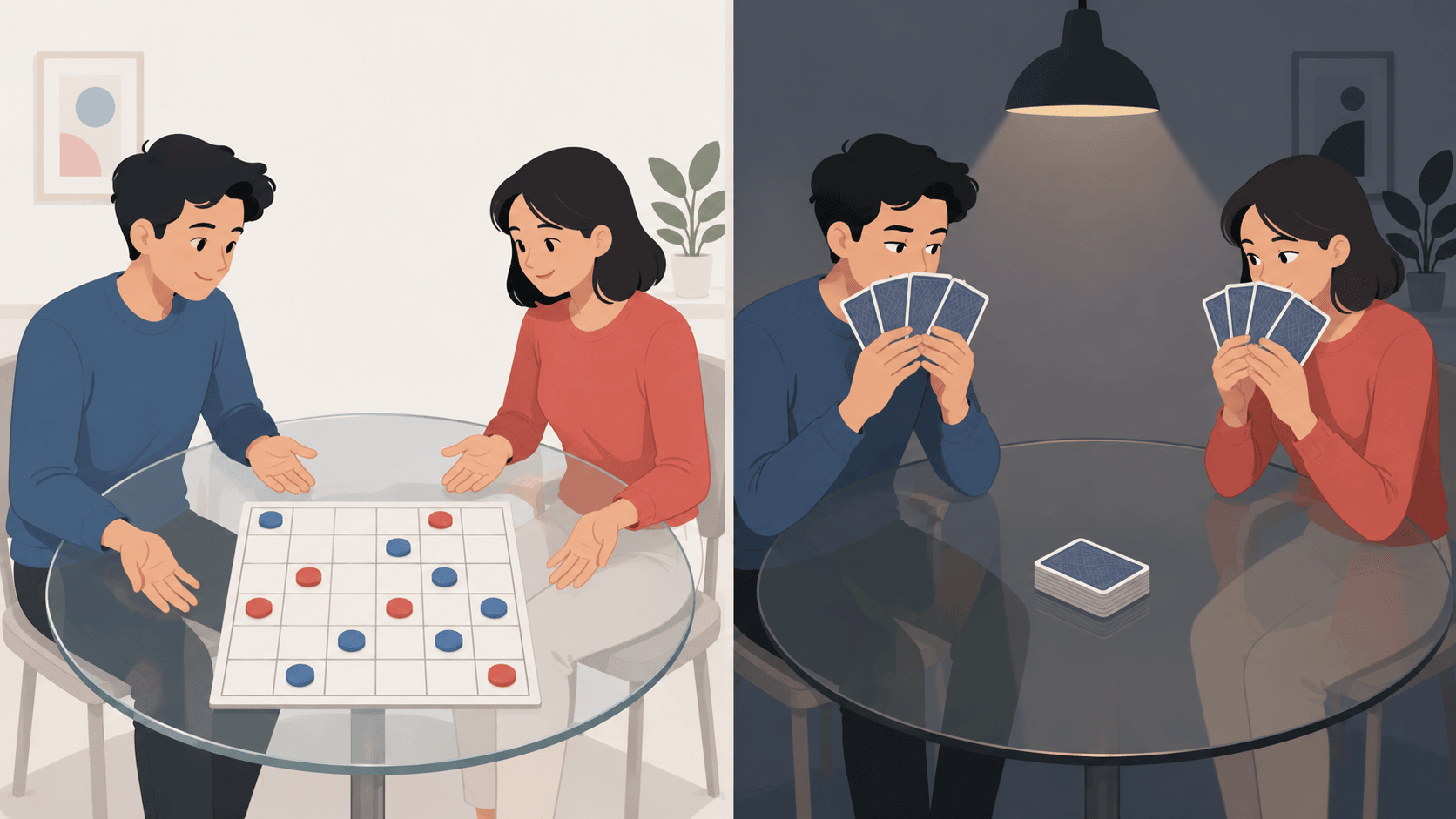
An open board is not an open mind
Now for the twist that keeps perfect-information games interesting: seeing everything is not the same as understanding everything.
The board shows you the position. It does not show you the plan. Your opponent's intention — the shape they're building toward, the square they've decided matters, the trade they're willing to make — is hidden in the one place no rule can expose: their head. Perfect information means the evidence is public. The interpretation is still private.
This is where the games get their psychology back. Strong players of open games talk constantly about reading the opponent: not their cards (there are none) but their tendencies. Does she overvalue the center? Does he panic when pushed toward the edge? Did that last quiet move mean patience, or a trap being set in plain sight? In a game like Oustwit, where every placement shoves the neighboring pieces, an experienced player starts recognizing an opponent's style within a handful of moves — aggressive shover, careful builder, edge-camper — and plays the person as much as the position.
There's also a second hidden layer: the future. Even with everything visible, neither player can calculate every continuation. The game tree outruns human lookahead within a few moves in any deep game (we've written about why even small boards hold astronomical numbers of games). So both players are peering into the same fog — not a fog of information, but a fog of consequence. The board is public; the future is not.
That's the precise flavor of open-game tension: two people looking at identical evidence and drawing different conclusions, each betting their position on being the better reader. No cards, and somehow still a staring contest.
What open boards feel like across the family
The principle is one thing; the sensation is another. Each open game gives "nothing hidden" its own flavor, and touring a few teaches you what the property actually does at the table.
In chess, openness means threats have shape. A knight fork doesn't appear from nowhere — it assembles in front of you, move by move, and the skill is noticing the assembly before the hammer falls. Experienced players describe it as the board "getting loud" in a particular corner: nothing is hidden, so danger literally looks like something.
In Go, openness operates at a grander scale. Every stone ever played stays visible, so the board becomes a complete public history of the game — both players' whole philosophies, sitting there in patterns. Reading a Go position is reading a transcript of every decision made so far, which is why strong players can reconstruct entire games from memory: the logic chains are all on display.
In Othello, openness turns brutal. Every disc that will flip is countable before you place — the information is all there — but the cascades are so visual and so dramatic that beginners feel ambushed anyway. Othello teaches the crucial distinction faster than any game: available is not the same as absorbed. The board hid nothing; your attention did.
And in a displacement game like Oustwit, openness gets physical. Because every placement pushes all its neighbors one square outward, the consequences of a move are geometric and visible in advance — you can trace, with a fingertip if you like, exactly where each adjacent piece will slide before you commit. New players don't bother tracing; they place, watch the board lurch, and gasp. The information was public the whole time. The discipline of actually consulting it is the entire learning curve.
The culture open games grew
Games shape the manners of the people who play them, and perfect information has grown a recognizable culture over the centuries — one worth knowing about, because you inherit it the moment you start playing.
Resignation is honorable. In open games, a lost position is visible to both players, so playing on to the bitter end can read as denial of the obvious. Tipping the king — conceding with grace — became a mark of respect: I can see what you've built, and I won't pretend otherwise. No card game could develop this custom; there, the miracle draw is always technically coming.
The review is the second game. Because everything was visible, two players can rebuild the game afterward and argue about it — and in Go culture especially, this post-game review is half the point of playing. Winner and loser become collaborators examining a shared object. Modern apps inherited this instinct directly: when every Oustwit match is recorded and replayable move by move, the ancient custom of "let's see where it turned" survives as a feature you can tap.
Study became literature. Open games can be written down completely — a few symbols per move captures everything — which is why chess and Go accumulated centuries of books, famous games, named openings, and puzzle traditions. A fully public game is a fully publishable game. When you solve a chess puzzle from 1850, you're enjoying the openness property at 175 years' distance.
Spectating works. An audience can watch an open game and understand it in real time — no hidden hands to reveal, no dramatic irony withheld. The great title matches of chess and Go drew crowds and newspaper columns for exactly this reason, and today's streamed matches are the same phenomenon with better cameras.
Why computers cracked open games first
A little history explains a lot about these games. When researchers began teaching machines to play, they started with perfect-information games — and it wasn't an accident.
An open board is, from a machine's point of view, a fully specified math problem. The current position is completely known, the legal moves are completely known, so a computer can search: if I go here, they go there, then I go here... Checkers fell first among the giants — by the 1990s a program called Chinook was champion-level, and in 2007 checkers was solved outright: with perfect play from both sides, it's a draw. Chess resisted longer, but in 1997 Deep Blue defeated the reigning world champion, and today the chess app on your phone plays beyond any human who has ever lived. Go, whose vast board defeated brute-force search for decades, finally fell in 2016 — and notably, the conquest required machines that could approximate something like intuition, not just calculation.
Hidden-information games took longer precisely because the math is messier: the machine must reason about what it can't see and about how opponents behave, not just what moves exist. Superhuman poker programs eventually arrived too, but a generation later.
Two things follow from this history. First, a practical gift: because open games are so tractable for computers, the AI opponent in a good abstract strategy app is a genuinely strong, honest sparring partner — it plays the same visible board you do. Second, a reassurance: machines "solving" or dominating a game has never once made humans stop playing it. Chess is more popular today than at any point in its fifteen centuries. The point of the game, it turns out, was never to be the strongest calculator in the universe. It was the contest between the two particular minds at the table.
Perfect information on your phone
Open games and screens fit together unusually well, and it's worth noticing why.
First, nothing is lost in translation. A game whose entire state is public can be shown, completely, on a display — there's no hand of cards to hold awkwardly, no hidden zone requiring a second device or an honor system. The 6×6 grid on your phone is the whole game, exactly as a wooden board would be.
Second, replays become perfect. Because the full state is known at every moment, an open game can be recorded move by move and replayed losslessly. This is why Oustwit records every online match server-side: you can rewatch any game and see precisely what both players saw at each moment, which — as we said above — is a complete diagnosis of every loss. Hidden-information games can't offer this in the same way; a replay that reveals the hidden cards shows you a game neither player actually experienced.
Third, honesty is enforced by physics. On an open board there's nothing to peek at, no shuffle to botch, no misdeal. The app applies the rules identically for both players, and the only variable left is the quality of the moves. For a family of games whose entire identity is "the fair fight," the screen turns out to be a very clean arena.
Common questions
If everything's visible, isn't it all just memorization? No — and this worry keeps more people from open games than any other. Memorized openings matter at the top of chess, much less elsewhere, and barely at all in younger games that have no opening books yet. What open games reward at every level below "professional" is noticing things: patterns, threats, shapes. That's perception, not recall — closer to reading faces than reciting dates.
Does perfect information require perfect memory? Not at all. The whole point is that the board remembers for you — the current position contains everything you need, on display. (Blindfold chess, where masters play without sight of the board, is a famous stunt precisely because it forgoes the game's central courtesy.) Contrast a card game like Stratego or gin rummy, where tracking what's been revealed is a memory burden. Open games are, ironically, the forgetful player's friend.
Is a game with dice but no secrets — backgammon — "perfect information"? Formally yes, in the everyday sense we've used here: nothing is concealed from either player at any moment. It fails the family's other test, the no-luck one. The two properties travel together often enough that people blur them, but they're separate dials — the borderline-cases article pulls them apart with examples.
Do open games work for kids? Beautifully — arguably better than hidden games, because an adult can see a child's position and coach in real time ("look at the whole board — anything feel dangerous?"). You can't do that with a hand of cards without the game collapsing. Open boards make every game a potential lesson without anyone giving up secrets.
A short honesty test for your favorite games
Want to classify your own shelf (or home screen)? Ask one question per game: at any moment, could I reconstruct everything my opponent knows about the game by looking at what's public?
Run it on a few familiar names. Chess, checkers, Go, Othello, Connect Four, Hive, Oustwit: yes — full view, both players, always. Backgammon: also yes, surprisingly — the dice are random but nothing is hidden; both players see every checker and every roll the moment it happens. (Backgammon fails the family's no-luck test instead — a useful reminder that open and luck-free are different properties.) Scrabble: no — your rack is yours alone, and the bag keeps its counsel. Poker, Stratego, Battleship, most card games: no, and gloriously so.
You'll find the classification takes seconds and never really surprises you — but doing it once sharpens something. You start noticing which kind of losing each game offers you, and which kind you're in the mood for tonight: the soft landing of "the cards fell badly," or the clean mirror of "everything was visible, and I'll see it next time."
Players who fall for that second feeling tend to stay fallen. There's a quiet addiction in games with nothing to hide: no alibis, no noise, just you, another mind, and a board that tells the whole truth.
Three ways to feel it tonight
Trace before you place. In your next open game — any of them — adopt one rule for yourself: before committing a move, spend five seconds asking what it lets your opponent do next. That's the whole discipline of open play in embryo. In a push game, literally trace the displacement with your eyes: where does each neighbor end up? The information is free; take it.
Review one loss, start to finish. Take a game you lost — a saved replay is perfect — and walk it back to the move where things turned. You're not looking for every mistake, just the one turning point. This is the open family's oldest ritual, and the first time you catch your own blunder and understand it, you'll know why players have kept the custom for centuries.
Watch two strong players. Find any well-played match — a streamed chess game, a top replay in your app's lobby — and watch it knowing you can see everything they can see. Notice how often you're surprised anyway. That gap between what was visible and what you noticed is your growth area, measured precisely, for free.
And when you're ready for the map's next region: the companion article on how much of your favorite game is luck covers the family's other defining refusal.