Learn › What makes a game abstract? › Almost abstract: the borderline cases
Almost abstract: backgammon, Stratego, and other borderline cases
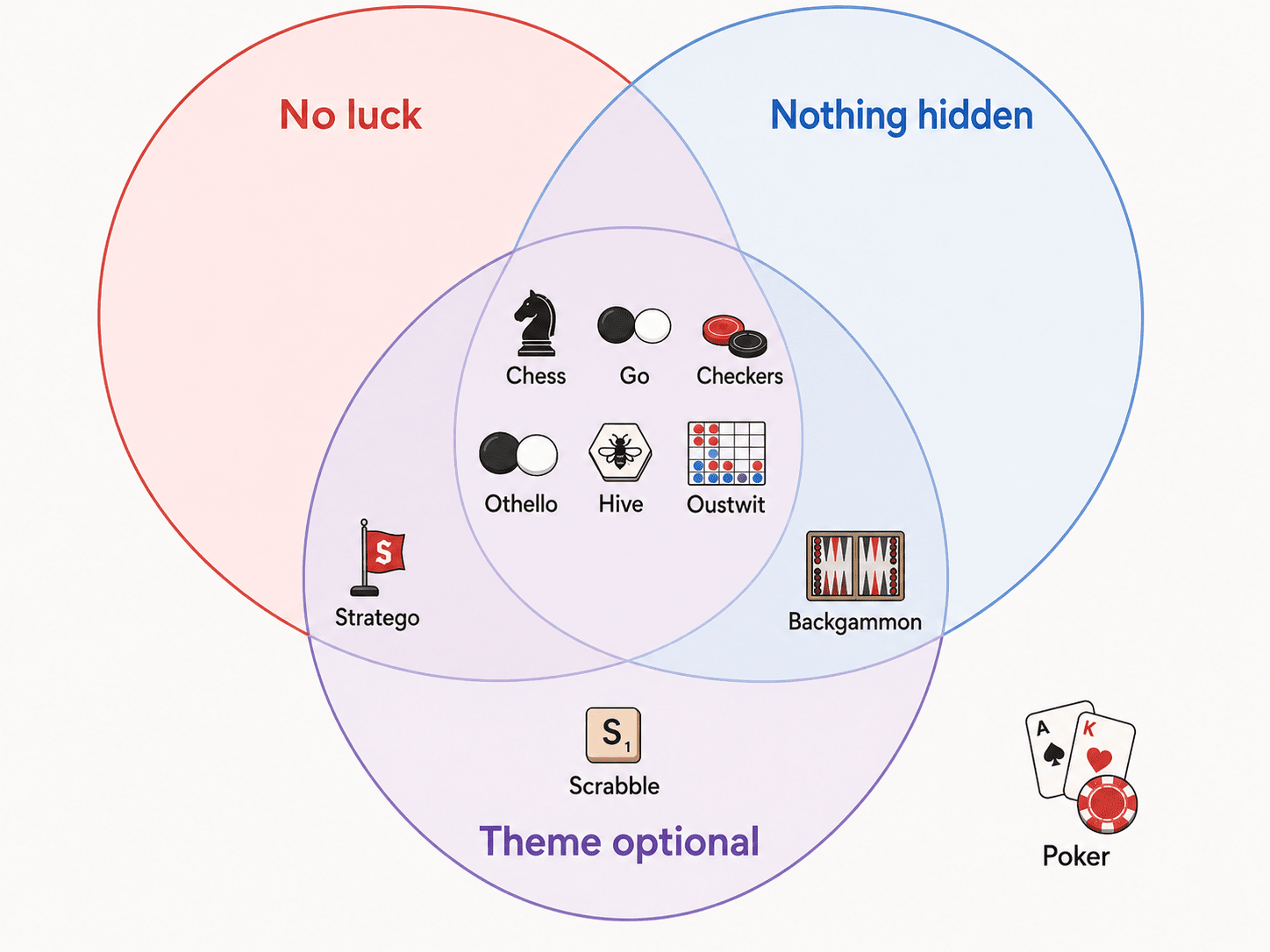
Every definition earns its keep at the edges. Backgammon has dice. Stratego has secrets. Scrabble has a bag with opinions. None of them are quite abstract strategy games — and each near-miss teaches you exactly what the pure family is made of.
Why the borderline is the interesting part
Our plain-English definition gives the abstract strategy family three tests: no luck, nothing hidden, theme optional. Chess passes all three without breaking stride. Snakes and Ladders fails two before the box is open. Neither case teaches you much — definitions get interesting only when a beloved game walks up to the border and stops one step short.
Those near-misses are the subject here. They matter for two reasons. First, they're great games — several are among the greatest ever made, and "not abstract" was never an insult. Second, each one fails a different test, which makes them a perfect anatomy lesson: remove one organ at a time and watch what changes. By the end you'll know the family better from its neighbors than you ever could from its members.
Backgammon: dice with a PhD
Start with the most honorable near-miss of all. Backgammon is ancient — older than chess — and it passes two tests effortlessly: the board is completely open (both players see every checker and every roll), and the theme is as minimal as themes get, a pure race. One test stands between it and the family: those two dice, rattling away at the heart of every turn.
What makes backgammon fascinating is how little the dice decide over time. The roll sets your menu, but you choose the meal — and the choices are deep: when to run, when to block, when to leave a shot on purpose because the odds favor it. Experts think in probabilities the way chess players think in lines, and over a long match the stronger player wins with brutal reliability. Luck controls the evening; skill controls the year (a pattern we mapped in the luck-versus-skill article).
Then there's the doubling cube — backgammon's stroke of genius. At any point a player can propose doubling the stakes; the opponent must accept or resign on the spot. The cube is a pure-skill instrument bolted onto a dice game: judging exactly when your position justifies the double is the hardest skill in the game, and it involves no dice at all. Backgammon, in other words, is what happens when you take an abstract racing game and install a weather system. The purists keep it just outside the family. Everyone keeps it on the shelf.
What this near-miss teaches: luck and openness are separate dials. A game can hide nothing and still surprise you — randomness is a different kind of unknown than secrecy.
Stratego and the fog of war
Now flip the dials. Stratego has no dice, no shuffles mid-game, no randomness of any kind once the armies are placed. What it has instead is forty secrets per side: every piece stands with its back to the enemy, rank hidden, and the entire game is the slow, violent unmasking.
Play it and you feel how profoundly one hidden layer changes everything. Memory becomes a weapon — tracking which enemy piece revealed itself as what, three captures ago. Bluffing becomes possible: march a lowly scout forward with confidence and watch a stronger piece flee. Deception, probing sacrifices, information traded for position — none of these exist on an open board, and all of them are the point here. Losing also changes flavor: "how could I have known that was a bomb?" is a sentence with no equivalent in chess, where the answer would be by looking.
Games like this — Battleship is the family's kindergarten, and the great deduction games its university — are strategy games of a genuinely different species. We explored the divide fully in the perfect-information article; Stratego is that article's argument standing on one leg.
What this near-miss teaches: hidden information is the second, independent dial. Turn it even slightly and the skills being tested change species — from reading positions to reading people.
Scrabble: the bag has opinions
Scrabble fails one and a half tests, which makes it the connoisseur's borderline case. There's setup-and-draw luck (the bag decides whether you get a rack of silk or a rack of consonant gravel) and there's hidden information (your rack is yours alone). And yet — run it through the expert test and Scrabble behaves almost like chess: a tournament player will beat a living-room player practically every game, forever. Skill dominates that hard.
How? Because the skill surface is enormous and mostly invisible to casual players. It isn't vocabulary alone — it's rack management (what you keep matters more than what you play), board control (opening and closing bonus lanes), probability (knowing what's left in the bag), and endgame counting worthy of any abstract. Champions routinely win with modest words placed with vicious geometry.
Scrabble also introduces a useful concept: luck mitigation. The randomness is real, but nearly every act of skill in the game is an act of managing it — sculpting your rack toward future draws, timing exchanges, playing the odds of the unseen tiles. Where backgammon's expert rides the dice, Scrabble's expert farms them.
What this near-miss teaches: luck's weight matters as much as its presence. A game can contain real randomness and still be, functionally, a skill duel — if the decisions outnumber and outmuscle the draws.
The card-driven cousins
Modern hobby games mine the borderline deliberately, and one technique deserves its own section: using cards to ration what a player may do. A hand of cards, drawn from a personal deck, dictates your options each turn — think of the many beloved games where you play a card to move, attack, or build, then draw another.
Designers love this for exactly the reasons purists distrust it. The cards inject variety (no two games open alike), pace the game (you can't do everything at once), and create agonizing hand-management decisions that are themselves a form of skill. But they also mean your brilliant plan can die in the draw — the move existed, the card didn't come. One familiar example from the abstract world's own edge: Onitama deals five movement cards from a larger set at setup, then rotates them with perfect visibility — randomness in the setup, purity ever after. Its neighbors that keep drawing all game long sit further from the border.
The rule of thumb the hobby has settled on: randomness before the game (a dealt setup, a scrambled board) bends the family definition; randomness during the game breaks it. A game of pure skill played from a shuffled starting position is a cousin. A game where the deck keeps talking is a different genre.
What this near-miss teaches: when chance speaks matters. A random beginning still allows a fair fight; a random middle keeps interrupting it.
Poker: the anti-abstract masterpiece
No tour of the borderline is complete without the game that fails every test and became a masterpiece anyway. Poker has luck (the deal), hidden information (the hole cards), and even a theme of sorts (money, nerve, the green felt mythology). By our three tests it is as far from abstract strategy as a card game can get — and it is also, by common consent, one of the deepest skill games humanity has produced. Professionals grind out positive results year after year against fields of millions; the long run is merciless. How?
Because poker made the "flaws" the curriculum. The luck isn't noise around the skill — managing probability is the skill. The hidden cards aren't an obstacle to reading the game — reading people through their bets is the game. Poker took the two properties the abstract family excludes and built its entire depth out of them, which makes it the perfect mirror image: proof that our three tests define a family, not a hierarchy. The abstract games test one thing — open-board judgment between equals. Poker tests another — decision-making under uncertainty against liars. Both are profound; they're just profound about different parts of being human.
The mirror is instructive one more way: notice that poker needed stakes to work. Remove the betting and poker collapses into a luck game; the skill lives entirely in the wagering layer. Abstract games need no stakes at all — the contest is self-supporting. Neither fact is a criticism. But it explains why one family filled the world's casinos and the other filled its parks and schoolyards.
Mahjong, dominoes, and the parlor borderline
Two more household names deserve their placement, because they're among the most-played games on Earth and both live on the border.
Mahjong — the four-player tile game, not the solitaire matching app that borrowed its tiles — mixes a shuffled wall (draw luck), concealed hands (hidden information), and enormous skill in hand-building, reading discards, and knowing when to fold a beautiful hand for safety. Its balance sits near poker's: luck rules the round, skill rules the season, and serious communities score across long sessions so the dice noise cancels. It also carries deep cultural weight across East and Southeast Asia — a reminder that the border regions of our Venn diagram contain some of the most beloved games in history, not the leftovers.
Dominoes runs lighter but the same shape: a random draw of tiles, hands hidden, then genuinely sharp play in counting what's out, controlling the board's open ends, and setting partners up in team variants. Caribbean and Latin domino cultures treat it exactly the way this shelf treats pure abstracts — a lifelong skill game with local etiquette and standing rivalries — while a casual family plays it as light luck. Same tiles, different seriousness: the skill was always in there, waiting for a community to farm it.
Both games teach the Scrabble lesson at scale: hidden draws don't forbid depth — they just relocate it into probability, memory, and inference. The pure family keeps those skills optional. The parlor borderline makes them mandatory.
The 98% club
Finally, the strangest neighbors: games that are almost entirely pure and fail no test loudly, but carry a pinch of something that keeps definition-lawyers arguing at conventions.
The Viking game hnefatafl is open, luck-free, and theme-light — but wildly asymmetric: one side outnumbers the other two-to-one, with different win conditions. Is a deliberately unfair fight still a "fair fight of minds"? (Most say yes — you swap seats between games, and the contest is really across the pair.) Chess itself harbors a whisper of arbitrariness: White moves first and wins measurably more often, which is why serious matches alternate colors, and why Go handles the same issue by paying Black's advantage off with bonus points. Even the coin flip for who starts is, pedantically, a random event in an otherwise pure game.
The club's lesson is that purity is an engineering target, not a mystical state. Every real game contains some residue of arbitrariness, and the family's habit — patching first-move advantage, alternating colors, mirroring matches — shows a tradition that takes fairness seriously enough to keep sanding it down. A modern duel like Oustwit inherits the same instinct: one shared open board, identical pieces, symmetric rules, and rematches a tap away so the colors even out. The purity is maintained, not assumed.
A field guide: five questions to place any game
You now have enough anatomy to classify anything on your shelf or home screen in about a minute. Ask, in order:
- 1. Does anything roll, shuffle, or draw during play? If yes, note whether the randomness arrives before your decision (menu-setting, skill-friendly) or after it (verdict-giving, drama-friendly). During-play randomness of either kind puts the game outside the strict family.
- 2. Could you reconstruct everything your opponent knows by looking at the table? If not — hidden hands, face-down pieces — you're in Stratego country, where the skills are memory, inference, and deception.
- 3. Was the setup random? A shuffled start with pure play afterward (the Onitama pattern) is the gentlest bend: a cousin, welcome at every family gathering.
- 4. Would the game survive a costume change? If relabeling every piece changes nothing, the theme is decoration and the game's soul is structure — whatever the box art says.
- 5. Could an expert beat you every single game? The final sorting question. "Yes, immediately" is the pure family and its near-pure cousins. "Yes, over a season" is the deep borderline — backgammon, poker, Scrabble, mahjong. "No" is the luck aisle, where the only expert is the dice.
Run the five on a few favorites and you'll find the exercise oddly clarifying — not because the labels matter, but because each question points at where a game keeps its depth, which tells you exactly what practicing it would mean.
Why pure-strategy players study the neighbors anyway
A closing secret of the strong: the best abstract players are rarely abstract-only players, because each borderline game trains a muscle the pure family leaves optional.
Backgammon teaches probability as a felt sense — not calculated but inhabited, the way a sailor knows weather. Players who've logged serious backgammon bring a looseness to pure games: they stop treating single losses as verdicts, because they've learned in their bones what variance is and what it isn't. Poker teaches composure and opponent-reading — tilt control under real pressure — and a duelist who has folded pocket kings without complaint brings unshakeable table nerves back to the open board. Scrabble and mahjong teach efficiency under constraint: making the most of a hand you didn't choose, a skill that translates directly to defending bad positions with dignity.
So treat the borderline as cross-training, not contamination. The pure family's own skills — calculation, pattern sight, tempo sense — sharpen fastest inside the family, where every loss is a complete lesson. But the neighbors round out the player. The old advice holds: master one open game, and visit the border on weekends.
Quick answers from the border
Is Monopoly a borderline case? Not really — dice drive movement, cards drive events, and the famous skill layer (trading, mortgage timing) is thin relative to the noise. It's a luck-forward family game with negotiation attached; fine at what it is, far from this border.
What about dots-and-boxes or Nim? Fully inside the family — open, luck-free, themeless. Their only oddity is being small enough that perfect play is learnable, which moves them toward "puzzle" as players mature. The family's three-in-a-row branch tells that story in full.
Rock-paper-scissors? A delightful degenerate case: no luck in the rules at all, yet nothing visible to analyze — both players move simultaneously, which acts exactly like hidden information. It's a pure psychology game wearing a two-second ruleset, and serious RPS competition (it exists) is entirely about human pattern-leakage.
Do borderline games have ratings and ladders too? The deep ones, absolutely — backgammon, Scrabble, and mahjong all support serious competitive scenes. Their ratings just need more games to stabilize, since luck noise takes longer to average out. The existence of a working ladder is itself evidence of where a game sits on the spectrum.
What the borderline teaches
Line the near-misses up and the family portrait sharpens beautifully. Backgammon shows what luck does to an open game: it adds weather. Stratego shows what secrecy does to a luck-free game: it changes the species of skill. Scrabble shows that luck can be farmed nearly into irrelevance. The card-driven cousins show that the timing of randomness decides whether it seasons a game or steers it. And the 98% club shows that even purity itself is a discipline — something games maintain the way athletes maintain fitness.
Which leaves the center of the Venn diagram: games where nothing rolls, nothing hides, and nothing needs a costume. Not better games — the borderline is stuffed with masterpieces — but games making one specific, bracing promise the neighbors can't: everything that happens here will be caused by one of the two of you.
If you've read the whole shelf to this point, you now know precisely what that promise means, and what it excludes. The only question left is the practical one — with app stores full of pretenders, how do you find games that deliver it? That's the next article: how to spot a deep game in a store full of shallow ones.