Learn › What makes a game abstract? › How to spot a deep game
How to spot a deep game (in a store full of shallow ones)
"A minute to learn, a lifetime to master" is printed on a thousand boxes and a hundred thousand app listings. It's true of maybe a handful. Here are five signs a game will still be interesting after fifty plays, five red flags that it won't survive five — and a fifteen-minute test you can run before spending money or shelf space.
The claim every game makes
No box has ever said "shallow." Every game in every store promises easy rules and endless depth, the famous slogan Othello made into a genre's mission statement — and since the promise is universal, it carries no information. The dragon-covered box makes it. The ad-stuffed app makes it. The masterpiece makes it in the same font.
So you need instruments. Depth — the property where a game keeps revealing new ideas as you improve — turns out to leave fingerprints you can check quickly, even as a newcomer. The five signs below work on board games, card games, and apps alike; the red flags catch most of the fakes; and the audition protocol at the end pulls it all into a routine that costs you fifteen minutes. (If you want the theory underneath, the small boards, deep games shelf covers why depth has nothing to do with size or complexity.)
Sign 1: Real decisions, every turn
Watch a single turn of the game and ask: how many moves are available, and how many are worth considering?
Shallow games have turns that play themselves. There's one legal move, or one obviously best move, and your role is to execute it — you're not a player, you're a croupier for the rules. Deep games put you in genuine doubt regularly: two or three candidate moves, each defensible, reasonable people disagreeing. That doubt is the game. A useful marker: in a deep game you'll want to think by turn three or four of your very first play. If your hands have made every decision so far without consulting you, the store shelf has one more sleeping pill on it.
Careful, though — the sign is meaningful choices, not many choices. A game offering forty options where one is clearly best is shallower than a game offering four that are genuinely hard to rank. Menu length isn't depth; doubt is depth.
Sign 2: Turns that talk to each other
Second question: does this move change the future?
In deep games, every move reshapes the landscape the next moves happen in. Place a stone in Go and the whole board's balance shifts by a whisper. Push a piece in Oustwit and three other pieces now stand somewhere new, with everything that implies. Your move talks to my next move, which talks to yours after that — the game is a conversation, and planning is possible because the turns are connected.
Shallow games have amnesia between turns. You do a thing, collect a reward, and the board resets to neutral; nothing you did echoes. These games can be pleasant — slot machines are the extreme case, each pull a fresh universe — but they cannot be deep, because nothing accumulates for a plan to build on. A quick test: could you explain why your third move was better or worse because of your first? If the game can't support that sentence, it has no memory, and games without memory have no strategy.
Sign 3: Tension between goals
The deepest games make you want two things at once — and refuse to let you have both.
Attack or defend. Develop or strike. Spend the tempo improving your position, or spend it damaging theirs. Every classic runs on some version of this fork, because tension between goals is what makes decisions cost something. A choice with no tradeoff is just a chore with a button.
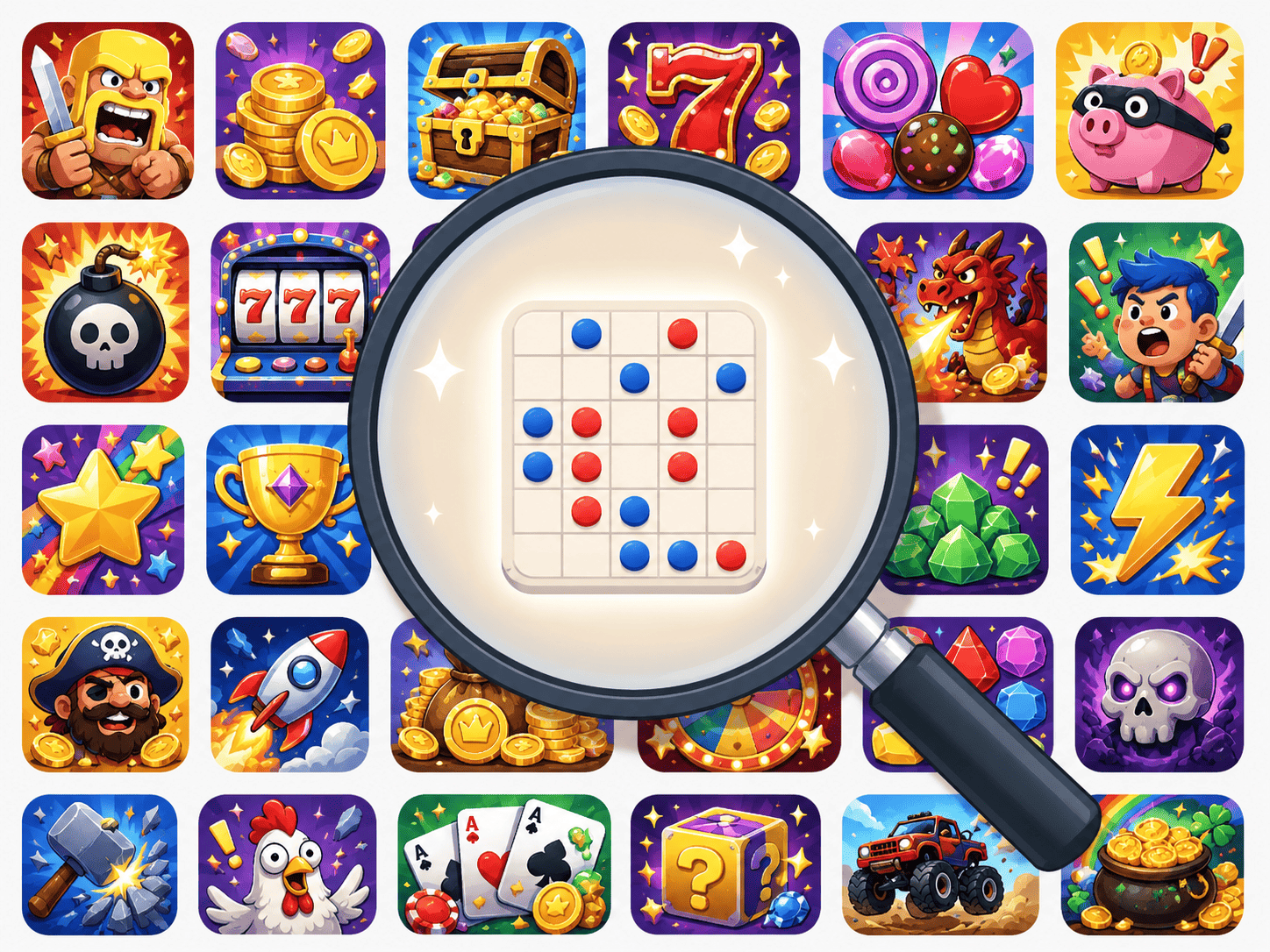
Dual win conditions are the cleanest way designers build this in, and Oustwit is a convenient specimen: you win by making three in a row or by placing all eight of your pieces. Every single turn quietly asks which race you're running — build toward a line (and your opponent will shove it apart), or grind toward the full-board win (and you've stopped threatening lines, freeing them to build their own). The two goals pull in different directions, so no move is ever automatic. When you audition any new game, hunt for this feeling of being pulled apart. If every decision points the same direction — more points, more points, more points — the game is an escalator, not a contest.
Sign 4: Comebacks that are earned
Fourth question: when a losing player recovers, why did it happen?
In deep games, comebacks come from play: the player behind finds the sharper moves, sets a trap, converts their opponent's overconfidence into a turnaround. The mechanism is skill, which means a comeback means something — and means the player ahead must keep playing well, all the way to the end. Tension survives until the final move.
Shallow games manufacture comebacks with rubber bands: catch-up mechanics that punish the leader automatically, lucky events that reset the score, rules that tax success. These keep scores close — that's their marketing job — but they hollow the game out from both ends. Being ahead stops mattering (you'll be dragged back) and being behind stops mattering (you'll be dragged forward), so the middle of the game becomes theater between two arbitrary endpoints. If you watch a game hand the trailing player free gifts twice in one session, you've learned what the designer thinks of your decisions.
The related tell is whether the better player reliably wins. Run the thought experiment from the luck-versus-skill article: if an expert would beat you every time, decisions rule the game. If you'd take half the games off a world champion, the game has already told you how much your choices weigh.
Sign 5: The same-opponent test
The final sign needs a week rather than a minute, and it's the one that never lies: play the same person five times and see what happens.
A shallow game is used up by repetition. By game three you both know the trick; by game five you're playing out of politeness, and the box migrates to the closet. A deep game runs the opposite direction — repetition feeds it. You adapt to their style, they adapt to your adaptation, and by game five you're not playing the game so much as playing each other through the game. Openings become inside jokes. A rivalry forms. The rematch button starts pressing itself.
This is the property that has kept the classics alive for centuries — a chess rivalry and a two-thousand-year-old game are the same phenomenon at different zoom levels — and you can measure it in an evening. If five games against one human left you wanting a sixth, you've found something with a floor under it. If you were reaching for your phone by game three, trust that instinct.
Depth is not difficulty
Before the red flags, one confusion needs clearing, because it costs buyers more money than any other: deep and difficult are different properties, and the store constantly sells you the second dressed as the first.
Difficulty — better called complexity — is what you must carry: rules, exceptions, icons, upkeep, the fifteen-page rulebook and the forty-minute teach. Depth is what you get to discover: the ideas that keep emerging after the rules are long since trivial. The two aren't even correlated. Go sits near the bottom of the complexity scale and the top of the depth scale — a handful of rules, three thousand years of discoveries. Plenty of sprawling boxes manage the reverse: an evening to learn, a weekend to exhaust.
Picture two icebergs. The complex-shallow game is all above the waterline: impressive silhouette, minis and dashboards and chrome, and underneath — not much. The simple-deep game shows almost nothing above the surface: four rules, two colors of pieces, and a mass below that players spend decades mapping. The five signs in this article all probe below the waterline, which is exactly why they work on a plain grid and a dragon box alike. When someone warns you off a game as "too simple," check which iceberg they measured. Simple rules are not a symptom of shallowness; they're the precondition for elegance — depth per rule is the whole art. (The small boards, deep games shelf digs into this ratio properly.)
Three quick case studies
To see the five signs working together, run three familiar specimens through the full battery.
Tic-tac-toe. Sign 1 fails by the second game you ever play — the best moves become automatic, and doubt never visits again. Sign 2 technically passes (moves do constrain the future), Sign 3 fails (one goal, no tension), Sign 4 is moot (nobody comes back from anything), and Sign 5 fails catastrophically: the same opponent twice produces the same draw forever. Verdict: a teaching toy, honorably retired by age eight. The interesting part is how designers fixed it — a story we tell on the three-in-a-row shelf.
The roll-and-move family classic. (Pick your childhood favorite; the analysis is the same.) Sign 1: most turns offer zero decisions — the dice choose your square. Sign 2: turns barely speak to each other. Sign 4: comebacks and collapses arrive by card draw, not craft. Sign 5: game five feels identical to game one, because nothing you learned can change what the dice do. And yet these games pass a test this article doesn't measure: they let four generations sit at one table with equal chances, which is a real virtue — luck's honest job — just not depth. Verdict: keep for the family holiday; don't confuse it with a duel.
A modern pure duel — Oustwit will do. Sign 1: doubt arrives by the third placement of your first game (center push or safe corner?). Sign 2: every placement physically rearranges the neighbors, so turns can't help talking to each other. Sign 3: the line-or-race twin goals pull every move in two directions, as covered above. Sign 4: no dice exist, so every comeback is authored by the player making it. Sign 5: the same opponent adapts — the shover learns patience, the builder learns aggression — and game five looks nothing like game one. Verdict: passes the battery, which is exactly what the five signs are calibrated to find. Run the same battery on any classic from the canon shelf and watch it pass identically; that's not coincidence, that's the family resemblance.
Red flags: the shallow game's tells
The signs find depth; the flags find its absence fast — especially in app stores, where the real games share shelf space with slot machines in disguise.
The game interrupts itself to sell you things. Energy timers, ad breaks, "double your reward?" popups. A design confident in its decisions doesn't keep pausing them to pass the hat; the interruptions are the design.
Progress is purchased, not learned. If upgrades, boosters, or premium pieces make you stronger, then the game measures your wallet, not your play. Depth requires that improvement live in you — it's the whole reason wins feel earned.
"Content" is promised instead of depth. New levels weekly! A thousand puzzles! Endless events! A deep game doesn't need a treadmill of content, because the players generate the content by playing each other. Chess has shipped no new levels since the queen got her powers, and nobody has finished it yet.
The tutorial can't stop congratulating you. Confetti for tapping a button is a tell: the game plans to reward compliance, not thought. Relatedly — if the tutorial makes every move for you and you win anyway, you've just previewed the whole relationship.
Nobody can explain why a move was good. Ask a fan of the game to walk you through one clever play. Deep games produce enthusiastic, specific answers. Shallow ones produce "you just kind of... do the thing."
Where to actually look
The signs tell you how to judge a candidate; they don't tell you where candidates come from. A shopping map, aisle by aisle:
In the app stores, search by name, never by category. Browsing "board games" surfaces whatever spends the most on ads — which correlates with the red flags almost perfectly. Arrive with names: the classics (chess, Go, Othello, checkers all have fine free apps), the modern abstracts you've met on this shelf, or a curator's recommendation. The deep games are all in there; the store's front door just doesn't lead to them.
Trust communities over storefronts. Hobbyist forums, the board game databases with player ratings, and long-running "what's deep and quick?" threads are where games that pass the five signs get found and kept. A game still being discussed five years after release has passed the same-opponent test at civilization scale.
Let the classics be your control group. Free chess and Go apps cost nothing and calibrate your instruments: play a few games of a known-deep classic, feel what doubt-by-turn-three is like, then hold every shiny newcomer to that felt standard. Most fold immediately. The ones that don't are keepers.
And when auditioning anything new, prefer games that let you audition. A free tier with real gameplay, an offline AI to spar with, no wallet required to test the actual decisions — a developer who lets you run the fifteen-minute protocol below is telling you they expect to pass it. (It's no accident the honest end of the market works this way: a deep game's best salesman is the second game.)
Questions people ask
Is deeper always better? No — depth is a property, not a grade. A silly dice game at a family party is the right game; a brain-burner on a first date usually isn't. The five signs exist so you know what you're buying, not to shame the shallow end of the pool. The failure mode isn't playing light games; it's wanting depth and being sold its costume.
How many deep games does one person need? Fewer than the backlog suggests. Depth means one game can absorb years, so the classic pattern is a small stable: one duel you take seriously, one or two social games, and rotating guests. Serial shallow-game churn is often just depth-hunger misdiagnosed — the fix is one game held longer, not ten held briefly.
Do these signs work on single-player games? Mostly. Signs 1–2 apply directly; Sign 5 becomes "does the puzzle generator or AI keep surprising you?" The big adjustment is Sign 3 — solo games replace an opponent's pressure with the system's, and only the good ones manage real tension. A strong AI opponent is the bridge case: solo in logistics, duel in structure.
Can a deep game be bad? Certainly — depth with miserable pacing, or depth accessible only after fifty hours of complexity tax, fails plenty of players. The full formula is depth per rule and per minute. That ratio — elegance — is the real treasure, and it's the standing theme of the small-boards shelf.
The fifteen-minute audition
Pulling it together — here's the protocol before any game earns your money or your shelf:
- Minutes 1–3: read the rules, count the ideas. Can the rules fit on a card? Good start. Now find the tension (Sign 3): what two things will I want that conflict? No tension found, no purchase.
- Minutes 4–8: play one fast game — against a friend, a demo, or the app's easiest AI. Notice when you first feel genuine doubt about a move (Sign 1). Notice whether your early moves echoed later (Sign 2). Notice whether the ending was decided by play or by an event (Sign 4).
- Minutes 9–13: play the rematch immediately. One data point for Sign 5: did game two feel different because of what you both learned in game one? That difference is depth introducing itself.
- Minutes 14–15: check the flags. Was the experience interrupted by selling? Did anything you bought (or could buy) affect strength? Would you be embarrassed to explain your last clever move — or do you not have one?
Fifteen minutes, no money down, and the store's whole aisle of "lifetime to master" claims sorts itself into two piles. The tragedy of the shallow pile isn't that it exists — light fun has its place — it's that it wears the deep pile's slogan and wastes the evenings of people who wanted the real thing.
The real thing announces itself quietly: doubt by turn three, moves that echo, two goals pulling you apart, comebacks you have to author, and a rematch that plays itself. When all five arrive in one small ruleset, hold onto that game. There are fewer of them than the store implies — and the ones that pass tend, on the historical evidence, to stick around a very long time.