Learn › What makes a game abstract? › Luck vs. skill
Luck vs. skill: how much of your favorite game is chance?
"You only won because of the dice." Every game night has heard it. Here's a fair way to think about luck and skill — what each one actually does to a game, how to place any game on the spectrum, and how to find the mix that fits your mood.
The argument every family has had
Somebody wins, somebody loses, and within seconds the real match begins: was that skill, or was that luck? The winner remembers their clever choices. The loser remembers the three sixes in a row. Both are telling the truth — their halves of it.
The argument never resolves because most games genuinely are mixtures, and the mixture is invisible in any single playing. One game of anything proves nothing. Luck and skill only separate when you zoom out — across many games, many evenings, many rematches — and there's a simple way to do that zooming, even from an armchair.
A simple test: could an expert beat you 100 times in a row?
Imagine sitting down against the best player in the world at your chosen game, for a hundred games. Ask one question: how many do you win?
At chess, against the world champion, an ordinary club player wins zero. Not "a few" — zero, and it wouldn't be close. The same is true of Go against a top professional, or checkers, or Othello. That's what a (nearly) pure skill game looks like: expertise crushes, reliably, every single time.
Now try Snakes and Ladders against the world's greatest Snakes and Ladders player — a title nobody holds, because there is nothing to be great at. You'd win about half. The game contains no decisions, so it cannot contain skill. The dice play; you merely spectate on their behalf.
Between those poles, the interesting cases. At backgammon, a world-class player against an amateur wins most games — but not all, and on any given night the amateur can genuinely triumph, because the dice have moods. Over a long match, skill reasserts itself. At poker it's starker still: the pro can lose all evening and yet, across a year of hands, ends up ruthlessly ahead. The luckier the game, the longer skill needs to show itself. That's the whole trick of the spectrum: luck controls the short run; skill controls the long run; games differ in how long the long run takes to arrive.
Purely open, luck-free games — the abstract strategy family — are the games where the long run arrives immediately. Every single game is the long run. That's not automatically better; it's a specific, bracing choice, and the rest of this article is about what you gain and lose by making it.
The four kinds of luck
"Luck" sounds like one ingredient, but designers will tell you there are several, and they taste different.
1. Luck before you choose. The dice roll first, then you decide what to do with the result. Backgammon works this way: the roll is random, but the choice of which checkers to move is pure judgment. This is the most skill-friendly kind of luck, because randomness sets the menu and you still do the ordering.
2. Luck after you choose. You commit to an attack, then roll to see if it works. Many war and adventure games do this. It's the most dramatic kind — everything hangs on the tumble — and the most rage-inducing, because a good decision can be punished right in front of you.
3. Hidden information. Strictly speaking this isn't chance at all — the cards are already dealt, the Stratego pieces already placed — but it feels like luck ("how could I have known?") and it behaves like luck in small doses. We gave it a full article of its own.
4. The shuffle you started with. Random setups, dealt hands, scrambled tiles: the game's opening conditions vary from play to play. This kind adds variety more than volatility — it asks you to be skillful at whatever you're given, like a musician sight-reading.
When someone says a game is "lucky," it's worth asking which of the four they mean. A game with only setup randomness (Scrabble's bag, say) plays very differently from a game where your battle plans roll dice after commitment — even if both get called "luck" at the table.
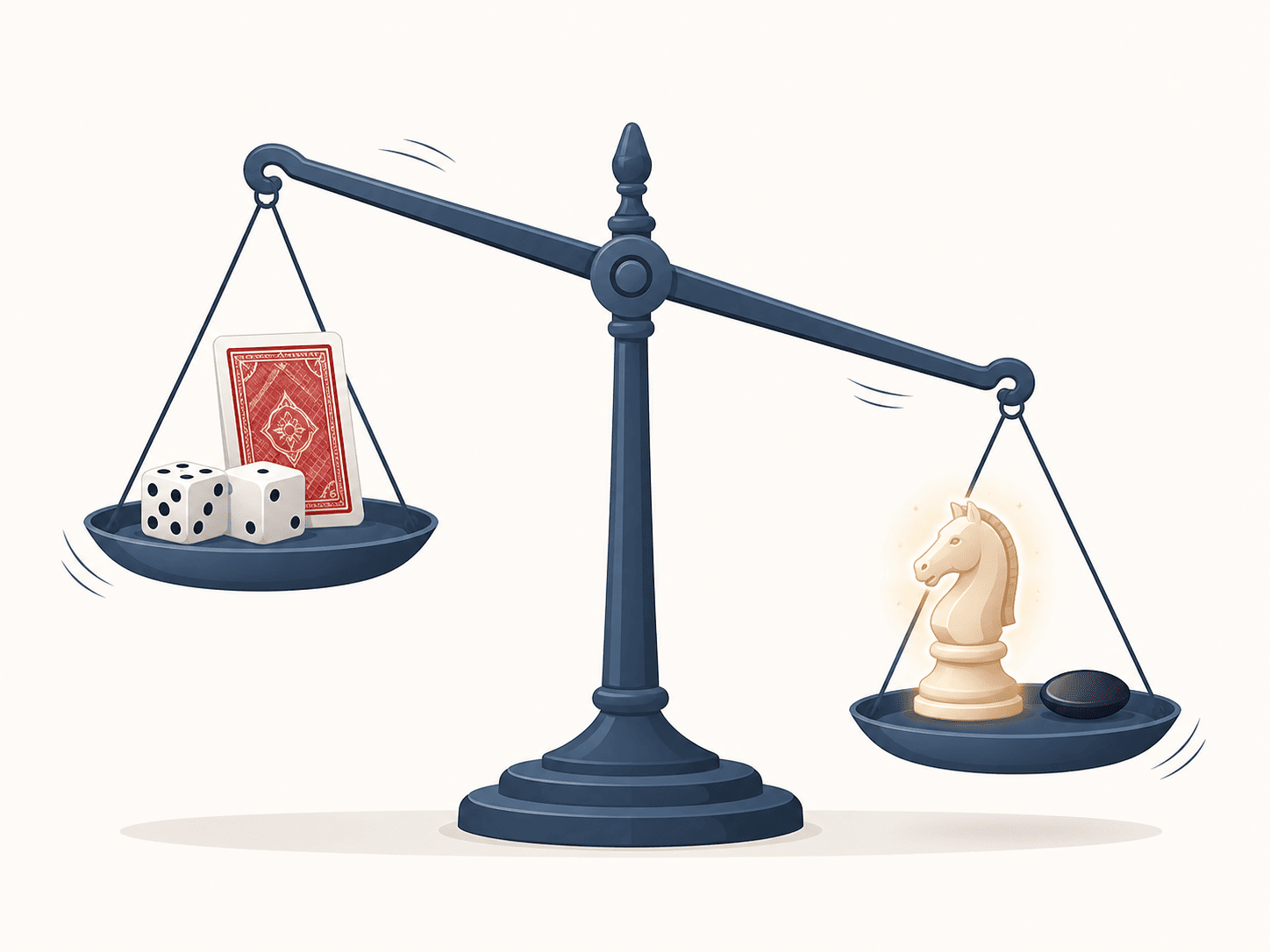
What luck is for
It's tempting, on a shelf devoted to pure-strategy games, to treat luck as a flaw. That would be unfair, and wrong. Designers add randomness on purpose, and their reasons are good ones.
Luck lets anyone win tonight. A parent and an eight-year-old can share a dice game as genuine rivals. Without luck, the stronger player wins every time, and "every time" is poison for mixed company. Randomness is the great social equalizer — it hands the underdog real hope.
Luck manufactures drama. The roll everyone leans in for, the top-decked miracle, the comeback nobody earned — these are theater, and theater is fun. Pure-skill games generate tension too, but it's a slow-burn tension; dice deliver fireworks on a schedule.
Luck provides mercy. When you lose a dice game, some of the loss belongs to the dice. That cushion keeps things light. Nobody's self-image is on the line at the Snakes and Ladders table.
Luck adds variety. Shuffled setups mean no two games open alike, keeping a light ruleset fresh across hundreds of plays.
These are real virtues. They're also, note carefully, mostly social virtues — luck is doing work on the people, not on the decisions. Which sets up the other side of the ledger.
What removing luck does
Strip every die and shuffle out of a game and three things happen, all of them at once.
First, the alibis vanish. No cushion, no mercy, no "the dice hated me." If you lose a game of Go or Othello or Oustwit, you were outplayed, full stop. Some players find this exposure uncomfortable — worth admitting honestly. The same players often discover, a dozen games in, that the exposure is the appeal: wins with no asterisk. A victory nothing handed you.
Second, improvement becomes visible. In a luck-heavy game, you can play better and still lose for a week — feedback arrives slowly, smeared across statistics. In a pure-skill game, feedback is immediate and unpolluted. When you start winning more, it's because you got better, and you can feel the exact shape of the improvement. This is why "one more game" hits differently in skill games: every game is a fresh, honest measurement.
Third, the drama changes address. It doesn't disappear — it moves from the dice to the minds. The tension of a pure-strategy duel is the tension of two plans colliding in full view, of watching a trap close slowly, of knowing that nothing random can save either of you. The five-minute endgame of a close Oustwit match — one player a push away from three-in-a-row, the other racing to land their eighth piece — has no dice anywhere in it, and nobody watching would call it calm.
The gambler's detour: when luck becomes the product
One more distinction before the table of verdicts, because the app stores have made it urgent: there's a difference between a game containing luck and luck being the product.
A dice game uses randomness in service of play — the decisions still matter, the drama serves the contest. A slot machine (and its many descendants dressed as casual games) inverts this: the randomness is the experience, and whatever taps you perform exist to pace your exposure to it. The psychology is well studied — unpredictable rewards on a variable schedule are the most habit-forming pattern known — and an entire industry builds "games" on that engine, complete with celebration animations for outcomes you didn't influence.
The test from earlier cuts through the costume instantly. Could an expert beat you at this? If nobody on Earth could be meaningfully better than you at it, it isn't a contest — it's a ride. Rides can be enjoyed! But they should be chosen knowingly, and they charge differently: a skill game costs effort and pays in improvement; a luck engine costs money and pays in near-misses. Half the reason this shelf exists is that both kinds share the words "board game" in a store search, and only one kind deserves your evenings. (Our field guide to spotting deep games among the shallow turns this into a fifteen-minute test.)
Skill you can bank: what ratings really measure
Here's a pleasant consequence of choosing the skill end of the spectrum: your progress becomes a number you can watch.
Rating systems — chess's Elo and its many cousins, including the skill tiers in modern app lobbies — work by a simple principle: beat players rated above you and your number rises; lose to players below and it falls. Over dozens of games the number converges on something honest, and here's the key point: ratings only converge in skill games. Rate a pure dice game and everyone's number wobbles around the same average forever, because there's nothing for the number to find. The very existence of a stable rating is proof that decisions rule the game.
This is why skill-game players get quietly attached to their number. It's not vanity — it's the only place in most adult lives where improvement at a purely mental craft gets measured to the point. Study endgames for a month, watch the number drift upward; play tired at midnight for a week, watch it sag, fair and pitiless. Luck-heavy games can't offer this mirror. In backgammon it takes hundreds of games for the dice noise to average out of your results; in a no-dice duel, the signal starts arriving with game one.
A practical note for the rated-anxious: the number measures your current play, not your worth, and everyone's dips when they experiment. The players who improve fastest treat the rating as a lab instrument, not a report card.
Placing familiar games on the line
With the four kinds of luck and the expert test in hand, the household names sort themselves quickly:
| Game | Main luck source | Would an expert beat you 100 straight? | Verdict |
|---|---|---|---|
| Snakes and Ladders | Everything | No — nobody can be expert | Pure luck |
| Candy Land, bingo | Everything | No | Pure luck |
| Uno | Draws + hidden hands | No — they'd win somewhat more than half | Luck-leaning |
| Poker | Deals (hidden) | Not in games — but always over a year | Skill wearing luck's coat |
| Backgammon | Dice before choice | Nearly — and certainly over a match | Deep skill, loud dice |
| Scrabble | The bag + hidden racks | Practically yes | Skill-heavy |
| Chess, Go, checkers, Othello, Hive, Oustwit | None | Yes — every single game | Pure skill |
Two footnotes to the table. Poker's placement surprises people: it's listed as deep skill because over the long run the same players always end up on top — yet in any single hand, luck is shouting, which is exactly why it works as a gambling game. And the bottom row hides one nuance: even among pure-skill games, who moves first is a tiny arbitrary edge, which serious games patch with rules like alternating colors across a match. The purists take fairness seriously all the way down. (Where do near-misses like backgammon and Stratego formally sit? We've given the borderline cases their own article.)
How designers tune the dial
Luck versus skill isn't just a property games have — it's a dial designers and communities actively turn, and watching the tuning tricks makes you a sharper judge of everything you play.
Best-of-N is luck's tax collector. One game of anything can be stolen by fortune; a match of eleven rarely is. Competitive communities around lucky-ish games (backgammon, card games) run long matches precisely to let skill compound — the format is doing what the rules alone can't.
Mirrored hands and duplicate play. Some tournament formats deal the same shuffled setup to every table, so everyone plays identical luck and only the decisions differ. It's the cleanest proof that a community knows exactly where its randomness lives — and wants it neutralized when pride is on the line.
Choice after chance. Remember the four kinds of luck: dice-then-decide is friendlier to skill than decide-then-dice. Modern designers overwhelmingly prefer the first kind — randomness that sets a menu rather than randomness that grades your homework. When you feel a new game respecting your choices even while dice rattle, this is usually why.
The doubling cube. Backgammon's great invention deserves its own mention: a stakes mechanism that adds a layer of pure judgment on top of a dice game. Knowing when to double is skill about luck — the dial turned so cleverly it became a second game.
And at the far end: removal. The abstract family's answer is the simplest tuning of all — take the dice out entirely and patch the one arbitrary residue left (whoever moves first has a small edge) with alternating colors, mirrored rematches, or bonus points for the second player. When a modern duel like Oustwit offers instant rematches with colors swapped, that's the same instinct: even the last percent of arbitrariness gets engineered away over a session.
A kitchen-table experiment
Don't take the theory's word for any of this — luck weight is measurable at home, and the measuring is fun.
The ten-game test. Pick a two-player game and one regular opponent, and log ten games — nothing fancier than tally marks on a fridge pad. In a skill game, a pattern appears fast: the stronger player pulls ahead, and (more interesting) the gap is stable — 7–3 this week probably means 7–3 next week too, until somebody studies. In a luckier game the tally wanders: 6–4 one week, 4–6 the next, no signal emerging. The speed at which your tally stops looking like coin flips is the game's skill weight, measured on your own table.
The swap test. For games with unequal positions or first-move advantage, play every match as a pair with sides swapped. If the same person wins from both sides, that's skill talking. If victory follows the seat, you've learned something about the game's balance instead — also worth knowing.
The advice test. Sneakiest of all: let a stronger player whisper advice to the weaker one for a session. In a skill game, the coaching visibly moves results within a few games. In a luck game it changes nothing, because there was nothing to advise. Games where a mentor matters are games where decisions matter — which, incidentally, is why open skill games are the classic vehicle for parents and kids to actually teach each other something across a board.
Luck, skill, and kids
Speaking of kids: the spectrum doubles as a parenting map, because children need different mixes at different ages.
Little ones need luck. A four-year-old cannot out-think anyone, but dice make them a real competitor, and real competitors get to feel the whole cycle — hope, triumph, disaster — safely. Pure luck games are training wheels for emotions, and they're doing honest work.
The graduation moment comes somewhere in the early school years, and it's worth marking deliberately: the first game where the child wins because they saw something. Three-in-a-row games are the classic doorway — simple enough to grasp at five, strategic enough that the first earned fork feels like sorcery. From there the ladder runs upward through checkers and the gentler abstracts, and every rung teaches the same quiet lesson: your choices did this. Psychologists have a name for believing your actions affect outcomes, and it's one of the most valuable beliefs a child can install.
One warning shines through every parenting thread on the subject: don't fake losses forever. Kids smell it, and a diet of arranged wins teaches the opposite lesson. The kinder gift is a game with a handicap the rules respect — extra pieces, first move always, an easier AI level — so the wins they get are real ones. Luck games hand children victories; skill games, tuned right, let children build them.
Finding your own comfort zone
Here's the part gaming discourse usually skips: there is no correct place on the spectrum. There's only the right place for you, tonight.
Ask yourself a few honest questions. When you lose, do you want a cushion or a diagnosis? Is tonight for laughing across the table or for locking eyes with a problem? Do you want your eight-year-old to have a real chance, or do you want your best friend of twenty years to have no excuse whatsoever when you finally beat him? Different answers, different games, same healthy hobby.
Many players end up with a portfolio: something dicey and social for the group, something shuffled and clever for two, and one pure-skill duel they're quietly serious about — the game where they track their rating, review their losses, and savor wins that belong entirely to them. If that last slot is currently vacant in your collection, the abstract family is the traditional place to fill it: the games are free or nearly free to try, they run from three-in-a-row simple to Go-deep, and the modern ones fit in a pocket and finish in five minutes.
Just know what you're signing up for. In a game with no luck, the first dozen losses come with nobody to blame. Somewhere around the thirteenth, that stops being the game's most frightening feature and becomes its best one.