Learn › What makes a game abstract? › What is an abstract strategy game?
What is an abstract strategy game? A plain-English guide
No dice. No secrets. No story in the way. Here's what abstract strategy games are, why people love them, and how to tell whether a game — on your table or on your phone — belongs to the family.
The one-sentence answer
An abstract strategy game is a game you can only win by out-thinking the other player — because there is no luck to save you, nothing is hidden from you, and the theme (if there is one) doesn't matter to how the game plays.
Chess is the famous example. So is Go. So are checkers, Othello, and Connect Four. So are hundreds of newer games you may not have met yet. They look different, but they all make the same promise: everything you need to win is sitting right there in front of you. The board hides nothing. The rules favor no one. If you lose, you were outplayed — and if you win, you earned it.
That promise is the whole appeal. It's also what scares people off, because it sounds intimidating. It shouldn't. Abstract games include some of the simplest games ever made. Tic-tac-toe is one. You've been playing abstract strategy since you were six; you just didn't know the name.
The three tests
Players and designers argue happily about edge cases, but almost everyone agrees on the core. A game is an abstract strategy game when it passes three tests.
Test 1: No luck
There are no dice to roll, no cards to draw from a shuffled deck, no spinners, no random setup that decides who gets the good start. Every change on the board happens because a player chose it.
This matters more than it first seems. In a dice game, a bad night can beat a good plan. In an abstract game, there is no bad night — only a bad plan. Some players find that stressful. Most find it liberating: for once, the result is entirely yours.
One nuance: a game can contain a tiny bit of chance and still feel abstract in spirit. Backgammon has dice, yet rewards skill so heavily that experts win consistently. Purists keep it just outside the family; almost everyone agrees it's a close cousin.
Test 2: Nothing hidden
Game designers call this perfect information. It means the full state of the game is visible to both players at all times. No hand of cards held to your chest. No face-down tiles. No fog of war. When it's your move, you can — in principle — see everything your opponent can see.
Poker fails this test spectacularly: the entire game lives in what you can't see. Stratego fails it too — the pieces have secret identities. Chess passes: both armies stand in the open, and the only hidden thing is your opponent's intention.
Games of perfect information have a special honesty. You can't be ambushed by information; you can only be ambushed by an idea you didn't notice. Every "surprise" was available to you the whole time. That stings — and it teaches.
Test 3: The theme is optional
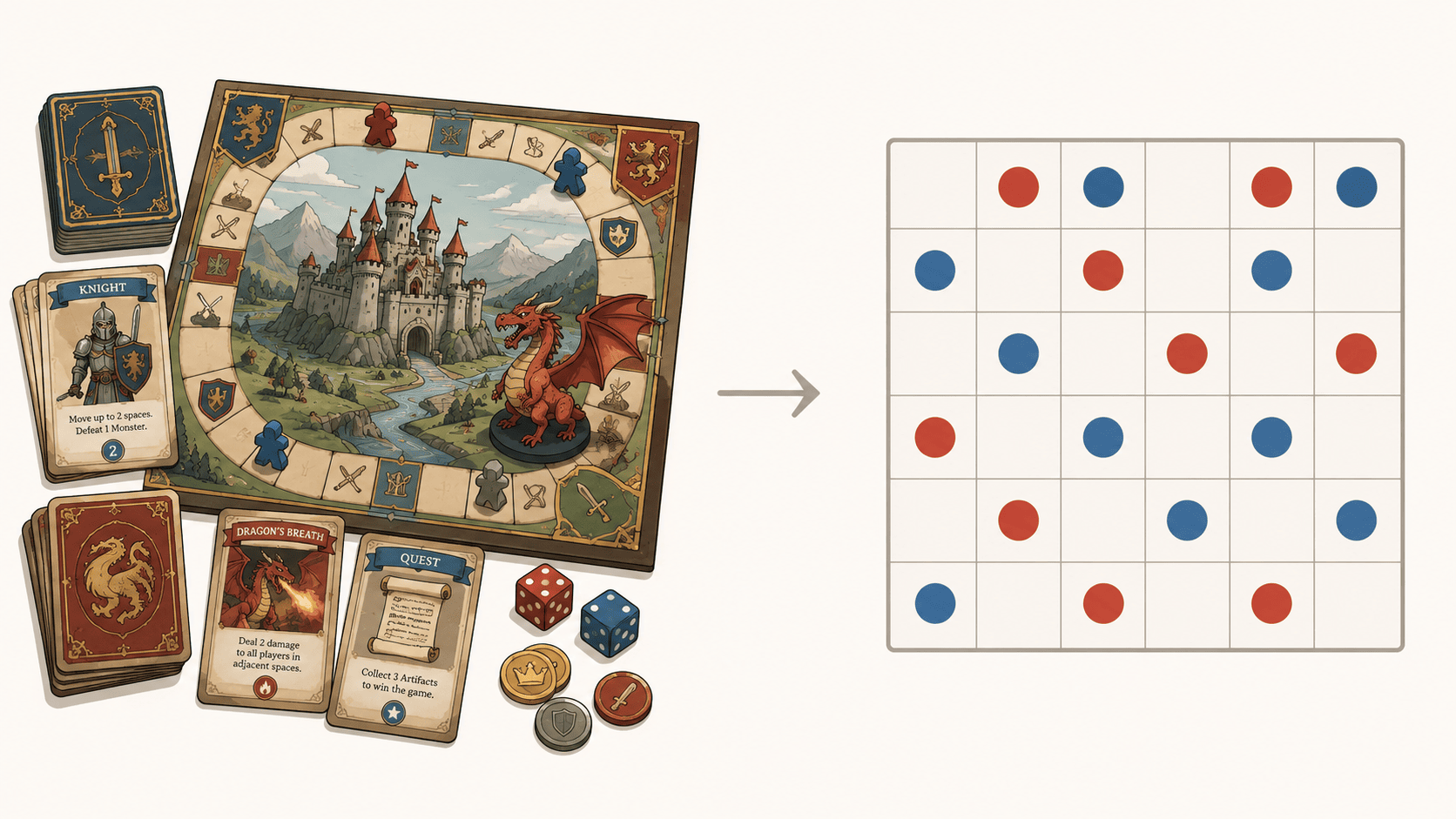
This is where the word abstract comes from. In a themed game, the story does real work: in a farming game you plant fields, in a dungeon crawler you fight monsters, and the rules lean on those pictures to explain themselves. In an abstract game, the pieces could be stones, discs, warriors, or bottle caps and the game would play exactly the same.
Chess has knights and kings, but nobody needs to know medieval history to castle. Go has nothing at all — black stones, white stones, and a grid — and it's one of the deepest games our species has produced. The theme is a coat of paint. The game underneath is pure structure: position, timing, and threat.
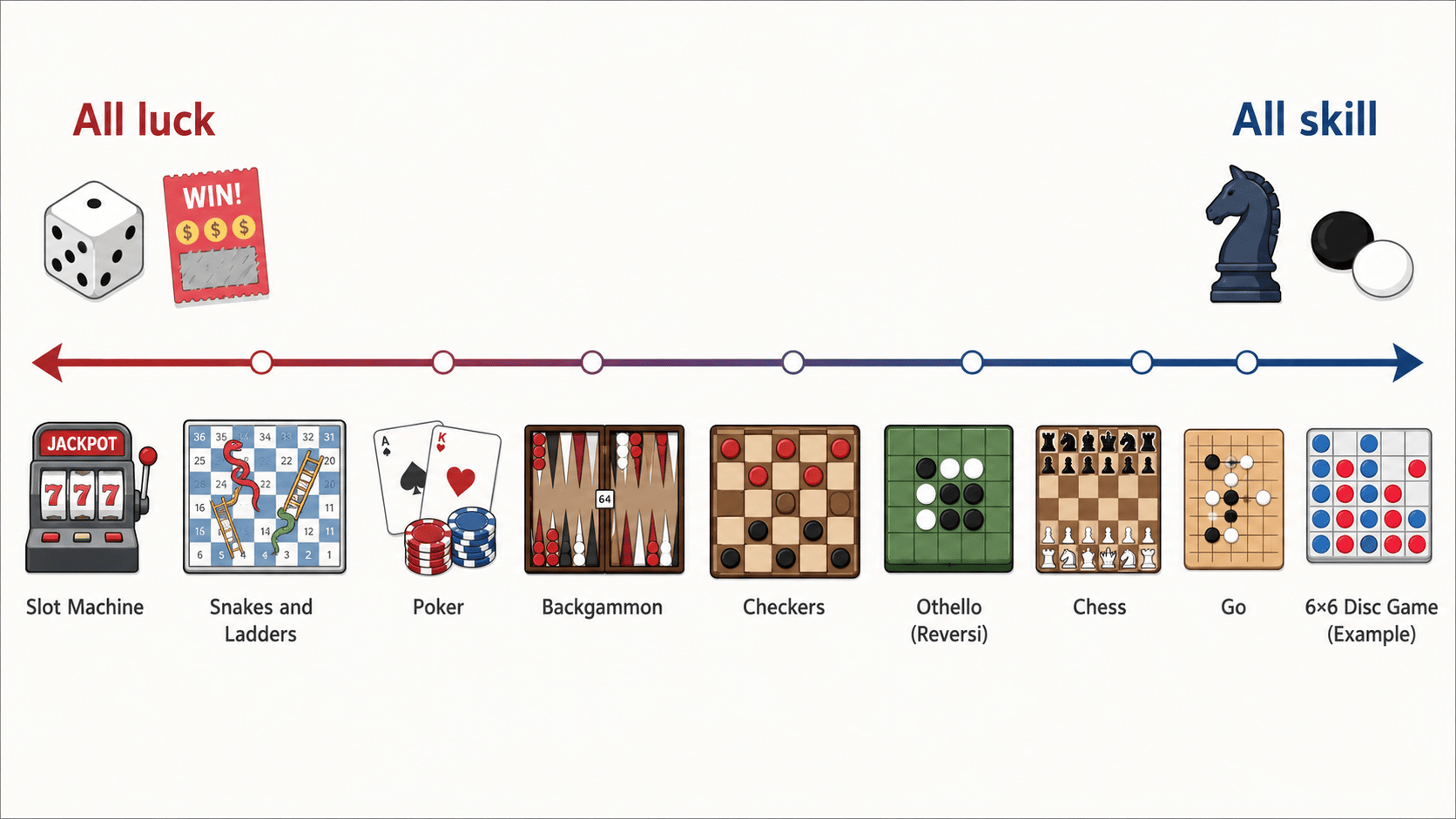
Where familiar games land
The three tests turn fuzzy arguments into quick answers. Run a few household names through them:
| Game | Luck? | Hidden info? | Abstract strategy? |
|---|---|---|---|
| Snakes and Ladders | All of it | No | No — there are no decisions at all |
| Uno | Heavy | Yes | No |
| Poker | Some | The whole point | No — but deeply skillful |
| Backgammon | Dice | No | Borderline — a beloved cousin |
| Stratego | No | Yes | No — hidden pieces break test 2 |
| Checkers | No | No | Yes |
| Othello / Reversi | No | No | Yes |
| Chess, Go, Hive, Oustwit | No | No | Yes |
Notice what the table doesn't say: it doesn't say luck makes a game bad. Some of the best evenings of your life will involve dice. The point is only that abstract games are a particular kind of contest — a fair fight of minds, with no alibis available to either side.
How old is this family?
Older than writing about games; nearly as old as writing about anything. Boards for Senet were placed in Egyptian tombs some five thousand years ago. The Royal Game of Ur was played in Mesopotamia before anyone alive could have imagined a phone screen — and when researchers reconstructed its rules, modern players sat down and enjoyed it. Go has been played continuously in East Asia for well over two thousand years. The mancala family has been sowing seeds across Africa and Asia for centuries beyond counting, often with nothing more than pits scooped in the earth and a handful of pebbles.
Not every ancient game was purely abstract — Senet and Ur had dice-like throwing sticks — but the direction of history is striking. The games that survived longest and traveled farthest are overwhelmingly the simple, open, skill-driven ones. Empires fell, languages died, and somebody kept a grid and two colors of pieces going the whole time.
Knowing this changes how a new player feels at the table. When you learn an abstract game, you're not picking up a product; you're joining the oldest continuous pastime the species has. The person teaching you was beaten by someone, who was beaten by someone, in a chain that runs back past every border on the map. (If this thread pulls at you, the history of board games shelf of this hub goes much deeper.)
Why people fall in love with these games
The fairness is addictive. Once you've won a game where nothing was random and nothing was hidden, other wins can feel slightly borrowed. There's no "I got lucky" and no "you got lucky." The scoreboard measures exactly one thing, and it's you.
Simple rules, bottomless depth. Most classic abstracts explain themselves in a minute or two. Go has a handful of rules and has been studied for well over two thousand years without being used up. This ratio — tiny rulebook, enormous game — is the quality abstract players prize most. You spend no effort remembering rules and all of it actually playing.
They respect your time. Because there's no setup of decks and tokens and boards full of chrome, abstract games start fast, and many finish fast. A full match of a modern abstract can fit inside a coffee break, and losing fast is a feature: the rematch starts immediately, and the rematch is where the learning lives.
They last a lifetime. You can't outgrow a good abstract game, because the game grows with you. The chess you play at forty is a different, richer game than the chess you played at nine — same board, same rules, new player. Very few purchases work like that.
They travel perfectly. No language on the cards, because there are no cards. No text on the board, because there's no text. A grid and two colors of pieces cross every border on Earth — which is why the same handful of abstract games are played, in local variations, on every continent, and why they fit so naturally on a phone screen.
What these games quietly train
Nobody should pick up a hobby as homework, and the "brain training" industry has overpromised for years. So let's keep the claims honest. Playing abstract games will not raise your IQ, and researchers still argue about how much skill transfers from a board to the rest of life. What the games demonstrably give you is practice — pleasant, repeated, voluntary practice — at a few things most of us rarely practice at all.
Looking ahead before acting. Holding a plan while conditions change. Noticing that your "great idea" has a refutation, and finding it yourself before your opponent does. Sitting with full responsibility for a result, because there's no die to blame. And losing — frequently, quickly, in private or in public — without it meaning anything about you except that the next game will go better. Ask longtime players what the hobby gave them and they rarely say "intelligence." They usually say some version of patience, or calm, or "I stopped needing to win to have a good time." Those are strange gifts to get from a grid and some discs. They're real, though.
Five myths worth clearing up
"You have to be a genius"
No. You have to be willing to lose a few games while your brain quietly builds pattern memory — the same way you learned to catch a ball or parallel park. Studies of expert players point at trained pattern recognition, not raw IQ, as the engine of strength. The genius myth survives because we mostly hear about world champions. You don't need to be one to enjoy the pool; you don't need a gold medal to enjoy swimming.
"They're cold and dry"
Watch two friends play a close game of anything abstract and report back about the coldness. Because nothing is hidden, both players see the same drama building at the same time — the trap forming, the escape narrowing, the one square that decides everything. The tension is real precisely because no die can dissolve it. Abstract games aren't emotionless; they're emotion with nowhere to hide.
"It's basically just chess and Go"
The family is enormous and still growing. The last few decades produced a wave of modern abstracts — games like Hive, Santorini, Onitama, Azul, and the push-and-shove school that includes Abalone and, yes, Oustwit. Modern designers learned to deliver classic depth in twenty minutes instead of two hours, and the results are some of the most elegant games ever published.
"They're too slow and serious"
Some are stately. Plenty are knife fights. Modern abstracts in particular are built for speed: small boards, few pieces, sudden endings. A game where every placement shoves the neighboring pieces around does not play out like a museum. Five minutes of an aggressive abstract can hold more reversals than an hour of a heavier game.
"Digital versions aren't the real thing"
An abstract game is its rules, not its furniture. Because the theme is optional and the state is fully visible, nothing essential is lost on a screen — and a few things are gained: an always-available opponent, automatic rule enforcement, replays of your games, and opponents from around the world at any hour. Wood and stone are lovely. The game is the same game.
Meet the family
The ancients. Go (East Asia), chess and its regional siblings shogi and xiangqi, checkers and the wider draughts family, mancala's dozens of local variants, Nine Men's Morris. These have survived centuries to millennia of continuous play — the longest field test any entertainment has ever passed.
The moderns. From the 1960s onward, designers began building new abstracts on purpose: first the classics of the era like Twixt and Othello's modern form, then the great wave — the GIPF project, Hive, Abalone, Santorini, Onitama, Tak. Modern abstracts tend to be faster, tighter, and friendlier to learn than the ancients, with the same no-luck, nothing-hidden soul.
The digital-native generation. The newest branch was designed with the phone in mind from day one. Oustwit — the game this site belongs to — is a current example: a 1v1 duel on a 6×6 board where every piece you place pushes the neighboring pieces outward, and you win by making three in a row or getting all eight of your pieces onto the board. No dice, no hidden information, five-minute matches. It's the old promise — a fair fight of minds — shaped to fit the device already in your pocket.
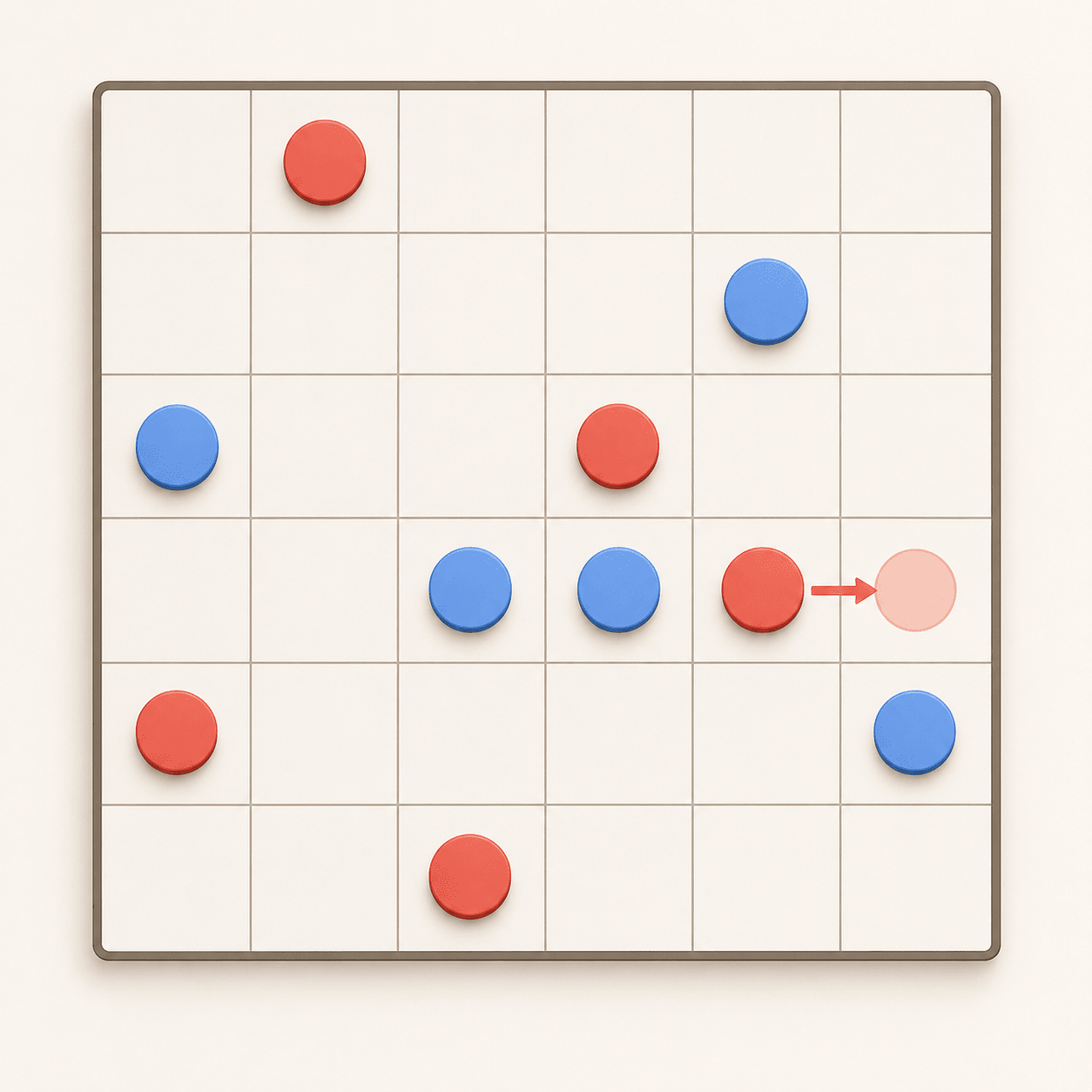
What five minutes of one feels like
Definitions only go so far; here's the texture. Take Oustwit's opening moves as the example, since its whole ruleset fits in a breath: place a piece, push every neighboring piece one square outward, win with three in a row or by landing all eight of your pieces.
The first placement is peaceful — an empty board, a piece dropped near the middle where its future pushes will have the most reach. The reply lands beside it, and the board moves for the first time: your piece slides a square toward the edge, shoved by the newcomer. Nothing is lost yet, but you feel the game's physics wake up. By the fourth or fifth move, every placement is doing two jobs at once — building toward a line of three while nudging enemy pieces somewhere worse. Then someone gets careless near the rim, a piece is shoved clean off the board and returns to its owner's hand, and both players sit up straighter.
The endgame arrives fast. One player threatens a diagonal line; the other blocks it and, in blocking, accidentally sets up a second threat somewhere else. Every abstract game has its version of this moment — the fork, the squeeze, the move that asks two questions when only one can be answered. When it lands on you, there's a beat of pure appreciation before the loss registers. Five minutes, no luck, and the rematch button already glowing. That cycle — quick, fair, one-more-game — is the family trait every abstract shares, whatever the board looks like. (The full rules, with a move-by-move opening, live on the how to play page.)
How to spot a deep game before you commit
Once you start looking for abstracts, you'll meet a hundred apps and boxes claiming to be "easy to learn, hard to master." A quick sniff test separates the deep games from the merely simple ones:
- Real choices every turn. If most turns have one obvious move, the game is playing itself. Depth begins where reasonable people disagree about the best move.
- Moves that change the future. In deep games, this move reshapes what both players can do next turn. If turns don't talk to each other, there's nothing to plan.
- Tension between goals. The best abstracts make you want two things you can't both have — attack or defend, build or block, make a line or land your pieces. If Oustwit's two win conditions sound like that tension bottled, that's exactly the design.
- Comebacks that are earned. A deep game lets a losing player fight back through better play, not through a lucky event that resets the score.
- Games between the same two people stay interesting. The ultimate test. A shallow game is used up in five plays; a deep one gets better as you both improve.
How to get started (without getting flattened)
Pick one game and stay a while. Depth is the reward of these games, and depth only appears with repetition. Ten games of one abstract will teach you more than one game of ten abstracts.
Start against a computer opponent. A good app gives you difficulty levels — a patient sparring partner that never judges, never gloats, and is available at 6 a.m. Climb the levels before you face humans, and the humans will be much less terrifying.
Lose on purpose — that is, on schedule. Everyone loses constantly at first. Expect it, budget for it, and ask one question after each loss: where did it turn? If the game or app keeps replays, watch the last few moves before things went wrong. One found mistake per game is a spectacular rate of improvement.
Learn one idea at a time. Not openings, theory, and endgames all at once. This week: "control the middle." Next week: "count before you commit." Abstract strategy is a stack of small ideas, and they compound like savings.
Play people you like. The fastest improvement and the best memories both come from a standing rivalry — a friend, a partner, a coworker, a parent. A rematch button and a little trash talk have carried these games for five thousand years.
Quick answers
Is tic-tac-toe really an abstract strategy game? Yes — a fully solved, therefore boring one. It's the family's kiddie pool: real water, no depth. Games like Connect Four, Gomoku, and Oustwit are what three-in-a-row grows into when designers add room to maneuver.
Is backgammon abstract? The dice say no; the depth says almost. Most players file it as a skill game with a heartbeat of luck — outside the strict family, welcome at the reunion.
Is poker a strategy game? A profound one — but not an abstract one. Hidden cards fail test 2, and managing luck is the very skill being tested. Different family, different pleasures.
Are abstract games good for kids? Wonderful for them. No reading required, rules in a minute, and gentle, repeated lessons in planning ahead, taking turns, and losing without drama. Start small — three-in-a-row games are the traditional door in.
Do I need to be good at math? No. You need to notice patterns, and noticing patterns is something human brains do for free. The math, if it's in there, stays politely out of sight.
The short version
An abstract strategy game is a fair fight: no luck, no secrets, no story required. The family runs from tic-tac-toe to Go, from ancient stone grids to five-minute duels on your phone. The rules are small. The games are not. And the only way to find out what all the fuss is about is to sit down across from someone — in person or online — and play.