Learn › The classics › Go
Go: the deepest simple game on Earth
A grid, black stones, white stones, and one goal: surround more territory than the other player. Go's rules fit in a breath, it has been played continuously for well over two thousand years, and nobody has come close to using it up. This is a visit to the deep end of the entire hobby — and an argument that the water is friendlier than its reputation.
The astonishing ratio
Every deep game balances two quantities: how much you must learn before playing, and how much there is to discover afterward. Chess asks you to memorize six different piece movements plus castling, promotion, and en passant before your first legal game. Go asks almost nothing — stones go on intersections, stones with no breathing room are captured, more territory wins — and then pays out discoveries for a lifetime. Centuries of professional study have produced proverbs, schools, and libraries, and the game's frontier still isn't in sight.
That ratio — depth divided by rules — is the yardstick this whole shelf uses to measure elegance, and Go simply sets the world record. It's the reason designers speak of the game with the reverence musicians reserve for Bach: not because it's old, but because nothing so small has ever contained so much.
The scale deserves a number. The standard board is a 19×19 grid — 361 intersections — and the count of legal Go positions is a number roughly 170 digits long, dwarfing the count of atoms in the observable universe by a margin that itself dwarfs the count of atoms in the observable universe. You will never see a repeated game. Nobody ever has.
How Go works, in one cup of coffee
Here is the whole game, honestly. Two players alternate placing stones — Black first, then White — on the intersections of the grid. Stones never move once placed (no pushing here; this is the stillest game on the shelf). Every stone or connected group needs at least one empty adjacent intersection — a "liberty," a breath. Surround a group completely, taking its last liberty, and you capture it off the board. When both players agree there's nothing useful left to do, they pass, and the game ends: count the empty territory each side has walled off, add captures, and the bigger total wins. White gets a handful of bonus points — the komi, tuned over decades to around seven — as rent for moving second.
That's genuinely all of it. A curious eight-year-old can hold every rule after one demonstration. What the rules don't tell you — what nothing can tell you in advance — is what happens when two people actually start drawing borders on the same small world: every stone is simultaneously a wall, a threat, a promise about the future, and a question about how much of the board you think you deserve.
Why "surround more space" gets so deep
Go's depth comes from a tension the rules never state but every game discovers. Stones near the edges and corners wall off territory quickly and safely — small, certain profit. Stones toward the center claim little directly but radiate influence, shaping every future battle. The whole game is a negotiation between those two currencies: cash now or power later, territory or influence, the corner or the middle. Neither is right. That's the point.
From that one tension, everything else emerges. Local fights — sharp, tactical, chess-like — over whether a group lives (makes itself uncapturable) or dies. Whole-board judgment about which of the four or five simultaneous negotiations matters most right now. And the game's signature skill, one almost no other game teaches as purely: the willingness to lose a battle on purpose. Because the score is counted across the entire board, a Go player is constantly abandoning fights — politely, profitably — to take a bigger point elsewhere. Beginners cling to every stone; strong players give stones away the way good negotiators concede small clauses. If chess is a war for the king's life, Go is a season of trade talks where the map itself is the treaty.
Players of other strategy games recognize the muscle immediately: it's exchange thinking — what is worth what — stripped of every distraction and made the entire game. An afternoon of Go will change how you evaluate trades in anything, from a card game to a 6×6 push duel to an actual negotiation.
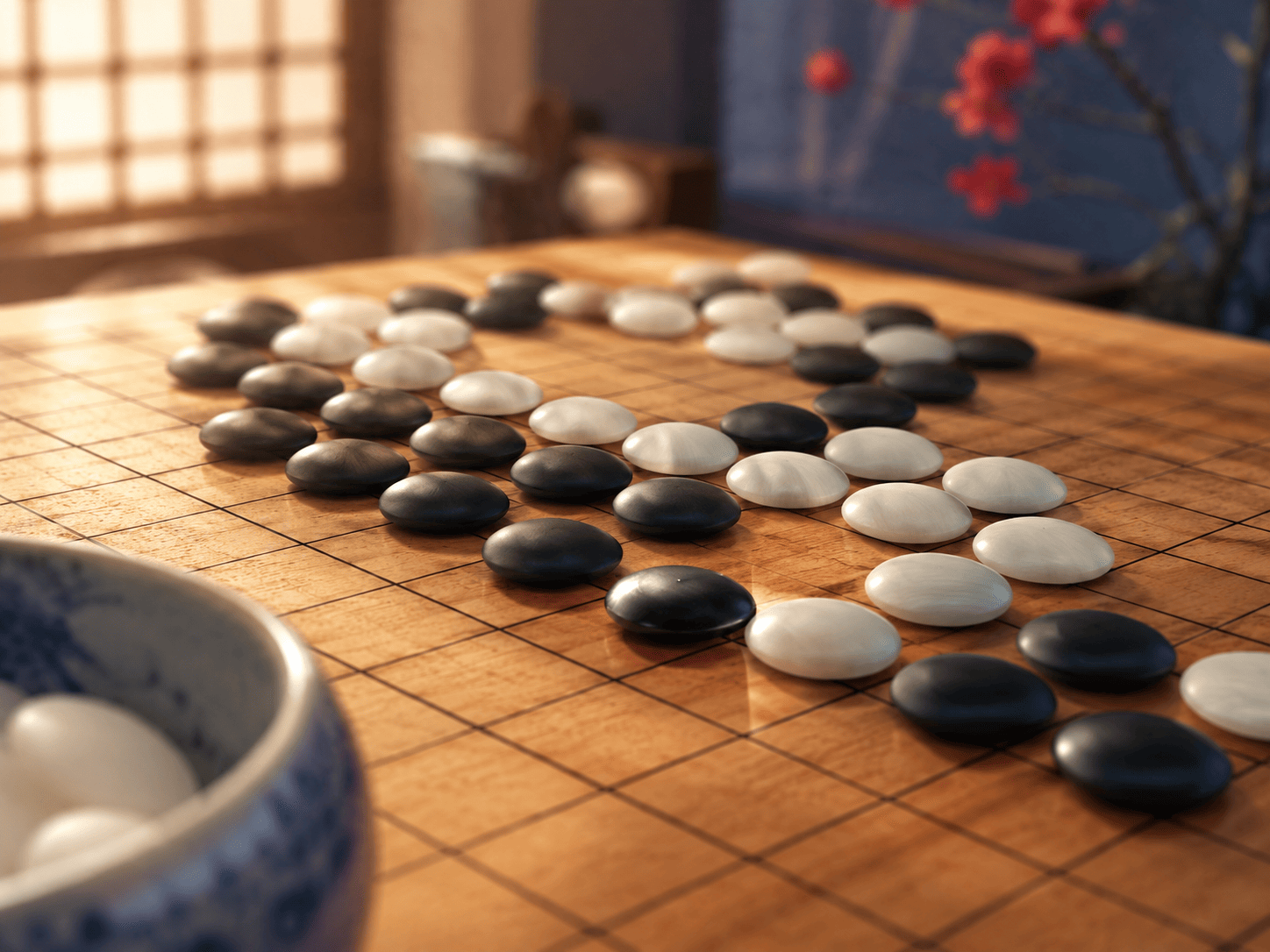
One corner, one capture: a worked taste
Words make Go sound abstract, so here's thirty seconds of it, slowed down. Picture an empty corner of the board.
Black places a stone a few lines from the corner. It has four empty neighbors — four liberties, four breaths. White places a stone directly beside it. Black's stone now has three breaths; so does White's. Nothing is captured; they're just touching, like two hands on the same armrest.
Black ignores it and plays elsewhere — remember, the whole board is the score. White presses: another stone against Black's, taking a second breath. Two liberties left. Black tenses and answers, extending to a neighboring point — and here's the first quiet miracle: the two Black stones connected together now share their breaths. They've become one group, harder to kill than either stone alone. Connection is safety. Every Go player learns it in the hands before the head.
Suppose instead Black had kept ignoring the corner. White surrounds until one breath remains — a state with a name, atari, the game's version of "check." One more White stone fills the last liberty, and the Black stone lifts off the board, leaving a hole in White's wall shaped exactly like a captured prisoner. That's the entire tactical engine of Go: breathing, connecting, surrounding. Everything else — the ladders, the nets, the life-and-death problems professionals drill like scales — is that engine, elaborated for two and a half thousand years.
Farmland and billboards
The strategy layer has a beginner-friendly translation too. Territory is farmland: fenced, counted, yours. Influence is billboards: it earns nothing today, but it shapes everything that happens near it later. Every Go move buys one, the other, or a blend.
The board's geometry sets the prices. Corners are cheap to fence — two sides are already walls — so the oldest proverb in the game says: corners first, then sides, then center. Beginners who grab the middle discover their vast unfenced prairie leaks at every border; beginners who only hoard corners discover their opponent's central influence deciding every fight. The masters' games are price negotiations between the two, and reading one with the farmland-and-billboards lens is enough to follow the plot. It's the same cash-now-versus-position-later tension that powers every deep game — tension between goals, sign three — here purified into the whole of strategy.
A game treated as a discipline
Nothing else in gaming carries Go's cultural weight in East Asia — the closest comparisons aren't to other games but to classical music or martial arts.
In China, where the game was born, Go (wéiqí) was counted among the four arts of the cultivated scholar, alongside calligraphy, painting, and the qin. In Japan — which received the game more than a millennium ago and institutionalized it during the Edo period — hereditary academies like the famous Honinbo house refined it for centuries on government stipends, producing the world's first professional gaming class and title matches that newspapers still sponsor today. Aspiring professionals (insei) still enter training academies as children; in Korea, where the game is baduk and the competitive scene burns hottest, top matches air on dedicated television channels. Titles carry names like "Kisei" — go sage — and the great historical games have names and anniversaries, studied the way musicians study recordings. (The world-tour shelf visits this culture properly.)
Some of that culture travels with the game anywhere it's played. The post-game review — winner and loser rebuilding the game together, hunting the truth of it — is Go's oldest ritual and its best export. So is nigiri, the graceful randomization of who plays Black; so is resigning a lost game as a courtesy rather than a surrender; so is the etiquette of the first and last greeting. You can play Go rudely, but the game will quietly make it feel wrong.
The handicap system: engineered humility
Go solved a problem almost every competitive game still struggles with: how do a strong player and a weak player share a genuinely interesting game?
The answer is stones. Before the game starts, the weaker player places two to nine free stones on the board — a head start calibrated by the exact difference in the players' ranks. A well-set handicap produces a real contest: the stronger player must overreach and punish every inaccuracy; the weaker player must convert a lead under pressure. Both are playing at full strength, and either can honestly win.
Around the handicap grew Go's beautiful rank ladder — kyu grades counting down through student levels, dan grades counting up through mastery, exactly as in martial arts (which borrowed the scheme from Go, not the reverse). Your rank isn't a boast; it's a unit of measurement that tells any player on Earth precisely how many free stones separate you. The system makes mismatches playable, progress visible, and humility structural — the ladder always shows how far up it goes. Modern rating systems in every online game are chasing the same goal; Go got there centuries early, with nine free stones and no mathematics at all.
The AlphaGo moment
For decades, Go was the game computers couldn't crack — its possibility space too vast for brute force, its judgment calls ("this position just feels better") seemingly beyond machines. That made March 2016 one of the most dramatic weeks in the history of games: AlphaGo, a neural-network program, defeated Lee Sedol — one of the greatest players of the era — four games to one, a decade before most experts predicted it possible.
The match produced a moment players still discuss with awe: move 37 of game two, a shoulder hit on the fifth line that professional commentators initially called a mistake — no human school taught it — before slowly realizing it was brilliant. The machine hadn't just matched human judgment; it had found doors in a house humanity had lived in for two and a half thousand years.
And then the pattern chess had already demonstrated repeated itself, amplified: Go grew. Sign-ups surged worldwide; the game reached millions who'd never heard of it; and professionals — after the grief — went to school on the machines, mining the new ideas until the "AI style" reshaped modern opening theory. Humans still play humans, in the same title matches, with the same tea and the same bows. The mountain turned out to be taller than anyone knew, which for people who love climbing is the best possible news.
For people who bounced off (or never dared)
Go's reputation — the 19×19 ocean, the professional mystique — scares off exactly the people who'd love it. The secret the reputation hides: Go comes in small sizes, and the small sizes are real Go.
Start on 9×9. The beginner board is a fifth the size of the full grid, games take ten or fifteen minutes, and every concept — liberties, life and death, territory, trade — appears in miniature. It isn't training wheels; it's a deep small game in its own right, sharp and fully strategic, and many players stay on small boards happily for years. (Everything this site's shelf says about small boards fitting phones and stolen minutes applies to 9×9 Go perfectly.)
Learn capture first. The traditional teaching game — first capture wins, nothing else — lets a total beginner play meaningfully within two minutes and discover liberties by touch rather than lecture. Territory can wait a session or two; the stones will teach it.
Let the apps referee. Scoring the end of a Go game confuses every beginner; digital boards count instantly and exactly, which removes the one genuinely awkward part of learning. Add graded AI opponents and worldwide servers with rank-matched pairing — the same modern kit every good pocket strategy game ships — and the ancient game's famous unfriendliness to newcomers simply evaporates.
Expect one experience unique to Go: your first ten games will be confusing in an unusually pleasant way, because the game withholds nothing (it's perfect information at its most serene) and yet meaning arrives slowly, like learning to hear the structure in unfamiliar music. Somewhere around game ten, borders start looking like borders. Players remember that click for the rest of their lives.
Questions people ask
Is Go harder than chess? Different, mostly. Go's rules are far simpler; its board is far wider. Chess concentrates difficulty into sharp tactics; Go spreads it into judgment. A fair summary: chess is harder to learn, Go is harder to feel like you understand — and both repay a lifetime. The happiest players stop ranking them and keep both.
Why don't the stones move? Because permanence is the game. Every stone is a promise you can't take back, and the board becomes a complete history of both players' decisions. It's the exact opposite philosophy of a displacement game like Oustwit, where nothing stays put — and playing both teaches you what motion and stillness each do to strategy.
What is komi, again? Black moves first, and first moves are worth points, so White receives a compensation of around seven points at the end. The number was tuned across decades of professional results — an ancient game still patching its balance, which tells you how rules actually evolve.
Should I play 9×9 or 19×19? 9×9 until small-board games feel readable, then whenever curiosity wins, try the full board and feel the room get enormous. There's no promotion exam; plenty of happy players live on small boards forever, especially on phones.
Is Go solved? Not remotely. Machines now play it beyond human level, but solving — proving perfect play — is out of reach for any technology on any horizon anyone will commit to. The ocean got mapped a little; it didn't get smaller.
What's the fastest way to get less bad? The game's own famous proverb answers with a smile: "Lose your first fifty games as quickly as possible." Play small, play often, review lightly, cling to nothing. The fifty-first game arrives sooner than you think.
What Go gives players of every other game
You don't have to adopt Go to be improved by it. A month of casual 9×9 reliably upgrades three muscles that transfer everywhere. Exchange judgment: Go players stop defending things because they're theirs and start asking what everything is worth — the cure for the beginner's universal disease of clinging. Whole-board vision: the habit of lifting your eyes from the local fight to ask "is this even the important part of the board?" — devastating when brought back to any game with multiple simultaneous threats, very much including a 6×6 where two win conditions run in parallel. Losing gracefully and specifically: the review ritual turns every defeat into a diagram of exactly where the game turned, which quietly rewires how you lose at everything.
A first week, if you're tempted
Day one: learn the rules from any app's interactive tutorial — ten minutes — then play two games of capture-go (first capture wins) against the easiest AI. Days two and three: real 9×9 games against the AI, one or two a day, counting nothing, just noticing breaths and borders. Day four: turn on scoring and lose a full 9×9 game on territory; let the app count and study the final picture of the two territories for one minute. Days five and six: keep playing, and adopt exactly one proverb — "corners first" is the classic — as your only strategy. Day seven: play a human near your level online, bow in whatever way a chat window allows, and rebuild one game afterward. That's the whole on-ramp. Total cost: about an hour, spread across a week in five-minute pieces — the same pocket-sized ritual every small deep game rewards.
The deepest game on Earth turns out to be one of the most generous — a handful of rules, a lifetime of study, a culture that treats thinking as an art, and lessons that follow you home to every other board you'll ever play. Pull up a small grid some quiet evening, place a stone at the edge of all that history, and see whether the water is as deep and as welcoming as promised. The rest of the classics shelf will be here when you surface.