Learn › Push, pull, slide › The push
The push in Oustwit: one mechanic that changes everything
Most board games move one piece and leave the rest of the world alone. Oustwit's single twist — every piece you place shoves all of its neighbors — turns a quiet 6×6 grid into a board that never stops moving. Here's a deep look at that one rule: what it does, what it threatens, and how to make it fight for you.
One rule, restated slowly
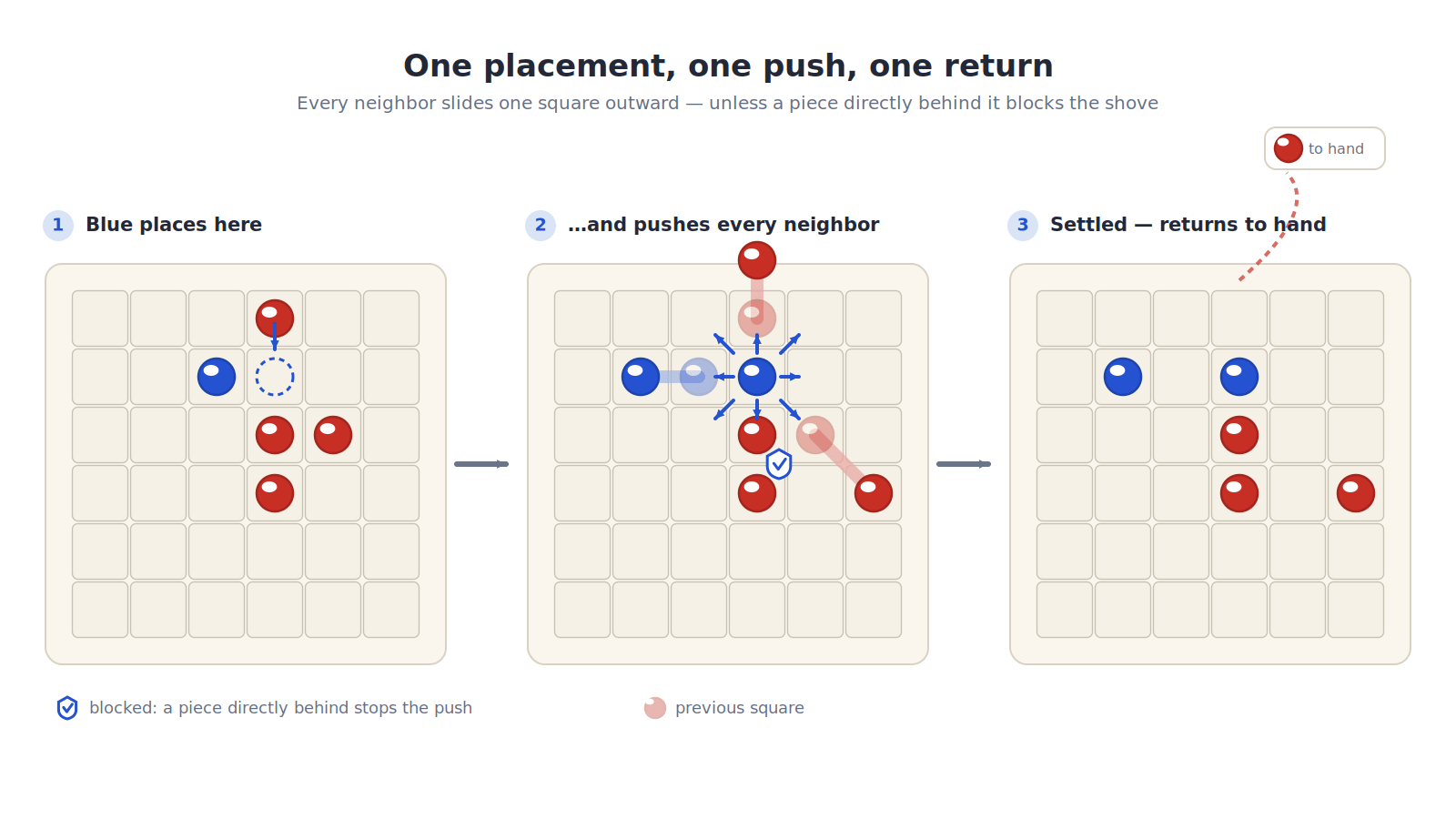
If you haven't played yet, the entire physics of Oustwit fits in three sentences. On your turn you place one of your pieces on any empty square. The moment it lands, it shoves every neighboring piece — up, down, left, right, and all four diagonals — one square outward, directly away from your new piece. A neighbor only stays put if another piece sits immediately behind it, blocking the shove.
That's it. There are no other movement rules in the game, because there is no other movement in the game: pieces never walk, slide, or jump on their own. The push is the only way anything that's already on the board ever changes position — which means the push isn't a feature of the game. It is the game.
Two details complete the picture, and both matter enormously. First, the push plays no favorites: your placement shoves your own adjacent pieces outward exactly as it shoves your opponent's. Second, a piece pushed off the edge of the board isn't captured or destroyed — it goes back to its owner's hand, ready to be placed again. Hold onto both of those; they're where half the strategy lives. (The how to play page walks through the basics with a sample opening if you want the ground floor first.)
The eight-direction blast: placement is geography
Because a placed piece pushes in all eight directions at once, where you place decides how much you push. The board's geography does the math for you.
A piece dropped in the center of the board has up to eight neighbors, so a center placement is the game's biggest explosion — one move that can rearrange nearly a quarter of a full board. An edge placement touches at most five squares. A corner placement touches three. In most games "the center is strong" is a slowly-learned abstraction; in Oustwit it's physics you can count on your fingers.
This gives the opening its shape. Early placements gravitate toward the middle not for mystical reasons but because that's where a placement does the most — the way a stone thrown in the middle of a pond moves the most water. And it gives the edges their character: quieter squares where your piece disturbs less and is disturbed less, at the price of standing nearer the rim. Every square on the 6×6 sits somewhere on this loud-middle-to-quiet-edge gradient, and strong players place with the gradient consciously in mind.
There's a second, sneakier geography lesson: the push moves pieces outward, away from your placement. Place centrally and you tend to scatter things toward the edges — toward the drop. Place from the edge inward and you herd pieces toward the middle, toward safety. The direction of your pressure is a choice, every single turn.
Nothing on this board is ever finished
Here is the deepest consequence of the push, the one that changes how the game feels: no position is permanent. In chess, a pawn on e4 stays on e4 until somebody spends a move on it. In Oustwit, any piece with an empty square beside it can be relocated by the opponent's next placement — without them spending anything extra at all. The shove comes bundled free with the move they were already making.
New players absorb this as a nasty series of surprises: the line that was one move from winning, scattered; the safe-looking piece, suddenly on the rim; the carefully arranged formation, rearranged. Experienced players absorb it as the game's central discipline. You stop asking "is this square good?" and start asking "is this square good after every push my opponent can throw at it?" A plan in Oustwit isn't a picture of where your pieces will stand; it's a claim about what will survive the shaking.
This is also why the game refuses to go static. Games with only quiet placement can drift into parallel solitaire — you build your thing, I build mine. The push makes every placement a potential act of violence against the whole neighborhood, so contact starts on move two and never stops. If you've read our piece on what makes games deep, you'll recognize the property: turns that talk to each other. In Oustwit they never stop talking; mostly they argue.
The return-to-hand twist: material never dies, tempo does
In Abalone — the classic of the shove school — a marble pushed off the rim is gone forever, and the whole game orbits that permanent loss. Oustwit makes the opposite choice: an ousted piece returns to its owner's hand. At first glance that sounds gentler. Play a few games and you'll discover it's not gentle at all; it just moves the wound.
What you lose when your piece is shoved off isn't material — you'll place it again. What you lose is time. You spent a turn putting that piece on the board; your opponent spent nothing extra removing it (their placement was doing double duty); and you'll spend another turn putting it back. In the language every strategy game shares, being ousted costs you tempo — and in a race toward three-in-a-row, tempo is the whole bank account.
The return rule also reshapes the second win condition. You win by having all eight of your pieces on the board at once, so every oust knocks your count backward a step. A player grinding toward the eight-piece win isn't just placing pieces; they're trying to build positions solid enough that the count stays climbed. Meanwhile the rule quietly protects the game from death spirals: because nothing is ever destroyed, no position is ever mathematically hopeless. The player behind on the board is never behind on material — there's always a full hand's worth of comeback sitting in reserve.
One more wrinkle rewards attention: the edge gives back your pieces too. Deliberately letting one of your own pieces ride near the rim isn't always carelessness — sometimes recycling a badly-placed piece back to hand, at the cost of a shove you wanted to make anyway, is a quiet way to redeploy. Rare, advanced, and deeply satisfying.
Pushing as a weapon
Offensive pushing has three classic jobs, and most strong moves do at least two of them at once.
Breaking lines. The obvious one: your opponent has two in a row with the third square looming, and one placement beside the middle piece scatters the whole project. The skill isn't the scatter — it's choosing the scattering placement that also advances your own plan, so the defense costs you nothing. (Much more on this in the companion piece on how three-in-a-row works on a moving board.)
Herding. Less obvious and more powerful: pushing enemy pieces isn't only about the rim. You can shove an opponent's piece onto a square that ruins their shape — into the path of their own developing line, out of reach of the formation it belonged to, or simply toward the edge where its future options shrink. Think sheepdog, not battering ram: a herded piece is often worth more to you alive and badly placed than ousted and back in their flexible hand.
Ousting on schedule. Shoving a piece clean off the board is the flashiest move — a tempo theft plus a setback to their eight-piece count. The discipline is timing. An oust that doesn't serve a plan hands the opponent a free redeployment; the piece returns to their hand and lands somewhere better next turn. The best ousts hit pieces that were well placed — that's when returning to hand is a genuine demotion.
Pushing as a shield
Every push has an off switch, and the off switch is the blocking rule: a neighbor doesn't move if a piece sits directly behind it. Defense in Oustwit is the craft of arranging those "behinds."
The brace. Two of your pieces in a line — one behind the other relative to a likely push — are a wall. The front piece can't be shoved along that axis, no matter what lands beside it. Three in an L cover two axes. Every piece you place is potentially armor for a neighbor, and reading which axes need bracing (which directions can an attacking placement actually come from?) is the defensive read that separates beginners from regulars.
The board's own walls. There's a beautiful inversion at the rim: a piece on the edge can't be pushed further outward from the middle by anything placed toward the center of it... but it stands one square from oblivion against a push from the inside lane. Edge pieces are simultaneously the safest and the most doomed squares on the board, depending entirely on which side the pressure comes from. Learning to tell the difference — this edge piece is anchored, that one is teetering — is half of Oustwit defense.
Structure over sprawl. The sum of the two ideas: clustered pieces defend each other; scattered pieces are individually pushable. But clusters have a cost — pieces braced tight are pieces not spreading toward new lines, and a turtled position can't win a race. The game keeps charging you for safety, which is exactly as it should be.
A worked opening: four placements, four lessons
Theory lands better with the board in motion, so here's a typical opening read through push-colored glasses.
Move 1 — Red plays a central square. The board is empty, so the biggest explosion in the game detonates on nothing: no neighbors, no pushes. That's the point. Red isn't shoving; Red is buying future shove potential — a piece whose next-door squares now all carry a threat, and which sits in the board's line-rich middle. Opening placements are investments in geography.
Move 2 — Blue lands diagonally adjacent to Red. First contact, first push: Red's piece slides one square outward, away from Blue. Notice what Blue bought for one move — position and displacement. Red's investment just got relocated a square toward the rim, and Blue's piece now radiates its own threats. This is the bundled-violence principle: Blue would have placed somewhere anyway; the shove came free.
Move 3 — Red replies beside Blue, pushing back toward the edge. Now both players are learning the opening's real subject: neither is building lines yet — they're negotiating where the building will later happen, by herding each other's early pieces toward or away from the good squares. Watch high-level replays and you'll see this pressure-trading phase in nearly every game: the first three or four placements are a conversation about geography conducted in shoves.
Move 4 — Blue declines the shoving match and places two squares away, quiet. The subtlest lesson last: not pushing is also a move. A placement with no neighbors triggers nothing, disturbs nothing, and quietly claims a line-rich square while Red's pieces sit where the earlier pushes left them — slightly off-center, slightly committed. Aggression spent the tempo; patience banked it.
Four moves, no lines anywhere, and the game is already fully underway. That's the push's first strategic gift: an opening phase with real content, in a genre where openings are often just polite queueing.
Common push mistakes (and their cures)
The decoration shove. Pushing an enemy piece because it's adjacent and you can. If the push doesn't break, herd, or oust with purpose, you've often helped — plenty of shoves relocate an enemy piece somewhere better. Cure: the one-sentence test from the drills below; every push must finish the sentence "which accomplishes…".
The reflex oust. Shoving a piece off the rim purely because the rim was there. You spent your placement at the board's edge — the low-traffic squares — to hand your opponent a flexible piece in hand. Cure: before ousting, ask whether that piece was well placed. Oust their good pieces; leave their bad ones exactly where they are.
Forgetting your own passengers. Your placement shoves your pieces too, and a careless drop can knock your own two-in-a-row out of alignment. Everyone does this exactly once per lifetime, usually with an audience. Cure: the all-eight-directions sweep counts your neighbors as carefully as theirs.
Edge blindness. Treating an edge piece as "safe" when the pressure lane runs along the inside. Edge pieces are anchored from one side and doomed from the other. Cure: for every rim piece, know which side the danger enters from — it's always the inside lane.
The uncounted diagonal. Seven of a placement's eight push directions get checked; the eighth — usually a diagonal — delivers somebody's piece somewhere fatal. Cure: there is no shortcut. Eight means eight.
The push that wins — and the push that loses
Two special cases sit at the top of the push's skill curve, and they're mirror images.
Pushing yourself into victory. Remember: your placement shoves your own neighbors too. So a line of three doesn't have to be built square by square — it can be assembled by shove. Place a piece that pushes one of your own pieces the final square into alignment, and the line is complete the moment the dust settles. These finishes are Oustwit's checkmates-in-one: invisible to players who only look at empty third squares, unmissable to players who've learned that every piece adjacent to yours is a potential passenger. Defenders must learn the same sight in reverse — the threat isn't only "which empty square completes their line" but "which placement slides a piece into it."
Pushing them into victory. The rule that keeps every Oustwit player honest: if your placement shoves opponent pieces into three in a row, they win — the board doesn't care whose move built the line; the first line on the board takes the match. Every aggressive shove near enemy pieces carries this tiny loaded chamber. Before any placement in a crowded region, the mandatory question is: after all eight directions of consequence resolve, does any accidental red (or blue) line exist? It's the game's signature blunder, everyone commits it exactly once in a way they never forget, and checking for it becomes as automatic as looking before crossing a street.
Quick answers about the physics
Does a push travel down a chain of pieces? No — and this single fact is the game's defensive foundation. Only the pieces directly adjacent to your placement move; a piece with another piece immediately behind it doesn't move at all, and nothing behind that stirs either. Pushes are one square deep, period. No dominoes, no shockwaves.
Can I place a piece that pushes nothing? Absolutely — any empty square with no occupied neighbors is a quiet placement, and as the worked opening showed, quiet moves are real moves. Some of the strongest placements in the game touch nothing at all.
Are diagonal pushes weaker or different? Identical in every way: one square, directly away, blocked by a piece behind. The only thing weaker about diagonals is human attention to them.
Can a push shove a piece onto an occupied square? Never — that's what blocking is. If the destination square is occupied, the push simply fails for that neighbor and it stays put. Pieces don't stack, merge, or capture; Oustwit has no capturing at all, only relocation and return-to-hand.
Is the push optional? No — it's the weather, not a choice. Every placement pushes every eligible neighbor, always. You choose where the storm lands; the storm itself is not negotiable. That's precisely why placement is the whole game.
Making the push yours
You can read about a physics engine or you can throw rocks in the pond. Three ways to build push instinct fast:
Play the AI ladder with one question. Against the Easy computer opponent, narrate every placement — out loud if nobody's home — with the same sentence: "this pushes these pieces there." Nothing else. One session of that and the eight-direction blast stops being a surprise and starts being a tool; then Medium and Hard will start punishing the pushes you didn't mean to make, which is the advanced course.
Replay one loss and find the shove that turned it. Every online match is recorded. Losses in Oustwit almost always pivot on one push — an oust you walked into, a brace you didn't build, a line assembled by slide while you watched empty squares. Find it. It's visible; everything in this game is.
Spend one game pushing only with purpose. A self-imposed drill: no placement that pushes an enemy piece unless you can say what the push accomplishes (breaks a line, herds badly, ousts on schedule). It's astonishing how many of your shoves turn out to have been decoration — and how much stronger the game gets when they stop.
One rule. Eight directions. A board that never sits still, pieces that never die, and two win conditions both reachable by shove. That's the whole machine — and if this article is your first look at the school of games it belongs to, the push, pull, slide shelf tours the ancestors, from Abalone's sumo lines to the design theory of why displacement makes players gasp.