Learn › Three in a row › Three in a row on a 6×6
Three in a row on a 6×6: how Oustwit modifies the oldest goal
Three in a row is the first winning condition most humans ever learn — and the first one we outgrow, the day tic-tac-toe goes permanently to a draw. Oustwit takes that worn-out childhood goal, puts it on a board where every placement shoves the neighborhood, and hands it back with its teeth restored. Here's how the oldest goal in games got dangerous again.
The oldest goal meets a board that fights back
Line-forming games are ancient beyond reckoning — morris boards are scratched into Roman stones and cathedral cloisters, and every culture's children discover some version of noughts and crosses. The goal survives because it's perfect in one specific way: a line of three is instantly visible, instantly checkable, and instantly satisfying. No counting, no scoring pad. You see it, you've won.
The problem, as every eight-year-old eventually discovers, is that the goal is too easy to guard on a small static board. Tic-tac-toe dies of protectability: block, block, draw, forever. The classic repairs — bigger boards, longer lines, gravity, movement phases — all work by making lines harder to build or harder to see (we walk the whole family tree on the three-in-a-row shelf).
Oustwit's repair is different in kind, and it's the reason the game exists: keep the line short and the board small, but let every placement move the pieces already on the board. Suddenly a line isn't a drawing on graph paper — it's an arrangement of objects that can be shoved apart, slid together, and reassembled somewhere you weren't looking. Three-in-a-row stops being an exercise in claiming empty squares and becomes an exercise in building something that stays built on a board in constant motion. The goal your childhood solved turns out to have been waiting, the whole time, for a board that fights back.
Why three (not four, not five) is right here
Designers who scaled tic-tac-toe up learned that the line's length has to match the board's resistance. Gomoku needs five in a row because on a big open board with permanent stones, four is too easy to force. Connect Four gets away with four because gravity constrains where pieces can land. The rule of thumb: the harder the board makes construction, the shorter the line can afford to be.
Oustwit's board makes construction very hard — not by size or gravity, but by instability. Every piece of your would-be line is a physical object your opponent can displace with an adjacent placement, without spending anything extra to do it. Two-in-a-row, the position that terrifies in tic-tac-toe, is here just a suggestion — a sketch your opponent can smudge in passing. Under that much resistance, three is not a trivial goal; it's a genuine construction project. Demand four in a row on this board and games would grind; with three, every game lives on a knife's edge where the winning line is always almost-possible and almost-preventable at once.
There's a second reason three works: the board is 6×6, so lines fit everywhere. Horizontals, verticals, and diagonals thread through every region — 80 possible three-in-a-row alignments in all, if you enjoy counting. Threats can sprout in any neighborhood, which keeps the whole board relevant from the first move to the last. Small board, short line, total instability: the three dials are set to keep maximum pressure on both players at all times. It's a compact demonstration of the deep-game signs — real decisions, turns that talk, tension that never resolves early.
Lines you build — and lines you're pushed into
Here's where Oustwit's version of the old goal turns genuinely strange, in the best way. In every classic line game, you and only you put your marks where they stand. In Oustwit, pieces arrive at squares three different ways: you placed them there, your own placement shoved them there, or your opponent's placement shoved them there. All three count. The board doesn't ask how a line was assembled — the rule is simply that the first three-in-a-row on the board wins, at the end of whichever turn created it.
Read that again slowly, because both halves are loaded.
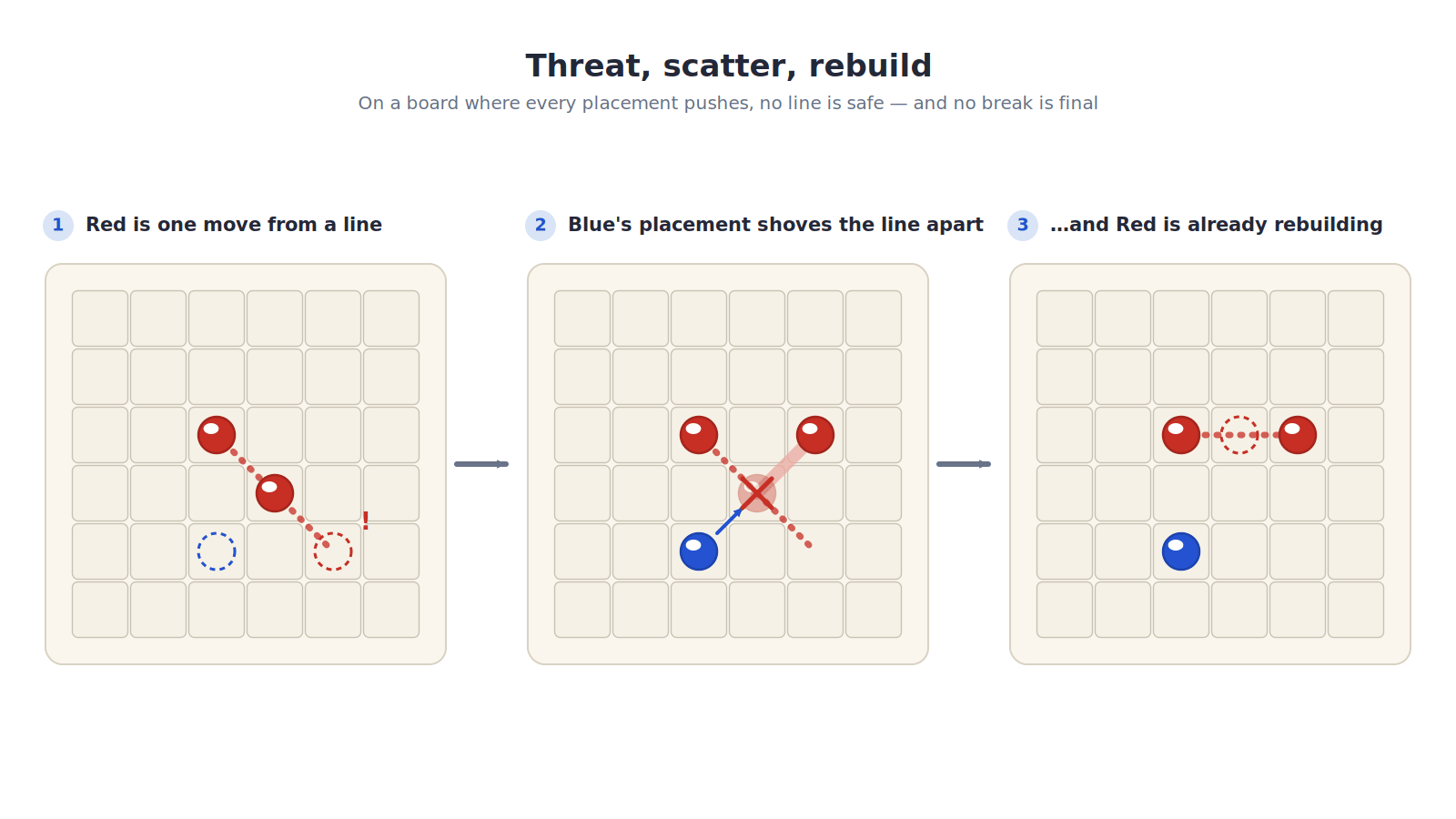
You can complete your own line by shoving. Your placement pushes your adjacent pieces outward too — which means the third piece of a line doesn't have to be placed into position; it can be delivered, slid the final square by a placement beside it. Beginners scan for empty third squares; veterans also scan for pieces one shove away from alignment. These slide-finishes are the game's signature winning move, the equivalent of a checkmate delivered by castling: legal, elegant, and invisible until you've learned to look.
You can complete their line by shoving. The mirror rule is the game's great act of justice: shove your opponent's pieces into three in a row and they win on the spot — your move, their line, their match. Every aggressive placement in a crowded region has to be checked against this possibility first. It transforms the emotional texture of the game: recklessness isn't just suboptimal, it's lethal, and the player who pushes hardest isn't automatically the player applying the most pressure. Sometimes they're one careless shove from handing over the game.
Together the two halves mean that "whose pieces are where" is only half the board state. The other half is momentum — which pieces are one push from which squares. Strong players see both boards at once: the one that exists, and the ghost board of everything one shove away.
The eighty lines, and where they live
Since the board hides nothing, the goal's whole geography can be mapped — and the map is worth carrying in your head. A 6×6 grid contains exactly 80 possible three-in-a-row alignments: 24 horizontal (four windows in each of six rows), 24 vertical, and 32 diagonal. Notice the diagonals: they're the largest group of the three, yet the group human eyes track worst. Nearly half the game's winning lanes run at 45 degrees, and nearly all of everyone's missed threats live there. If you upgrade one habit after reading this article, make it the diagonal sweep before every placement.
The lines aren't spread evenly, either. Count how many alignments pass through each square and the board reveals its terrain: a corner square participates in exactly 3 of the 80 lines. An edge square sits in around 6. The four central squares each sit in 12 — four times the corner's traffic. The middle of the board isn't strong by reputation; it's strong by arithmetic, and doubly so in Oustwit, where central squares are also where placements push the most neighbors. Center squares are simultaneously the best real estate for building lines and the most exposed to the weather — which is the game's opening dilemma in a single sentence.
The practical read: threats through the center are powerful but brittle (everyone's pushes reach them), while threats hugging the rim are modest but durable. Strong players harvest the center's line-richness early, then bank the game along the edges as the board fills. Watch a few replays of high-rated matches with the 3-6-12 numbers in mind, and you'll see the pattern everywhere.
The second goal that changes the first
If three-in-a-row were Oustwit's only win condition, one degenerate strategy would loom: pure demolition. Never build; just lurk beside everything your opponent assembles and scatter it. The game closes that door with its second win condition — get all eight of your pieces onto the board at once and you win — and the two goals together form the tension that powers every match.
Think of the fill win as a tax on pure defense. Every turn you spend shoving my line apart is a turn you placed a piece reactively, somewhere dictated by my threat rather than your plan. Meanwhile the piece counts tick along, and a player who does nothing but firefight can look up and discover the arsonist has quietly landed seven of eight pieces in stable, braced positions. Now every single further placement threatens to end the game two different ways, and no defense covers both.
The interaction runs the other way too. Ousting — shoving a piece off the rim, back to its owner's hand — is the counter to the fill win, knocking the count backward. But ousting requires placements near the rim, and placements near the rim are placements not contesting the middle where lines breed. Every one of the game's tactical verbs — build, block, shove, oust, brace — advances one clock while neglecting the other. That's the deep structure under the five-minute surface: two races, one set of moves, and never enough turns to run both flat out. Players of the classic line games will recognize the fork/double-threat principle scaled up to the level of the whole game: Oustwit is one long double threat, and the player who makes the two goals pull together — lines that brace, braces that fill — is the one the rating ladder smiles on.
Building lines that survive the weather
So how do you actually make three-in-a-row happen on a board that shakes? The craft comes down to building lines the push can't easily touch.
Brace the middle piece. A line dies fastest through its center — one shove on the middle piece breaks it into nothing. A line whose middle piece has a friend directly behind it (relative to the likely attack lane) is a different animal entirely: the standard scatter simply fails against it. When you find yourself with two in a row, your next thought shouldn't be "where's square three?" but "what's guarding square two?"
Use the rim as a backstop. Pieces on the edge can't be pushed further outward — the board itself braces them along one axis. Lines built along the edge trade reach for stability: fewer ways to extend, far fewer ways to be scattered. Edge lines are the game's slow, stubborn win plan, and they pair beautifully with the fill race, since braced edge pieces are also hard to oust.
Prefer the late reveal. Two in a row announces itself; experienced opponents smudge the sketch immediately. The stronger pattern is three pieces in a bent shape — an L or a wide angle — that are one shove or one placement from snapping into line along more than one axis. Bent threats are quiet, double-jointed, and horrible to defend, because straightening them is exactly the kind of slide-finish the defender can't watch for everywhere at once. Diagonals amplify all of this: every player sees ranks and files; diagonal alignments arrive like they were invisible, which on most evenings they effectively were.
Breaking lines like a professional
Defense gets its own craft, and it's more than lurk-and-scatter.
Break early or break profitably — never in between. Scattering a two-in-a-row costs your opponent little (they rebuild elsewhere) and costs you a reactive turn. Either disrupt the shape before it's a shape — a herding push that bends their development while advancing yours — or wait for the moment the break also does something for you: the scatter that simultaneously braces your piece, opens your diagonal, or ousts. The break that only breaks is the defense of last resort.
Count the ways, not the threats. A threatened line can complete by placement into an empty square or by a slide from an adjacent lane. Before panicking, count the actual completion routes and notice which single placement of yours closes the most of them at once — often it's not the square beside the line at all, but the square that shoves one endpoint somewhere harmless. And always run the mandatory pre-flight check: does your defensive shove assemble any line of theirs by accident? The rule from earlier never sleeps.
Attack the rebuilder, not the ruin. After a successful scatter, the displaced pieces are still on the board, still theirs, still one shove from realignment. The strongest follow-up usually pressures the displaced piece again — herding it toward the rim, away from every useful lane — rather than admiring the wreckage. In a game where nothing dies, defense is never an event; it's a policy.
The pre-move checklist: reading the ghost board
All of the above compresses into a discipline you can adopt tonight — four questions, asked in order, before every placement in a contested region. Veterans run them in about two seconds; the habit is the skill.
- Their empty squares: does any placement of theirs, next turn, complete a line the ordinary way? (Scan rows, columns — then the diagonal sweep.)
- Their slide-finishes: is any piece of theirs one push from completing a line — and do they have a legal placement that delivers that push?
- My accidental assemblies: does the placement I'm about to make shove any of their pieces into three? (The losing blunder. Check every neighbor you're about to move, all eight directions.)
- My own deliveries: does my placement shove any of my pieces into three — or set up a delivery for next turn? (The winning move most often missed.)
Two seconds, four questions, and the "ghost board" — everything one shove away — becomes as visible to you as the literal one. It's the Oustwit-specific version of the oldest advice in open games: the information is all there; the discipline is consulting it.
Quick answers
Can I really win with a line my own push assembled? Yes — a line counts whenever it exists at the end of a turn, however its pieces arrived. Slide-finishes are not a loophole; they're the intended crown jewel of the design.
What about four in a row? Any four in a row contains a three in a row, so the game ended one piece ago — the moment three aligned, whoever's line it was won. There's no bonus for overachievement, only the question of why your opponent allowed the third.
Do lines only count on my turn? A line wins for its owner whenever it stands at the end of any turn — which is precisely why pushing opponents into alignment loses on the spot, and why the checklist above has four questions instead of two.
Is the diagonal really that easy to miss? Ask anyone who's played ten games. Rows and columns align with how we read; diagonals don't. The 32 diagonal lanes are where beginners lose and where improving players first feel themselves getting stronger — the day a diagonal threat looks as loud as a horizontal one, your rating is about to move.
Three drills that install the skills
The diagonal-only game. Play one match against the easy AI in which you only allow yourself to threaten along diagonals (defend however you like). It's artificial and slightly absurd — and it force-feeds your eyes the 32 lanes they've been skipping. One game of this recalibrates your threat vision for weeks.
The slide-finish hunt. Against the AI, refuse to win by placing a third piece into an empty square; wins must come by shoving one of your own pieces into alignment. You'll lose some games you'd otherwise win — and you'll never again miss a delivery, yours or theirs, because you'll have spent a whole session seeing nothing else.
The ghost-board replay. Open a replay of any loss and pause before each of your placements. Ask only the four checklist questions, out loud, and find the move where your answers and your actual placement disagree. That move is your current ceiling — and naming it is how ceilings move.
The family portrait: where the 6×6 duel sits
Set Oustwit beside its relatives and each comparison sharpens what's new here. Nine Men's Morris also builds lines with placement-then-consequence — but its mills are demolished by removal, permanent and slow, where Oustwit's demolition is displacement, free and constant. Gomoku's stones are forever; its whole theory is forcing sequences on an immovable record, while Oustwit's theory is stability under motion — Gomoku players arrive with superb threat-vision and spend a week un-learning permanence. Pentago, the other modern that moves the board (twisting quadrants after each placement), shares the moving-goal spirit, but its motion is rotational and systemic where Oustwit's is local, aimed, and personal: you chose to shove that piece. And tic-tac-toe — the broken ancestor — contributes the goal itself, plus the measuring stick: the draw problem that killed it is unreachable here, because no blocking mark is ever permanent on a board where every mark can be moved.
One goal, five thousand years old, restored to working order by a single rule about pushing. If you want to feel the restoration for yourself, the rules take a minute, the AI's easiest setting is a patient teacher, and the companion piece on mastering the push itself covers the mechanic that makes all of this run. Childhood's first strategy game, finally all grown up.