Learn › Three in a row › The double threat
The double threat: the one skill every in-a-row game rewards
One threat gets blocked. Two threats win. That's the entire secret — the master key that opens tic-tac-toe, Connect Four, Gomoku, Oustwit, and honestly most of chess while it's at it. This article is about the fork: how to see it, how to build it, how to survive it, and why learning it changes every game you play.
The arithmetic that runs the world
Here's the whole logic, small enough to carry: your opponent gets one move per turn. One. If you create one threat, their one move blocks it. If you create two threats at the same time, their one move blocks one — and the other lands. Nothing about their skill, effort, or reading ability changes the outcome, because the problem isn't in their head. It's in the rules. One move cannot be in two places.
That's the double threat — the fork, as chess players named it — and it is the fundamental winning mechanism of every in-a-row game ever designed, from playground tic-tac-toe to tournament Renju. It's also, not coincidentally, pure tempo arithmetic: two threats bought with one coin, answered by a defense that can only spend one coin per turn. The fork isn't a trick that sometimes works. It's a bill the defender cannot pay, presented politely, in full view.
New players win their first games by accident. The fork is the moment winning becomes a craft — the first time you make a move whose real purpose is two moves away, and watch the game close around your opponent like a drawstring. Every strategy player remembers their first deliberate fork. It's the hobby's first taste of authorship.
Anatomy of a fork
Look at any double threat closely and you'll find the same three parts.
Two open roads. A fork needs two potential lines — two ways to finish — that are both genuinely available: empty completion squares, no defender already sitting in the lane. Half of fork-craft is just knowing where your open roads are, which is why strong in-a-row players constantly track their live lines the way drivers track mirrors. (On a 6×6 there are exactly 80 such roads, and the center squares sit on twelve of them each — fork country, by arithmetic.)
One crossing point. The fork piece stands where the two roads intersect, serving both at once. That's the move that looks so innocent a beat before it isn't — the piece isn't on either finishing square; it's at the junction behind them. Train your eye to notice crossings: any square where two of your open roads meet is a fork waiting for a tenant.
A defender who's already too late. The subtle part: by the time both threats exist, the game is over, so real fork defense happens a move earlier — and real fork construction is therefore about disguise and preparation, building the two roads quietly before occupying the junction. Which is the next section.
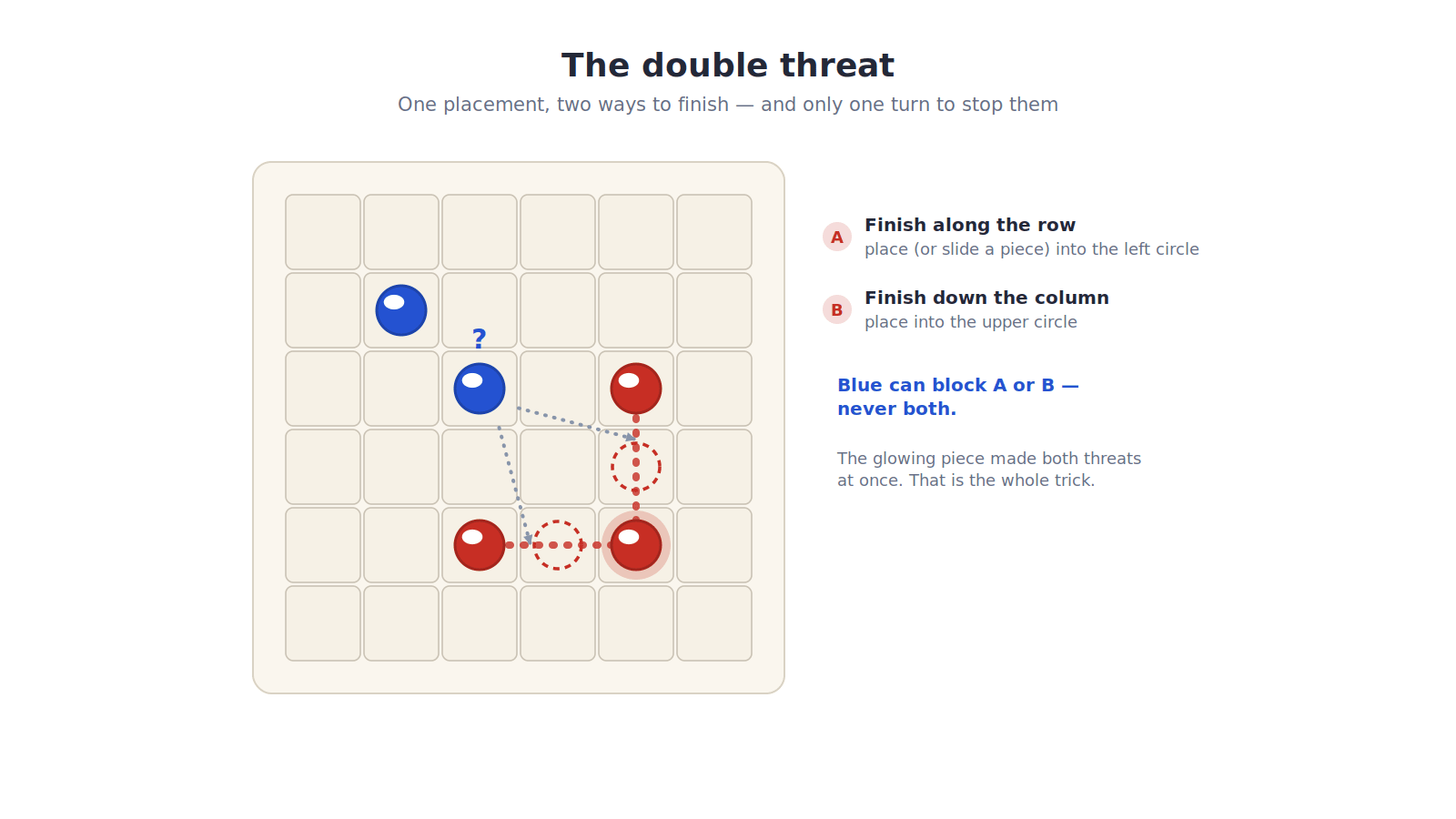
The family album: forks in every branch
Every game in the in-a-row family — and several famous games outside it — is, at competitive level, a fork-construction contest. A quick tour shows the same skeleton wearing different clothes.
Tic-tac-toe is the fork's kindergarten. The corner opening is the classic setup: take a corner, and if your opponent replies anywhere but center, a second corner builds two diagonal-and-edge roads at once — the double threat that wins the game outright. The reason tic-tac-toe dies as a game is that both players learn to see this one fork, and the whole family tree since is designers building boards where the forks don't run out.
Connect Four hides its forks in gravity: threats stack vertically, and the master version — the "odd threat" — is a fork with time as its second prong: you build a threat on a square that must eventually be filled on your turn as the columns fill up. The solved game's first-player win is, at bottom, one long guaranteed fork.
Gomoku and Renju are fork theory taken to professional extremes. An "open three" — three in a row with both ends free — is a double threat by itself (two completion ends, one defender), and serious five-in-a-row play revolves around building one threat that, when blocked, creates the next, until a double-three or double-four lands. Renju's famous forbidden moves exist precisely because unrestricted fork-chaining made the first player unbeatable — a century of balance patches aimed squarely at this article's subject.
Nine Men's Morris weaponizes the fork as an engine: the double mill, two mills sharing pieces so that each move out of one closes the other, grinding a capture every turn. It's the fork made renewable — the single most feared structure in the game.
Chess named the thing. The knight fork — one jump attacking king and queen at once — is most players' first taste, but chess forks come in every uniform: pawns attacking two pieces, the discovered attack (move one piece, unveil another's threat — a fork built from two of your pieces), the double check. Different geometry, same arithmetic: two problems, one reply allowed.
And Oustwit adds the family's newest twist: forked threats that complete by shove. Because a line can be finished by pushing your own piece into alignment, a completion square doesn't need to be empty-and-placeable — it needs to be reachable, by placement or by slide. Oustwit forks therefore come in more flavors than the diagram above shows: two placement finishes; a placement finish plus a slide finish; even two different slide finishes from one future placement. The defender's checklist doubles, exactly as described in the ghost-board article — and so does the builder's toolkit.
Building forks on purpose (quietly)
Announced threats get blocked; the craft is preparation that doesn't look like preparation.
Grow roads, not threats. A two-in-a-row shouts. A loose triangle of pieces — each pair one move from becoming a serious threat — whispers. Strong players spend the early middlegame placing pieces that sit on many potential lines at once without completing any pair, banking future roads while the position still looks quiet. Then one move converts: junction occupied, two roads open, curtain. When spectators say a fork "came out of nowhere," this is the nowhere it came out of.
Prefer bent shapes. The L, the wide V, the knight's-move spacing — arrangements whose pieces cooperate on two axes but don't yet align on either. Bent shapes are the fork's chrysalis, and they carry a bonus: diagonal roads, which human eyes under-monitor, hide beautifully inside them.
Use forcing moves as cover. The classic one-two: make a threat that must be answered (spending their coin — see the tempo article), and use the free tempo to place your junction piece. The defender, busy paying your first bill, watches the second one being written and can do nothing about the pen.
In displacement games, count shoves as roads. An Oustwit-specific habit with cousins elsewhere: when surveying your potential lines, include every alignment reachable by pushing your own pieces. Junctions multiply when sliding counts — and so does surprise, since opponents watching empty squares never see the finish that arrives sideways.
The diagram's backstory: a fork built in four moves
The position pictured above didn't fall from the sky, so let's build it — because the construction is the lesson.
Move one: Red places toward the board's lower right, on a square that sits on plenty of the 80 roads but completes nothing. Blue reads it as development and develops elsewhere. Nothing to see.
Move two: Red places again, two squares from the first piece along the row — a split pair, the bent shape's simplest cousin. Split pairs are quieter than adjacent pairs: no two-in-a-row exists, so nothing shouts, but the road through the gap is now half-paved. Blue, seeing no threat (correctly — there is none yet), builds their own position.
Move three: Red's third placement lands two squares above the first, up the column — a second split pair, sharing the corner piece. Look at what quietly exists now: two half-paved roads crossing at one square, and not a single two-in-a-row anywhere on the board to alarm a defender trained on adjacent pairs. This is the chrysalis at full size. A veteran Blue smells it here — two enemy roads, one junction — and this is the last moment defense is cheap: one placement on either gap square, or a shove that bends a road, ends the whole story.
Move four: Blue, alas, is mid-plan elsewhere. Red occupies the junction — the glowing piece — and both gaps become live finishes at once. The position in the diagram now exists; Blue's question mark is permanent. Total elapsed drama: none until the final move, which is precisely the point. Forks aren't found, like coins on the street. They're farmed.
Surviving forks: defense one move early
Fork defense has a bleak-sounding rule and a hopeful practice. The rule: once both threats exist, no defense exists — don't waste calculation looking for one; count instead whether you have a faster win or a forcing counter. The practice: forks are beaten in the chrysalis stage, and the tells are learnable.
Watch junctions, not just threats. Scan your opponent's pieces for squares where two of their potential roads cross. An enemy piece pattern with a live junction is a loaded gun on the table, whatever the rest of the board says. The block that matters is the junction square — or a piece placed so that one of the two roads dies (in Oustwit, often a shove that bends one road out of existence, which is cheaper than occupying anything).
Count defender duties. Before any quiet move of yours, tally the threats you're currently obligated to: zero means freedom, one means caution, and a potential two means your quiet move just lost the game. This thirty-second bookkeeping habit prevents more losses than any tactic ever will.
Counterattack arithmetic. The one genuine escape from a fork-in-progress: your own forcing sequence, faster than theirs. If every move of your counter forces a reply, the fork never gets its quiet turn to convert. This is why sharp games between strong players look like two people building forks at each other — the real contest is whose preparation converts first, and tempo (that word again) is the tiebreaker.
The grandest fork of all: crossing the win conditions
Oustwit hides one more fork species, and it's the game's endgame crown: the threat that runs across the two win conditions rather than across two lines.
Picture the late game: you have seven of your eight pieces placed, braced, and stable. Your next placement wins by the fill condition — that's one standing threat, and your opponent knows it. Now suppose your position also contains a live line road: one placement (or one slide) from three-in-a-row. Your opponent's single move faces the family arithmetic in its final form: oust one of your braced pieces to set back the count, or kill the line road — one coin, two different kinds of fire. Blocking the line concedes the fill; preventing the fill (if they even can — braced pieces resist ousting) concedes the line.
This is why the two win conditions article calls the whole game one long double threat, and why late-game piece counts deserve as much of your attention as line roads. Every piece you land and keep landed is quietly the first prong of the game's largest fork — assembled not in a move, but across the entire match. Watch for the moment both prongs sharpen at once; games that reach it end with a particular click, like a lock closing.
Drills that install the eye
The junction census. Once per game, mid-game, stop and mark (mentally or literally, against an AI) every square where two of your open roads cross, then every one of theirs. First sessions find two or three; trained eyes find them all in seconds. This single drill builds the fork-spotting reflex faster than anything else known.
Win only by fork. Against an easy AI, forbid yourself every victory except a genuine double threat. You'll decline simple wins, which feels absurd, and you'll finish the session seeing junctions in your sleep — the point exactly. (The Oustwit variant: at least one of the fork's two finishes must be a slide finish. Brutal, and transformative.)
The one-move-earlier replay. Take any game you lost to a fork — everyone owns several — and rewind to the move before both threats existed. Find the tell you missed: the bent shape, the junction, the forcing move that bought their tempo. Losses to forks are the best-documented losses in games; nothing was hidden, which means the lesson is sitting in the replay, timestamped.
Questions people ask
Isn't winning by fork sort of… cheap? The opposite — it's the most earned win available. A fork requires seeing two futures at once, preparing both without alerting anyone, and financing the whole project with clean tempo. Nobody rolls a fork. The feeling of cheapness belongs to the defender's hindsight, and it fades permanently the first time you build one yourself.
Can both players have forks brewing at once? Constantly — that's what a sharp middlegame is. Two junction projects racing, each player deciding every turn between advancing their own fork and delaying the opponent's. The race is settled by tempo: whoever's preparation needs fewer coins, or steals more through forcing moves, converts first. Games between strong players are effectively fork-versus-fork from the midpoint on.
I only ever see their fork one move too late. Fixable? Completely — lateness means your scan runs on threats (two-in-a-rows) instead of roads and junctions, which is one abstraction earlier. The junction census drill above rewires exactly this. Give it five sessions; the tell you keep missing is a bent shape, and bent shapes become impossible to unsee.
What about a triple threat? Gloriously unnecessary — the second threat already wins, so the third is style points. Triples appear naturally in structures rather than moments (the double mill grinding forever, chess batteries stacking attackers), and if you find yourself building one, enjoy it: it means your roads multiplied faster than your opponent's pruning. Just don't delay a working double hunting for a flourish; scoreboard beats aesthetics.
Do forks exist outside duels — solo modes, co-ops? The arithmetic does. Any system that answers one problem per turn — an AI opponent, a spreading fire in a co-op, a puzzle's constraint — folds to simultaneous problems. Players who master duel forks report the same reflex working everywhere: when the system can only say no once, ask twice.
From fork to philosophy
Zoom out far enough and the double threat stops being a tactic and becomes the shape of strategy itself. Asking one question, your opponent answers. Asking two questions with one move — that's the entire art, and every deep game is a different grammar for asking. The engine-builder threatening two scoring routes, the Go stone that aids one group while pressuring another, the Oustwit placement that extends a line while herding an enemy toward the rim, even the negotiation that opens two acceptable outcomes: doubled questions, everywhere, forever.
Which is why this page sits linked from half the articles on this shelf. Learn to build the two-question move and you haven't learned an in-a-row trick — you've learned the load-bearing idea of the whole hobby. The rest of the vocabulary — tempo, initiative, sacrifice, zugzwang — is largely the study of how two-question moves get financed, protected, and survived.
Your opponent gets one move per turn. So do you. The player who regularly makes theirs count twice has, in every way that matters, been given a bigger allowance — and now you know exactly where the extra coins come from.