Learn › The classics › Chess
Chess: why the royal game still rules
Roughly fifteen centuries old, played on every continent, and more popular today than at any point in its history. Chess is the strategy game your brain pictures when someone says "strategy game" — and its long reign is no accident. Here's what chess got right, what it honestly gets wrong, and the friendliest ways in if the royal game has always intimidated you.
The game everyone recognizes
No game on Earth carries chess's cultural weight. A knight silhouette means "clever" on a thousand logos. "Checkmate," "stalemate," "opening gambit," "pawn in their game," "endgame" — the vocabulary escaped the board centuries ago and colonized ordinary speech. Politicians play chess while their rivals play checkers, at least according to their supporters; every heist movie mastermind keeps a board nearby; and when Hollywood needs to establish in four seconds that a character is brilliant, it hands them a rook.
That recognition is a strange kind of achievement for what is, mechanically, an abstract strategy game like the others on this shelf — no dice, nothing hidden, a theme thin enough that the "king" is just the piece you must protect. Somehow this particular arrangement of sixty-four squares and six piece types became civilization's shorthand for thinking itself. The interesting question is why this game — and the answer turns out to be a fifteen-hundred-year story about design, luck, and infrastructure.
A game edited by fifteen centuries
Nobody designed chess. Everybody did. The earliest recognizable ancestor, chaturanga, appears in India around the sixth century — four military divisions (infantry, cavalry, elephants, chariots) that would slowly become pawns, knights, bishops, and rooks. The game traveled to Persia (where "shah!" — king! — became our "check"), flourished across the Islamic world as shatranj, and entered Europe through Spain and Italy, changing a little in every court and coffeehouse that hosted it.
Then, in the late fifteenth century, Europe made the single greatest patch in gaming history. The old counselor piece — which crept one diagonal square at a time — was replaced by the modern queen, the most powerful piece on the board. The bishop got its long diagonals in the same era. Contemporaries literally called the result "mad queen chess," and it must have felt like a different sport: games that once developed at a stately crawl now exploded into contact within moves. The patch stuck because it fixed a real problem — the old game's slow openings — and the sped-up version swept the old one from the world's tables within a few generations.
It's worth pausing on what that story means. Chess wasn't handed down perfect; it was edited by centuries of players, the way a river edits its banks — castling invented to speed the king to safety, en passant patched in to stop pawns cheating the new two-square first move, stalemate's value argued about for hundreds of years. The chess we play is simply the version that survived every playtest since the fall of Rome. Very few human artifacts have passed a quality check that long.
What chess actually tests
Sit two people at a chessboard and what, exactly, is being measured? The popular answer is "intelligence," which is why the game intimidates. The truer answer is more specific and more learnable.
Pattern recognition, above all. The classic studies on chess expertise found something wonderful: masters shown a position from a real game for a few seconds can reconstruct it almost perfectly, while beginners manage a handful of pieces — but show both groups random scatterings of pieces and the masters' advantage nearly vanishes. Mastery isn't a bigger brain; it's a vast learned library of meaningful shapes — pins, forks, pawn chains, mating nets — built through exposure, the same way you recognize faces and words without effort. Strong players don't calculate everything; they recognize almost everything and calculate only the frontier.
Calculation, second. The "if this, then that" tree — visualizing positions that don't exist yet. It matters, especially in sharp tactical positions, but far less than outsiders assume, and it improves with practice like any skill.
Nerve, always. Chess is played by humans against humans, with all the tilt, fear, overconfidence, and time-pressure panic that implies. Two players of equal knowledge are separated by composure — which is why the game has always been described in the language of sport as much as science. If you've read our piece on luck and skill, chess is the textbook far end of the spectrum: no dice anywhere, so every one of these faculties is measured cleanly, every single game.
Meet the cast
Part of chess's genius is that its six piece types feel like six personalities. Players talk about them the way you'd talk about coworkers.
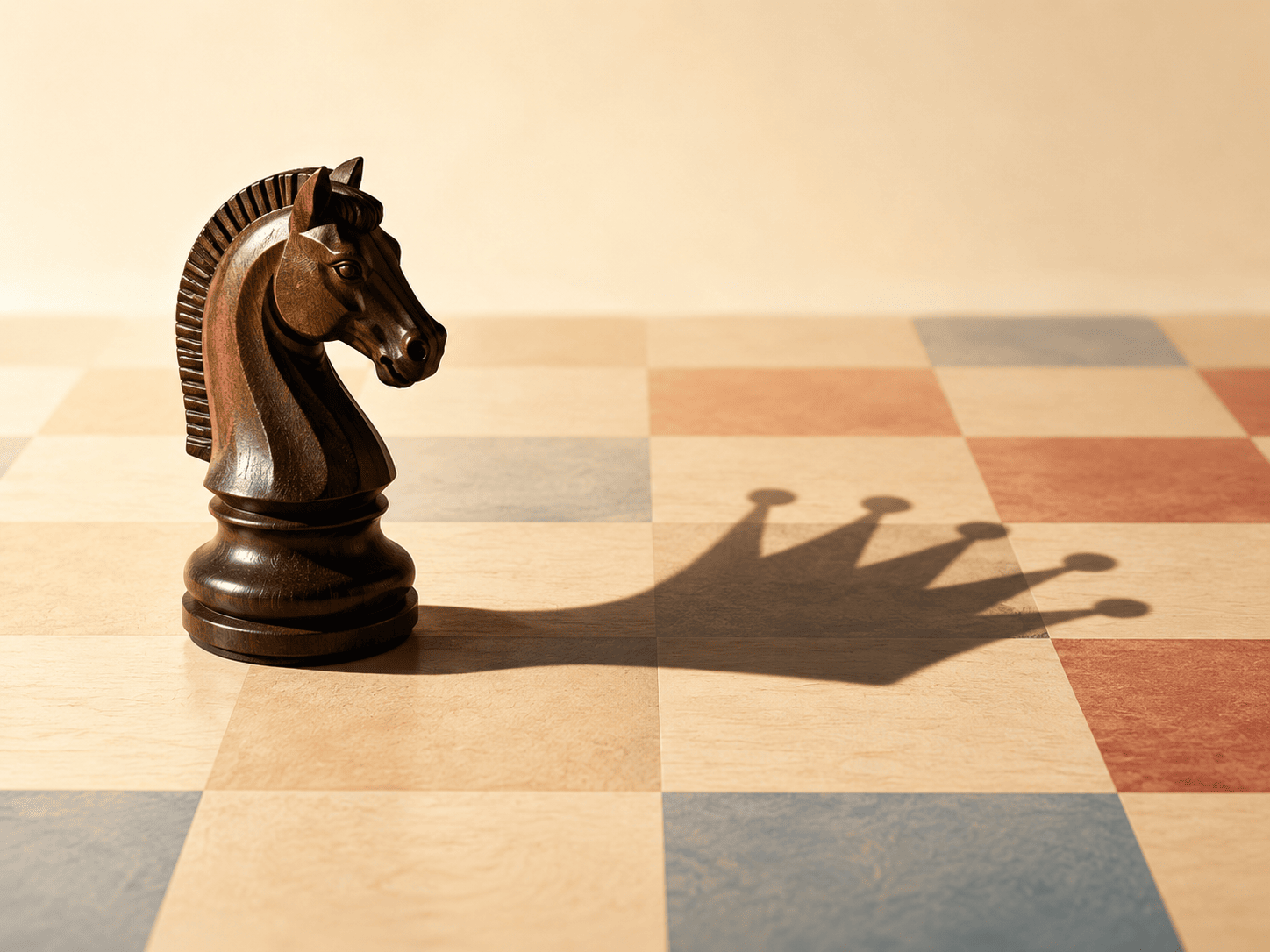
The rook is honest power: straight lines, long reach, no tricks. Rooks love open files the way trucks love highways. The bishop slides diagonally forever — but each bishop is locked to one color of squares for the whole game, a beautiful built-in limitation. One bishop sees half the world perfectly and the other half not at all. The knight is the trickster: the only piece that jumps, the only one whose attack can't be blocked, the author of most beginner disasters. Every player remembers their first family fork — a knight attacking king, queen, and rook at once while all three watch helplessly. The queen does everything rooks and bishops do, which makes her both the strongest piece and the easiest to over-use; dragging the queen out early is the classic new-player sin, and punishing it is the classic new-player rite of passage. The king spends the game as a liability and the endgame as a warrior — once the board empties, the slow old man marches out and fights. And the pawns, famously called the soul of chess, are the terrain itself: they move one way, capture another, and any one of them that survives the crossing becomes a queen. Entire strategies orbit that humble promotion clause.
Six personalities, one board, and no dice anywhere — the drama writes itself, which is much of why it has kept writing itself for fifteen hundred years.
Why chess outlived every rival
Plenty of good games existed alongside chess and vanished. Chess's secret weapon wasn't just the game — it was everything humans built around the game, an infrastructure no rival matched.
Notation made it a literature. Chess moves can be written in a few characters, which means games can be recorded, printed, mailed, and studied at a distance of centuries. From early printed manuals to newspaper columns to databases of millions of games, chess accumulated a written tradition that turned every brilliant game into a permanent public lesson. A game you can read is a game that teaches at scale.
Clubs, cafés, and federations made it a society. The legendary coffeehouses where masters held court, the club ladders, the national federations, the world championship's drama — chess built social structures that gave players somewhere to belong and something to climb. The Elo rating system, invented for chess, gave every player on Earth a number and a next rung; ratings only work in skill games, and chess wore its number proudly enough that the whole world of competitive gaming borrowed the idea.
Celebrity made it a story. Morphy's tour of Europe, the Cold War title matches watched like space launches, prodigies and rivalries and scandals — chess kept generating human drama that pulled in people who'd never pushed a pawn. The pattern continues: the streaming era and a certain pandemic-year television drama sent millions to the board, and by every measure — club memberships, online accounts, tournament attendance — the ancient game is currently at its all-time peak. A 1,500-year-old pastime having its best decade ever is the strongest evidence there is for the immortality checklist: simple rules, bottomless depth, cheap equipment, human rivalry, and institutions that compound.
The three acts of every game
Every chess game tells the same three-act story, and knowing the acts makes both playing and watching clearer.
The opening is the mobilization: both sides bring pieces off the back rank, fight for the center, and tuck their kings into safety. This is the phase with all the famous names — Sicilian, Ruy Lopez, Queen's Gambit — but underneath every named line sit the same three jobs: develop, control, castle. Do the jobs and any sensible sequence works fine at almost every level.
The middlegame is the story's conflict — plans collide, tactics spark, and most games are decided here by whoever spots the fork, wins the exchange, or seizes the open file. It's the least teachable phase and the most fun: pure pattern recognition and nerve, everything the studies say chess actually measures.
The endgame — few pieces, empty board, kings marching — looks like leftovers and is secretly the game's friendliest classroom. Endgame principles are few, concrete, and permanent: activate your king, push the passed pawn, cut the enemy king off. Here's the open secret of chess improvement: club players who study endgames gain strength faster than players who memorize openings, because endgame knowledge decides close games and quietly teaches what every piece is truly worth. If the opening library intimidates you, skip it and study the empty board instead — you'll ambush people for years.
The machines came — and chess grew
If any event should have killed chess, it was 1997: Deep Blue defeating the reigning world champion, the game's summit conquered by silicon. Today the engine on an ordinary phone plays far beyond any human who has ever lived, and chess is... more popular than ever. The lesson is one every strategy game learned from chess's example.
The point of chess was never to be the strongest calculator in the universe — it was the contest between the two particular minds at the table. Cars outrun sprinters, and the hundred-meter final remains appointment viewing. What the engines actually did was quietly wonderful: they became the greatest teachers in the game's history. Every player now has a world-class coach in their pocket — an analyst that reviews your game instantly, shows you the move you missed, and never sighs. The centuries-old ritual of the post-game review, once a privilege of players with strong friends, is now free for everyone. Machine mastery didn't shrink the game; it shortened the road to being good at it.
The honest downsides
A shelf that only flattered chess wouldn't be worth your trust, and chess has real ones.
The opening library. At high levels, the first dozen-plus moves of a game are often theory — sequences studied and memorized in advance. Below master level this matters vastly less than beginners fear (principles carry you a long way), but the memorization culture is real, it grows every year, and some players find it turns the game's early phase into an exam.
The draw problem. Between well-matched strong players, chess's most likely result is a draw — perfect defense is just slightly too available. Elite matches manage this with faster tiebreak games, but it's a genuine design blemish, and one many modern abstracts were explicitly designed to fix (dual win conditions, shrinking boards, forced contact — the whole anti-draw toolkit exists because of chess's example).
The intimidation tax. Chess's prestige cuts both ways: the same reputation that flatters players scares off newcomers, who assume they're signing up to be measured. And the first-move edge is real if small — White scores measurably better, which is why serious play alternates colors. None of these flaws is fatal; all of them are worth knowing before you decide how deep to go.
Ideas you can steal for every other game
Even if you never make chess your main game, its concepts are the hobby's common curriculum — chess named ideas that show up on every board, including a 6×6 push duel.
Control the center — central squares touch more of the board, so influence radiates from the middle. (In Oustwit this is literal arithmetic: central squares sit in four times as many winning lines as corners, and central placements push the most neighbors.) Develop before you attack — bring your forces into play before starting fights; premature attacks with one piece fail everywhere, in every game. Mind your tempo — a move that does two jobs beats a move that does one; a forced retreat is a move donated to the opponent. Weak squares — some squares can no longer be defended, and strong players park their pieces there. The exchange — knowing what's worth trading for what, the skill that the whole vocabulary shelf orbits. Learn these five from chess or learn them anywhere else; they're the transferable core of abstract strategy, and chess is where most of them got their names.
Questions people ask
Is chess solved? No. Checkers is solved — perfect play draws. Chess is far too large; no computer has proven its perfect result, and none will soon. Engines play beyond humans without playing perfectly. The strong suspicion is that perfect chess is a draw, but it remains a suspicion. The game keeps its final secret.
Do I have to memorize openings? Below serious tournament level: no. Principles — develop your pieces, control the center, keep your king safe, don't move the same piece twice for no reason — will carry you through thousands of enjoyable games. Memorized lines matter when your opponents have memorized lines. Casual chess is a thinking game, not a recital.
Is it too late to learn as an adult? It's a perfect adult hobby. You won't become world champion — the prodigies start at six — but "solidly good at chess" is reachable at any age, and the climb itself is the fun. Adult improvement is one of the friendliest corners of the chess internet: study plans, progress diaries, and the shared joy of finally beating the friend who taught you.
What's a good first goal? Not a rating. Try this instead: reach the day you lose a game and know why without being told. That's the moment chess switches from confusing to fascinating — usually a few dozen games in, faster if you review your losses (the habit every open game rewards).
Phone, computer, or wooden board? All of it counts, all of it is real chess. Phones for puzzles and quick games, a board for friends and atmosphere. The game is the same game — it has survived every change of furniture for fifteen centuries and will survive yours.
If chess intimidates you: the friendly doors
Maybe you tried chess once, got flattened by a cousin, and filed it under "not for me." The game's own culture offers gentler entrances now.
Puzzles before games. Daily tactics puzzles — find the winning move in a set position — teach pattern recognition with zero fear of losing, and they're genuinely fun, like crosswords with drama. A few weeks of puzzles quietly builds the shape library that makes real games feel readable.
Fast games lower the stakes. A five-minute blitz game hurts for ninety seconds, not an evening. Playing many short games against opponents your own strength (online pairing handles this) is both the fastest and the least painful way up the curve.
Variants dodge the library. Chess960 — where the back-rank pieces start in a shuffled arrangement — deletes opening memorization entirely and returns the early game to pure thought. Purists argue; newcomers thrive.
And smaller games teach the same muscles. If the full royal apparatus still feels heavy, the same skills — center control, tempo, double threats, composure — are trained by every deep game on this shelf, from checkers to Othello to modern five-minute duels. Chess is the most famous door into abstract strategy; it was never the only one, and any game passing the deep-game tests will grow the same mind. Start where the fear is smallest and the rematch button is closest; the royal game will still be there — it has, after all, waited fifteen centuries — whenever you feel like paying your respects.