Learn › Three in a row › Connect Four, solved
Connect Four is solved: what perfect play looks like
The verdict is in, and has been since 1988: with perfect play, the first player wins Connect Four — but only by starting in the center column. Here's what "solved" really means, the double detective story of how it happened, what perfect play actually looks like, and why the game on your shelf is still worth playing anyway.
The verdict, stated plainly
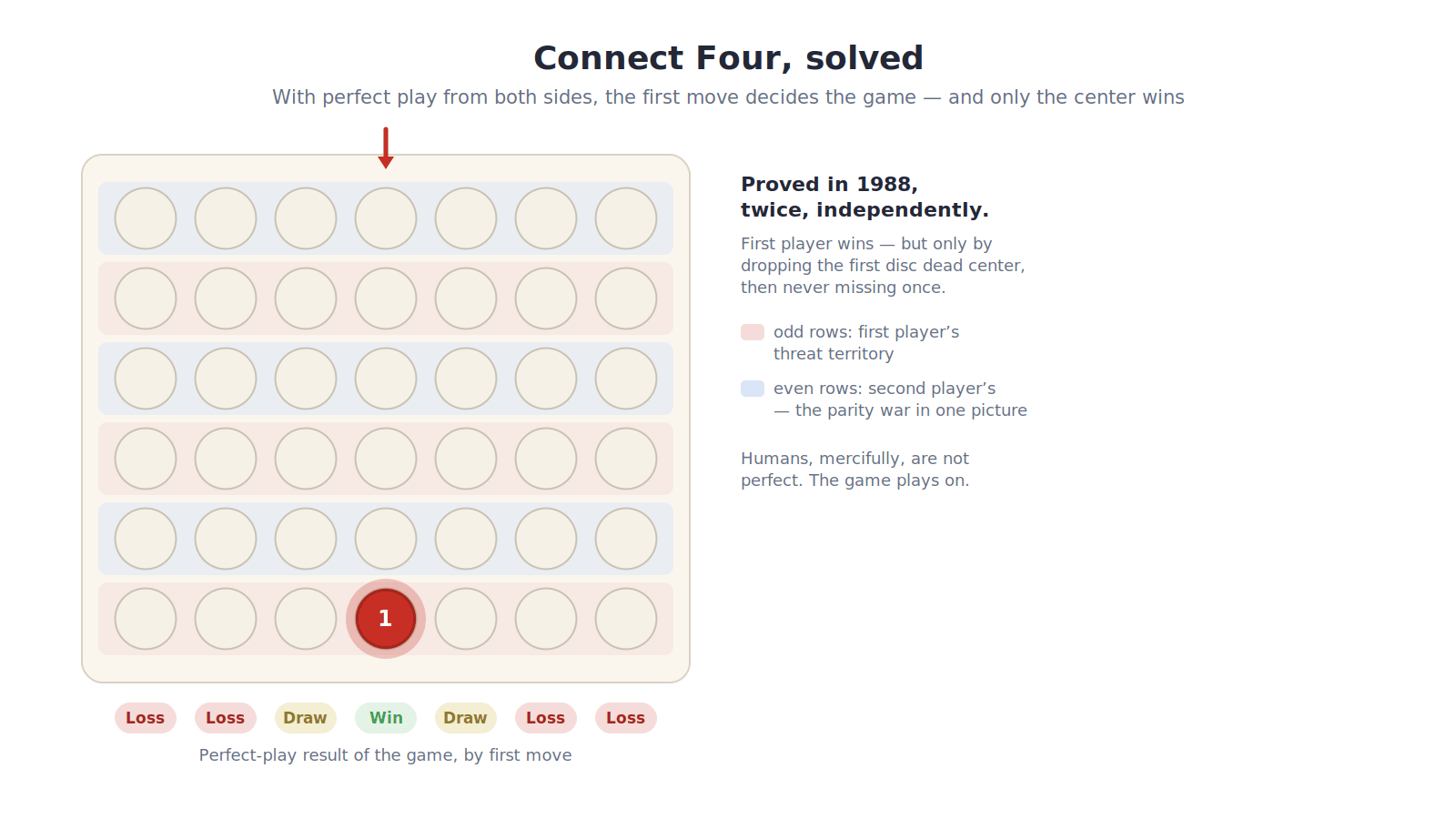
Connect Four — the standard seven-columns-by-six-rows frame — is a first-player win. Not "usually," not "with good play": always, provided the first player drops the opening disc in the center column and never errs afterward. Start that first disc one column to either side of center and perfect play from both sides produces a draw. Start it anywhere in the outer four columns and the first player, astonishingly, loses — perfect play by the second player wins the game.
Sit with that last part, because it's the verdict's real jaw-dropper. The advantage of moving first in Connect Four is so delicately balanced against the geometry of the board that five of the seven possible opening moves throw the win away, and four of them actively hand it to the opponent. One column of glory, two of safety, four of quiet self-destruction — all invisible to the eye, all sitting there in the yellow plastic since the game hit shelves in the 1970s, waiting for mathematics to notice.
What "solved" means (and the three sizes it comes in)
"Solved" is a precise term researchers use in three strengths, and Connect Four makes a perfect specimen for learning them.
Ultra-weakly solved: we know the perfect-play result — who wins — but not necessarily how. (Some games are proven first-player wins by clever logic, like the "strategy-stealing" argument, without anyone knowing the winning moves.) Weakly solved: we know the result and hold a complete recipe achieving it from the opening position. Connect Four reached this level in 1988. Strongly solved: we know the best move from every legal position, including the messy middles of imperfect human games — the level tic-tac-toe sits at, and Connect Four itself reached with later exhaustive computation.
The ladder matters because each rung answers a different question. Weak solving answers "what should the box say?" — this game, played perfectly, ends thus. Strong solving answers "what should I have played from here?" — the coach's question, and the reason you can today consult perfect-play databases from any Connect Four position and receive the truth like a weather report. For the wider shelf of solved games and how they stay fun, keep reading; the philosophical turn comes at the end.
Two detectives, one month apart
The solving of Connect Four is a double story, and game researchers tell it with affection. In 1988, two people cracked the game independently, within weeks of each other, using nearly opposite methods.
James Dow Allen announced first: a solution grounded in brute computational search — the machine grinding through the game tree's possibilities with clever pruning, confirming the first-player win by exhaustion. Almost simultaneously, a Dutch student named Victor Allis completed a master's thesis solving the same game by the opposite route: knowledge. Allis's program, VICTOR, encoded nine strategic rules — human-comprehensible principles about threats, parity, and column control — and proved that following them guarantees the result, no exhaustive search required. Two roads up the same mountain: one paved with computation, one with understanding.
The double solve became a small legend in the field because it staged a genuine philosophical contest. Allen's method says: games fall to power. Allis's method says: games fall to insight — the win was provable with rules a person can learn. Both were right, and their heirs have divided the world between them: brute-force descendants solved checkers two decades later, while knowledge-style analysis still powers how humans actually study games. When Allis moved on, incidentally, his next target was Gomoku — which he also helped prove a first-player win, becoming a recurring character in this family's story.
What perfect play actually looks like
Here's the beautiful part: the winning strategy isn't an alien printout. Its skeleton is learnable, and learning it upgrades your human game immediately.
The center is everything. The middle column passes through more four-in-a-row lines than any other — it's the board's high-traffic square, Connect Four's version of the universal center principle. Perfect play begins there because every future threat wants a piece of that column.
Threats are savings accounts, not attacks. Expert Connect Four is barely about making four now. It's about creating a threat — three discs with a gap — on a square you don't fill, and then keeping it in the bank while the board fills up. Endgames come down to whose banked threat sits on a square that must eventually be filled on the right turn.
And the right turn is a matter of parity. Count rows from the bottom, one to six. Because the first player makes the odd-numbered moves of the game, the deep logic works out to a famous rule of thumb: the first player wants a banked threat on an odd row; the second player wants one on an even row. As columns fill in the endgame, whoever's threat-square arrives on their own turn cashes it; the other player is forced to fill the square beneath the enemy threat and hand over the game. This odd/even territory war — invisible to casual players, decisive among experts — is the purest playable example of parity in all of gaming, and it's why the diagram above paints the rows in two colors. Once you see the stripes, you never watch a Connect Four endgame the same way.
Zugzwang, in yellow plastic. Put the last two ideas together and you get the expert endgame in one sentence: both players tiptoe through the filling columns trying not to be the one forced to unlock the opponent's banked threat. Being compelled to make a losing move because passing is illegal has a grand old chess name — zugzwang — and Connect Four delivers it to eight-year-olds in primary colors.
A banked threat cashes: one endgame, in words
The parity war sounds abstract until you watch a single banked threat mature, so here's the classic ending, slowed to narration.
Mid-game, Red (who moved first) engineers three discs with a gap — a threat — where the empty square sits on row three: an odd row. Crucially, Red doesn't try to fill it; the column beneath the gap is still open, and dropping in now would just let Yellow block above. Instead Red banks it — leaves the threat hanging in the air like a note that will come due — and gets on with the game.
The board fills. Both players tiptoe: nobody wants to drop a disc into the column below an enemy threat, because raising the pile hands the opponent their winning square. But the board is finite, and this is the trap's engine — eventually the safe columns run out, and somebody must play where they'd rather not. Now count the parity. Discs alternate Red, Yellow, Red, Yellow; in a column where Red's threat waits on row three, the square directly below it — row two — will, by the remorseless arithmetic of alternation, be filled on a Yellow turn... which places Red's winning square on a Red turn. Yellow is forced to build the staircase to Red's victory, step by mandatory step, seeing it coming the entire time. The last moves of a decided Connect Four endgame have a distinctive doomed rhythm — the loser filling squares like a person signing their own paperwork — and that rhythm is what "first player wants odd threats" actually means in play.
The mirror rule follows instantly: Yellow's banked threats want even rows, where the alternation delivers the square on Yellow's turn. Two players, two row-parities, one filling board — every expert game is a race to bank the threat whose row-color matches your own name.
Four and a half trillion, felt
The number behind the 1988 proofs deserves a moment of scale. Connect Four's position count sits around 4.5 trillion — count one position per second and you'd need well over a hundred thousand years; a human who somehow reviewed one position per heartbeat for an entire long life would cover perhaps three billion, a rounding error of the whole. That's the mountain 1980s hardware couldn't brute-force naively — which is what makes the two ascents instructive.
Allen's route compressed the search with pruning and endgame knowledge — teach the machine what can't matter, and the trillions collapse toward the merely enormous. Allis's route barely searched at all: his thesis distilled the game into nine named strategic rules — with bureaucratic-sounding titles like Claimeven and Baseinverse — each a provable claim about who controls which squares under which conditions, assembling into a complete second-player defense against everything except the center opening, and a first-player win with it. Nine rules, where the tree held trillions of branches. It remains one of the cleanest demonstrations in the field that understanding compresses: the game's truth was never four trillion facts — it was a handful of principles wearing four trillion costumes. (The same bet — insight over enumeration — is why humans can play deep games at all.)
House rules that wake the game back up
Between well-matched adults who both know the skeleton strategy, standard Connect Four can start feeling like the solved object it is. The community's fixes are worth knowing — they're the tic-tac-toe workshop operating one floor up.
The pie rule neutralizes the center opening's crown: one player makes the first move, the other chooses who plays Red from there. Suddenly opening in the center is a trap for its own maker — bid too strong and you've bid it for your opponent. (Five-in-a-row's community built a whole legal system on this idea.)
Pop-out variants let a turn remove one of your own discs from the bottom of a column instead of dropping — gravity's version of the movement fix. Banked threats stop being permanent; the parity ledger gets an eraser; the solved skeleton dissolves.
Bigger frames (wider or taller boards, five-in-a-row goals) push the game back past the solved frontier — the scale dial again. And misère (make four, lose) turns the familiar engine into a nervous avoidance dance that resets everyone to beginner. Each fix trades away some of the classic's purity; all of them return the one thing solving took: nobody at the table knowing the truth.
Does solving kill a game?
The reflexive fear — why play a game whose ending is known? — dissolves on contact with three facts.
Fact one: you are not perfect, and neither is your opponent. The winning strategy is long, deep, and unforgiving; humans holding the full recipe in their heads are vanishingly rare, and one slip anywhere re-opens the entire game. Between mortals, Connect Four plays exactly as it always did — sharp, trappy, and decided by whoever banks the better double threat.
Fact two: solved is a property of the summit, not the slopes. Chess-with-perfect-play is (probably) a draw and nobody cares, because nobody plays chess against God. The same is true here at smaller scale. What solving actually changed is pedagogy: Connect Four now has an answer key, which makes it one of the best games on Earth for studying your own mistakes — every position checkable against truth.
Fact three: the solved shelf keeps growing, and the games keep breathing. Nine Men's Morris: solved, a draw — still played. Checkers: weakly solved after a heroic multi-decade computation, a draw — still played passionately, still deeper than its reputation. Small Go boards, various mancala variants, 3D tic-tac-toe: solved, solved, solved; played, played, played. Meanwhile chess, Go, and — cheerfully — young displacement games like Oustwit sit far beyond solving's reach, their game trees swollen by mechanics that multiply possibilities. The pattern across the whole shelf: mathematics finishes a game's theory and leaves its practice almost untouched. Humans, mercifully, are not perfect. The game plays on.
Bringing it to the table: three exercises
The center discipline. For one session, always open center and always fight for the middle column — count how often your casual opponents concede it without a thought. You're practicing the high-traffic principle in its purest habitat, and the win rate shift will startle you.
The banker's game. Play one game where your explicit goal is not to connect four but to create and preserve one threat on a row of your parity — odd if you went first, even if second. Don't cash early; let the board fill. Feeling the endgame walk toward your banked square on rails is the lesson no paragraph can deliver.
The autopsy. After any loss, rebuild the final position and find the enemy threat that decided it — then walk backward to the move where its square's parity was set. Connect Four losses are unusually diagnosable: the cause is almost always visible ten moves before the effect, sitting in plain sight on a tinted row. It's open-game review with training wheels, and the habit transfers to every board you'll ever study.
Questions people ask
Can I learn the full winning strategy? The skeleton, absolutely — center first, bank threats, count parity — and it will make you monstrous at family gatherings. The complete perfect recipe is practically a database, not a memorizable plan; even strong players consult solvers rather than carry it. Knowing the skeleton plus punishing mistakes is the human version of perfection.
If I play second, is it hopeless? Only against the solved strategy, which you will never face at a kitchen table. Practically: steer for even-row threats, deny the center early, and remember that four of your opponent's seven opening moves are theoretical losses — most people start in the wrong column and hand you the game's blessing without knowing it.
Why did Connect Four fall in 1988 while chess still stands? Size. Connect Four holds about four and a half trillion positions — huge, but 1980s-tractable with cleverness. Chess's tree dwarfs it beyond metaphor, and Go's dwarfs chess. Solvability is a census question first: counting the games inside a game tells you which mountains mathematics can currently climb.
Is the app version the same game? Rules, yes — and often better in one respect: good digital versions offer analysis against the solution, turning the solved game into a personal trainer. The plastic frame teaches the family; the solver teaches you.