Learn › Three in a row › Why tic-tac-toe draws
Why Tic-Tac-Toe always ends in a draw (and how designers fix it)
Somewhere around age eight, every human solves their first game — and it stops being a game. Tic-tac-toe's guaranteed draw is the most famous flaw in all of gaming, and also the most productive one: fixing it built an entire family of better games. Here's exactly why the old grid is broken, and a tour of the workshop where it keeps getting repaired.
The day the game dies
It happens to everyone the same way. You're a child, you lose to a sibling, you get annoyed, you start paying attention — and one afternoon you notice that if you take the center, and then answer each of their moves just so, nothing bad can ever happen to you. A few games later you notice the other half: nothing good can happen either, if they're doing the same thing. Draw. Draw. Draw. The game doesn't get harder as you improve; it evaporates.
Congratulations: you solved a game before you could ride a bike. "Solved" is a real term — it means the perfect result is known and reachable — and tic-tac-toe is the one solved game everybody solves personally, with no computer required. That experience is quietly formative. It's most people's first proof that a game can be finished as an idea, that beneath the fun there's machinery, and that machinery can run out. The interesting question — the one this article exists for — is why this particular machine runs out so fast, because the answer is a free course in what makes deeper games deep.
The autopsy: three fatal conditions
Tic-tac-toe's draw isn't bad luck. It's overdetermined — three separate conditions, each nearly fatal alone, all present at once.
Condition one: too few roads. A 3×3 grid contains exactly eight winning lines — three rows, three columns, two diagonals. Eight roads is a hamlet. Compare the 80 lines of a 6×6 or the thousands of five-in-a-row lanes on a Go board: real games give attackers a road network too big to patrol. Eight roads can be patrolled by anyone who's paying attention, and the center square — sitting on four of the eight — patrols half the map by itself.
Condition two: defense is permanent. Marks never move. When your opponent blocks a line, that line is dead forever — the block can't be pushed aside, lured away, or made to retreat. Every defensive mark is a wall that stands until the game ends. Now do the arithmetic of a game where attack must constantly find new roads but defense accumulates: with only eight roads total, defense wins the accounting long before the nine squares run out.
Condition three: the board fills before the plan does. Nine squares, five marks for the first player, four for the second. The game is so short that long construction projects — the quiet preparation that makes forks deadly in bigger games — simply don't fit. There's room for exactly one trick (the corner fork every child eventually finds), and once both players know it, the box is empty.
Notice that all three conditions are versions of one imbalance: defense is too cheap relative to attack. Hold that sentence. Every fix in the workshop below is an attack on it from a different angle.
"Solved," precisely
Because tic-tac-toe is where most people meet the concept, it's worth thirty seconds of precision. Game researchers use "solved" in three strengths. Ultra-weakly solved: we know the perfect result (win/draw/loss) without knowing the strategy. Weakly solved: we know the result and a strategy that achieves it from the start. Strongly solved: we know the best move from every legal position, even weird ones mid-game. Tic-tac-toe is strongly solved — by children informally, and by computers exhaustively, since the game tree is tiny: 255,168 possible games, a number a laptop enumerates before your finger leaves the key.
The concept scales up in wonderful and unsettling ways — checkers took decades of computation to solve weakly (draw), Connect Four fell in 1988 (first-player win, and the story is worth its own article), while chess and Go remain unsolved and probably permanently so. The philosophical question solving raises — does knowing the perfect result kill a game? — gets a fuller treatment there. For tic-tac-toe the answer was simply: yes, at age eight, forever.
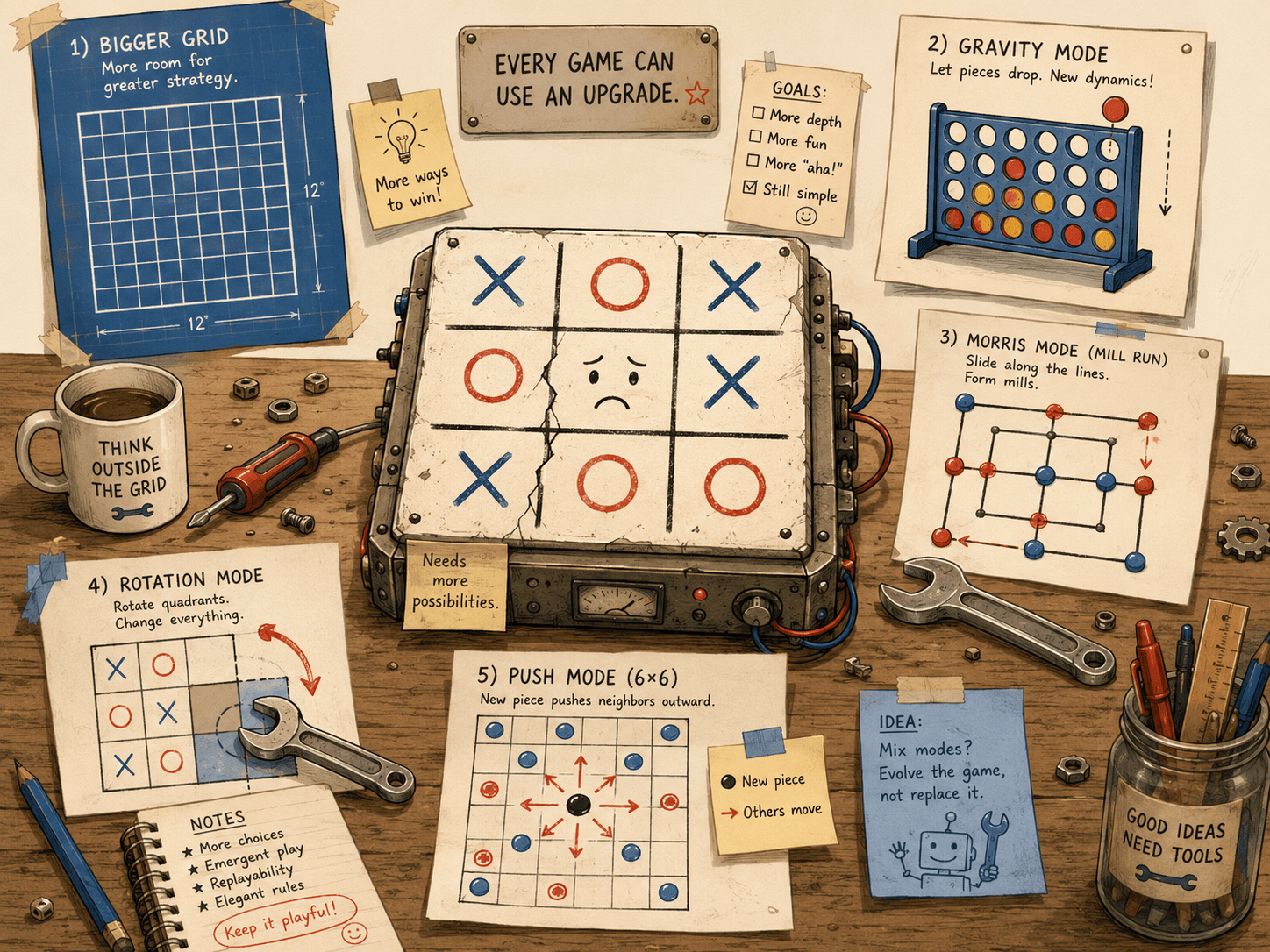
The workshop: five families of fixes
Designers never abandoned three-in-a-row; they diagnosed it. Each fix below attacks one of the fatal conditions, and each became at least one successful game. (The full genealogy runs through the family-tree article; here we're interested in the engineering.)
Fix 1: More roads — scale everything up. Grow the board faster than the line and the road network explodes past any defender's patrol capacity. Gomoku's five-on-nineteen is the classic dose: thousands of potential lines, threats sprouting from open space, defense finally gasping to keep up. Overdose warning included: scale far enough and attack becomes too strong — the first player's freedom compounds — which is how the fix spawned a century of counter-patches. Lesson: the roads dial works, and it's touchy.
Fix 2: Constrain placement — gravity. Connect Four kept a small board but removed free claiming: discs fall to the lowest slot, so most squares are unreachable at any given moment. Defense can no longer just sit on the critical square — the critical square may not exist yet — and attack gains a new dimension: building threats on squares that will only come into existence later, on a turn of your choosing. Parity warfare, in other words. Attack got cleverness back not through space but through time.
Fix 3: Un-permanent the defense — movement. The morris insight, medieval and still fresh: if pieces move, a block is only a tenant, not a wall. Every defensive piece in Nine Men's Morris has other duties, and pulling it away reopens the road it guarded. Defense stops accumulating; the game stops converging on a draw. Modern movement variants (place your three, then slide them forever) apply the same medicine to the bare 3×3 — even the original grid becomes a real little game once marks can walk.
Fix 4: Move the board itself. The radical branch: make placement permanent but the terrain unstable. Pentago's rotating quadrants spin your careful line into a new orientation every turn. And displacement games — Oustwit chief among them — let every placement physically shove the neighboring pieces, so blocks get pushed out of their lanes, lines get scattered mid-construction, and no square is ever safely owned. Look at what this does to the three fatal conditions at once: roads effectively multiply (every alignment reachable by shove counts), defense is radically un-permanent (walls can be relocated by the attacker), and the plan-versus-board-size problem dissolves because position is renewable — pieces shoved off return to hand. One mechanic, all three conditions treated. That efficiency is why the push school could afford to keep the line at the child's original three on a board barely bigger than the original grid.
Fix 5: Bend the goal. The conceptual branch: misère (make a line, lose — suddenly the draw-machine becomes a tense avoidance dance), wild variants (either player plays either mark — every move a double agent), order-versus-chaos asymmetry (one player wants any line, the other wants none), 3D stacks, and nested boards where your move chooses your opponent's arena. These fixes attack the frame rather than the mechanics — proof that even a broken game's goal contains more games than it first appears.
The little grid by the numbers
For a dead game, tic-tac-toe has lovely arithmetic, and walking it makes "solved" feel concrete.
Nine squares, two marks, and the raw count of ways to fill a grid — 39, since each square is X, O, or empty — comes to 19,683. Throw out the illegal ones (five X's and one O, and other impossibilities) and about 5,478 legal positions remain. Fold together boards that are mirror images or rotations of each other and the game shrinks to just 765 essentially different positions. Play them out and there are 255,168 possible complete games — a number your phone enumerates faster than you blink. Compare the counts for real games — Connect Four's trillions, chess's number-with-no-name — and you see the diagnosis in digits: tic-tac-toe isn't shallow because people got smart. It's shallow because there was never anywhere to hide.
The eight winning lines have their own tidy census: the center square sits on four of them, each corner on three, each edge square on just two. That little table is the strategy guide: take the center (four roads), prefer corners (three), treat edges as the suburbs (two). Every "expert" tic-tac-toe tip your uncle ever gave you is this arithmetic wearing a mustache — and it's the same square-value arithmetic that scales up to real boards, where the center's road count is why everyone fights for it.
The one trick the box contains: the corner fork, slowly
Since the game has exactly one piece of real technique, let's honor it properly — it's most humans' first taste of the double threat.
You go first. Take a corner — not the center, the corner. Most casual opponents answer somewhere other than the center (the center feels less urgent than it is). Now take the corner diagonally opposite your first. Look at the board: you hold two corners on one diagonal, and suddenly several of your roads — the diagonal, plus a row and a column through each corner — are half-built at once. Your opponent blocks the diagonal, naturally. And now the trick: take one of the two remaining corners. Count your threats: the row through your corners… and the column through your corners. Two roads, one move each from winning, one defender. The fork. They block one; you complete the other, and someone at the table demands a rematch with the air of a person who has been robbed.
Two footnotes complete the lesson. First, the defense: the center answer to a corner opening defuses the whole script — which is why the fork works on casual players and never twice on the same sibling. Second, the meta-lesson: notice that the fork required your opponent's cooperation (skipping the center). Perfect defense kills it — that's the draw reasserting itself — but imperfect defense loses to preparation, and that asymmetry, discovered at age eight over a paper grid, is the entire principle that solved games stay dangerous between humans.
What the repairs teach about every game you play
The workshop's real product isn't the fixed games — it's the diagnostic eye you take away from it. Once you've seen tic-tac-toe's three fatal conditions, you can't help checking other games for them. Does this game give attack enough roads? Is defense permanent or degradable? Can plans outlast the board? Those questions are, at bottom, the questions of the deep-game field guide — turns that talk to each other, tension that doesn't resolve, comebacks that stay possible — asked from the designer's side of the bench.
And there's a second, humbler lesson. Tic-tac-toe fails as a contest between skilled adults — but as a teaching machine it has never failed once. It still teaches every child turn-taking, threat, block, and fork; it's still the first place a human mind discovers that the future can be forced. The broken game is the door the whole family walks in through. Games, like people, can retire from competition and keep teaching.
Three experiments to run tonight
The broken game makes a wonderful laboratory, because it's small enough to see everything. Three experiments, each about ten minutes.
Experiment one: solve it with a child. If there's a seven-to-nine-year-old in your life, play a dozen games and let them find the draw themselves — resist explaining. Watch for the visible moment the machine becomes transparent to them: it's one of the first pure deduction victories a human gets to have, and being present for it is better than winning anything. Then teach the corner fork as a graduation gift.
Experiment two: play misère. Same grid, same marks, one flipped rule: make three in a row and you lose. Notice how strange your instincts feel — every pattern you've known since childhood is now a trap, and the center square flips from best to radioactive. Ten minutes of misère is the cheapest demonstration anywhere of how much of "skill" is just cached habit, and what happens when the cache is poisoned.
Experiment three: give the marks legs. Three pieces each; once all six are placed, turns become slides — one piece, one square, along a line. Play five games. Somewhere in game two or three, a blocked line will reopen because the blocker had to leave, and you'll feel the entire medieval insight land in your hands: permanent defense was the disease. You've just watched the oldest repair in the family fix the oldest broken game — the same repair that, pushed to its modern extreme, produces boards where the pieces don't even wait to be moved.
Questions people ask
Can the first player force a win if the second player is just okay-ish? Against imperfect defense, yes, easily — the corner-fork trick wins constantly on playgrounds. The draw is guaranteed only between two players who both know the strategy. That gap — solved in theory, alive in practice — is the tiny version of why solved games stay playable.
Is 3×3 with a longer board — 4×4, three in a row — better? Interestingly, mostly not: scaling the board without scaling resistance makes attack trivially strong (three-in-a-row on 4×4 is a first-player romp). The dials have to move together — which is exactly the balance law the whole family tree demonstrates.
What's the best fix to actually play tonight? With a child: movement tic-tac-toe (three pieces each, slide forever) — the original grid, revived. With an adult and ten minutes: any branch of the tree. With a phone and five: this site can offer a suggestion involving a 6×6 and a push rule, and an article on why the old goal bites again there.
Did anyone ever play tic-tac-toe seriously? Its cousins, yes — and one machine did: one of the earliest computer games ever built played perfect tic-tac-toe in the early 1950s, and university courses still assign the solver as a first AI project. The broken game has one more career: it's the "hello, world" of game programming.