Learn › Three in a row › The in-a-row family tree
From Tic-Tac-Toe to Gomoku: the in-a-row family tree
Line up three and win. It might be the oldest victory condition humans ever invented — carved into Roman stones, scratched into playground dirt, glowing on a billion phone screens. This is the story of one simple goal and the remarkable family of games it grew: where it came from, how it branched, and why it refuses to retire.
The goal every human learns first
Before most of us could read, we knew how to win at something: make three in a row. Tic-tac-toe is close to a universal human experience — a game taught in thirty seconds, played on anything (paper, dirt, fogged windows, restaurant napkins), and understood so instinctively that nobody remembers learning it. Ask why a line of three should win and you'll find there's no reason, except the perfect one: a line is instantly visible. No counting, no scoring, no judgment calls. You see it, it's over.
That property — the self-announcing win — is the family's founding genius. Other goals need referees or arithmetic; a line needs only eyes. It's why line-forming games teach children turn-taking and planning before any other genre can get in the door, and why the goal transplants into any medium ever invented. Whatever else changes in the family tree below — boards, gravity, movement, shoving — the glowing thread through all of it is that a win is a picture, and everyone can see the picture at once.
Deep roots: lines before history
How old is the goal? Honest answer: older than we can prove, and the proving is tricky. Grid patterns that look tantalizingly like line-game boards are scratched into surfaces across the ancient world — Roman-era boards among them — though archaeologists are careful to note that a carved grid might be a game, a calendar, or decoration; reading play from stone is a discipline of educated maybes. The Roman game terni lapilli ("three pebbles at a time") is commonly linked to tic-tac-toe's ancestry, and what's certain is that by the medieval period, line-forming games were everywhere.
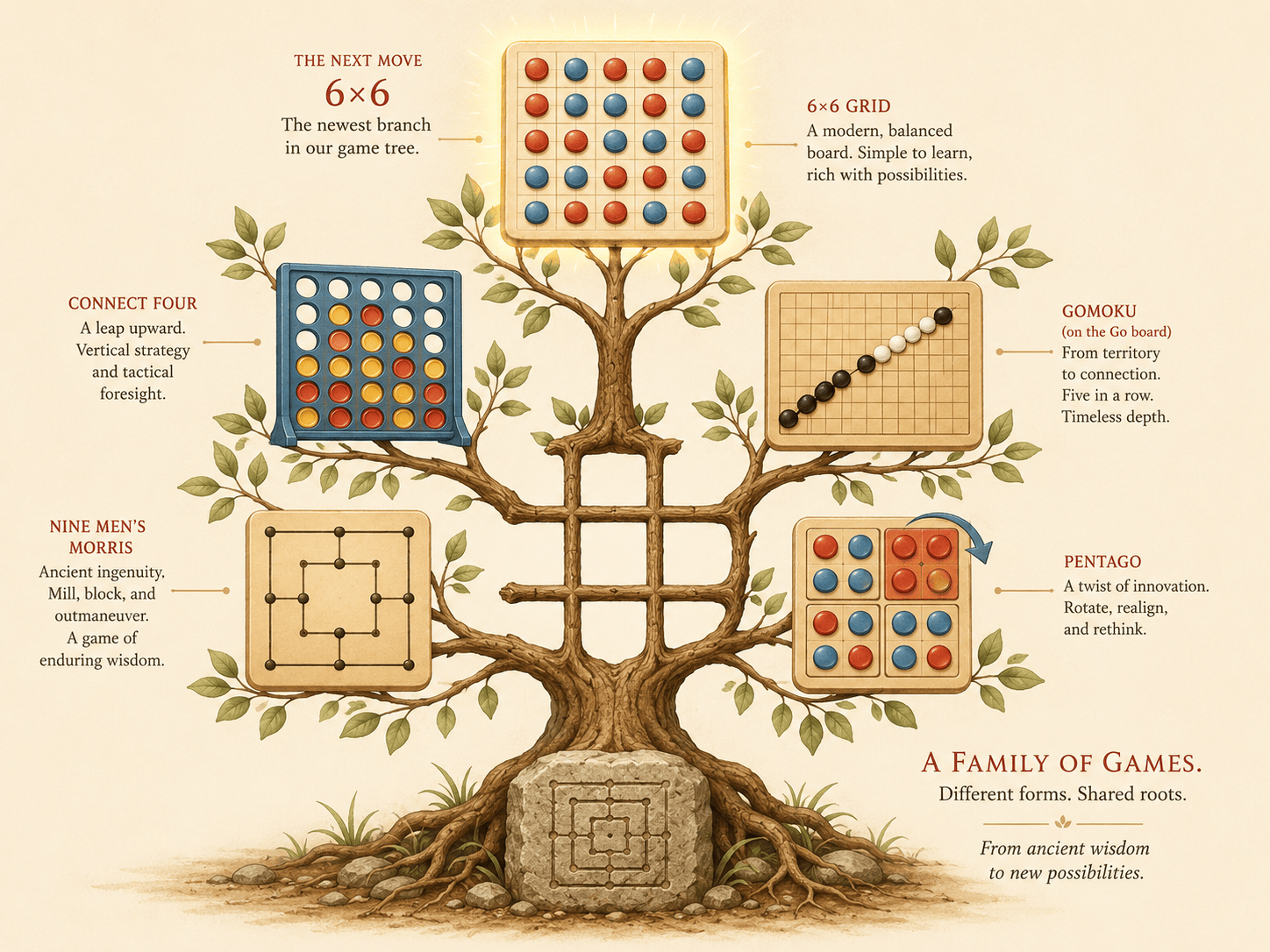
The grandest of the old branch is Nine Men's Morris — three-in-a-row with a career plan. Players first place their nine pieces, then move them along the board's lines, forming and re-forming "mills" (rows of three), each mill removing an enemy piece. Morris boards are carved into cathedral cloisters and ancient stonework across Europe and beyond; the game was serious enough for Shakespeare to name-check. Notice what morris already understood, centuries before modern design: bare three-in-a-row on a small static board is too easy to guard, so give the pieces a second life — let them move — and the goal stays dangerous forever. Hold that thought; the whole family keeps rediscovering it.
The problem at the root of the tree
Every branch of this family exists because of one embarrassing fact: the trunk is broken. Tic-tac-toe, played by two people who are paying attention, is a guaranteed draw — always, forever. A child who thinks for a while can work out the complete strategy, and most children do, which is why the game has a global retirement age of about nine.
The diagnosis matters more than the disease. Tic-tac-toe fails because the board is too small for the goal: three squares of line on a nine-square board means every threat is adjacent to every defense, and one blocking mark kills a threat permanently — marks never move, so a blocked road stays blocked until the board fills and the music stops. Too few roads, defense too cheap, no second chances. (We've given the full autopsy, and the fixes, an article of its own.)
What happened next is the most instructive pattern in game design: instead of abandoning the broken goal, players and designers spent roughly two thousand years repairing it, and every distinct repair became a branch of the family. The tree below is really a museum of answers to one question — how do you make three-in-a-row hard again?
Branch one: make the board bigger and the line longer
The most direct repair: if three-on-3×3 is too easy to guard, demand five on a board that feels endless. That's Gomoku — five in a row, traditionally played with Go stones on a Go board's generous grid. Suddenly the geometry flips: threats can develop in open space faster than a defender can fence them, lines can grow from either end, and multiple threats braid together into forcing attacks. The repair worked so well it created a new problem — the first player, moving with the advantage on an open board, turned out to be too strong, and taming that advantage became a century-long project called Renju, with rulebooks of forbidden moves for Black. That arms race is its own remarkable story, told in the Gomoku and Renju article.
The scaled branch teaches the family's first design law: line length must match board resistance. Every working in-a-row game since is a balance struck between how long the line is and how hard the board fights construction — remember that law when we reach the newest branch.
Branch two: add gravity
The 1970s produced the family's great mass-market hit by adding one constraint: discs fall. Connect Four keeps the line goal (four, now) but forces every piece to the lowest empty slot in its column — you can't just claim the square you want; you must build up to it, and every disc you drop changes what squares exist for both players. Gravity created a wholly new threat grammar: threats stacked above threats, traps built on squares that don't exist yet, and the famous odd-and-even-row warfare that decides expert games (a parity battle we unpack in the Connect Four article — including the day computers solved the game completely).
Gravity's lesson for the family: constraining placement is as powerful as expanding the board. You can make lines hard again not by giving players more room, but by taking away their freedom to use it.
Branch three: let the pieces move
Morris's ancient insight — mobile pieces keep the goal alive — has modern descendants everywhere. Movement-phase games let a blocked line un-block itself: the defender's wall is made of pieces that have other jobs, and every piece pulled away reopens a road. The branch runs from the medieval mill games through countless modern designs where forming a line requires maneuvering rather than claiming — and it points directly at the family's newest and strangest twig.
Because there's a more radical version of "pieces move": pieces that are moved by the opponent. Rotation games like Pentago place-then-twist a quarter of the board every turn, so your line survives only if it survives the spin. And displacement games — Oustwit's whole school — make every placement physically shove the neighboring pieces, so a line isn't a drawing you complete but a structure you hold together against constant weather. On Oustwit's 6×6, the line is back down to three — the child's number! — because the board's instability provides all the resistance the goal needs. That's the first design law again, running in reverse: crank up board resistance and the ancient short line becomes honest work. (How that plays in practice — braced lines, slide-finishes, lines you're pushed into — fills its own article.)
Branch four: bend the win itself
The tree's quirkiest branches repair the goal by aiming it somewhere new. Misère variants flip it — form a line and you lose — turning the game into mutual bomb-disposal. Wild variants let either player place either symbol, so every mark is a double agent. Order-and-chaos style games make one player pursue lines while the other prevents any line existing — asymmetric war over the goal itself. 3D variants stack grids into cubes (the 4×4×4 version was solved decades ago — first player wins). And the internet age contributed ultimate tic-tac-toe: nine little boards nested inside a big one, where your move dictates which small board your opponent must play in next — the humble trunk, fractalized into something genuinely strategic. None of these became giants, but together they map the goal's flexibility: even the win condition itself is a dial.
Which branch is for you tonight?
The tree is also a menu, and matching branch to mood is half the fun of knowing it.
For a child's first real strategy lesson: the trunk itself, then movement tic-tac-toe (three pieces each, slide forever) the week the draws begin. The upgrade lands like a magic trick: same grid, game suddenly alive.
For family across generations: Connect Four. The gravity constraint keeps choices small enough for a six-year-old, while the parity endgame gives adults something real to chew. Few games span sixty years of players at one table so comfortably.
For pencil, paper, and a rainy café: Gomoku on graph paper. Zero equipment, tournament-grade depth, and games short enough for a lunch break. The best free game in the world, by some accounting.
For lovers of old things: Nine Men's Morris, ideally on a wooden board, ideally explaining to someone that the pattern is carved into a cathedral somewhere. The phases — place, then move, then (at three pieces) fly — give it a three-act structure no other branch has.
For the phone in your pocket: the modern branches were built for it — rotation games, nested boards, and the displacement school, where five-minute duels carry the old goal into push-button physics. Same three-in-a-row your grandmother taught you; the board just learned to fight back.
A one-week tour of the tree
The family's best feature: you can visit every major branch in seven evenings, mostly for free, and feel eight centuries of design evolve in your hands.
Day one: the trunk. Play tic-tac-toe with someone — really play it, five games. Feel the draws arrive. You're touching the broken machine, and the week only works if you start here.
Day two: movement. Same grid, three pieces each, slide one piece per turn along rows and columns. The medieval fix, and the week's first shock: the dead grid gets up and walks.
Day three: gravity. Connect Four, physical or app. Notice what falling discs do to your planning — you're now building toward squares that don't exist yet. Watch one banked threat pay off, yours or theirs.
Day four: scale. Graph-paper Gomoku, five in a row. Feel the fences fail — threats now outrun defense, the opposite of day one's problem. Notice who wins more: whoever moved first, probably. File that thought.
Day five: morris. Nine Men's Morris (boards are printable; apps abound). The placement-then-movement structure gives you the family's only three-act play, and the double mill will happen to you before you do it to anyone. Everyone's first double mill is a formative injustice.
Day six: the modern twist of your choice. A rotation game, ultimate tic-tac-toe with pencil and paper, or a displacement duel on your phone. Whatever you pick, notice the shared move: the designer changed the board's behavior, not the goal.
Day seven: return to the trunk. One last game of tic-tac-toe. It will feel microscopic — and you'll see everything in it: the roads, the fork, the permanence problem, every branch's reason for existing, folded inside nine squares. That double vision — tiny game, whole family visible through it — is the week's souvenir, and it never really fades.
Questions people ask
Is tic-tac-toe really Roman? Probably something like it — grids and three-pebble games are attested, and terni lapilli is the usual candidate — but ancient boards rarely come with rulebooks, so historians hedge. What's certain is that line-forming games are ancient, global, and independently reinvented: the goal is obvious enough that humanity keeps discovering it. That's not a weakness of the evidence; it's the strongest evidence of all.
Why lines? Why not squares, or diagonals-only, or corners? Designers have tried them all, and lines keep winning for one reason: the human visual system detects collinearity instantly and effortlessly. A "win by square corners" game exists (and is clever), but you have to check for the win. Lines announce themselves. The goal that referees itself outlives the goals that need checking.
What's the biggest living branch today? By raw players, Connect Four and phone-app five-in-a-row variants dwarf everything. By competitive infrastructure, Renju and tournament Gomoku — federations, world championships, named openings. By growth, arguably the modern small-board branches, riding the same phone wave as the rest of the abstract renaissance.
Is there a branch where the second player is favored? No natural one — line-forming inherently rewards moving first, which is why the family invented so much first-move law: Renju's forbidden moves, swap openings, and the pie rule. The full arms-race story is its own article, and it's the family's contribution to fairness engineering across all of gaming.
What the whole tree teaches
Stand back from the branches and a few family truths come into focus.
The goal is immortal because it's legible. Every repair kept the self-announcing win — the picture anyone can see — while changing everything else. Designers sacrifice boards, gravity, even stillness itself before they'll sacrifice the visible line. There's a lesson there about what makes games last, and it's not complexity.
Every branch trains the same master skill. Whatever the repair, winning always comes down to the double threat — two roads, one defender — because that's the arithmetic at the goal's heart. Learn the fork once, in any branch, and you've learned the whole family's endgame.
The family is a ladder. Tic-tac-toe at five years old, Connect Four at eight, Gomoku or morris in adolescence, and the modern branches whenever curiosity strikes — the in-a-row family is the hobby's natural staircase, each step reusing everything learned below it. Which makes it the ideal answer to a question every player eventually fields from a child, a parent, or a friend: where do I start with strategy games? Start where humanity started. Three in a row — then climb the tree and see how far up the branches go.