Learn › Three in a row › Gomoku and Renju
Gomoku and Renju: the five-in-a-row arms race
Take the child's goal — make a line — stretch it to five, and hand it to serious adults on a big open board. What happened next was a century of brilliance, crisis, and rule-patching: proof that even the simplest goal, at full power, needs laws to contain it. This is the story of five-in-a-row growing up.
The child's goal, all grown up
Gomoku is what happens when three-in-a-row escapes the playground. Two players alternate placing stones — traditionally Go stones on a Go board's wide grid — and the first to line up five in a row, any direction, wins. Stones never move. That's the entire rulebook, learnable in the time it took to read this paragraph, and it repairs everything broken in the tiny original at a stroke: thousands of potential lines instead of eight, room for long plans, threats braiding across open space faster than any defender can fence them.
Don't let the minimalism fool you — serious Gomoku is sharp. Because stones are permanent and the board is generous, attacks develop as forcing sequences: a line of three with both ends open demands an answer, a four demands one square in particular, and strong players chain such demands together — threat, forced block, new threat off the block — like a boxer working combinations. The game rewards exactly two things, both purely: the double-threat eye, and the tempo discipline to keep asking questions your opponent must answer. Anyone who wants to see what "forcing line" means in laboratory conditions should watch expert five-in-a-row for an afternoon.
The crisis: when the first player got too strong
Then came the problem that gives this article its title. Give a sharp game an open board, permanent stones, and alternating turns, and the player who moves first enjoys compound interest: one extra stone on the board at every moment of the game, one step ahead in every forcing race. In casual play the edge is a whisper. At expert level it grew into a shout — first-player winning rates climbed absurdly as theory developed, and master players increasingly found that with correct play, Black (who moves first in stone games) simply won. The suspicion hardened for decades, and computation eventually made it formal: free-style Gomoku — the bare, no-restrictions version — was proven a first-player win in the 1990s, with the winning attack itself mapped. (The researcher who led that proof, Victor Allis, had warmed up by solving Connect Four. Some people collect stamps.)
Every competitive game faces first-move advantage — chess's White scores a few points better, Go pays the second player komi points as rent — but bare Gomoku is the spectacular case: the advantage isn't a lean, it's checkmate-from-the-opening, given perfection. A game community can respond to that three ways: shrug (casual play survives fine), abandon the game, or legislate. Five-in-a-row's community chose legislation, and produced gaming's most fascinating body of balance law.
Renju: rules against the strong
The oldest and boldest legislation is Renju — five-in-a-row as codified in Japan, where the game grew a professional culture more than a century ago. Renju's radical idea: handicap the first player with forbidden moves. Black wins only with exactly five; Black may not make an "overline" of six or more; and — the heart of it — Black is forbidden from playing the game's nuclear weapons: the double-three (one stone creating two open threes at once) and the double-four. Make one of those forks and Black doesn't win — Black loses on the spot, the move itself illegal. White, meanwhile, may do all of it freely.
Read that against the double-threat article and the design becomes luminous: Renju identified precisely which weapon made the first player unbeatable — the fork — and banned it for one side only. The result is a deeply asymmetric dance: Black attacks under a legal system, threading wins through the gaps in the forbidden list, while White plays both defender and prosecutor, actively trying to trap Black into an illegal shape. Yes: in Renju, you can win by maneuvering your opponent into a position where their only good moves are crimes. The rulebook became a playing field.
It wasn't enough. Theory kept advancing, Black kept winning through the restrictions, and Renju added opening regulations on top: prescribed first moves near the center, and swap-based opening protocols culminating in the modern tournament standard — variations on the elegant idea we turn to next.
The pie rule: fairness by "I cut, you choose"
The most beautiful patch in the arms race borrows from every parent's cake-cutting wisdom: one child cuts, the other chooses. Applied to games, it's called the swap or pie rule. In its simple form: one player sets up the opening (placing the first stones), and the other player then chooses which color to play. Make the opening too strong and your opponent takes it; too weak and they hand it back. Your only safe play is to build the most balanced opening you can — fairness enforced not by law but by incentive.
Modern competitive Gomoku runs on an elaborated version (swap2: the first player places three stones, the second may take either color, swap, or extend and hand the choice back — a little auction for the first-move advantage). The pie rule's genius is its universality: it balances any game with a strong first move, without touching the game's rules at all, and variants of it now appear across the abstract world — Hex uses it, tournament organizers of many games reach for it, and designers cite it as the cleanest known answer to the oldest asymmetry in turn-based play. Five-in-a-row's crisis gifted the whole hobby a tool.
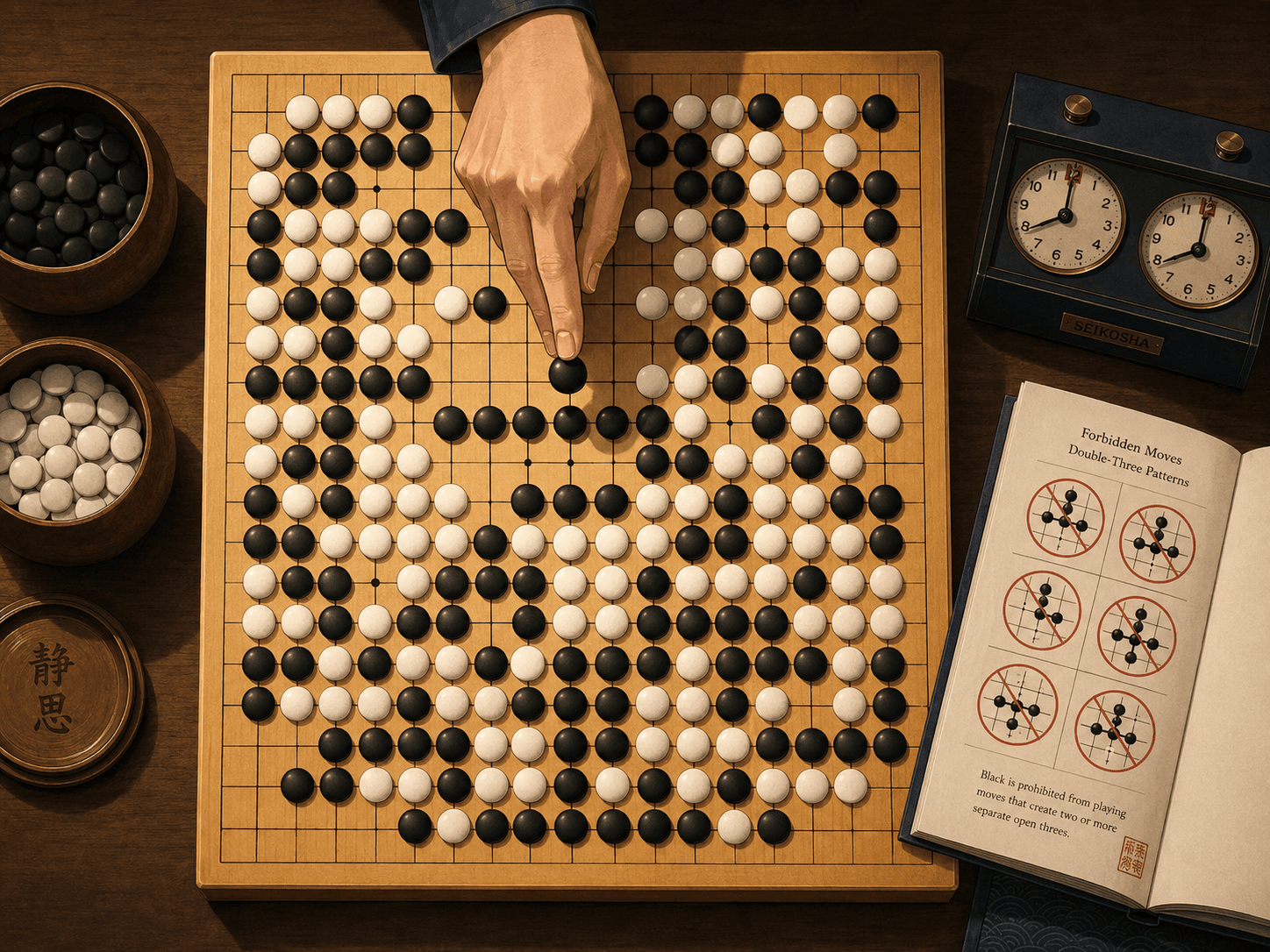
The attacker's alphabet: threes, fours, and forcing wins
To feel why the legislation was necessary, you need a taste of the weapons system — serious five-in-a-row has a taxonomy of threats as precise as chess's checks, learnable in one sitting.
A four — four stones with one empty completion point — is the game's version of check: answer the exact square or lose now. An open three — three in a row with both ends free — is subtler and deadlier: unanswered, it becomes an open four (two completion points, unstoppable by one move), so it too demands a response, but the defender must choose an end, and choices leak information and shape. A broken three (three stones in four squares, gap inside) whispers the same threat with even less announcement. Expert attacks are sentences composed in this alphabet: three (forced answer), four (forced answer), new three rising off the forced stone, until the sequence lands a double — the fork this family always converges on — or runs dry.
The pinnacle concepts even have names players chant: victory by continuous fours — a forcing sequence made entirely of checks, immune to counterattack because the defender never gets a free breath — and its cousin mixing threes and fours. When theory proved bare Gomoku a first-player win, the winning object was exactly such a composition: the opening advantage, compounded through forced answer after forced answer, arriving at a double before White ever got to speak. Once you can read that sentence, Renju's forbidden-move list stops looking fussy and starts looking like exactly what it is: gun control, written by people who had seen the gun.
One forcing sequence, in words
Watch the engine turn over once. Black has stones scattered mid-board; White has just answered elsewhere. Black plays a stone that makes an open three — silent, both ends breathing. White must answer (ignore it and the open four ends things) and blocks the left end. But Black's next stone, placed against White's block, does two jobs: it makes a four along a different direction — check! — and White's forced block of that leaves Black free to convert the original threat's remaining end into a new open three, this one crossing a second Black formation. Two breaths later the crossing point becomes a double-four. White has answered every single move correctly and lost anyway — each block was forced, each forced block was a brick in Black's cathedral.
That's what "the first player was too strong" means in the muscles: with the extra stone always in hand and an open board, Black's questions could be arranged to never stop. Every patch in this article — forbidden doubles, prescribed openings, the swap auction — is an attempt to make the questions stoppable. And it's the purest illustration on this whole shelf of the tempo/initiative machinery: a forcing chain is initiative crystallized, and Renju is what happens when one player's chain can be built infinitely long.
Playing the family today
All this law and theory sits atop a game you can start in the next five minutes, and the on-ramps are gentle.
Paper first. Graph paper, two pens, five-in-a-row, no restrictions: still the best value in gaming. Play ten games and you'll independently discover the open three, the forced block, and the first-mover's punch — the entire historical arc, reenacted on one page.
Then boards and apps. Any Go set plays Gomoku (use the 15×15 area of the board, the modern standard, rather than the full 19 — tighter is sharper). Apps and online servers offer graded AI and human ladders; look for ones offering swap openings once bare-Gomoku's Black-bias starts showing in your results — you'll know the moment, because you'll start fighting over who goes first.
Renju, for the curious. The full legal system has federations, world championships, and a professional literature, most visible in Northern Europe, Russia, and East Asia. You don't need any of it to enjoy the forbidden-move game at home: print the three rules (Black: no double-threes, no double-fours, no overlines), play, and savor the strange new experience of hunting your opponent into illegality. It's the only game on this shelf where "gotcha" is a legal term.
A century of patches, read as a design story
Line the era up and the arms race becomes a parable every game player should know.
Round one: scale the board — the fix that created the game — and discover the fix's own excess: attack too strong, first mover unbeatable. Round two: ban the strongest weapons for the strongest side (Renju's forbidden forks) — and discover that deep theory tunnels under any fixed law. Round three: regulate the opening itself — prescribed patterns, then swap protocols — converting the first-move advantage from a weapon into a price that players bid on. Each round is the same lesson the whole history of rules teaches: games are never finished artifacts; they're treaties, renegotiated whenever one side finds a loophole. Chess re-balanced with faster tiebreaks and alternating colors; Go tunes komi decade by decade; Renju wrote a criminal code. The methods differ; the impulse — protect the contest — is identical.
And the deepest lesson sits underneath: balance problems are compliments. Only a game whose players got very good ever discovers its first-mover crisis. Tic-tac-toe never needed a swap rule; nobody cared enough. The size of five-in-a-row's law library measures the size of its players' devotion — a century of people who loved the bare goal enough to keep it fair at any legislative cost.
Modern designers took the other exit
There's a coda that brings the story to this site's shelf. Renju-era legislation fixes imbalance by adding law. Modern abstract design more often fixes it by changing physics — building boards where the first player's compound interest never accumulates in the first place. Shrink the board so contact is instant and permanent stones become targets. Add dual win conditions pulling energy in two directions. Or make placement itself disturb the board — the displacement school, where every stone placed shoves the neighbors and no line, Black's or White's, is ever a permanent fact. A first move in Oustwit buys geography, not a compounding attack; the board's instability taxes every accumulated advantage each turn. Where Renju polices the fork with law, a push board polices it with weather — the line is always three shoves from scattered.
Neither approach is "right." One preserves a beloved classical game by fencing its extremes; the other designs the extremes out and accepts a different game. But it's no accident that the modern branch runs on physics: a century of five-in-a-row jurisprudence demonstrated exactly how much law a bare permanent-stone line game eventually requires, and designers took notes.
A starter week with five-in-a-row
Simple plan, mostly paper, no purchases. Days one and two: bare Gomoku on graph paper with anyone willing. Just play. The open three will teach itself — you'll make one by accident, watch it become a four, and understand the whole alphabet in your hands. Day three: alternate who moves first every game, and keep score by color. You're collecting your own data on the first-mover edge; most pairs see it inside ten games. Day four: try the simple swap — one player places the first stone, the other chooses colors. Feel how the choice changes your opening: suddenly you're placing a fair stone, not a strong one, and you've reinvented a century of tournament law at your kitchen table. Day five: hunt one forcing chain. Your only goal in every game: make a three that forces a block, then a move off that block that forces again. Two forced answers in a row and you've spoken the language's first sentence. The weekend: an app with graded AI, or — if the legal drama calls to you — print Renju's three forbidden-move rules and play the courtroom version. Either way, you'll never again see a line of stones as just a line of stones.
Questions people ask
Can I just play bare Gomoku for fun? Absolutely — below serious study, the first-mover advantage is theoretical seasoning, not a practical problem, and free-style five-in-a-row remains one of the best quick pencil-and-paper games in existence. The laws exist for the top of the mountain; the meadow at the base is lovely.
Is Renju's forbidden-move rule fun or fussy? Both, honestly, and deliberately. It adds a genuine second game (trap-the-opponent-into-illegality) at the cost of rules overhead — the classic depth-versus-complexity trade made vivid. Players who love legal intricacy adore it; players who want purity play swap-rule Gomoku instead.
Five in a row on a small board — does that work? Poorly: on tight grids, five is nearly unreachable and the game stalls, which is why small boards pair with short lines plus added resistance — gravity, movement, or displacement. The family's balance law again: line length must match board resistance.
What does this arms race teach me for tonight's games? Two portable habits. Respect the first move — in any sharp game, moving first is worth real value, so spend it on the highest-traffic real estate available. And when a friendly game keeps ending the same lopsided way, don't abandon it — patch it: alternate who starts, try a pie rule, add a house restriction. You'll be walking a path a hundred years of five-in-a-row lawmakers paved, and the game you save may become your group's favorite.