Learn › The classics › Checkers
Checkers: deeper than you think
Everybody "knows" checkers: the kids' game on the back of the chess board, the thing you play while waiting for something better. Almost everything in that sentence is wrong. Checkers is a family of serious games, home to arguably the most dominant champion in the history of all competition, and the arena of one of computing's greatest sagas. Time to re-meet the game you think you've met.
The most underestimated game in the world
Checkers suffers from a unique curse: universal, shallow familiarity. Nearly every human has played it; almost none have seen it. The rules arrive in childhood, the games end in childhood, and the adult verdict — "simple" — gets filed away forever, usually right next to a chess set that gets all the respect. The verdict survives because casual checkers genuinely is casual: two beginners shuffling pieces produce a game about as deep as their attention.
But run the actual tests. Would an expert beat you a hundred times in a row? Without breaking conversation — checkers sits at the far skill end of the luck–skill spectrum, with a competitive history running back centuries, professional literature, named openings, and a world championship lineage older than basketball. Does it pass the five deep-game signs? Every one, and the same-opponent test spectacularly: the game between two students of checkers bears no resemblance to the game between two eight-year-olds. The gap between checkers' reputation and checkers' reality is the widest on this shelf — which makes it this article's favorite kind of subject: a masterpiece hiding behind its own welcome mat.
The rule that changes everything: captures are compulsory
One rule powers the whole machine, and casual players routinely soften or skip it: if you can jump, you must jump. No discretion, no declining. Where chess offers captures as options, checkers issues them as orders — and that difference rebuilds the entire strategic universe.
Think through what compulsion does. Every piece you advance is now a lever your opponent can pull: place a piece where it can be jumped and your opponent controls a move of yours — they choose when to offer, and the rules force your acceptance. Your own army becomes a set of strings an opponent might yank. Suddenly "developing a piece" is double-edged in a way chess never dreams of: each advance creates both presence and obligation.
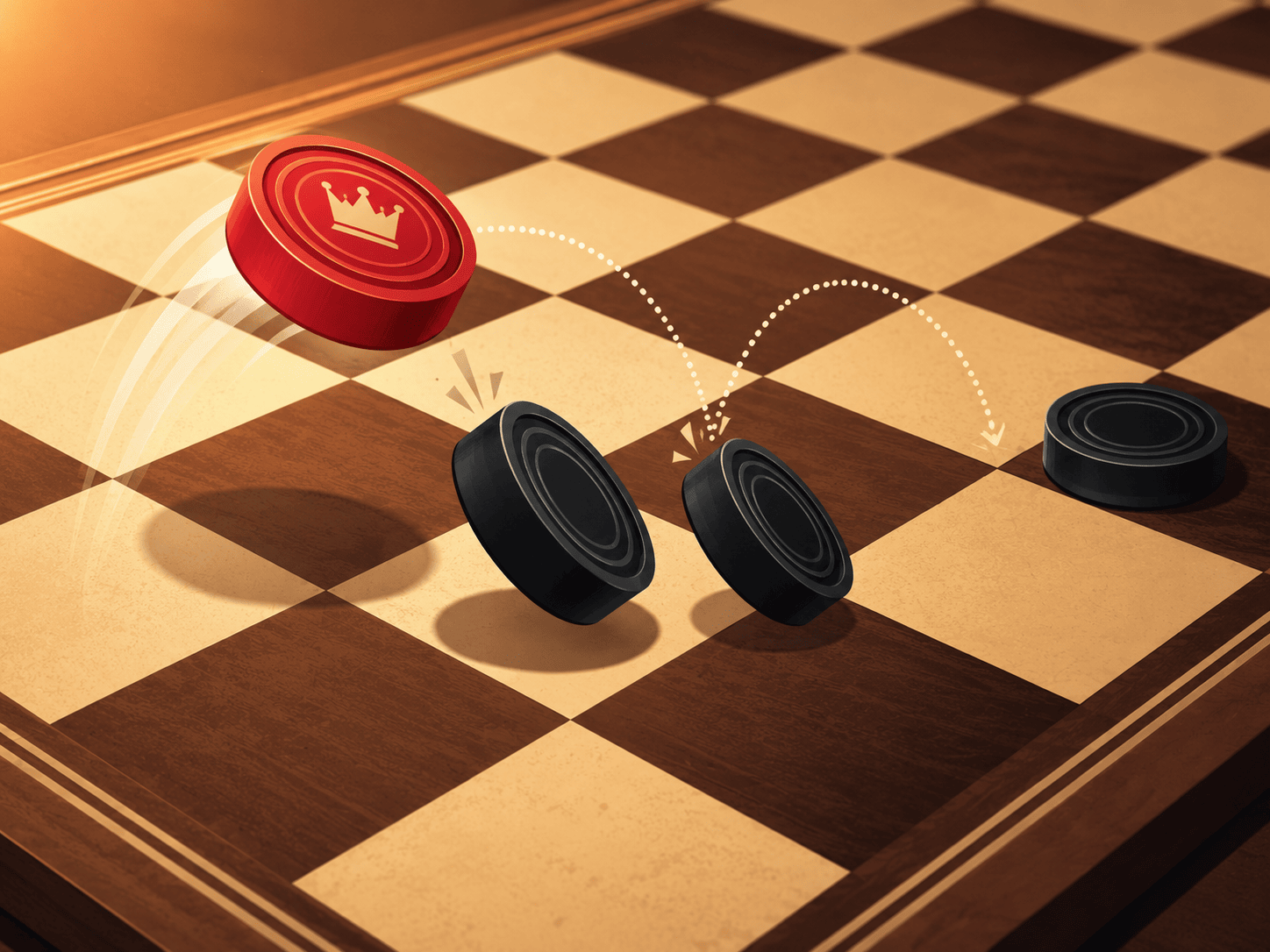
From compulsion, the game's signature weapon: the shot — a sacrifice chain where you feed one piece to force a jump, which drags the enemy piece onto a square where it must jump again or be jumped, cascading into a multi-capture that nets you two, three, four pieces from a position that looked serene one move earlier. Shots are checkers' tactical poetry, and they are pure forcing sacrifice: payment up front, compulsion as the purchase, cashed in a sequence your opponent executes against themselves by rule. The first time a three-for-one shot detonates against you, the "simple game" verdict dies mid-sentence.
And beneath the fireworks, compulsion makes checkers a paradise of zugzwang and counting: with forced captures pruning options and no pieces moving backward (until kings), safe moves are a scarce, countable resource. Master-level checkers is substantially the science of move-starvation — arranging that, when the music stops, your opponent is the one holding an obligation.
A family, not a game
"Checkers" is really a surname. The 8×8 twelve-piece game familiar in the English-speaking world — draughts, formally — is one member of a global family whose branches differ enough to be separate games entirely.
International draughts, the family's flagship in much of Europe, Africa, and beyond, plays on a 10×10 board with twenty pieces a side — and with two rule upgrades that turn the tactics incandescent: ordinary pieces may capture backward, and kings become "flying kings," sliding any distance along diagonals like bishops with a license. The bigger board and longer-range compulsion produce combination sequences of operatic scale — five- and six-piece shots that rearrange half the board — and a professional scene with the depth and seriousness of any classic game.
Regional masters fill the family album: Turkish draughts moves and captures orthogonally (straight lines, not diagonals — same soul, alien geometry); Italian rules forbid ordinary pieces from capturing kings; Spanish, Russian, Brazilian, Thai branches each tune capture rules, king powers, and board size into a distinct dialect. Like chess's world family, the variations aren't noise — they're a centuries-long distributed experiment on one mechanism, and sampling even two branches teaches more about capture-compulsion design than any essay.
The family lesson for the shelf: when a game looks "simple," check whether you've only met its kindergarten. The 8×8 game your childhood knew is the family's gentlest member.
Marion Tinsley: the closest thing to perfection
Every game has its legends; checkers has something stranger — a champion so dominant the story reads like fable. Marion Tinsley, a soft-spoken mathematics professor, ruled checkers from the 1950s into the 1990s, and across four decades of world-class competition he lost fewer than ten serious games. Not matches — games. Grandmasters in chess lose more games in a single tournament than Tinsley lost in forty years. Within his sport he was called, without much argument, the closest any human has come to perfection at any game — he studied the game's deep lines for decades, and opponents at the world's top level reported the sensation of playing not a stronger player, but the game's answer key.
The fable's final act belongs to computing history. In the early 1990s a team led by researcher Jonathan Schaeffer built Chinook, a checkers program aimed explicitly at the summit — meaning aimed at Tinsley, then in his sixties. Their 1992 world-title match is one of the great human-versus-machine stories: the machine, backed by enormous computation, took games off him — among the only losses of his life — and Tinsley still won the match, finding moves the program's search called mistakes until, many plies later, they weren't. A rematch in 1994 ended early and sadly: Tinsley withdrew for health reasons and died soon after, undefeated in his own terms, and Chinook inherited a crown its builders openly wished it had taken across the board.
Schaeffer's team kept going — for thirteen more years — at a different summit: not beating the champion, but finishing the game itself.
Solved — and still worth playing
In 2007, after nearly two decades of continuous computation, Schaeffer's group proved it: checkers, played perfectly by both sides, is a draw. It remains among the largest games ever weakly solved — roughly five hundred billion billion positions, tamed by endgame databases and search — and the announcement produced the predictable obituary headlines about the game being "dead."
The obituaries misread the result exactly as they always do. Perfect play is a summit no human occupies — even Tinsley drew his draws by finding them, game after game, across the board from opponents laboring to make him slip. Between mortals the game is untouched: the shots still detonate, the move-starvation endgames still squeeze, and the draw sits at the top the way it (probably) sits atop chess — a fact about God's game, not yours. What solving actually delivered checkers was the same gift it gave Connect Four: a perfect answer key, which makes the old game one of the best-instrumented studies in existence. And there's a quiet vindication in the result: the game "simple enough for children" required one of the longest computations in the history of game research to pin down. Simplicity of rules, as this shelf keeps finding, is no measure of smallness.
A shot, step by step
The signature weapon deserves a slow-motion replay. Here's a simple two-for-one, in plain steps.
Step one. You advance a piece to a square where your opponent can jump it. On purpose. It looks like a gift. Casual opponents barely pause.
Step two. They jump. They had no choice — captures are compulsory. Note what just happened: you chose where their piece now stands, because a jump's landing square is fixed. Their piece didn't travel; it was delivered.
Step three. The delivery address was chosen in advance. Their piece now sits diagonally adjacent to another of yours — with an empty square beyond. Your turn. You jump it. And from your landing square, a second enemy piece sits in jumping range. The rules say keep going. You do.
The receipt: you paid one piece and collected two, and every move after your first was executed by rule — half of them by your opponent, against themselves. That's the shot. Bigger ones run three, four, five captures deep, and in international draughts they clear whole regions. Building one backward — choose the harvest, then the delivery square, then the bait — is the game's core craft, and it's learnable within weeks.
The defensive habit arrives with it: before every advance, ask where a jump of that piece would deliver the enemy. In checkers, "can this be captured?" is the beginner's question. "Where would the capture land them?" is the player's.
Getting good fast: five habits
Enforce the real rules. Compulsory captures, always. Optional-capture checkers is a different, flatter game — most childhood verdicts were rendered on it.
Hold the back row longer than feels natural. Your back-row pieces deny the enemy kings. Advancing them early feels active and usually isn't. Patience there wins endgames you won't see coming for weeks.
Trade when ahead, never when behind. With one piece type, material math is naked: each even trade grows a lead's proportion. Up two pieces? Every swap tightens your grip.
Count safe moves in the endgame. The move-starvation game: tally your harmless moves and theirs. If theirs is smaller, quiet play may win by itself — the count does the fighting.
Review one shot per session. Whenever a combination lands — by you or on you — replay it once and find the bait move. Shots are built two moves before they fire; learning to see the construction is learning the game.
What checkers teaches best (and how to let it)
As a training partner for every other game you play, checkers has three specialties no other classic delivers as purely.
Forcing-sequence vision. Because captures compel, checkers combinations are deterministic — calculate the chain and it happens, no cooperation required. It's the cleanest possible gym for the skill chess players call calculation and this shelf calls spending forced coins: sequences you can trust to the end.
The exchange discipline. With one piece type and no material imbalances to hide behind, every trade in checkers is a naked question of structure and count — who gets the better squares, who runs dry first. Players who learn trading here bring unusual clarity to every other game's exchanges.
Respect for quiet games. Checkers punishes flash and rewards patience — the win often goes to whoever prepared the compulsion three moves earlier with an innocuous-looking advance. It is the classic curriculum for the lesson every loud beginner needs: the question that matters is often the one whispered.
The on-ramp: play the 8×8 game with compulsory captures enforced — non-negotiable; it's the whole game — against an app's mid-level AI until your first shot lands by your own design. Then treat yourself to one revelation: a few games of international draughts, flying kings and all, to see the family's cathedral. Somewhere in that sequence, between the first shot and the first five-piece combination executed against you, the childhood verdict will quietly reverse itself — and the game on the back of the chess board will have become, as it's been all along for those who looked, the front of its own.
Questions people ask
Is checkers easier than chess? Easier to start, absolutely — one piece type, five minutes of rules. At the top, the comparison dissolves: Tinsley-level checkers demanded a lifetime of study, and the solved-game computation suggests the well runs deeper than the bucket anyone brought to it. Different shapes of difficulty — chess is wide, checkers is sheer.
Why do casual games feel shallow, honestly? Because casual play skips compulsion (house rules soften forced jumps) and never reaches the endgame science. Checkers with optional captures is genuinely a lesser game — the "simple" verdict is usually a review of that house-ruled cousin, not of checkers.
Which version should I actually learn? Start 8×8 (apps and opponents everywhere), graduate to 10×10 international if the combinations enchant you. Turkish draughts is the connoisseur's field trip — same compulsion, rotated ninety degrees, wonderfully disorienting.
Did anything replace Tinsley? Engines rule now, as everywhere, and serve as the same free coaching staff they became in chess. No human has replaced him, and given the draw sitting at perfect play, the sport's strange truth is that nobody can: the ceiling he nearly touched turned out to be the game's own.