Learn › Push, pull, slide › Why pushing feels good
Why pushing pieces feels so good
Every game verb has a feeling. Capturing feels like victory; building feels like progress. But no verb in gaming delivers quite the visceral, grinning satisfaction of the shove — pieces physically displaced, a neighborhood rearranged, an opponent's tidy plan sliding sideways in real time. This is an article about one feeling, where it comes from, and why the games built on it hook players so fast.
Playground physics
Start with how ancient the verb is in you. Before any human learns a single game rule, they understand pushing: the toddler shoving a block across the floor is running the same intuition engine you'll use decades later reading a shove on a board. Displacement is embodied knowledge — force, direction, resistance, consequence — installed years before language finishes loading.
Game designers talk about "intuitive mechanics," and displacement is the category's king. Compare the teaching cost of chess's knight (an L-shape? that jumps? explained how?) with the teaching cost of a push: your piece shoves the ones next to it. Done. Nobody has ever needed the rule repeated. This is why push games teach in seconds and why their drama reads instantly to spectators who've never seen the game before — the eye already knows what shoving means, what danger-near-an-edge means, what a pile-up means. The rules borrow physics your body already paid for.
One move, many consequences
The second pleasure is density. In most classic games, a move changes one thing: a piece was there, now it's here. In a displacement game, one placement can move many pieces at once — in Oustwit's case, up to eight neighbors sliding outward simultaneously — and the board visibly lurches with each turn.
That lurch is drama-per-move, and the arithmetic behind it is the same one the depth articles keep meeting: interaction multiplies futures. But set the math aside and attend to the feeling — each placement is a small physics event, a stone dropped in a pond, and human attention is built for ripples. Players describe push games as feeling "alive" compared to quiet placement games, and they're reporting something real: a board where every action has radiating consequences behaves less like a document being edited and more like a thing in the world — and things in the world are what our nervous systems find interesting.
Force you can see
Third pleasure: legibility. In many deep games, threat is abstract — a bishop's diagonal is invisible until it fires; a Go group's weakness is a judgment call. In push games, threat is geometric and visible: that piece is near the edge; this placement would shove it closer; everyone at the table, including the six-year-old watching, can see the danger the same way they'd see a glass near a table's edge.
Visible force does lovely things to a game's social life. Spectators can follow the plot without knowing theory — gasps arrive on schedule. Beginners aren't ambushed by invisible rules; they're outplayed in plain sight, which stings less and teaches faster (the open-board honesty, doubled by physics). And table talk gets good, because trash talk requires a shared understanding of the stakes: "your piece is one shove from the rim and we both know it" is community theater in a way "your pawn structure is compromised" never will be.
The emotional economy of the shove
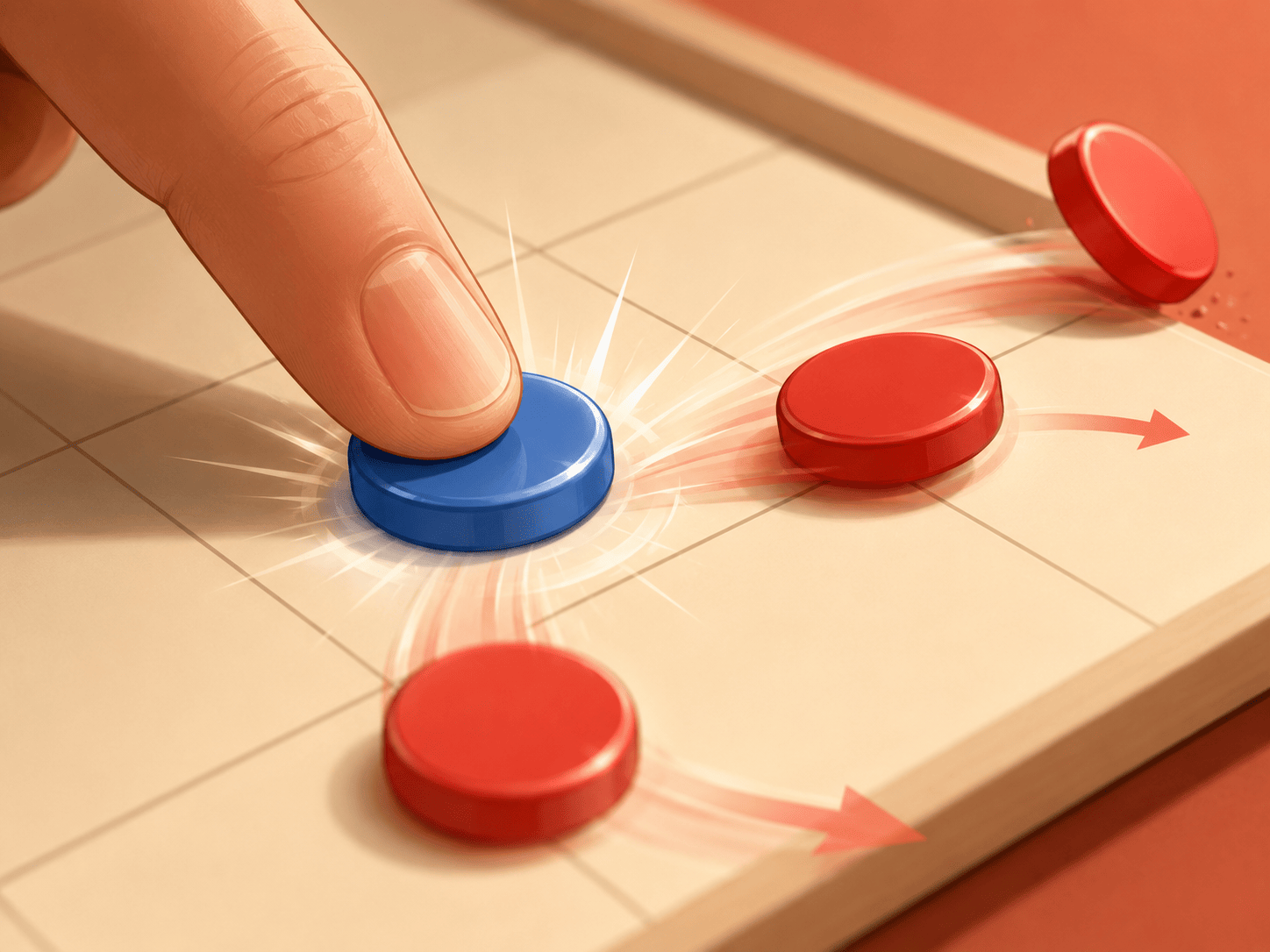
Now the honest chapter: half of the shove's pleasure is interpersonal, and games are allowed to admit this. Being pushed is a small indignity — your piece was there, and now, by someone else's hand, it isn't. Pushing is the corresponding small delight. Displacement games run on a constant low-voltage current of these micro-transgressions, and the current is precisely what makes their rivalries so lively: every game is a conversation with poking in it.
Crucially, the best push games keep the voltage friendly, and they do it through design. In Abalone, a marble shoved off the rim is gone — the transgression is permanent, and the game correspondingly severe. Oustwit makes the opposite choice: an ousted piece returns to its owner's hand — the indignity is real but the loss is temporary, tempo rather than treasure. That single design decision changes the emotional temperature of the whole game: shoves sting and are forgiven, aggression cycles instead of accumulating, and the rematch stays warm. Payback loops matter: a push game's return policy is its personality.
A quick tour of the shove family
The displacement school has more members than most players realize, and each tunes the verb differently. Abalone is the sumo branch: massed marbles pushing in lines, strength-in-numbers rules, the rim as oblivion — gravity and menace. Shobu plays the verb as poetry: four boards, mirrored moves, a shove on one board echoing on another. The physical-dexterity cousins — carrom, crokinole, every flicking game — deliver displacement literally, fingers and friction, the verb's original hardware. Even the giants borrow it in moments: the chess pawn storm bulldozing a file, the Go squeeze walking a group toward its doom, are shove-shaped plays in politer clothing. And Oustwit compresses the school onto a 6×6: placement-only, eight-direction radial pushes, return-to-hand — the shove miniaturized, systematized, and welded to the oldest goal in games. (The full anatomy of the family lives across this shelf.)
Three table moments the shove owns
Every push player collects the same three memories. They're worth naming, because they're the feeling this article keeps pointing at, caught live.
The first oust. Somebody's piece — maybe yours — goes off the board for the first time. Not captured; evicted. The table makes a sound. In a return-to-hand game the sound is laughter, because the piece sits there in the owner's hand like a boomerang that came back embarrassed. Nobody forgets their first eviction, on either end of it.
The revenge shove. Three turns after being pushed, the wounded player lines up the reply — and the whole table sees it coming except, somehow, the original shover. Push games generate narrative arcs the way quiet games generate positions: setups, grudges, comeuppances. The pieces are doing soap opera, and everyone's watching the same show.
The gasp chain. One placement, and the board does three things at once — a line scattered, a piece teetering at the rim, an accidental alignment barely dodged. Spectators gasp in unison, because visible physics synchronizes an audience the way hidden calculation never can. When designers talk about "table presence," this is the phenomenon: a game whose drama broadcasts itself. The shove owns it because the shove is the only game verb the whole room already speaks.
The design magic trick
Step back and admire what displacement does for a designer, because it's close to a free lunch. One rule — placements shove neighbors — and the game gains: tactics (breaks, herds, ousts) without a tactics chapter; defense (bracing, walls) without a defense chapter; drama (reversals, cliff-edges, chain reactions) without a drama budget; and depth (the multiplied game tree) without a single additional rule. It's the elegance ratio at its most extreme: complexity cost near zero, depth yield enormous, and the whole package pre-taught by every player's childhood.
The trick has one price, and honest design pays it openly: displacement adds chaos, and chaos taxes planners. A board where everything can move is a board where nothing stays planned — some pure strategists find that maddening, preferring the stone-still permanence of Go, and they're not wrong; they're just buying a different pleasure. The push school's answer is constraint: small boards, one-square shoves, blocking rules — walls around the physics — keeping the chaos readable, plannable, and honest. Tame the ripple without stilling the pond: that's the whole craft.
The shove in slow motion
Slow the moment of a push to quarter speed and you can watch the pleasure assemble. First, anticipation: your finger hovers, and your visual system — which has been predicting object motion since infancy — pre-renders the outcome; you feel the slide before it happens. Then commitment: the tap, the moment of no return, a micro-dose of the same thrill as releasing a bowling ball. Then confirmation: the pieces slide exactly as predicted — and prediction confirmed is one of the brain's favorite meals; it's the mechanism under every satisfying physical skill. Then, best of all, surplus: something you didn't predict — a second piece nudged, an alignment appearing — because eight directions always hold one more consequence than attention tracked. Prediction rewarded plus surprise included: that's the neurological recipe for "one more game," and the shove serves it every single turn. Quiet games serve it too — but by the plateful, at the end of long calculations. The push game serves it by the bite, continuously, which is why the evening disappears.
Feel the argument: three experiments
The narrated game. One match against the AI, narrating only the physics: "this pushes these two there; that shoved mine here." Ignore strategy entirely. You're letting the playground engine drive — and noticing how much of the game it already understands.
The spectator test. Show a complete non-player thirty seconds of a push game mid-crisis, then thirty seconds of any classic quiet game. Ask what's happening in each. The comprehension gap is this article's thesis, measured on one bystander.
The two-ponds comparison. Play one game of a stone-still classic (Go on 9×9, say) and one push duel back to back, attending to your own pulse. Stillness rewards depth of reading; displacement rewards breadth of consequence — and knowing which register your evening wants is the connoisseur's whole trick. Most players end up keeping both ponds: one for contemplation, one for the grin.
Questions people ask
Is the shove's fun just aggression? Partly — and defensibly: games are where small aggressions go to be safe. But the deeper pleasure profile is consequence-richness (the ripple) plus legibility (the visible force); pacifists report loving push games too, usually as wall-builders. The verb has room for every temperament; it just refuses to let anyone be bored.
Do push games reward planning or improvisation? Both, in ratio to your bracing: unprotected plans get scattered (improvise!), braced structures survive the weather (plan!). The school's real lesson is planning for disturbance — building what the storm can't take — which is arguably the more life-like of gaming's planning curricula.
Why does losing to a shove sting more than losing to a capture? Because captures happen to your pieces; shoves happen to your arrangements — the thing you made. That's also why the sting fades faster in return-to-hand games: nothing died, and the rematch button exists. Choose your return policy to match your table.
One-line summary? Displacement is the game verb your body already knew: it teaches in seconds, dramatizes every turn, and buys a designer oceans of depth for one sentence of rules — which is why, once a player has felt a good shove, the quiet games all look slightly asleep for a week.