Learn › Small boards, deep games › The beauty of constraints
The beauty of constraints: why less space means more tension
Give two players infinite room and they'll bore each other politely forever. Take space away — squeeze the board, ration the pieces, forbid the pass — and the same two players are suddenly locked in a knife fight over every square. This is the paradox at the heart of small-game design: constraint doesn't limit a game. Constraint is the game.
The open-field problem
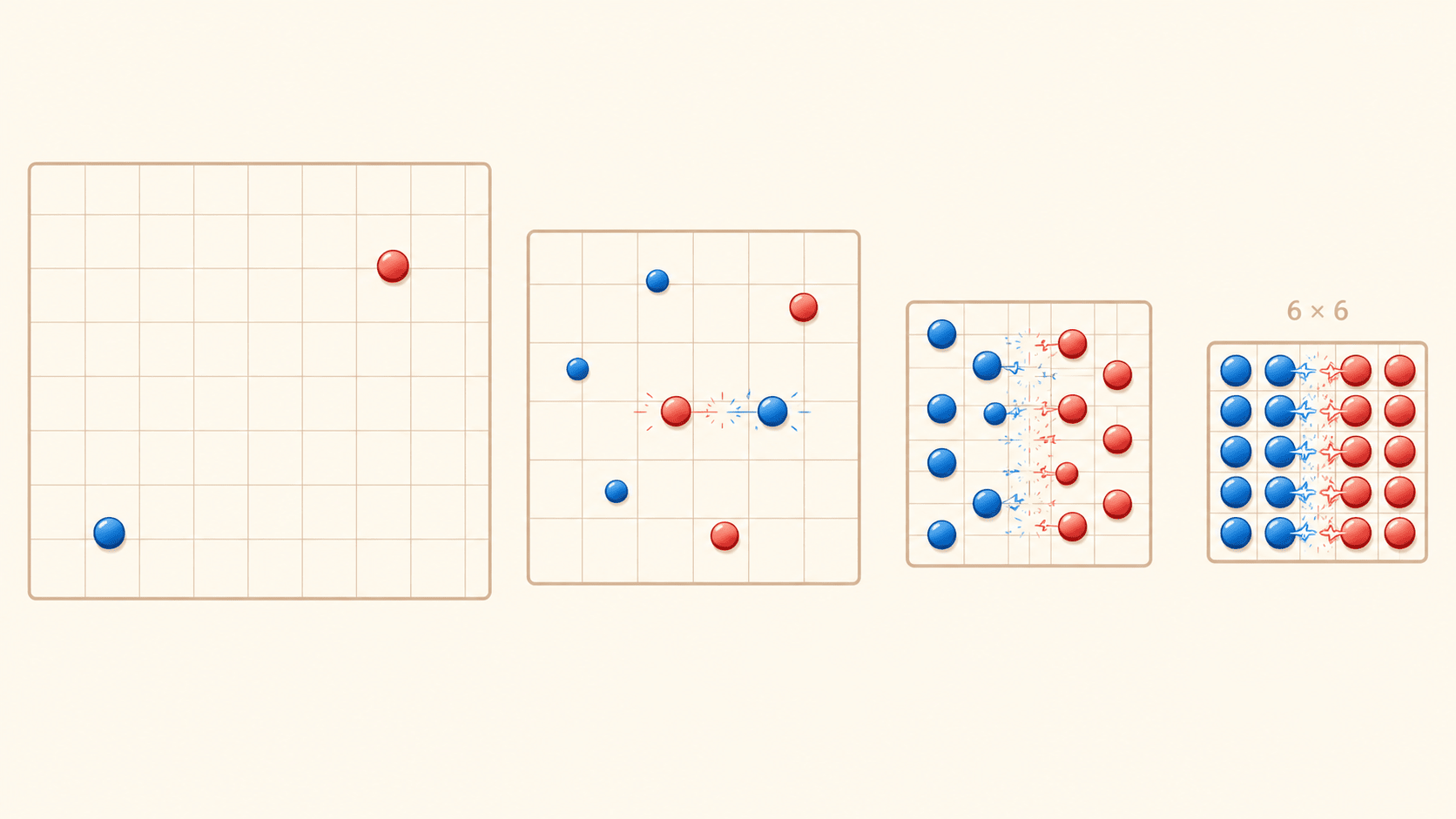
Imagine a duel on an endless grid. Place anywhere, threaten anything, retreat forever. It sounds like freedom, and it plays like fog: with unlimited room, no square is worth fighting for (there's always another), no threat is urgent (there's always an escape), and two competent players can simply avoid each other indefinitely. Openness dilutes. Games die of it — designers who prototype on big boards learn this in their bones, watching playtesters wander politely past each other like strangers in an airport.
Now shrink the field. Every removed square raises the value of the survivors. Escape routes thin; threats gain deadlines; plans start colliding because there's nowhere left for them not to. The same rules that produced fog on the open field produce tension inside walls — and nothing about the players changed. That's the core exchange this article explores: space traded for meaning, room for urgency. Strategy games don't happen in arenas. They happen in corners — and the good designers build the corner first.
The wall as co-author
A board's edge looks like where the game stops. It's actually where the game starts — the one feature every position must negotiate with, and different games cast their walls in wonderfully different roles.
In Othello, the wall is the only source of permanence: corners can't be bracketed, so the edge is where the churning board finally freezes — the game's entire endgame is a negotiation about who touches the rim's fatal approach squares first. In Abalone, the rim is death itself: six marbles off the edge loses, so the whole sumo contest is about controlling the gradient toward the cliff. In Oustwit, the edge plays both parts at once — the danger zone where a shove means a piece returns to hand, and a structural resource, since edge pieces braced from inside can't be scattered outward. And in chess, the wall is a weapon of confinement: entire mating patterns exist only because the enemy king ran out of world.
The shared lesson: edges create endgames. A wall converts "somewhere else" from an option into a fiction, and every classic's late-game character — Othello's freeze, Abalone's cliff war, the 6×6's rim scramble — is its wall's personality expressing itself. When you size up any new game, ask early: what do the edges do here? The answer is usually the game's third player.
Scarcity pricing: every square honest
Walls compress space; scarcity prices it. On a 6×6, thirty-six squares must host two players' entire ambitions — every line, every brace, every escape shares the same tiny real-estate market, and the market never sleeps. This is why square-value arithmetic (centers on twelve lines, corners on three) matters so much more on small boards: when supply is short, the good addresses are worth fighting wars over, and every placement is a bid against a rival bidder.
Scarcity also does something subtler: it makes moves honest. On a huge board, a bad move disappears into the acreage — there's room to recover, reroute, pretend it was prophylaxis. In tight quarters, a wasted square is a wasted percent of the world; errors compound fast and visibly, feedback arrives while the lesson is still warm, and the coin economy runs at full price. Small boards are strict teachers for exactly this reason — and strictness, for learning, is a gift: ten honest games teach what fifty foggy ones can't.
Constraints beyond the board
Space is only the most visible ration. The deep small games constrain everything, and each ration is a tension generator with its own flavor.
Rationed pieces. Eight per player, say. Now material is a budget, not a supply: every piece placed is a commitment of scarce capital, the morris placement phase problem — nine decisions, all permanent — in its purest form. And a piece-count win condition (land all eight) turns the ration itself into a racetrack.
Rationed actions. One placement per turn, no more, ever. The single-action turn is the strictest ration in design — no action points to spend, no combos to chain — and it forces the double-purpose discipline this shelf keeps meeting: when you get one act, acts that do two jobs stop being clever and start being survival.
The forbidden pass. You must move, always — the constraint that makes zugzwang possible and turns the turn itself into a resource with a dark side. Games that allow passing (Go, at the end) trade that whole drama away; games that forbid it keep a loaded spring under every endgame.
Rationed information? No — the opposite. The abstract family's strangest constraint is on the players: nothing hidden means nowhere to hide, no fog to blame, full accountability as a design choice. Constraint, it turns out, can bind the mind as productively as the board.
Five constraints hiding in games you love
Once you're looking, every great game reveals itself as a bundle of deliberate shortages. A quick recognition tour.
Chess: pawns can't retreat. The humblest rule in the game is a one-way ratchet — every pawn advance permanently spends space that can never be un-spent. That's why pawn moves are the moves masters agonize over longest: they're the only irreversible ink on the board.
Go: the ko rule. One tiny prohibition — you may not immediately recreate the previous position — prevents infinite capture loops, and from that single constraint blooms the entire economy of ko fights and ko threats, some of the deepest play in the game. A rule that forbids one move, generating a thousand strategies.
Connect Four: gravity. You may want any square; you may have the lowest one. The whole parity war — odd rows, even rows, banked threats — exists because placement freedom was rationed down to seven choices.
Onitama: five moves in the whole universe. Chess offers dozens of movement patterns; Onitama's dueling monks get five cards, shared and rotating. The shortage is the game.
Oustwit: one act, no pass, eight pieces. Place — that's the entire verb list — every turn, no exceptions, from a budget of eight. Three rations stacked, which is why a forty-second ruleset produces endgames where the obligation to act is itself the battlefield.
The pattern across all five: the rule that frustrates beginners is almost always the one generating the depth. When a game annoys you precisely, look closer — you've probably found its engine.
The psychology of tight spaces
Why does constraint feel so good? Because human attention is itself a small board. A vast game asks you to care about forty things dimly; a tight game asks you to care about six things intensely — and intensity, not scope, is what the nervous system files under thrill. Players describe the same signature sensations: the pleasant claustrophobia of a filling 6×6, the weight of a decision when every square is somebody's plan, the heightened stakes of contact that arrives by move two and never leaves. Small boards produce the emotional register of an elevator argument — nowhere to go, everything at close range — which sounds unpleasant and is, in games, exactly the good part.
There's a creative payoff too, and it's the same one poets report. The haiku's seventeen syllables, the sonnet's fourteen lines, the blues' three chords: severe constraint doesn't strangle invention — it focuses it, forcing depth where breadth is forbidden. Players under tight rations invent harder: the shove that defends by attacking, the brace that doubles as a line, the sacrifice that spends the one thing you had spare. Freedom lets you do anything, which is why it produces so little. The wall, pressing back, is what gives the push meaning — on boards, in verse, and (the suspicion is hard to shake) rather beyond both.
The designer's dial (and the home tinkerer's)
Constraint isn't a setting a game has; it's a dial designers turn, and watching the tuning demystifies the craft. Playtests of a new duel typically start too loose — the fog problem — and tighten iteratively: shrink the board a size, cut the piece count, remove an action, forbid the pass. Each turn of the dial trades freedom for tension, and the designer is listening for the click where players stop wandering and start colliding — with enough doors left open that the collisions stay decisions rather than corridors. Too loose: polite fog. Too tight: a solved hallway. The click lives between, and finding it is most of what "balancing a small game" means.
The dial is yours too, which is the home-tinkering lesson: when a family game runs long and loose, tighten it — smaller board, fewer pieces, a forbidden move — and watch the tension arrive on schedule. Loosening, by contrast (more space, extra powers), almost always thins the soup. The whole century of five-in-a-row law was constraint-tightening in public, and your kitchen table is allowed the same jurisprudence, one house rule at a time.
Test it tonight: the two-field experiment
Feel the whole article in twenty minutes. First, play any placement game — tic-tac-toe rules will do — on a big hand-drawn grid, ten by ten, line of three still wins. Notice the fog: threats everywhere and nowhere, blocks optional, the game wandering. (You've just met the open-field problem, and incidentally re-derived why scaled boards demand longer lines.) Then play the tightest game you own — the 6×6 duel on your phone is ideal — and attend to the difference in your own chest: decisions arriving with weight, squares mattering by name, the walls pressing every plan against every other plan.
Same evening, same brain, two spatial economies. Most players come back from the experiment with the article's thesis installed as instinct — and with a new eye for the moments big games manufacture smallness (the chess king hunt in a corner, the Go fight in one cramped quadrant, the endgame anywhere): the constraint contracting until, for a few critical moves, even the giants become small boards. Because that's the quiet secret at the end: tension lives in tight spaces on every board ever made. Small games just refuse to make you wait for it.
Questions people ask
If constraints are so good, why do giant games exist? Because scope buys different pleasures — campaigns, geography, the long arc — and because the giants generate their own local smallness when it counts (every chess endgame is a tiny board wearing a big one). It's a spectrum of where the tension lives, not a ranking. The honest-limits section next door treats both sides fairly.
Can a game be too constrained? Yes — squeeze until only one reasonable move exists per turn and you've constrained the decisions away: tic-tac-toe's fate, over-tightened into a solved corridor. The design target is walls tight enough to force contact, loose enough to leave real choice — the corridor with three doors, never one.
Do added constraints make house-ruling safer or riskier? Usually safer than adding freedoms: banning a move, shrinking a board, or rationing a resource tends to sharpen casual games (the entire Renju tradition is constraint-as-repair), while granting new powers tends to blow balance apart. When tinkering at home: subtract first.
One line to keep? Space is the cheapest thing a designer can give you and the most expensive thing they can take away — and the games that take it away are the ones you'll still be playing when the sprawling ones are shelved.