Learn › The classics › Othello and Reversi
Othello and Reversi: a minute to learn, a lifetime to master
One game gave the whole hobby its favorite slogan — and then spent fifty years proving it wasn't marketing. Othello is the game of the flip: discs that change sides in cascades, fortunes that reverse in one placement, and a strategy so counterintuitive that being ahead usually means you're losing. Time to meet the trickiest classic on the shelf.
The slogan that named a genre's promise
"A minute to learn, a lifetime to master" entered the world as Othello's advertising line when the modern game launched out of Japan in the 1970s — and it became the mission statement every abstract game has been measured against since. It's the depth-per-rule ideal in seven words: entry cost of nothing, ceiling out of sight.
Does Othello deliver? The minute is real: place a disc so it brackets enemy discs between itself and one of yours; everything bracketed flips to your color; most discs at the end wins. That's the entire rulebook, teachable across a coffee. The lifetime is real too — world championships since the 1970s, a professional literature of openings and endgame technique, and a strategy layer so inverted from first appearances that Othello functions as the hobby's best-documented lesson in why beginners' instincts betray them. The game's history runs deeper than the branding: its ancestor Reversi was a Victorian English invention, and the modern standardized version — fixed starting position, the trademark name, the green felt and flip-discs — is the twentieth-century refinement that conquered the world. Same soul either way: everything below applies to both names.
The flip: one mechanic, endless whiplash
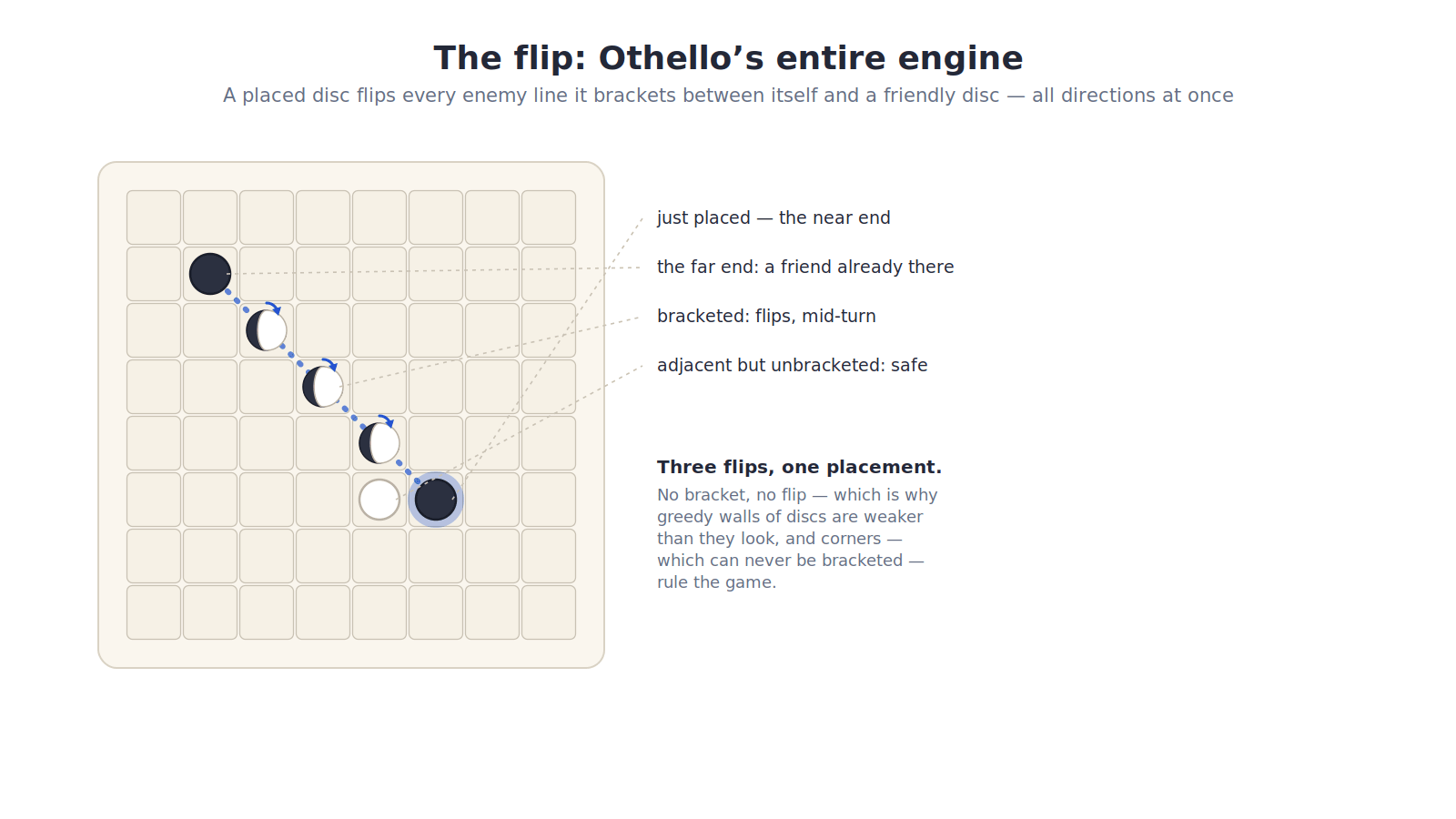
Othello's engine is capture-by-bracketing, and its personality comes from three properties of that engine.
Flips are total. A bracketed disc doesn't retreat or die — it defects. Material in Othello is never destroyed, only converted, which makes the game's material count the most volatile in all of classic gaming: a single placement can flip a dozen discs across four directions at once, swinging the score by twenty-plus in a stroke. No other classic delivers reversals this large, this legally, this often.
Flips are chained to geometry. You can only place where you bracket — every legal move must flip something. Your options each turn are dictated entirely by the pattern of discs, which means players don't really own discs; they own the shape of the position, and the shape decides who has moves at all. Hold that thought; it becomes the whole strategy.
Flips flow both ways. Every disc you flip today sits on the board as material your opponent can flip back tomorrow. Nothing is settled until it's stable — uncapturable — and almost nothing on an open board is stable. The beginner sees a scoreboard; the veteran sees a tide pool, all of it still moving.
The whole rulebook, stated plainly
Since the minute-to-learn claim is on trial, here's the actual minute. The board is 8×8. The game starts with four discs in the center: two of each color, diagonal to each other. Black moves first.
On your turn, place one disc of your color on an empty square. The placement must bracket at least one enemy disc: a straight, unbroken line of enemy discs with your new disc at one end and another disc of yours at the other. Every enemy disc in every line you bracket flips to your color — horizontals, verticals, and diagonals, all at once. If you have no legal placement, you pass. If neither player can move, the game ends. Most discs wins. That's everything. No captures leave the board. No piece ever moves after placement. The game lasts at most sixty placements, which is why a full game fits in a coffee break.
One minute, as promised. The lifetime starts the moment you notice that following these rules greedily loses almost every game — which is the next section.
Your first three games, narrated honestly
Here's what actually happens to every new Othello player, so you can enjoy it instead of being ambushed.
Game one: the feast. You flip big lines. It feels wonderful. Six discs here, eight there — by mid-game the board is a wall of your color, and you're mentally drafting your victory speech. Then, somewhere around move forty, something odd happens: you start running out of good moves. Every placement you have left flips things you didn't want to flip, or hands your opponent an edge. Your opponent, who seemed asleep, suddenly takes a corner. Then everything near it. The final count isn't close, and you stare at the board wondering what happened. What happened was the mobility trap — your feast was the trap.
Game two: the overcorrection. Burned once, you now flip nothing. You hoard tiny quiet moves. Better! But you treat all quiet moves as equal, wander onto an X-square around move thirty, and hand over a corner anyway. Closer game. Same ending.
Game three: the beginning. Now you're watching options, not discs. You count who has more moves available. You skip the X-squares. You lose again, probably — but now it's close, and you can see the game. That's the real minute-to-learn: three games to unlearn your instincts. Everything after that is the lifetime, and it's a good one.
The beautiful backwards heart
Now the reason Othello earns its place on this shelf: almost everything a reasonable person assumes about it is wrong, and the corrections are one of gaming's great mind-openers.
Having more discs mid-game is usually bad. Read that again; it's not a typo. A mid-game wall of your color is a wall of targets — every disc of yours adjacent to empty space is a bracket waiting to happen, while your opponent's sparse position offers you nothing to flip. And since every legal move must flip something, the player with fewer discs tends to have more moves available, and the player smothered in material starts running out of legal placements entirely. Champions routinely cruise through the middlegame twenty discs "behind," perfectly content.
The real currency is mobility. Othello's strategy, one level down, is a fight over who will have choices: maximize your future legal moves, minimize theirs, and the endgame plays itself — a cramped opponent must eventually make self-wounding placements, handing you the flips you politely declined to grab earlier. If you've read the initiative article, you've met this exact idea wearing its Othello uniform: mobility is initiative held as inventory. Quiet moves that flip one disc — ideally an inconspicuous one — are the professional's bread and butter, while the beginner's maximum-flip feasts are usually donations to the tide.
The endgame inverts everything again. In the final dozen moves, material suddenly matters enormously — stability spreads, flips become permanent, and the greed that was poison at move twenty is the entire point at move fifty-five. Learning when the flip flips — the moment the game switches from mobility-currency to disc-currency — is the core of intermediate Othello, and a lesson in phase-awareness that transfers to every game with hot and cold periods.
Corners, edges, and the geometry of forever
Why does everyone — even people who've played Othello twice — know that corners matter? Because the corner is the board's only unconditionally stable square: no line passes beyond it, so a corner disc can never be bracketed, never flips, and never leaves. From a corner, stability spreads: edge discs anchored to a corner become uncapturable too, then diagonals behind them, whole regions crystallizing into permanent territory. Corners are where the tide pool freezes.
The deep lesson isn't "grab corners" — it's the negative space around them. The squares diagonally adjacent to corners (players call them X-squares) and beside them (C-squares) are the most dangerous real estate in the game: place there carelessly and you hand your opponent the bracket that delivers the corner itself. Strong players treat X-squares like landmines for forty moves, and half of practical Othello strategy is maneuvering your opponent into being the one who must touch them first — pure move-starvation warfare, played with real estate. The parallel to every game on this shelf is exact: the board's geometry creates squares of wildly different value, and knowing the map beats knowing tricks.
Modern Othello: the scene and the science
Othello's competitive world stayed vigorous into the present: world championships with national teams, a strong online scene, and — this being the computer age — engines far beyond human strength that have refined opening theory to a science. The full 8×8 game remains formally unsolved, with expert consensus and machine analysis pointing toward a draw under perfect play; the smaller 6×6 board has been solved by computation — a second-player win, pleasingly contrary — putting Othello's little sibling on the solved shelf while the main game keeps its secret. As with every solved-or-nearly game: between humans, nothing whatsoever has changed. The tide pool doesn't care what God would do with it.
One more modern note: Othello may be the classic that benefits most from digital play. Physical Othello involves a lot of disc-flipping bookkeeping (and a lot of "wait, did we miss that diagonal?"); apps flip flawlessly, legal moves are highlighted, and the game's short length — a guaranteed sixty moves maximum — makes it a perfect pocket duel. Purists keep the satisfying click-flip of the physical discs for the table; everyone else discovers the game runs beautifully on a lunch break.
A five-lesson starter course
Lesson one: flip less. For one whole game, choose the legal move that flips the fewest discs. You'll feel ridiculous and finish the middlegame with more options than your opponent — the mobility lesson, self-taught in twenty minutes.
Lesson two: play the frontier consciously. Discs bordering empty space ("frontier discs") are your liabilities; interior discs are quiet strength. Before each move, glance: does this placement bloat my frontier or shrink it?
Lesson three: respect the minefield. No X-squares or C-squares without a concrete reason. When you must eventually touch one — the count often decides who's forced first — choose the one farthest from a corner your opponent wants.
Lesson four: count the last dozen. From ten empty squares onward, switch brains: now flips are forever, parity of remaining moves matters, and the player who counts the final sequence — who moves last, which regions fill on whose turn — collects the corners and the game. Endgame counting is Othello's most learnable expert skill.
Lesson five: lose to the pattern, not the score. Reviewing losses, ignore the disc count entirely (it lies all game); find instead the move where your options started shrinking. That inflection — visible in any replay, since nothing was hidden — is where Othello games are actually decided, and learning to see it is graduating from the scoreboard to the game.
Watching a game: the spectator's cheat sheet
Othello is unusually good to watch once you know where to look — matches are short, swings are visual, and the real story runs under the disc count. Four things to track from the rail. The frontier: whose discs border more empty space? That player is carrying more liability, whatever the count says. The move lists: good broadcasts (and good apps) show legal moves — watch the number of each player's options shrink or grow; that curve is the actual scoreboard. The minefield clock: as safe squares run out, someone will be forced to touch an X-square first — you can often see the compulsion coming three moves away, pure musical chairs. The last ten discs: endgame counting, where the tide freezes and every flip is forever — the phase where champions earn their titles and casual games flip winners twice in three moves. Watch two games with this sheet and your own play jumps a level without touching a disc.
Questions people ask
Othello or Reversi — which name is right? Both: Reversi for the Victorian ancestor and generic versions, Othello for the standardized modern game (fixed diagonal start, trademarked name). Rules differences are minor to none in common play; the strategy in this article applies to both.
Why do I keep losing while ahead? Because ahead-in-discs usually means behind-in-position: bloated frontier, shrinking options, X-square obligations queuing up. Othello's scoreboard is the most deceptive in classic gaming — treat mid-game disc counts as noise, or better, as a contrary indicator.
Is it closer to Go or to chess? Strategically it's a cousin of Go (territory, stability, influence) played with chess's sharpness — one-move swings everywhere. Players of Go recognize the frontier instantly; chess players recognize the tactical whiplash. Everyone recognizes losing their first ten games to whoever taught them.
Fastest way in? Any app with legal-move highlighting, lesson one above (flip less), and ten games. Othello's learning curve is steep exactly once — the backwards heart — and the whole climb fits in an evening. After that, the lifetime part begins, precisely as advertised.