Learn › Push, pull, slide › Blocks and walls
Blocks and walls: the defensive side of pushing
Everyone learns the shove first — it's loud, it's fun, and it wins the early games. Then somewhere around game twenty, you meet a player whose pieces simply don't move when you push them, and the education begins. This is the quiet half of every displacement game: the blocking rule, the wall, the anchor — and why, in the long run, the defenders collect the trophies.
The rule that stops the world
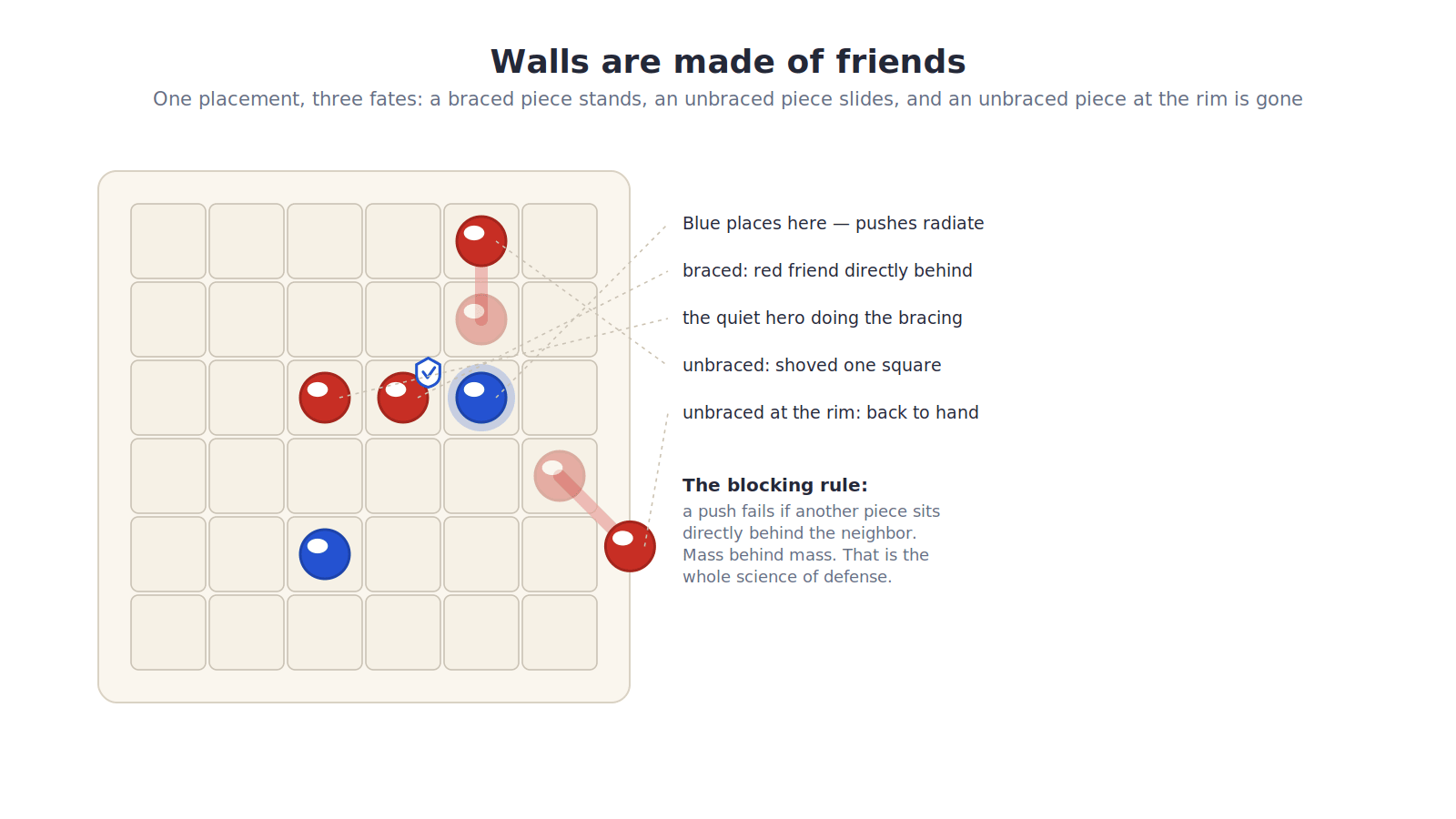
Every push game has an off switch, and in Oustwit it's one sentence: a neighbor isn't pushed if another piece sits directly behind it. The shove needs somewhere for the piece to go; occupy that square and the physics simply fails — no shove, no slide, nothing. The attacker's placement still lands, still pushes its other eligible neighbors, but the braced piece stands like a bollard.
Sit with how strange and how deep that is. Offense in a displacement game is automatic — every placement pushes, whether you meant it or not. Defense is the opposite: it never happens by accident. A block exists only because somebody put mass behind mass on purpose, one move earlier or five. Which means that when you watch a push fail against a braced pair, you're seeing the game's only premeditated structure — evidence of a player who thought about the future. The whole skill gap between shovers and players lives in that difference. (Abalone runs the same principle as arithmetic — pushes succeed only with more marbles in-line than the defenders — and the family lesson generalizes: displacement defense is always mass behind mass.)
Walls, and what they're made of
Scale the blocking rule up and you get architecture. A pair — two of your pieces in line along a threat axis — is the atom of defense: the front piece unpushable from that direction, the back piece spending its turn-equivalent as armor. An L covers two axes with three pieces. A braced line — your forming three-in-a-row with a friend behind its middle piece — is the structure the line-building article calls the difference between a threat and a wish: scatter-proof along the axis that matters.
Two properties of walls deserve engraving. First, walls are directional. A pair braces exactly one axis; the same front piece is fully pushable along the other three. Real defense is therefore a reading exercise — from which squares can an attacking placement actually arrive? — and the economical defender braces the live axes only, spending nothing on directions geometry already guards. Second, walls have jobs on both sides of the ball. The back piece of a brace isn't just armor: it's a piece on the board, counting toward the fill race, sitting on its own lines. The best walls moonlight — brace a line and extend one, guard an anchor and claim a lane. Single-purpose defense is affordable; double-purpose defense is how the coin economy gets won from the back foot.
The anchor: one square that organizes a region
Among defensive ideas, the anchor is the quiet aristocrat: a piece that — through bracing, geometry, or both — has become effectively immovable, and around which everything else can be arranged with confidence. Anchors change the local physics. Pieces adjacent to an anchor can be braced by it; lines built through it can't be scattered at that point; and plans that route through an anchored square inherit its certainty, the way a climber trusts a bolted hold.
Where do anchors live? Mostly in the interlocking middle of your own structure — the piece braced on two axes by friends who are themselves braced, defense compounding like interest. The board's edge plays a double game here and deserves precision: a rim piece can never be pushed along the rim into oblivion by an inside placement on its row — but it stands one diagonal shove from the void, so the rim is an anchor's wall on one side and a trapdoor on the other. Edge anchors are real and valuable — brace the inside lanes and the board itself guards your back — but they're earned structures, not free ones. The corner, guarding two sides, is the cheapest anchorage in the game and correspondingly prime retirement property for a fill-race piece. (The walls-as-co-author principle, cashed into technique.)
The price of the fortress
Now the chapter that keeps this article honest: defense in Oustwit cannot be a lifestyle, because the game was designed — rather pointedly — to punish turtles. Every brace is a piece not spreading; every armor turn is a coin spent on insurance; and while your fortress admires itself, two clocks run against it. The opponent's line game operates wherever your walls aren't — walls are directional, boards are wide. And the fill race ticks regardless: a player who braces eight pieces into a beautiful immovable castle has also, notice, placed all eight pieces — and if the opponent lands their eight first because you spent turns armoring instead of racing, the castle loses by rule. Pure defense is a slow resignation with good posture.
So the working doctrine is the one every deep game converges on: defense as a spring, not a shell. Brace what enables offense — the line's middle piece, the anchor your race runs through — and let the merely-nice pieces take their chances in the weather. The wall's purpose is never safety; it's guaranteed tempo later: structures the opponent can't profitably touch are structures you'll never spend repair-coins on, and the savings fund the attack. Watch strong players and count their braces: few, load-bearing, and almost always doing second jobs. The fortress fantasy is for beginners; the veterans build bones.
A wall built in four moves (while racing)
Doctrine lands better as narration, so here's a defender's mid-game, four placements long, doing everything this article preaches at once.
Move one. You place toward your forming line — and the square you choose happens to sit directly behind the line's middle piece, along the axis their pushes have been arriving from. Extension and brace, one coin. The wall's first stone doesn't look like a wall; it looks like progress, because it is both.
Move two. Their placement shoves at your line's middle piece. It doesn't move. You watch them recalculate in real time — the plan they'd been building for three turns just hit the bollard. They spend their next thought, and their next coin, somewhere less prepared. That silence was your armor paying rent.
Move three. You place your sixth piece in the corner region — the board's cheap anchorage — where the walls guard two of its sides for free. It braces nothing yet. It's a fill-race deposit in the safest bank on the board, and it will never cost you a repair coin.
Move four. Their attack, rerouted, comes at your line's end piece instead — unbraced, and you knew it, because your pre-read flagged that pad two turns ago. You let it slide. The end piece was the wall's designated sacrifice: one square of drift you'd already priced, while the middle holds and your seventh piece lands. The fortress fantasy would have braced everything; the bones braced two squares and won the race.
That's the whole quiet half in one exchange: double-purpose stones, directional armor, cheap anchorage, priced losses — and not one turn spent on defense that wasn't also spent on winning.
Reading an attack before it lands
Practical defense is mostly pre-reading, and the pre-read has a checklist. For any piece of yours that matters, ask: which adjacent squares are empty? Each is a potential attacker's landing pad. For each pad, where would the shove send me? One square directly away — trace it: empty (you slide), occupied (you're braced — by whom? do they stay?), or off-board (you're ousted). And what does the attacker's piece do after landing? The shove is bundled with a placement — the best attacks put the new piece somewhere useful, so a pad that's also a good square for them is doubly live. Three questions per important piece, a few seconds each, and incoming weather stops being surprise and becomes forecast. It's the defensive mirror of the ghost-board read, and together they're most of what "board vision" means in a push game.
Three drills that build the mason's eye
Survive ten. Against the AI, your only goal for the first ten turns: no piece of yours ousted, no line of yours scattered. Winning is irrelevant. You'll over-brace horribly — and learn in one session which braces were actually needed, which is the entire lesson.
Protect the line. Build a two-in-a-row early and keep those two specific pieces alive and aligned for the whole game, completing it whenever the moment comes. Teaches braced-line maintenance and the patience of the late reveal.
Break the siege. Hardest and best: let the AI (medium or above) develop freely for five turns while you place only in one quadrant — then dig out. You'll learn counterattack-from-compression, the defender's spring released, and you'll never fear a cramped opening again. (Players of checkers and Othello will recognize the drill's flavor — cramped positions with counterplay are the family's shared graduate course.)
Questions people ask
Can a brace be broken? Not directly — the block is absolute while the back piece stands. The attacks that work are indirect: shove the back piece away along its own unbraced axis (armor has axes too), or force the front piece sideways with a placement from a different direction. Deep braces — three pieces interlocking — exist precisely to close those side doors, at three pieces' rent.
Is bracing worth it in the opening? Rarely. Early boards are empty — threats are cheap to dodge by simply having options — and early braces are usually decorations with insurance paperwork. Bracing earns its coins from the midgame on, when lines are forming and the fill race is real. Exception: a brace that's also development (the pair that extends toward a line) is fine anytime — the double-purpose rule outranks the timing rule.
Which do I brace first, line pieces or race pieces? The piece that appears in both plans — the line-middle that's also a settled fill piece is the most valuable square on your board, and its brace pays double. Where no piece overlaps, brace whichever win condition your position is actually pursuing; walls, like every coin, follow the plan.
One line to keep? Anyone can push — the rules do it for you. Standing still is the part you have to earn: mass behind mass, few walls, all of them load-bearing, all of them moonlighting. That's the quiet half of the game — and over a long rivalry, it's the half that gets engraved on the trophies.