Learn › Small boards, deep games › Depth vs. complexity
Depth vs. complexity: they're not the same thing
Two words get used interchangeably at every game table, and confusing them costs players money, evenings, and the occasional friendship: complexity is what you must carry; depth is what you get to discover. Pulling them apart is a ten-minute upgrade to your taste — and your buying.
Two words, two directions
Complexity is the load a game puts on you before the thinking starts: rules, exceptions, icons, piece types, upkeep steps, the fifteen-page rulebook, the forty-minute teach, the "wait, can I do that?" lookups mid-game. It's measured in what you must remember, and you pay it whether or not the game repays you.
Depth is the volume of meaningful discovery a game holds once you're playing: strategies that keep emerging, judgments that keep sharpening, the property this shelf has been circling all along — more futures than you can see, still surprising you at play five hundred. It's measured in how long mastery keeps receding as you approach it.
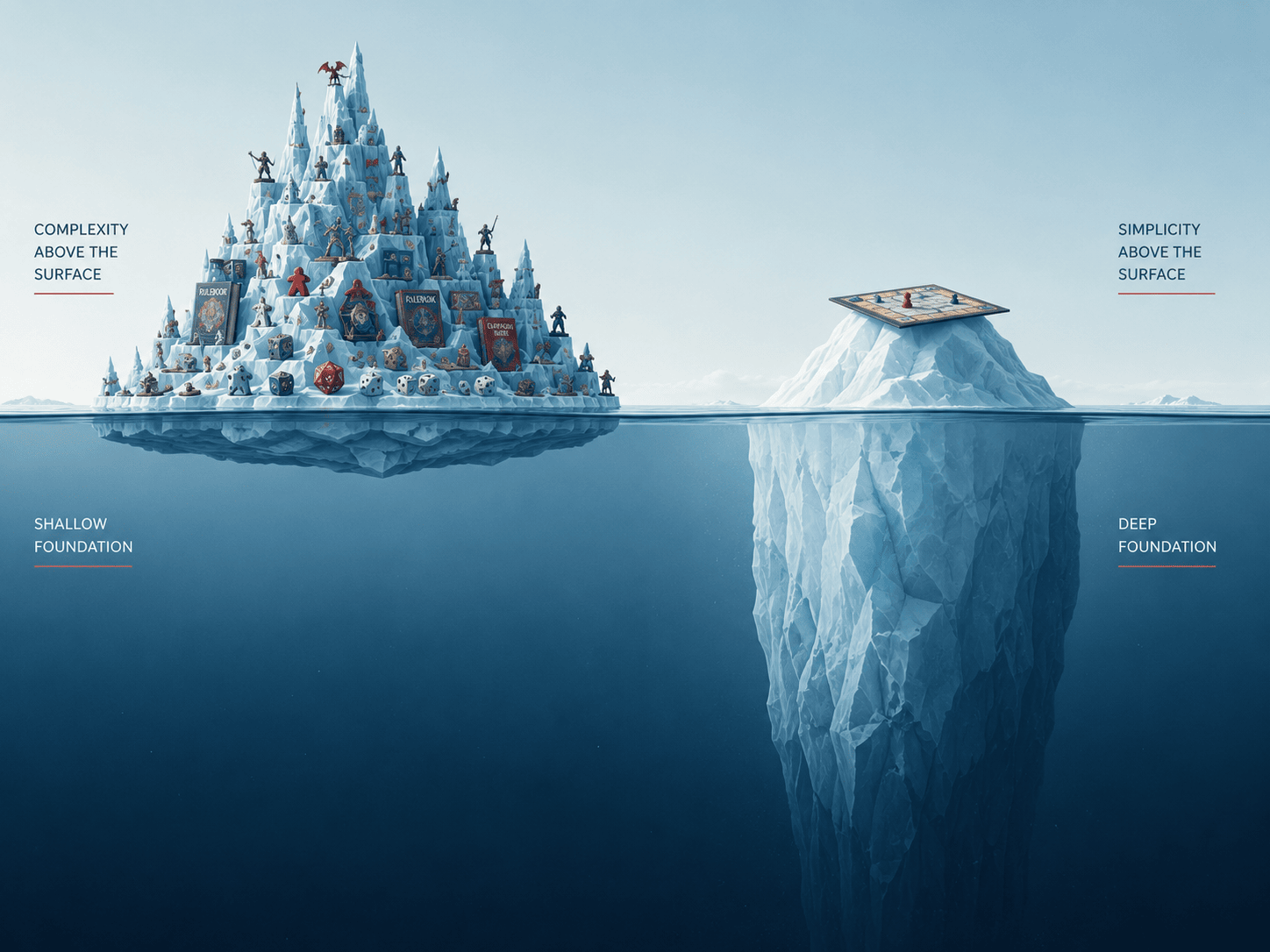
The crucial fact — the whole article in one line — is that the two are independent axes. Games can be high on either, both, or neither, and the four combinations produce four utterly different species that the words "simple" and "complicated" mash together. Untangling them explains most of the arguments you've ever had about whether a game is any good.
The four quadrants, with residents
Simple and shallow. Light rules, quickly exhausted: tic-tac-toe (retired by age nine), war-the-card-game, most promotional freebies. Honorable as teaching tools and time-passers; nobody's lifetime game.
Complex and shallow — the trap quadrant. Heavy rules concealing few real decisions: the sprawling box where forty minutes of setup and exception-handling deliver a game whose turns, once decoded, mostly play themselves. This quadrant photographs magnificently — miniatures! dashboards! — and reviews badly at play fifty, because rules mass was doing the work depth should have done. Every experienced gamer owns one shelf-regret from here; the field guide's red flags are substantially a map of this quadrant.
Complex and deep. Heavy rules that genuinely fund heavy discovery: serious wargames, the grand hobby epics, the simulations whose exceptions each earn their keep. Real masterpieces live here — at a real price: the complexity tax is charged to every player, every session, and the audience narrows to those who'll pay it. Worthy, demanding, occasionally worth the whole weekend.
Simple and deep — the ideal. Rules in a minute, discovery for decades: Go is the eternal exhibit; checkers, Othello, oware, and the modern small-board school — Oustwit included — all compete in this corner. The whole abstract tradition is, at bottom, a centuries-long pilgrimage toward this quadrant, and "a minute to learn, a lifetime to master" is its address.
Where complexity hides (an audit checklist)
Complexity isn't only page count — it lurks in places the box never admits. Exception load: every "except when," "unless," and "in this phase only" is a rule you'll carry forever; ten exceptions cost more than twenty clean rules. Upkeep: steps executed between decisions — refill, refresh, resolve, advance the track — are complexity charged per turn, the administrative overhead of fun. Lookup dependency: if normal play routinely consults charts, glossaries, or the rulebook's index, the game has outsourced its memory to your evening. State you must track mentally: hidden counts, triggered abilities, whose modifier applies — invisible weight, heaviest of all. The audit matters because complexity compounds against attention: every unit spent carrying rules is a unit unavailable for the actual thinking, which is why the heaviest game at the table is often being played worst by everyone at it.
Note what's absent from the list: number of possible strategies, difficulty of mastery, richness of decisions. Those are depth. A game is not complex because it's hard to play well — Go is the standing refutation, four rules and bottomless — and a game is not deep because it's hard to learn. The conflation runs both directions, and both directions cost you.
Where depth comes from (and why it's cheap)
Here's the wonderful asymmetry the ideal quadrant exploits: depth doesn't come from rules mass — it comes from rules that collide. A handful of clean mechanisms, forced to interact, generate combinatorial futures no rulebook could enumerate: placement plus displacement (every move rewrites the neighborhood), one goal pulling against another (tension, sign three), simple captures compounding into forced cascades. The depth of the simple-deep classics is emergent — nobody wrote the double mill or the granary or the slide-finish into any rulebook; they grew in the space between three rules, and players are still finding rooms in houses whose blueprints fit on a card.
That's why depth, unlike complexity, is nearly free to the player: it charges nothing up front and meters itself to your curiosity. You can enjoy oware counting two sows ahead or eight; the game scales to the mind it meets. Complexity can't do that — the fifteenth exception applies to the beginner too. The design lesson (and the buying lesson) in one sentence: rules are a cost, interactions are an asset, and great games maximize the ratio. Call it elegance — this shelf has been using the word all along, and now it has its formula: depth per rule.
The shelf test: sort five games you own
The quadrants become yours the moment you sort your own collection, so do it now, mentally, with five games you know well. For each, two questions. First: how long was the teach, and how often does play pause for a lookup? That's the complexity score. Second: after ten plays, were you still discovering — or executing? That's the depth score.
Most people's sort produces the same discoveries. One game you own is beloved because it's simple-shallow — the pure social lubricant, and now you can stop feeling guilty about it. One heavy box scores complex-shallow, and naming it is oddly freeing: you're allowed to trade away a game whose weight was doing the work its decisions couldn't. Your most-played game almost certainly sits in or near the simple-deep corner — most-played is the metric that quadrant always wins. And the heavy game you genuinely love lands complex-deep, which tells you its exceptions are earning rent.
Do the same sort in reverse when buying: before the reviews, before the art, ask which quadrant the game is trying to live in. A design aiming at simple-deep and missing lands in simple-shallow — a cheap mistake. A design aiming at complex-deep and missing lands in the trap quadrant — an expensive one. Aim, it turns out, is most of what a shelf's regrets have in common.
How designers cut weight (a look inside the workshop)
The simple-deep corner isn't reached by having few ideas. It's reached by deleting — and watching what good designers delete teaches the distinction better than any definition.
Playtesting kills exceptions first: the "unless" clauses merge into the main rule or die. Phases collapse — three-step turns become one decisive act. Bookkeeping gets automated into the components themselves or removed outright. Scoring systems shrink toward states a player can see (a line exists; the board is full) rather than tallies someone must compute. Every deletion is a bet that the interactions between the surviving rules will regrow, as emergence, whatever richness the cut rule provided by decree.
A worked example this site knows intimately: a duel with exactly one action (place), no captures at all (the push and return-to-hand instead), no scoring (two visible win states instead), no piece types, no phases. Practically everything a game could have was deleted — and each deletion's job is done by an interaction: the push generates tactics no capture table could list, the dual win conditions generate the tension a scoring system would have bought with arithmetic. Whether any particular game succeeds is for players to judge — but the method is the whole simple-deep tradition in miniature: rules are what you pay; interactions are what you keep; delete until only the engine remains.
Why the confusion persists
If the distinction is this clean, why does everyone keep blurring it? Three honest reasons. Complexity photographs; depth doesn't. A table crowded with components signals "serious game" at a glance, while Go's four rules look, in a store, like nothing at all — the marketing gravity pulls one direction, and it isn't toward the ideal quadrant. Complexity is provable in a demo; depth needs fifty plays. A reviewer can verify the rulebook's weight in an afternoon; verifying a lifetime of discovery takes, inconveniently, a lifetime — so "complex" becomes the lazy proxy for "deep" in most coverage. And learning them feels identical at first. Both hit the newcomer as difficulty; only later does the difficulty resolve — complexity into memorized bookkeeping, depth into ever-better questions. The gamer who has felt that fork in the road once never confuses the words again, which suggests the confusion is mostly a stage, and articles like this one are just a shortcut through it.
Choosing your budget
The practical payoff is budgeting, because the two axes bill different accounts. Complexity charges attention and time — scarce, non-renewable, and (for the audience this site knows best: adults with jobs, kids, and commutes) already overdrawn. Depth charges curiosity — pleasantly renewable, and the thing you came for. So the budgeting rule writes itself: spend complexity only where it demonstrably buys depth, and default to the simple-deep quadrant for daily play. The heavy masterpiece earns its Saturday; the pocket concentrate earns the other six days, because five stolen minutes can hold real decisions only if none of them are spent on upkeep — the exact logic of the phone-shaped game.
And one self-knowledge note: the hobby contains people who genuinely savor complexity — the systems, the chrome, the mastery of the manual itself. That's a real pleasure and this article isn't here to shame it, only to name it accurately: enjoying complexity is enjoying simulation; enjoying depth is enjoying contest. Knowing which appetite tonight's hunger actually is will pick your shelf faster than any review.
Try it tonight: the two-diary experiment
The distinction becomes permanent with one evening of note-taking. Pick two games — one heavy box you own, one simple-deep classic (any of the shelf's residents, or the duel on your phone). Play each for thirty minutes and keep two tallies per game, nothing fancy: a mark every time you consult rules, resolve upkeep, or explain an exception (the complexity diary), and a mark every time you face a decision where two moves genuinely pull at you (the depth diary).
The tallies do the teaching. The heavy game typically logs fifteen-plus complexity marks and a handful of real dilemmas; the classic logs near-zero complexity and a dilemma every minute or two. Neither result says which game is "better" — it says what each one charges and what each one pays, in your own handwriting. Most players who run the experiment once report the same aftermath: they still love their heavy game, they schedule it differently, and they never again mistake the weight of a box for the weight of its decisions.
Questions people ask
Can complexity ever create depth? Indirectly, yes — some decision spaces (grand campaigns, economic webs) may be unreachable without heavy rules, which is the complex-deep quadrant's whole justification. The test stays the same: is this exception funding discovery, or just weight? Great heavy games pass rule by rule; bloated ones pass the test never and the photograph always.
Is chess complex or deep? Moderately complex (six piece types, castling, en passant — a real but modest load) and enormously deep: the classic case of a game most of whose difficulty is the good kind. Go undercuts it on the complexity axis at similar depth, which is exactly the comparison that makes the two-axis model click for most people.
How do I estimate depth in a store aisle (or app listing)? You can't verify it, but you can bet wisely: count the rules (few is promising), hunt the tension between goals, check the age of the design or its lineage (survival is depth's best witness), and run the fifteen-minute audition the moment you're allowed to. Depth per rule leaves fingerprints even in a demo.
One sentence to take to the table? When someone calls a game "complex," ask which iceberg they measured — the one above the waterline, or the one below. The answer sorts the game, and occasionally the reviewer.