Learn › The classics › Mancala
Mancala: the world's oldest strategy engine
Rows of pits, a handful of seeds, and one motion — scoop and sow — repeated for centuries across more of the world than any other game mechanism has ever reached. Mancala isn't a game; it's a family of hundreds, older than most empires and deeper than its schoolroom reputation. Here's the engine, the family, and the way in.
The game you've seen even if you've never played
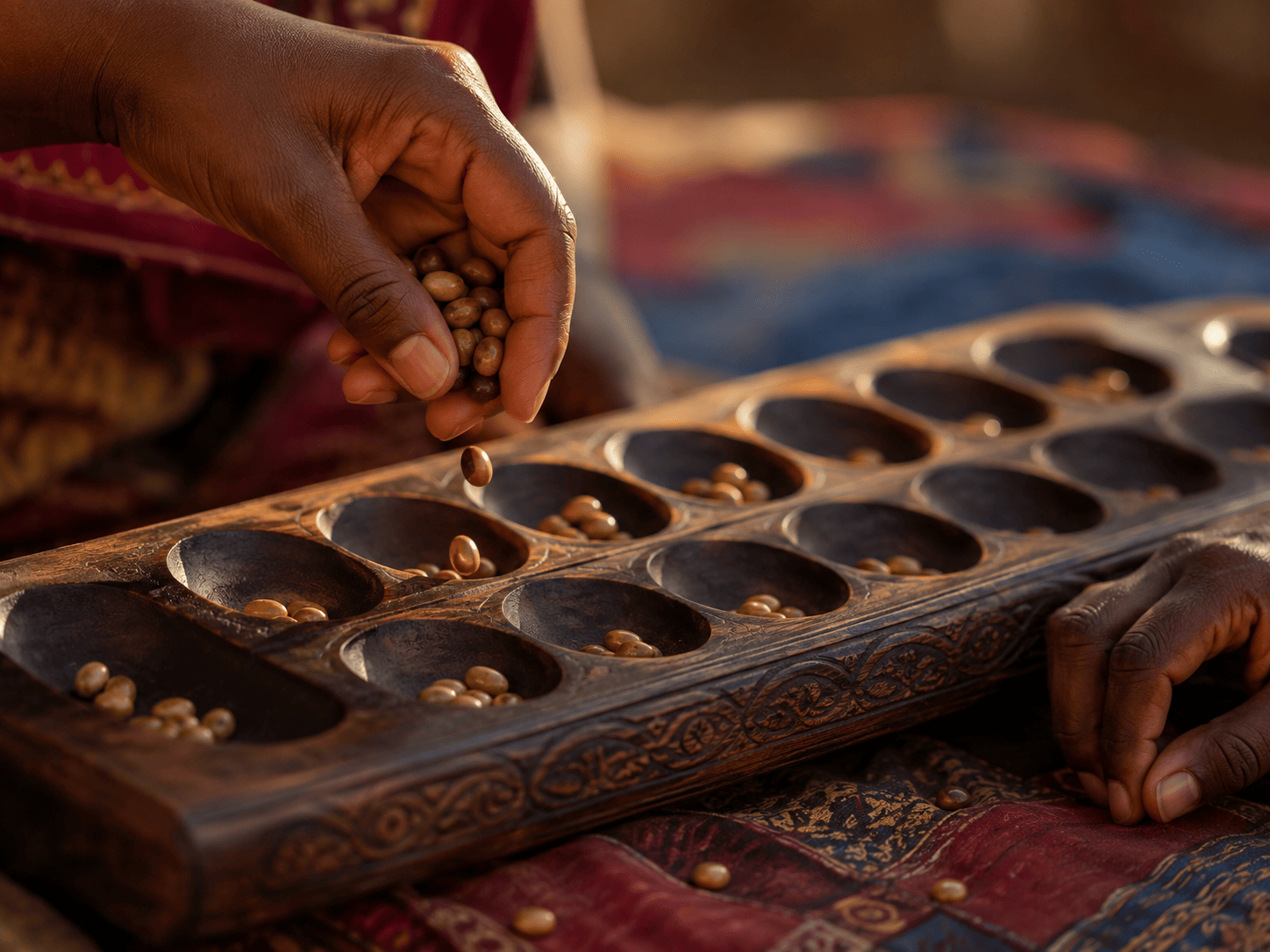
You know mancala by sight even if you've never learned a rule: the wooden board of scooped pits, the polished seeds or pebbles or cowrie shells, the hand moving in that hypnotic rhythm — scoop a pit empty, then drop the contents one by one into the pits that follow, around the loop. That motion is called sowing, and it is the entire mechanical basis of the family. No dice, no cards, no hidden anything: a perfect-information, pure-skill family whose only verb is distribute-and-count.
The reach of that one verb is astonishing. Mancala games are played, in local forms, across most of Africa, through the Middle East, across South and Southeast Asia, into the Caribbean and the Americas — a belt of hundreds of named variants (oware, bao, congkak, sungka, pallanguzhi, kalah, and on and on), most sharing no rulebook, all sharing the sow. Boards are heirloom hardwood, or tourist-stall carvings, or six holes scooped in the dirt with pebbles from the path — the family's genius has always been that its equipment is optional. If the immortality checklist wanted a mascot, mancala's cheap equipment, one-minute teach, and bottomless counting depth would win the audition.
How sowing becomes strategy
One mechanical loop — pick up, distribute, maybe capture, pass the turn — seems too simple to hold strategy. The depth arrives through three doors, and they open fast.
Door one: everything is deterministic, and therefore countable. When you sow a pit, where each seed lands is fully determined — which means a player who counts can know exactly what a move does three, four, ten sows ahead. Mancala is the purest counting game in the world: every position is an arithmetic problem wearing beads, and the entire skill curve is how far and how fluently you count. (If the parity article made counting feel like a superpower, mancala is the gym where that superpower trains heaviest.)
Door two: timing — the granary game. Because sowing distributes, a pit you let grow becomes a payload: hoard seeds in one pit (players call these granaries or kroos) and its eventual sow reaches all the way around the loop, landing where short sows can't. Whole strategies revolve around building a granary while starving the opponent's side of ammunition — feeding them nothing, forcing their pits empty, controlling when the big sow detonates. It's the engine-building instinct of modern hobby games, invented centuries before the phrase.
Door three: the feeding laws. Most serious variants have a rule beginners don't expect: if your opponent's side is empty, you must make a move that gives them seeds when you can. The starvation game has table manners — enforced ones — and they create a marvelous strategic texture: you want your opponent poor, but not destitute, and the boundary is where the sharpest play lives. A game family that spans continents converging on "you must feed a starving opponent" says something rather lovely about what games are for.
Kalah: the version on the school shelf
If you learned "mancala" in a Western school or bought the board at a toy store, you almost certainly learned Kalah — a simplified twentieth-century design: two rows of six pits, a scoring store on each end, captures by landing in an empty pit on your side, an extra turn for ending in your store. It's a genuine game with genuine tactics (the extra-turn chains are a child's first taste of tempo compounding), and it carries a spoiler: the common schoolyard configuration has been solved by computers — with best play, the first player wins. Like every solved game, kitchen-table Kalah survives the verdict untouched; just know that the family's ceiling is not here. Kalah is mancala's kiddie pool — honorable, teachable, and about one-tenth as deep as the family's serious members.
Kalah's rules in five short steps
So you can play tonight, here is the schoolroom version, complete. One: the board has two rows of six pits, plus a big store on each end. Your row is yours; the store on your right is yours. Put four seeds in each small pit. Two: on your turn, scoop all seeds from any pit on your side. Drop them one by one, counterclockwise: along your row, into your store, then along your opponent's row. Skip their store. Three: if your last seed lands in your store, take another turn. This is the rule children discover with a shriek of joy, and chains of extra turns are the game's first strategy. Four: if your last seed lands in an empty pit on your side, capture: take that seed plus everything in the opposite pit, into your store. Five: when one side's pits are all empty, the other player sweeps their remaining seeds into their store. Most seeds wins.
That's a complete game in five steps. Play it three times with anyone and two lessons teach themselves: extra-turn chains can be planned, and an empty pit on your side is a loaded trap. When those two feel obvious, you're ready for the family's real table.
Oware and Bao: the serious end
Oware — the West African branch, and the family's most internationally standardized serious game — plays on the same two-rows-of-six geometry with rules of beautiful severity: captures come from sowing your last seeds into opponent pits holding exactly two or three, chains of adjacent captures cascade, the feeding law is strict, and grand-slam captures that would empty the opponent entirely are forbidden or forfeited. The result is a tense, countable, deeply positional duel — championship oware is played with tournament clocks and national federations, and its best players calculate sowing chains with the fluency of chess masters calculating forcing lines.
Bao, the East African masterpiece, is the family's Everest: four rows instead of two, seeds sown and re-sown in relay chains that can circle the board multiple times in one turn, captures that inject harvested seeds back into your own sowing mid-stream. A single bao move can take a minute to physically execute, the board state churning the whole way — and masters track it all, several moves deep. Bao's reputation among game scholars is exactly Go's among strategists: the family's simple verb, escalated to the horizon. It's also famously a spectator sport — crowds gather around serious bao the way they gather around street chess or park Go, because the churning boards are genuinely dramatic to watch.
Between the pool and the Everest sits the whole belt: congkak and sungka in Southeast Asia (longer rows, home-pit stores, lightning shell-counting), pallanguzhu in South India, dozens more — each region's rules a distinct answer to the same design questions. The family album reads like a world tour because it is one.
One oware capture, in slow motion
To feel the serious family's flavor, walk one capture. In oware, you capture by sowing your last seed into an enemy pit that then holds exactly two or three seeds. So the whole game is played watching enemy pit counts: a pit with one seed is a target (your seed makes two). A pit with two is a target (yours makes three). A pit with four is safe — for now.
Say their third pit holds one seed. Count backward from it around the loop to your side. Any pit of yours that holds exactly the right number of seeds to end its sow there is a loaded gun. You find one: your second pit, holding five. You sow — one, two, three, four — and the fifth seed drops into their third pit. Two seeds now. Captured, both of them, into your bank.
Now the part that makes oware oware: your opponent saw the whole thing coming, three turns ago. Nothing is hidden — so their last few moves were quietly emptying or overfilling the target, or building a counter-capture timed for the turn after yours. Every capture in serious mancala is a race between two people counting the same seeds, and the win goes to whoever counts one pit further. There's no better description of the whole family's skill in one sentence.
The counting teacher
Mancala has a second identity worth naming: it may be the best arithmetic teacher ever disguised as a toy. Every turn is counting practice — subitizing pit contents at a glance, adding distributions, projecting landings — and the practice is invisible, because the child (or adult) experiences it as tactics, not homework. Teachers and researchers have long noticed what the family's home cultures always knew: regular mancala play drills number sense, planning, and working memory with a gentleness no worksheet achieves. It's also the rare strategy game where elders traditionally dominate — speed-counting is a lifetime skill, and the sight of a grandmother demolishing three generations at the family board is part of the game's culture across the belt.
For this shelf's readers the transferable gift is concrete: a month of casual oware permanently upgrades the counting instincts that every endgame on every board runs on. You'll feel it the next time you count a fill race without noticing you're doing it.
Playing today: which door to enter
Start with Kalah if you're playing with children or want the gentlest possible on-ramp — one game, the extra-turn trick discovered, done. Start with oware if you want the family's real strategic taste with a learnable rulebook: apps and online communities are healthy, the two-three capture rule takes one game to internalize, and the depth announces itself by game five. Visit bao the way you'd visit 19×19 Go — later, respectfully, for the view. Physical boards are everywhere from heirloom shops to airport stalls (and any egg carton plus dried beans works exactly as well, which is the family's whole point). Digital play adds the usual gifts — pocket sessions, patient AI, automatic counting for learners — though mancala purists will tell you, correctly, that the seeds-in-hand rhythm is half the pleasure, and some evening you should feel the real thing click through your fingers.
A first week with the family
Day one: Kalah, three games, any opponent (an egg carton and 48 dried beans is a full set). Let the extra-turn rule teach itself. Day two: Kalah again, but before every move, trace the sow in your head first — where does the last seed land? This one habit is the family's entire foundation. Day three: switch to oware rules (capture on two or three, the feeding law) via any app; lose cheerfully. Day four: oware with one goal only — spot a capture two moves before it's possible, yours or theirs. Day five: build your first granary: hoard one pit past twelve seeds and feel what a full-loop sow does to the board. The weekend: one long session against a patient human, and — if a video of serious bao crosses your path — ten minutes of watching the Everest, just to know it's there. Total cost: an hour and some beans. Return: the counting reflex every other game on this shelf quietly runs on.
Questions people ask
Is mancala really the oldest game family? It's a strong candidate — rows of pits resembling mancala boards are cut into ancient stone across Africa and the Middle East, though as always with stone boards, dating play from pits is educated inference. What's certain: the family is at minimum many centuries old, plausibly much more, and has been in continuous play longer than almost anything humans still do for fun.
Is there luck in it? None — no dice, no draws, nothing hidden. The randomness people sometimes perceive is just arithmetic outrunning their counting; to the player who counts one pit further, the "chaos" was a forced sequence. That property makes mancala the family's answer to the expert test: a strong ower or bao player against a beginner is a foregone conclusion, every single game.
Why did Kalah conquer schools instead of oware? Mid-century Western marketing, simpler capture rules, and the extra-turn dopamine loop that suits children. No conspiracy — but it does mean most Westerners have met the family's least member and judged the whole clan by it. The gap between Kalah and oware is the gap between house-rules checkers and the real game: same furniture, different sport.
One habit to bring from mancala to everything else? Sow-counting — the reflex of tracing a move's full distribution before making it. On a 6×6 push board it returns as tracing all eight shove destinations; in Connect Four it's projecting the column parities; everywhere it's the same discipline mancala drills purest: a move isn't where it starts. It's everywhere it lands.