Learn › The modern renaissance › Hive
Hive: chess without a board
Twenty-two hexagonal tiles, a cloth bag, and no board at all — Hive is the modern abstract renaissance's most beloved single object, a game you can carry in a jacket pocket and play on any flat surface on Earth. It's also, under the charming bugs, a duel that chess players take seriously. Here's what makes it sing, how the pieces work, and what its famous missing board teaches about design.
A game you carry in a pocket
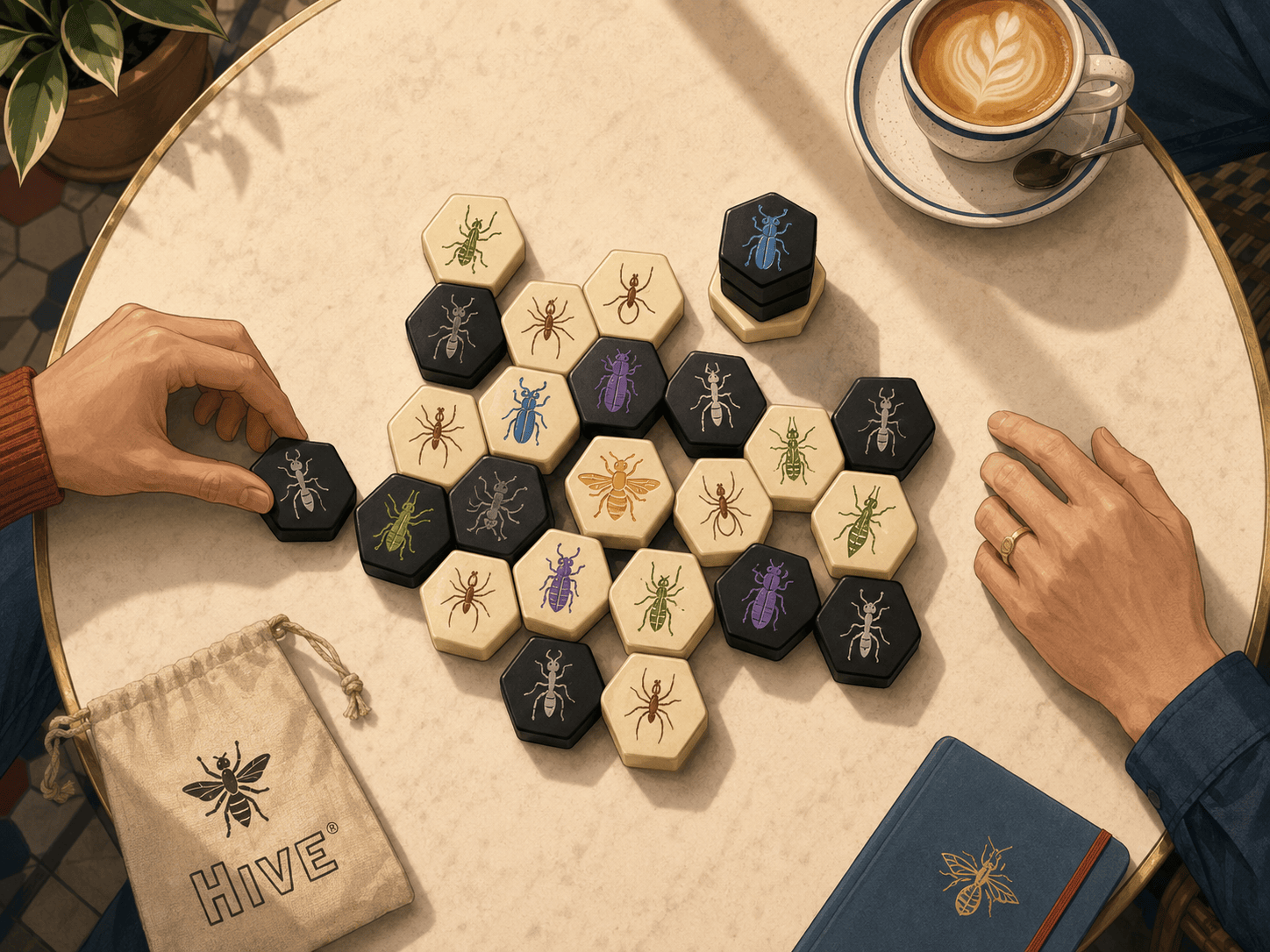
Hive, designed by John Yianni and published at the start of the 2000s, begins with a small magic trick: there is no board in the bag, and there never was one. The tiles themselves — chunky hexagons printed with bugs — are the board. The first tile establishes the world; every later tile attaches to the growing swarm; and the playing surface sprawls organically across the café table, its shape changing all game as pieces arrive and crawl. Where other games are played on something, Hive is played on itself.
The practical gifts are obvious the first time you play a game on a train tray-table: nothing to level, nothing to lose but tiles, no setup beyond reaching into the bag. But the design gift is deeper. Because the board is the pieces, geography is negotiable — the terrain of the game is a thing the players are jointly building, and reshaping it is what moves are. That single inversion generates most of what follows, and it's why the game earned the nickname this article borrows: chess without a board — with the missing board doing more work than most present ones.
Bugs with jobs
Each player brings eleven tiles: one queen bee, two spiders, two beetles, three grasshoppers, and three soldier ants. Every bug has one movement rule, and each rule fits in a sentence — this is the whole rulebook's combat section, such as it is.
The queen bee steps one space around the hive — slow, precious, and the whole game, since losing her loses everything. The soldier ant runs any distance around the hive's edge: the game's rook-equivalent, its errand-runner and siege engine at once. The spider moves exactly three spaces around the edge, no more, no fewer — a piece whose precision makes it strangely easy to misjudge. The grasshopper jumps in a straight line over any row of occupied spaces, landing on the first empty one beyond — the family's jump verb, ignoring every wall. And the beetle steps one space like the queen but with a party trick: it may climb on top of another tile, pinning whatever's beneath and converting that space to the beetle's color for placement purposes. Five verbs, five sentences, and no exceptions to memorize.
Notice what the theme is doing. Hive is a fully abstract game — no story, no simulation — yet the bugs make every rule instantly memorable: of course the grasshopper jumps, of course the ant runs everywhere, of course the beetle climbs on things. The theme is one molecule thick and load-bearing anyway: a mnemonic wearing a costume. It's the neatest existing answer to the question another shelf asks at length — does an abstract need a theme? No; but a well-chosen one can pay rent.
The one rule that makes it sing
Everything above is charm. The depth comes from a single constraint, stated in five words: the hive may never split. At every moment — during moves, not just after them — all tiles must remain one connected swarm. A piece whose departure would break the hive in two simply cannot move, however legal its motion otherwise looks.
This is the invisible geometry that makes Hive a serious game. Every tile is simultaneously a piece and a load-bearing wall; the connectivity map — which pieces are structural, which are free — is the real board state, and it's redrawn by every single move. Strong players see it directly: that ant isn't a threat, it's a pillar, frozen where it stands because the hive hangs from it; this beetle move doesn't attack, it releases two enemy pieces by rerouting the connection through itself. Pinning enemy pieces into structural duty while keeping your own swarm redundant — connected twice over, so nothing of yours is ever load-bearing — is the game's positional art. Chess players recognize the flavor immediately: it's the pin, generalized until it holds up the world.
One more physical subtlety completes the engine: the sliding rule. Tiles move by physically sliding around the hive's rim — they cannot pop out of a snug gap or squeeze between two tiles that touch. Space you can see isn't always space you can reach, and doorways matter. Between connectivity and sliding, Hive builds a full geometry of freedom and imprisonment out of nothing but adjacency — no board required, just as promised.
Surround the queen
The win condition matches the ruleset's economy: fully surround the enemy queen bee — all six spaces adjacent to her occupied — and you win. The elegant sting is in the fine print: the six surrounding tiles can be any color, including her own. Your pieces crowd your own queen at your peril; a defensive huddle can become a coffin with one enemy arrival.
From that fine print flows the game's characteristic tension. Every piece you commit to besieging their queen is a piece not defending yours, and — thanks to the one-hive rule — possibly a piece that gets pinned into the siege, structurally frozen at the moment you need it home. Attacks in Hive are investments with imprisonment risk. Meanwhile both players are managing breathing room around their own queen: one escape space is nerves, zero is checkmate-in-waiting. Endgames routinely become races — tempo counted in single moves — with both queens at five neighbors and the whole swarm's connectivity deciding who can bring one more tile to bear first. It's as sharp as any finish in the classical family, and it's built from a piece that barely moves.
Why chess players respect it
Hive cleared the bar that matters for a designed abstract: the serious-play community arrived and stayed. There's a real opening theory (which bug to place first is a genuine debate — ant flexibility versus early beetle pressure), a notation for recording games, online ladders with strong engines to spar against, and a tournament scene with world championships. The game is not solved and won't be soon; computers play it very well without exhausting it.
And it passed the other test — the argumentative fan base. The expansion bugs are debated exactly the way chess variants are: the mosquito (copies the movement of any bug it touches), the ladybug (exactly two steps over the hive, one step down), and the pillbug (can physically throw adjacent pieces to its other side, the swarm's crane). Each bends the base game's balance enough that tournament formats specify which are in play. A game people argue about at that level of detail is a game with a future — the immortals shelf would recognize the symptom.
Your first ten games: a learning path
Hive teaches fast but punishes specific beginner instincts. The classic errors, in the order you'll commit them:
Hiding the queen too deep. Tucking her behind your own tiles feels safe and builds her coffin — remember, your own pieces count toward her surround. She wants an edge posting with escape routes, not a bunker.
Ant neglect. Your three ants are the best pieces in the bag — unlimited range makes them your tempo, your defense, and your endgame. Beginners spend them early on stationary duty where they get pinned into architecture. Keep at least one ant free at all times; a trapped ant is a rook bricked into a wall.
Beetle impatience. Climbing onto things is delightful, and doing it early usually parks your beetle a full slow-motion journey from where the game gets decided. The beetle is an endgame piece; its climb onto the space beside the enemy queen — or onto her — decides sieges. Save it.
Forgetting placement law. New tiles must touch your own color and no enemy tiles (the two opening placements excepted). Your opponent can close your landing zones by advancing the frontier — and you can close theirs. Placement space is a resource; spend the enemy's, budget your own.
The drill that accelerates everything: play three games where your only goal is finishing with two ants unpinned and one empty space beside your queen. You'll lose some — and come out reading connectivity, which is the whole skill.
And since Hive spreads by being taught, here's a ninety-second teach that works on anyone. Say this, in order: we're building one connected swarm of tiles, and it may never split — that's the only law. New tiles arrive touching my color and not yours. Each bug moves one way: queen steps, ant runs the rim, spider walks exactly three, grasshopper jumps the line, beetle climbs on top. Surround my queen's six sides — any colors — and you win. Then play immediately; the rules settle in two turns of doing what no paragraph of reading achieves. First-night script for the new player's opening: place a beetle or spider first, queen second, then an ant — safe, flexible, and it keeps every lesson above available without requiring any of them yet.
What the missing board teaches
Zoom out to the design lesson, because it's the reason this article sits on the renaissance shelf. Hive demonstrates, more cleanly than any other single object, how little a deep game actually needs. No board. No capture. No dice, no cards, no scores. Most tiles never move more than a few times in a game. The entire engine is adjacency plus one connectivity constraint — and out of that austerity come pins, sieges, races, sacrifices, opening theory, and a tournament scene. It is constraint-as-engine in its purest commercial form, and the proof lives in a bag.
For players, the lesson is a taste worth acquiring: when you evaluate any new game, ask what its one generative rule is — the constraint everything else grows from. Games that have one (the hive may never split; a placement pushes all eight neighbors; equal numbers refuse) tend to be the ones that stay deep past their size. Games that have none — just accumulated features — tend to be the ones you shelve by spring. Hive is the field's cleanest positive example, which is why designers keep a copy the way writers keep a favorite short story: not to play, some weeks, but to remember what finished looks like.
Questions people ask
Is Hive really abstract, with all those bugs? Fully. The bugs simulate nothing — no foraging, no ecosystems; they're mnemonic paint on pure movement rules, and the game would play identically with numbered tiles (it would just be harder to learn and love). The definition article covers why theme-thickness, not theme-presence, is the test.
Which expansion should I add first? None for your first dozen games — the base bag is a complete education. When variety calls, the mosquito is the community's usual first pick: it adds decision texture without rewriting siege math the way the pillbug does. Treat expansions like hot sauce, not ingredients.
Is there a good digital version? The game thrives on screens — digital implementations with AI opponents and online play exist and are an excellent practice gym, especially for drilling the connectivity-reading this article keeps pointing at. The physical set remains the charisma champion; the phone is where the reps live. The usual gifts apply.
Hive or chess — which should I learn deeply? Wrong fork, happily: they exercise different muscles and stack beautifully. Chess drills calculation through a fixed geometry; Hive drills structural reading of a geometry that never stops changing. A player who does both reports the strangest crossover: chess pins start looking like load-bearing walls, and café tables start looking like boards. Both conditions are considered incurable.