Learn › What makes a game abstract? › Does a game need a story?
Does a game need a story? Why abstract games skip the theme
One box has dragons on it. The other has a plain grid. Both contain good games — but they're making different promises. Here's what a theme actually does for a game, what it costs, and why some of the best games ever made decided to go without.
Two boxes on a shelf
Picture the game aisle. The first box shows a dragon coiled around a burning castle; inside are plastic heroes, illustrated cards, dice like tiny jewels, and a rulebook that opens with a paragraph of lore. The second box shows a grid, some discs in two colors, and four sentences of rules on the back. A first-time shopper reaches — almost always — for the dragon.
Fair enough: the dragon is doing its job. But regulars of both aisles will tell you something the packaging can't: the plain grid might contain fifty times the game. The relationship between a game's story and a game's substance is much stranger than the shelf makes it look, and understanding it will change how you shop, and how you play.
First, a definition. A game's theme is the story its rules wear: you're not "moving a token to an adjacent node," you're marching an army into a province; you're not "converting three cubes into a point," you're selling spices in a port. An abstract game is one that skips the costume entirely — the rules present themselves as rules, the pieces as pieces. It's the third test in our definition of the abstract strategy family, and it's the one that provokes the most argument, because unlike luck or hidden information, theme is a matter of degree.
What a theme actually does
Give the dragon its due — a good theme performs real work, and the best themed games are marvels of that craft.
Themes teach rules by analogy. "The thief steals a card from another player" needs no memorizing; the story is the rule. A well-themed game can carry forty rules lightly because each one sits inside a picture that makes it obvious. This is theme's superpower, and it's genuinely great design: the fastest way into a complex system is a familiar story about it.
Themes set the mood. The same mechanics feel different dressed as a haunted mansion versus a farmers' market. Theme recruits your imagination as a co-player — for many people, being somewhere is most of the fun of the evening.
Themes create attachment. Nobody paints a checkers piece, but people paint their fantasy miniatures for weeks. Story gives players something to care about beyond the score, and hobbies run on caring.
And yes — themes sell boxes. There is no shame in this. A shelf is a marketplace, and the dragon is better advertising than the grid. The only trouble comes when the advertising is the whole product.
When the story is paint
Because here's the open secret of the hobby: in many themed games, the story is a sticker. Peel it off and the machinery underneath runs unchanged.
Players have a phrase for it — a "pasted-on" theme. The farming game where you could relabel the wheat as widgets and nothing about your decisions would shift. The space game that is, on inspection, an accounting exercise with rockets drawn on the ledgers. There's a classic test: could this game's theme be swapped for a completely different one without changing a single rule? If yes, the theme was decoration, not structure.
Decoration isn't evil. But it has costs. You learn the story and the rules, and when they disagree — when the "brave knight" piece behaves nothing like a knight would — the story actively misleads. Themed rulebooks run longer; setup takes longer; the table fills with chrome that must be sorted, shuffled, and eventually resented. And themes date. Artwork ages, jokes expire, licensed properties fade; the decade a themed game was born in is usually visible from across the room. Meanwhile the machinery underneath — if it was ever good — was the only part doing the work all along.
Once you see the sticker, you can't unsee it. And the natural next question is: what happens if a designer refuses to apply one?
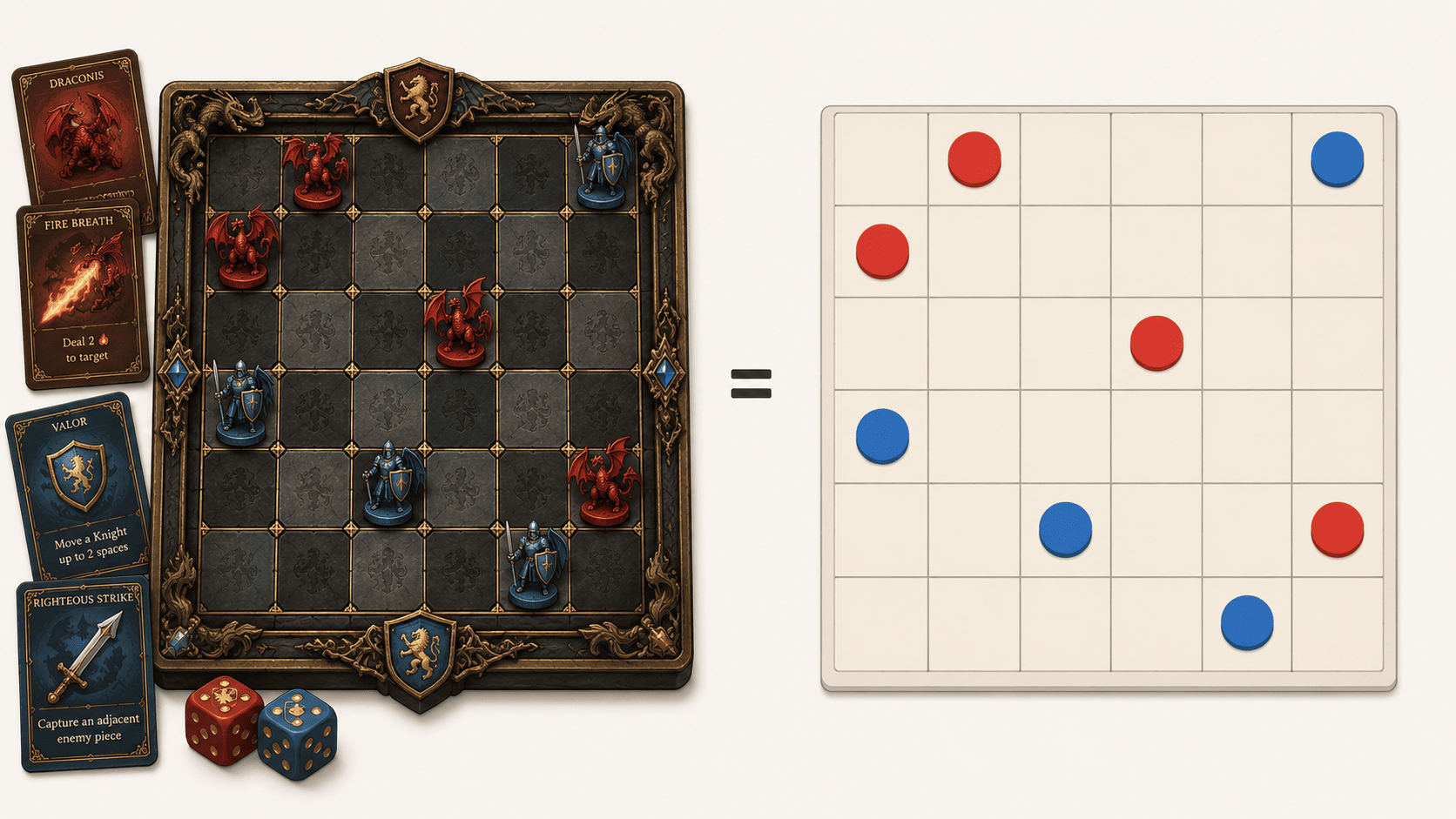
The case for no story at all
An abstract game is what remains when a designer strips away everything that isn't decisions. The bet is simple: if the contest itself is interesting enough, it doesn't need a costume. And the bet has been winning for thousands of years.
Nothing stands between you and the game. There's no lore to absorb, no icons to decode. The rules of Go fit in a breath; the rules of Oustwit fit on a card. You spend your first minute learning and every minute after that playing — the ratio themed games can only dream about.
Nothing dates. A grid and two colors looked contemporary in the eighth century and look contemporary on a phone screen tonight. Abstracts don't belong to a decade because they never wore the fashions of one. It's a large part of why the oldest surviving games are nearly all abstract: paint peels; structure doesn't.
Nothing is lost in translation. No text on the cards means no cards to translate. The same abstract game crosses every language and culture untouched — one reason the classics conquered the world so thoroughly.
And nothing misleads. The pieces don't pretend to be knights with personalities. What you see is the entire truth of the game — a property abstracts share with their other family trait, the open board. There's a deep consistency there: games that hide nothing in the fiction tend to hide nothing on the table either.
A short history of dressing games up
Here's a perspective-restoring fact: for most of gaming history, the plain grid was the norm. Heavy theming is the newcomer.
The ancient games — Go, mancala, morris, the chess ancestors — were structures first and stories barely at all. Chess picked up its royal court imagery as it traveled, but the costume stayed light enough that a thousand years of players never needed to read the lore. For centuries, "a game" meant an abstract contest, and the pieces were whatever the local craftsman carved.
The costume era arrived with mass printing and mass retail. Once games became boxed products competing on shelves, the box face became a battlefield, and story sells boxes to strangers better than structure does. The twentieth century perfected the form: family games wrapped in real estate empires, detective mansions, world conquest — decision systems of modest depth wearing magnificent coats. It worked commercially, and it fixed in the public mind the idea that a "real" board game looks like a story.
Then the modern hobby renaissance complicated the picture from both directions at once. Designers built themed games where the story genuinely drives the rules — masterpieces of integration where peeling the sticker really would break the machine. And simultaneously, a wave of modern abstracts proved the ancient formula still had room to grow: tiny rulesets, no story to speak of, depth that embarrasses boxes ten times their weight. The shelf today holds all three species — integrated themes, painted-on themes, and proud grids — which is exactly why knowing the difference pays.
The translation test
One practical superpower of themelessness deserves its own section, because you'll feel it every time you play across a border — or download an app.
A themed game is written in a language. Cards carry text; rules lean on cultural references; jokes and flavor need translating, and translations cost money, so many themed games simply never leave home. An abstract game is written in geometry. Two colors, a grid, a goal you can demonstrate in pantomime — it crosses every border on Earth without a customs check. This is a large part of how the same handful of abstract families conquered every continent centuries before global publishing existed: nothing about them needed carrying except the idea.
The digital age sharpened the advantage. An app store is a single worldwide shelf, and a game with no text to localize is instantly at home in two hundred countries — the tutorial shows legal moves instead of explaining them, which is a language everyone reads. When you match against an opponent from another hemisphere in an open lobby, the reason the game between you needs no translation layer is the same reason Go needed none on the Silk Road: structure is the one universal language games have ever found.
Abstraction as respect
There's a way of seeing this that goes beyond pros and cons. A themed game says: here is a story to enjoy; the decisions come with it. An abstract game says: you don't need the story. The decisions are enough. You are the kind of player who will find the drama in the structure itself.
That's a compliment, and players feel it. The drama of an abstract game is real drama — the trap closing, the race tightening, the one square both plans need — but it's drama you generate rather than consume. Nobody wrote it in advance. Every game of Oustwit that ends with a desperate final shove tells a story, and the authors are the two people at the table, nobody else.
This is also why abstract games age with you rather than past you. A story is the same story on the hundredth reading. A pure structure keeps revealing new rooms as you become a better explorer — the depth was always yours to find, not the designer's to narrate.
A tale of two game nights
Theory aside, the difference shows up most vividly when you teach — so run the thought experiment of two evenings.
Night one: the themed epic. You've invited friends to try the big story game. The teach takes twenty-five minutes, because every rule arrives wrapped in lore: what a "corruption token" is, why the harbor phase precedes the market phase, what the wizard's exception to the exception does. Your friends nod politely, holding forty small facts in rented memory. The first hour is played in a fog of "wait, can I do that?" — the story helps, but there's simply a lot of costume to learn before anyone gets to decide anything. By the time the table is fluent, it's late. It was a good night! But notice where the effort went.
Night two: the grid. You set out a 6×6 board, or hand your mother your phone. "Place a piece anywhere empty. It pushes every neighbor one square outward. Three in a row wins — or getting all eight of your pieces down." That's the whole teach; it took forty seconds. The first game starts immediately, and — this is the part that surprises people — the thinking starts immediately too. By game two your mother, who has never read a rulebook in her life, is setting a trap. By game four she is refusing to hand the phone back. Nothing stood between her and the decisions, so she reached them at once.
Neither night is wrong. But the comparison exposes what a heavy theme really costs: not intelligence, but onboarding time — and onboarding is exactly what busy adults, casual partners, and grandparents don't have to spare. The games that cross generations at a family table are, overwhelmingly, the ones you can teach in a minute. There has never been a forty-minute teach in the history of checkers, and that is precisely why everyone's grandmother can play it.
The gray zone (where most of the family actually lives)
Honesty requires admitting that "no theme" is rarely absolute. Chess has knights, castles, a king — a medieval skin so thin we forget it's there, but a skin nonetheless. Nobody needs the story to play; nobody minds that it exists. That's the gray zone, and it's crowded with excellent company.
Modern abstracts especially favor the whisper of a theme: Hive's insects genuinely help you remember how pieces move (the grasshopper jumps!); Santorini's Greek gods justify its rule-bending powers; Onitama's martial-arts framing gives its move cards a dojo elegance. The theme is a mnemonic and a mood, never a rulebook. Designers call this "light dressing," and it may be the sweet spot: all of abstraction's clarity, plus a handle for the memory. Oustwit sits here too — a duel between two warriors is the frame, but the game underneath is naked geometry: place, push, three-in-a-row or all eight pieces down. You could play it with bottle caps and lose nothing but the wardrobe.
So the real question was never "theme or no theme" — it's whether the game would survive undressing. The ones on this shelf all would. Many of the dragons, undressed, turn out to be spreadsheets. (For how modern designers learned to build depth with almost no costume at all, see the modern abstract renaissance.)
Reading a store page for theme-weight
The practical payoff: you can estimate how much of a game is costume before buying, from the listing alone. A few tells, tuned for both shelf and screen.
Count nouns in the rules summary. If the short description needs six proper nouns and three invented currencies to explain itself, the costume is heavy. "Place a piece; it pushes its neighbors; make three in a row" contains zero lore — that's a structure talking.
Look at the components list. Two hundred cards and five punchboards can be a rich system or a heavy coat — but a game that plays with "36 squares and 16 discs" has nowhere to hide shallowness or depth. Sparse components are a confidence signal: the decisions must carry everything.
Check what the screenshots show off. App-store images that showcase artwork, characters, and treasure celebrate the costume; screenshots that just show the board mid-game are betting you'll find the position itself interesting. (The latter is rarer and worth noticing when you see it.)
Find a review that describes a decision. Fans of integrated-theme games describe stories; fans of structural games describe choices ("I had to pick between blocking the diagonal and racing"). Whichever kind of sentence a game's community produces tells you where its heart is — a trick that pairs well with the deep-game field guide.
Questions people ask
Isn't chess themed? It has knights and a king. Lightly, yes — which is why definition-lovers say "theme optional" rather than "theme absent." The test is load-bearing-ness: chess plays identically if you rename every piece after vegetables. A game where the story does rules-work fails the test; a game wearing a thin coat passes it. See the full three-test definition.
Are word games abstract? Interesting edge: Scrabble's theme is nonexistent, but its content — a dictionary — is a giant cultural artifact, and its bag adds luck. Most players file word games in their own honorable category: structural games built on language rather than geometry.
Does a theme make a game easier to learn? For rule-heavy games, genuinely yes — analogy is a real teaching tool, theme's best trick. But note the sleight of hand: the theme makes it easier to learn many rules; the abstract solution is to need fewer rules. Both approaches reach "playable," by opposite roads.
Do abstract games have fans of the pieces themselves? Devotedly. Handcrafted Go stones and slate-and-shell sets, turned chess pieces, beautiful minimalist editions of modern abstracts — the aesthetic tradition is ancient and thriving. The pieces just get to be beautiful as objects, rather than illustrations of somebody's story.
Which one is for you tonight?
Both, eventually — that's the honest answer. A full gaming life has dragons in it and grids, the way a full reading life has novels and chess columns.
Reach for theme when the evening is about company and atmosphere: new players who need the story's help, friends who want to be somewhere together, kids who'll remember the dragon forever. Reach for abstraction when the evening is about the contest: a rival to face, a skill to sharpen, fifteen free minutes that deserve real decisions rather than administration. Reach for it, too, when you're tired of setup — the abstract game is always ready first.
And if you've spent your whole gaming life on the dragon side of the aisle, consider this shelf's standing invitation: pick one abstract — any of the classics, or a five-minute modern like the one this site is named after — and give it ten games with the same opponent. No story will be provided. Ten games in, you'll notice you've been telling one anyway.