Learn › Push, pull, slide › Abalone and sumo strategy
Abalone and the sumo school of strategy
Two players, a hexagonal board, twenty-eight marbles, and one gloriously blunt objective: shove six of your opponent's marbles off the edge of the world. Abalone turned pushing into a sport in the late 1980s and has sold millions of copies since — and under its gladiator surface sits a strategy school with lessons for every push game ever made. This is a guide to playing it well, and to thinking like a sumo wrestler anywhere.
Sumo on a table
Abalone was designed in France in the late 1980s by Michel Lalet and Laurent Lévi, and it announces itself faster than almost any game in the modern canon. The board is a hexagon of sixty-one spaces. Each player commands fourteen marbles, black or white, heavy and satisfying as river stones. Push six enemy marbles over the rim and you win. That's the whole pitch — no capture rules to memorize, no piece types, no scoring. Just mass, force, and a cliff.
Watch thirty seconds of a game and you understand it the way you understand a sumo bout: two bodies locked in the middle, straining, and the loser is the one who leaves the ring. It's the most legible of the great abstracts — the danger is literally visible as distance-to-edge — which is why it became many players' first taste of the displacement family. But legible doesn't mean shallow. The simple rules hide a real strategy school, and its first lesson arrives immediately: in this game, strength has nothing to do with how many marbles you have. Both sides always have fourteen until the endgame. Strength is formation.
The inline rule: three push two
On your turn you move one, two, or three of your marbles that sit in a straight line. Move them one space, all together. There are two kinds of move. Broadside: the line steps sideways, parallel to itself, into empty spaces — good for repositioning, but a broadside can never push anything. Inline: the line moves along its own axis, like a train on a track — and this is where the sumo happens.
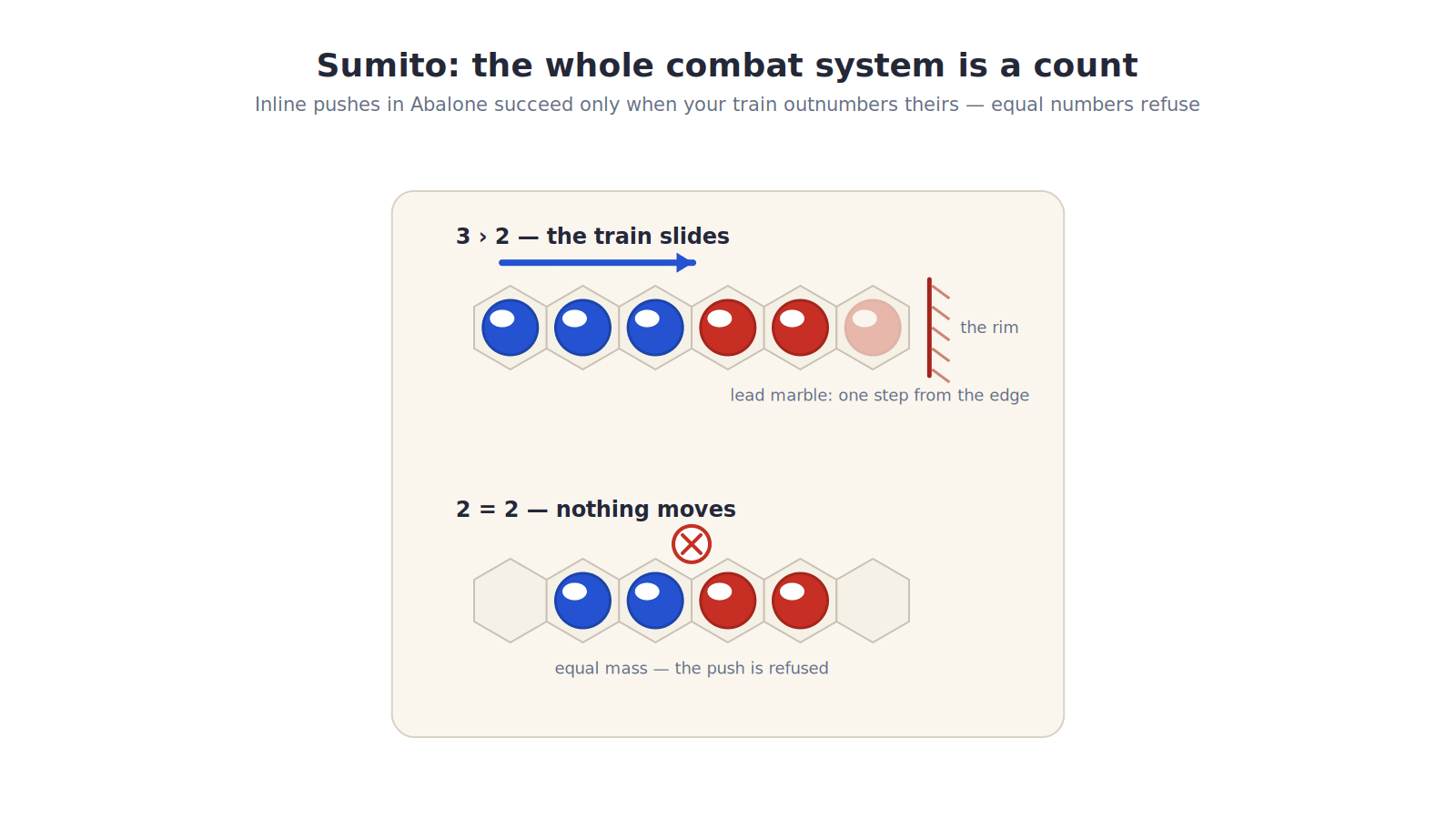
An inline move can shove enemy marbles ahead of it, but only if your train outnumbers theirs: three of yours push two or one of theirs; two of yours push one. Equal numbers refuse — two can't push two, three can't push three — and nothing pushes four. That single arithmetic is the entire combat system, and it's called sumito in the game's community. No dice, no captures, just a count: who has more mass on this line, right here, right now?
Sit with the consequences. A lone marble is powerless against a pair and helpless before a trio. A pair is strong until it meets a pair. A trio is the strongest unit in the game — and still stops dead against another trio. So power isn't a property of pieces; it's a property of alignments, and every alignment is temporary. Shift one marble and a mighty train becomes two weak fragments. This is the deepest difference between Abalone and capture games: your army's strength gets recounted every single turn, line by line, and the recount is the game.
Geometry of the hexagon: center, rim, and the death spiral
The board teaches the second lesson. The center of the hexagon is high ground — not because it scores anything, but because a marble in the middle is six spaces from every cliff, while a marble on the rim has already used up its margin. Being pushed is rarely fatal in the center; it's a delay. On the rim it's an execution.
This creates the game's characteristic death spiral. Losing the center means fighting with your back to the cliff, where every lost sumito costs a marble instead of a tempo — so you weaken, which loses more exchanges, which costs more marbles. Strong players therefore read the game not as "how many marbles has each side lost" but as "who is fighting downhill." Center control is the score for the first two-thirds of the game; ejections are just the score catching up.
And the rim rewrites the value of every push. Shoving an enemy marble one space in the middle of the board is a shrug. The same push against the rim is a kill. So the board has a gradient — every line points somewhere, and the question of the whole midgame is which player's pushes are aimed at the cliff and which player's are aimed at open space. Sumo wrestlers call it working toward the straw bales. Abalone players just call it position.
The classic sin: the spread
Every Abalone beginner commits the same crime, and it has a name: the spread. It feels natural — you fan your marbles out across the board to "cover ground" and chase pushes on both flanks at once. It loses, reliably and instructively.
The spread loses because of the sumito arithmetic. Fourteen marbles spread wide form no trios and few pairs — so everywhere the enemy's compact mass arrives, your local count is smaller. You're outnumbered on every line while equal in total. A wedge of enemy marbles drives into the gap between your halves, splits them further, and then eats the strays one push at a time — each lone marble a snack, powerless to resist even a pair. The classic collapse isn't dramatic; it's a harvest.
The cure is the sumo master's first principle: keep the body whole. Count your groups at any moment — one connected mass is strong, two is risky, three is usually lost. Move marbles you can support; advance the body, not the scouts; accept slower progress in exchange for never being outnumbered where it matters. It's the same mass-behind-mass instinct that displacement defense teaches on square boards, expressed here as a way of life. When in doubt, move a rear marble up to thicken the middle. It's never a wasted turn.
The stall problem, honestly told
Fairness requires this chapter: classic Abalone has a famous flaw. Two cautious players who both keep the body whole and hug the center can produce a long, shoveless hug — nobody willing to commit, since the first player to attack often over-extends and loses the exchange. The critique is decades old and real: at high level, the standard opening position can reward mutual patience to the point of stalemate-by-boredom.
The community's fixes are evergreen and elegant, and they all share one idea: start the armies closer together, interleaved, so that contact exists from move one and pure turtling has no safe shape. The best known of these alternative setups — the "Belgian Daisy" family, with each side's marbles split into two flower-shaped groups — is standard in serious play, and most digital versions offer it. The lesson for the rest of the shelf is bigger than one game: push mechanics need a force that compels contact, or defense becomes too comfortable. Some games solve it with starting positions; others build the compulsion into the rules themselves — a fill-the-board race, a shrinking supply — so that standing still loses by arithmetic. When you meet any new push game, it's worth asking: what stops two cowards from hugging forever? The good ones always have an answer.
Formations to learn: the wedge, the wall, the pivot
Sumo school gets practical here. Three named shapes will carry you from beginner to respectable, and each is just the sumito arithmetic wearing armor.
The wedge. An arrowhead: one marble at the tip, backed by a pair, backed by a trio. Any line drawn through the tip meets depth behind it — so the wedge pushes hard along its axis (there's always a trio available) and resists head-on counter-pushes (the enemy meets equal or greater mass on the same line). It's the game's battering ram, and driving a wedge through a spread opponent is the canonical winning picture.
The wall. A broad line of marbles set perpendicular to the enemy's advance. Walls don't push — they refuse. Since equal numbers can't move each other, a wall of pairs and trios turns a whole front static, which is exactly what you want on the flank you've decided not to fight on. Build a wall where you're weak, a wedge where you're strong, and you've translated "economy of force" into marbles.
The pivot. A compact block — think two rows of three — that can form a trio along several different axes depending on which marble steps. The pivot is about optionality: from one tight shape you can push in three directions, so the opponent must defend all of them. Where the wedge is a committed attack, the pivot is a threat generator; rotating your attack axis one broadside at a time while the body stays whole is the closest thing Abalone has to the double threat.
Sumo thinking beyond Abalone
Here's why this article sits on a shelf about push mechanics in general: the sumo school travels. Its principles apply, with local accents, to every displacement game ever designed.
Count the line, not the army. In any push game, ask where you're outnumbered along an axis — total material is a distraction. In Oustwit the count is binary: a piece with a friend directly behind it is a trio for defensive purposes; a piece alone is a one. Same arithmetic, smaller numbers.
Respect the gradient. Every board with an edge has a direction of doom. Know which of your pieces stand in the current, fight perpendicular to it when weak, and aim your own pushes down the slope. On the 6×6 this is the rim-versus-center reading that the push article maps square by square.
Keep the body whole. Scattered pieces are dead pieces in every game where force is local mass. The spread loses on sixty-one hexes and it loses on thirty-six squares — connection is strength, and strays are food.
Force the contact question. And when you design or house-rule a push game, remember the stall: somewhere, something must make hugging impossible. Abalone learned it the hard way, and every modern push design — the design view covers the toolbox — carries the scar as wisdom.
Questions people ask
Is Abalone solved? No. The game is far too large for exhaustive analysis, and while computers play it very strongly, nobody has a perfect-play verdict. What is settled is practical: the standard opening rewards caution enough that serious play uses interleaved setups like the daisy family.
Should I move trios all the time, since they're strongest? Mostly along contested lines, yes — but broadsides and pairs win games. Trios are power; pairs and singles are speed and shape. The masters' rhythm is roughly: broadside to aim, inline to strike. If every move you make is a maximum-force push, your shape degrades into a straight line that any wedge can flank.
How similar is Oustwit to Abalone, really? Different verb, same physics department. Abalone moves existing marbles in trains; Oustwit never moves a placed piece — each new placement blasts all eight neighbors outward, and ousted pieces return to hand rather than dying. So Abalone is slow mass warfare with permanent casualties; Oustwit is fast placement warfare where material recycles and only tempo dies. But the transferable instincts — line counts, edge gradients, body-whole discipline — carry straight across, which is why sumo school is worth attending even if your table is a phone screen.
What's the fastest way to get decent? Three habits: count groups after every one of your moves (one is good, three is a funeral); before pushing, look one exchange ahead on that line (who wins the recount after both sides reinforce?); and play five games where your only goal is never leaving a marble unsupported. The habits transfer to the whole push family, so nothing is wasted — this school gives transcripts.