Learn › Push, pull, slide › Designing with displacement
Why shove mechanics create drama: a design view
Some games generate stories and some generate calculations, and if you want to know which kind you're holding, check one thing: does the board rearrange? This article puts on the designer's glasses and looks at displacement — the push, the shove, the chain reaction — as a piece of dramatic machinery: what it buys, what it costs, and how the good games tame it.
Drama is state change
Start with a working definition a designer can use. Drama, in a game, is visible change in fortunes — the moment when the board looks different in a way both players feel in their stomachs. Games produce it at wildly different rates. In a quiet accumulation game, most turns adjust an invisible ledger: a slightly better position, a tempo gained, an evaluation shifted by a decimal. Real, but silent — the drama is deferred to the endgame, where the ledger finally gets read aloud.
Displacement games refuse the deferral. When every action physically moves other pieces, every turn is a state change by rule — the board lurches, visibly, now. That's not a side effect; it's the design's central purchase. One mechanic converts the game from a document being silently edited into a stage where things happen in front of witnesses. Players describe push games as "alive," spectators can follow them cold, and the psychology article explains why the nervous system loves it. The designer's view is simpler: displacement is a drama pump, and it runs every single turn.
Reversals on tap
The most valuable thing the pump produces is the legible comeback. In most strategy games, comebacks are slow arithmetic — you claw back a pawn's worth of advantage over ten patient moves, and only the scorekeepers notice. In a displacement game, one push can visibly flip a region: the line that was about to win gets scattered, the safe cluster is suddenly a rim-side liability, the "decided" corner reopens for business.
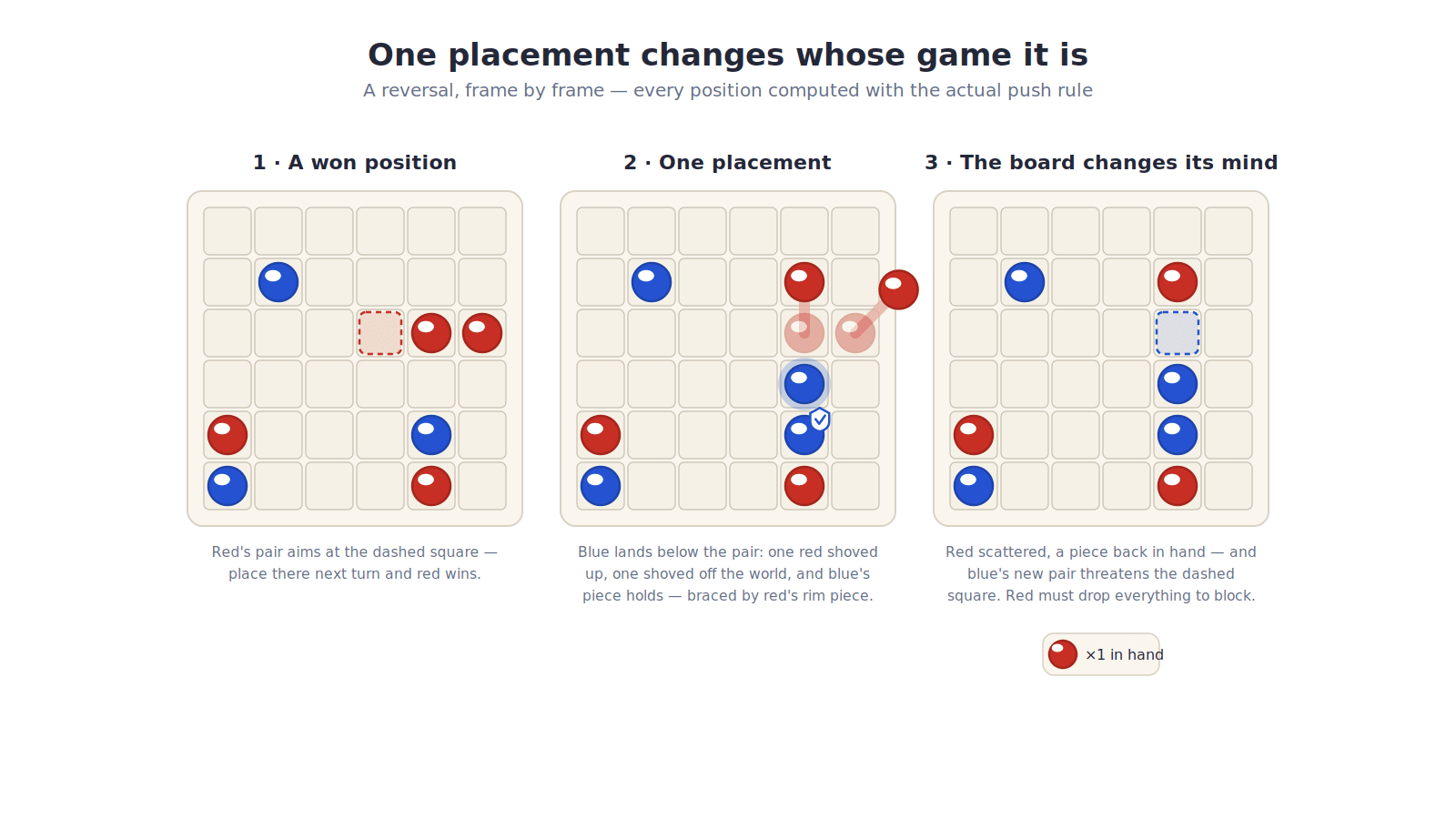
This matters for a reason that has nothing to do with fairness: hope is a gameplay resource. A player who believes the game is over stops playing well and stops having fun, whatever the score says. Reversal-rich mechanics keep both chairs emotionally in the game — the losing player always holds a lottery ticket that skill can genuinely cash, and the winning player can never fully relax. The figure below shows the shape of it: a position that looks finished, one placement, and a board that has changed its mind. Designers of quiet games work hard to graft comeback mechanisms on (catch-up bonuses, rubber-banding, scoring twists). Displacement gets them free, from physics.
The edge as narrative device
Every displacement game worth playing puts a cliff in the story, and the cliff is a storytelling machine that runs unattended. A piece near the edge is suspense that requires no rules knowledge to read: everyone at the table — players, spectators, the friend who wandered past with coffee — sees the marble at the rim, the disc one shove from gone, and understands the stakes exactly. Compare the classic alternative: in chess, danger is an abstraction living in the players' heads, invisible until it lands. The push game's danger is geographic. It has an address. You can point at it.
Designers get three gifts from this. Tension becomes self-narrating — the board communicates threat without UI, tutorials, or evaluation bars. Stakes escalate spatially — as the board fills and pieces crowd toward the rim, drama rises on its own schedule, a built-in third act. And player attention gets choreographed for free: everyone watches the same cliff-side crisis, which is what "table presence" actually means. The constraints article called the wall a co-author; in displacement games it moonlights as the narrator too.
Chain reactions and the gasp
The third dramatic engine is the multi-piece consequence: one action, several effects, at least one of them unplanned. Oustwit's radial blast moving up to eight neighbors at once. An Abalone train driving three marbles into a new alignment. The collapsing stacks of the GIPF family's wilder cousins. When a single decision produces multiple visible outcomes, you get the audible reaction — the gasp — and the gasp is worth designing for, because it's the sound of several people's predictions breaking at the same moment.
There's a precise recipe underneath it, and the slow-motion section of the psychology article assembles it: prediction confirmed (the pieces slide as your eye expected) plus surplus (one consequence attention didn't track). Displacement serves that dish every turn, because eight directions always hold one more ripple than working memory. The designer's job isn't to maximize the chaos — it's to keep the chain readable: short enough to trace afterward, so the gasp resolves into "of course!" rather than "what just happened?" The first is drama. The second is noise.
The costs, priced honestly
A design view owes the critique its full weight, so here it is. Displacement taxes planning. A board where everything can move is a board where nothing stays planned: the elegant three-turn setup you calculated gets rearranged by the opponent's next placement, and some players — good ones, serious ones — find that maddening rather than thrilling. They prefer the stone-still games, where a plan survives long enough to be judged. They're not wrong; they're buying a different pleasure.
The tax shows up on the math side too. Because each move disturbs many pieces, near-identical positions diverge violently — the game tree balloons — and deep lookahead gets expensive fast, for humans and engines alike. Calculation-lovers can feel cheated: their favorite skill buys fewer turns of certainty. And displacement has native failure modes: the shove-back-and-forth loop where two players undo each other forever, edge-camping, and the turtle who armors up and refuses contact. An untamed push game degenerates into one of these within twenty plays. Every shipped classic in the family is a survivor of that gauntlet, and the survival kit is the interesting part.
Taming the chaos: the toolkit
Five tools appear again and again in the games that made displacement thinky instead of merely noisy. Watch how each converts chaos into decisions.
The blocking rule. Some arrangement of mass stops a push — Abalone's equal-numbers refusal, Oustwit's piece-directly-behind. This is the crucial one: it restores the possibility of structure. Once players can build shapes the storm can't move, planning pays again, and the game becomes a dialogue between force and architecture. The whole defensive art grows from this single rule.
Limited range. Pushes move things one space, not across the board; trains cap at three. Bounded consequences keep chains traceable — the difference between a ripple and an avalanche is exactly the difference between drama and noise.
The return policy. What happens to a piece shoved off the world? Abalone says it dies, making every ejection permanent and the game correspondingly grave. Oustwit says it returns to its owner's hand, converting material loss into tempo loss — aggression cycles, grudges stay friendly, and the game can afford constant violence because nothing is ever truly destroyed. Neither answer is right; the choice sets the game's emotional key, major or minor.
The small board. Displacement on a huge board dissipates — ripples vanish into acreage, and the drama pump loses pressure. On a 6×6, every push matters to every plan; the constraint keeps consequences dense and the whole state readable at a glance.
Progress compulsion. Something must punish the coward. Abalone learned this the hard way — its stall problem needed fixed setups. The cleaner modern answer builds the compulsion into the win conditions: Oustwit's fill-the-board race means a pure turtle loses by rule, since armoring is not advancing. When standing still is itself a losing move, every tool above gets sharper.
Read the list backward and it describes one game rather exactly, which is honest to say out loud: placement-only, one-square radial pushes, brace-blocking, return-to-hand, thirty-six squares, dual win conditions. Oustwit is what you get when a design accepts the whole displacement critique and answers every clause of it. Whether the answers delight you is a matter of taste; that they're answers is a matter of engineering.
A displacement design checklist
For the reader who tinkers — and for everyone else, because a checklist for building is also a checklist for judging. Seven questions to ask of any push game, homemade or store-bought.
What stops a push? If the answer is "nothing," structure is impossible and the game is a weather report. What happens at the edge? The cliff needs a meaning — death, recycling, scoring — or the geography is decoration. How long can a chain run? Uncapped consequences read as chaos; bounded ones as drama. Can the pushed player answer? After being shoved, is there a dignified reply — a counter-push, a rebuild, a returned piece to redeploy — or does one shove snowball? What compels contact? Name the rule that makes mutual turtling lose. Does pushing serve a goal, or is it the goal? The shove should be a verb in service of a win condition, not a toy that scores itself. And is the gasp earned? After the big chain, can players reconstruct the causes? If yes, you've built drama. If no, you've built a slot machine with extra steps.
Seven yeses from Abalone, seven from Shobu, seven from the 6×6 duel this site orbits — and rather fewer from the prototype in your notebook, which is fine. That's what the checklist is for.
Watch one game like a designer: tonight's exercise
Theory lands better with a scorecard, so here's a twenty-minute field assignment. Play one push game tonight — or watch one; spectating works even better. Any game in the family will do. Keep three tallies on a scrap of paper.
Tally one: gasps. Every time a move produces more consequences than you predicted, make a mark. Include your own moves. A healthy push game earns a mark every few turns. Notice when they cluster — almost always mid-to-late game, as the board fills and the chains lengthen. That's the drama pump building pressure on schedule.
Tally two: reversals. Mark every moment the apparent leader changes — not the score, the feeling. Who would a stranger say is winning? In a quiet game the answer changes once or twice. In a good displacement game it can change five times, and you now know why: state change is cheap, so fortunes stay liquid.
Tally three: tools. Each time an attack fails or fizzles, name the tool that stopped it. A blocking rule? Limited range? The return policy softening the blow? You're watching the taming toolkit do its shift work — the quiet machinery that keeps the drama from souring into noise.
Twenty minutes, three tallies, and the whole article moves from your reading memory into your playing eye. Bonus round: run the same tallies on a quiet classic the next night. The contrast is the entire design lesson, measured in pencil marks.
Questions people ask
Isn't displacement just randomness wearing a costume? No — and the distinction is worth engraving. Random means unknowable in advance; displacement is fully deterministic physics that both players can read if they spend the attention. The chaos players feel is a budget problem (more consequences than working memory), not an information problem. That's why push games reward practice so steeply: the weather becomes forecastable, and the forecasters win.
Why do so few classical games use displacement? Partly equipment: shoving physical pieces around crowded boards is fiddly, and the mechanic only got comfortable with heavy marbles in frames — or screens, where the pieces animate themselves and the physics runs without fingers. Partly selection: the failure modes above killed most folk attempts before they could spread. The mechanic was waiting for its materials.
Does displacement scale to big boards and armies? Poorly. The pump loses pressure as space dilutes consequences — a push in a corner of a 19×19 world is a local anecdote, not a plot twist. Displacement is a small-board art almost by physics, which is why the family's masterpieces are all pocket-sized.
What should a designer steal first? The return policy decision, because it's the highest leverage per sentence: permanent loss versus return-to-hand changes the game's entire emotional register — severity or forgiveness, siege or sparring — before a single other rule moves. Decide what your cliff means, and half the remaining design decides itself.