Learn › Small boards, deep games › Five tiny games
Five tiny games with oceans of depth
The admission rules for this list are strict: the game must fit in a pocket or a phone, teach itself in minutes, and repay years — the smallest possible container holding the largest possible game. Five made the cut. These aren't rankings; they're love letters, each to a different way of being small and bottomless.
How the list was built (and what it excludes)
Three tests governed the door. Tiny: the whole game — board, pieces, rules — fits in a pocket, a print-out, or a phone screen with everything visible at once. Instant: a newcomer plays a real game within five minutes of first contact. Bottomless: after a hundred plays, you're still finding rooms — the game passes every sign in the deep-game field guide, especially the same-opponent test. The tests disqualify some magnificent games for being too big (the full 19×19, international draughts) and some charming games for being too shallow (the whole airport-gift-shop shelf). What survives is the concentrate aisle — depth per square at its most extreme. One per family, five families, alphabetical by nothing: here they are.
1. Go on the 9×9 board — the ocean, bottled
The full Go board is a sea that swallows careers. The 9×9 — the beginner's board that never stops being worth playing — is the same water in a bottle: every concept intact (liberties, life and death, territory versus influence, the trade), games of ten to fifteen minutes, and the whole state visible in one glance on the smallest phone.
What makes it bottomless rather than merely educational: contact arrives by move five, every stone is a meaningful fraction of the whole world, and the wall pressure that big-board Go defers for fifty moves starts immediately. Professionals play serious 9×9 events; servers run 9×9 ladders where lifetime students still climb. It's the strongest possible proof of this shelf's thesis: shrink the deepest game on Earth by four-fifths and what remains is still deeper than you. The five-minute version of forever.
2. Onitama — five cards, twenty-five squares, no bottom
Onitama is a chess-like duel with a twist of genius: pieces don't have fixed moves. Five movement cards are dealt from a larger deck; you hold two, your opponent holds two, one waits on the side — and when you use a card, it rotates to your opponent. Every move you make hands your weapon to the enemy.
The result is a game of perfect information about a changing vocabulary: you always know exactly which four moves exist and where each one will go next, so the lookahead is crystalline — and agonizing, because using your best card arms your rival with it. Games run ten minutes; the dealt-cards setup gives every match a fresh geometry from a pool of thousands of combinations (setup randomness, pure play after — the family's gentlest bend); and the depth question is never "what can they do" but "what does my move teach the board to do." A masterpiece of the modern renaissance, and the list's best answer to "chess is too much homework."
3. Hive — the board that isn't there
Hive deletes the board entirely: hexagonal tiles — bugs, each with one movement rule — placed and moved on any flat surface, the swarm itself becoming the terrain. One rule holds the universe together (the hive may never split), and one goal ends it (surround the enemy queen).
Hive's depth comes from that connectivity constraint: every tile is simultaneously a piece and a load-bearing wall of the world, so moving anything reshapes what everything else may do — interaction, maximized, with zero squares involved. It plays in fifteen minutes, travels in a bag smaller than a paperback, needs no table bigger than a café saucer, and supports tournament play with notation and championships. The pocket game in its platonic form: infinite board, finite bag, endless study. (The full tour of Hive and its modern siblings lives on the renaissance shelf.)
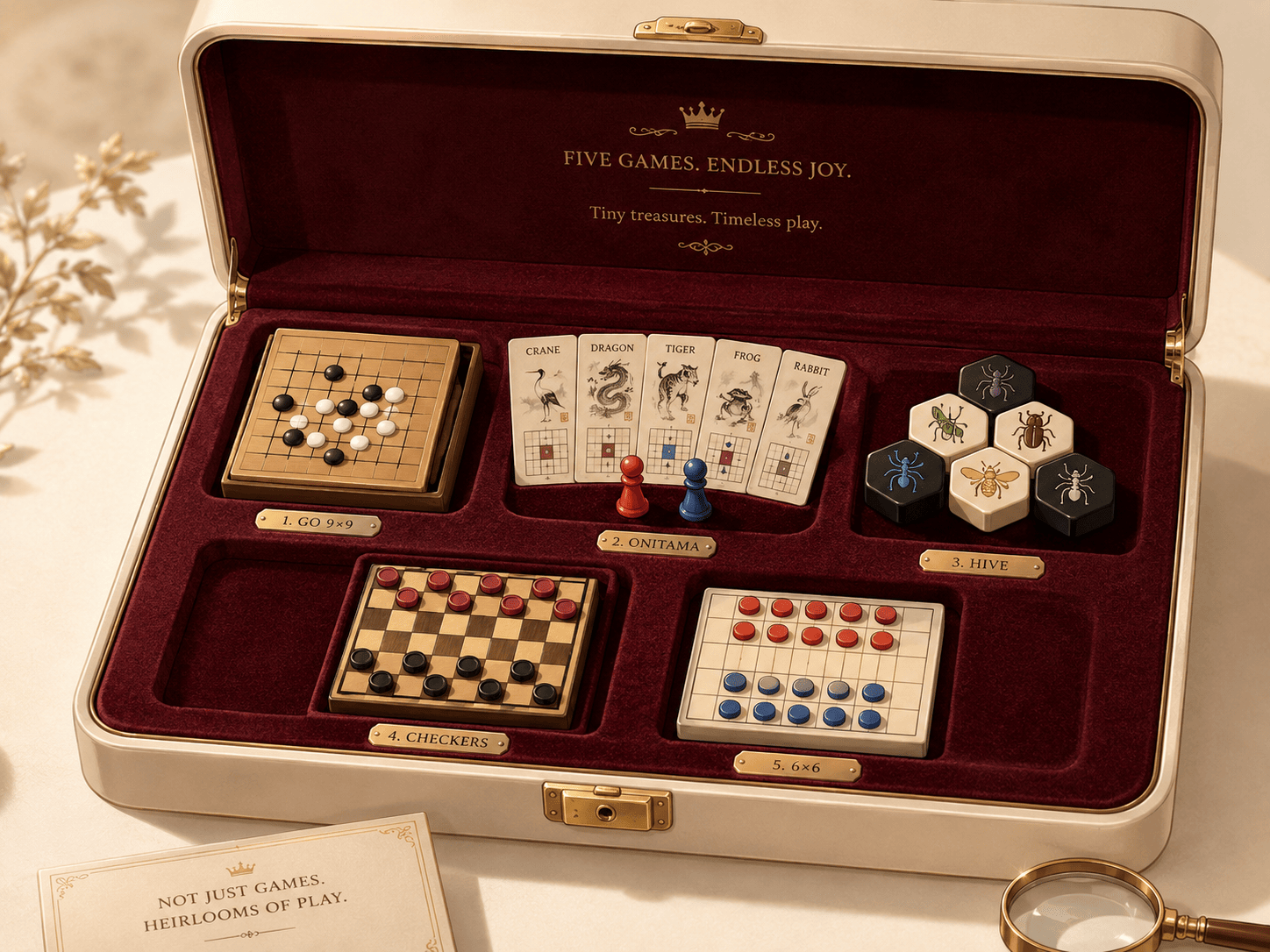
4. Checkers — the pocket classic hiding in plain sight
Yes, checkers — and if that surprises you, the full case is one shelf over. As a tiny game it's practically perfect: a board you can draw, pieces you can substitute with coins, rules told in five sentences — and beneath them, compulsory captures generating deterministic combination chains, move-starvation endgames of genuine severity, and a competitive history that produced perhaps the most dominant champion any game has known.
Checkers earns its case slot on accessibility-to-ceiling ratio: no game on the list is easier to start tonight with literally anyone — a child, a grandparent, a stranger on a train — and none hides its depth behind a friendlier face. The shot (feed one, forced jump, harvest two) remains among the purest tactical pleasures in gaming, and the 2007 solving proved the little board required one of the longest computations in research history to pin down. The kindergarten game that took science twenty years to finish: that's a tiny game with an ocean in it.
5. Oustwit — the newcomer, measured by the same yardstick
The fifth slot belongs to the game this site knows best, so let's be scrupulous and run the tests coldly. Tiny: a 6×6, sixteen pieces, whole state on one phone screen — pass. Instant: place a piece, it pushes all eight neighbors outward, three-in-a-row or all-eight-placed wins; the teach is forty seconds — pass. Bottomless: here's the honest audit. Contact from move two (walls, small board). Branching wide (any empty square, most turns). Interaction maximal — every placement moves up to nine pieces, the tree-ballooning property that makes small displacement games out-count their acreage. Dual goals in permanent tension, the fork-friendly, race-friendly structure this shelf has mapped in detail. And the same-opponent test — the one that needs no theory: rivalries in this game escalate, shover versus builder versus counter, game fifty unrecognizable from game five. Pass.
What honesty requires adding: Oustwit is young. It has no Tinsley, no century of literature, no solved-shelf certificate — its ocean is measured by structure rather than history, and history is the only judge whose verdict counts in the end. But the structural tests are exactly the ones the other four would have passed on their first birthdays, and that's the standard a list like this can apply. The newcomer sits in the case on merit, with the burden of proof where it belongs: on the next thousand rematches.
Matching the bottle to the drinker
Five games, five temperaments — and choosing well doubles the odds the thirty-day challenge below actually takes. A matchmaking guide, honestly biased by long observation.
The chess-curious who bounced off chess: Onitama. All the dueling geometry, five moves instead of a library, and the card rotation replaces opening theory with live thought. The refugee's soft landing.
The counter — the person who loves arithmetic more than they admit: checkers, and eventually oware from the mancala shelf. Deterministic chains, endgame counting, move-starvation: the games where being precise is the fun.
The traveler and table-sharer: Hive. No board to level, no setup to protect from a bus's jolts, and the swarm draws spectators like jam draws wasps. The most social object on the list.
The contemplative: 9×9 Go. Quiet, still, profound — the game for people whose favorite part of thinking is the silence around it.
The rivalry-seeker with a phone and five minutes: the 6×6 push duel, built for exactly that life — async needling, instant rematches, and a physics engine that keeps even losses entertaining. If your gaming happens in stolen slivers with a standing enemy, this is your bottle.
Mismatched anyway? No harm done — every game on the list teaches the others' skills. But matched right, the first week feels like recognition instead of homework, and recognition is what carries people to day thirty.
The 30-day one-game challenge
A display case invites browsing; depth rewards the opposite. So here's the protocol this list was really built for: pick one — exactly one — and give it thirty days.
Days 1–7: play daily against the easiest AI (or a patient human), no study, no reading. Just reps — five minutes counts. Days 8–14: raise the difficulty one notch, and start the one-lesson habit: after each session, name a single thing that keeps beating you. One sentence, out loud. Days 15–21: find the game's humans — a lobby, a rival, a standing opponent — and play them thrice weekly. Review one loss per week, sixty seconds, the replay has everything. Days 22–30: hardest AI or ranked play, plus one deliberate experiment per game: a new opening square, a style you've been avoiding, a sacrifice you'd normally decline.
What the month buys: the transition every deep game keeps behind its five-minute door — from playing at the game to playing in it, patterns surfacing, the rating moving, the container revealing that it never had a floor. Total time: perhaps six hours, spent in slivers your week was already leaking. The other four games will still be in the case when you surface. That's rather the point of forever games: they wait.
A case-keeper's note: on owning several forevers
One warning from everyone who's loved this aisle for years: the concentrate shelf has its own failure mode, and it isn't shallowness — it's browsing. Five bottomless games, sampled in rotation, produce a strange result: years of play, no depth reached in any, the same first hundred feet of five different oceans. Depth is a function of consecutive attention; it compounds in one game the way interest compounds in one account, and splitting deposits five ways starves them all. Hence the case-keeper's discipline: one main game per season. Play the others socially, freely, joyfully — but keep one bottle designated as the one you're actually drinking, the one whose replays you review and whose rating you mean. Rotate seasons if you like; many players orbit the case over years, returning to each game deeper than they left it. The display case is a library, not a buffet — and the difference, entirely, is whether you finish chapters.
Questions people ask
Where's chess? Failed the tiny test's spirit, narrowly — six piece types and a real rules load make its five minutes optimistic — and it hardly lacks for coverage. Consider it the case's honorary sixth, one shelf over.
Where's Othello? Agonizingly close — it missed on a technicality of the author's five-slot budget, and its own love letter exists precisely to compensate. Sixth-and-a-half.
Physical or digital for these five? All five run beautifully both ways; the phone versions add the usual gifts (AI ladders, replays, lobbies) and the physical versions add the tabletop's ritual pleasures. The 30-day challenge works on either. Rivalries work best wherever your rival is.
What if my thirty days reveal I picked the wrong one? Then you've spent a month sharpening the exact instincts — counting, forks, tempo, walls — that transfer to the other four, and to everything else on this shelf. In the concentrate aisle, there is no wrong bottle. There's only the one you opened first.