Learn › The modern renaissance › Santorini and Onitama
Santorini and Onitama: small rules, big depth
Two small boxes sit at the front door of the modern abstract renaissance, and they share one job: proving in five minutes that a tiny ruleset can out-think you. Santorini builds towers; Onitama duels with borrowed martial-arts moves. Between them they've converted more people to the abstract family than any lecture ever could — and each is a masterclass in a different kind of constraint.
Two small boxes, one big idea
Every generation of the family needs gateway games — designs so instantly playable that a skeptic is mid-match before the explanation ends, and so deep that the skeptic is still playing a month later. The classical era's gateways were checkers and the mill games. The modern era's are, by wide agreement, these two: five-by-five boards, rules that fit on a card, twenty-minute games, and decision quality far above their weight class.
The big idea they share is the one this library keeps meeting: don't add possibilities — ration them beautifully. Each game takes one savage constraint, builds everything around it, and lets depth condense where freedom was removed. But they ration different things, which is why they make such a perfect pair: Santorini rations space, straight up into the air. Onitama rations the rules themselves.
Santorini in a breath
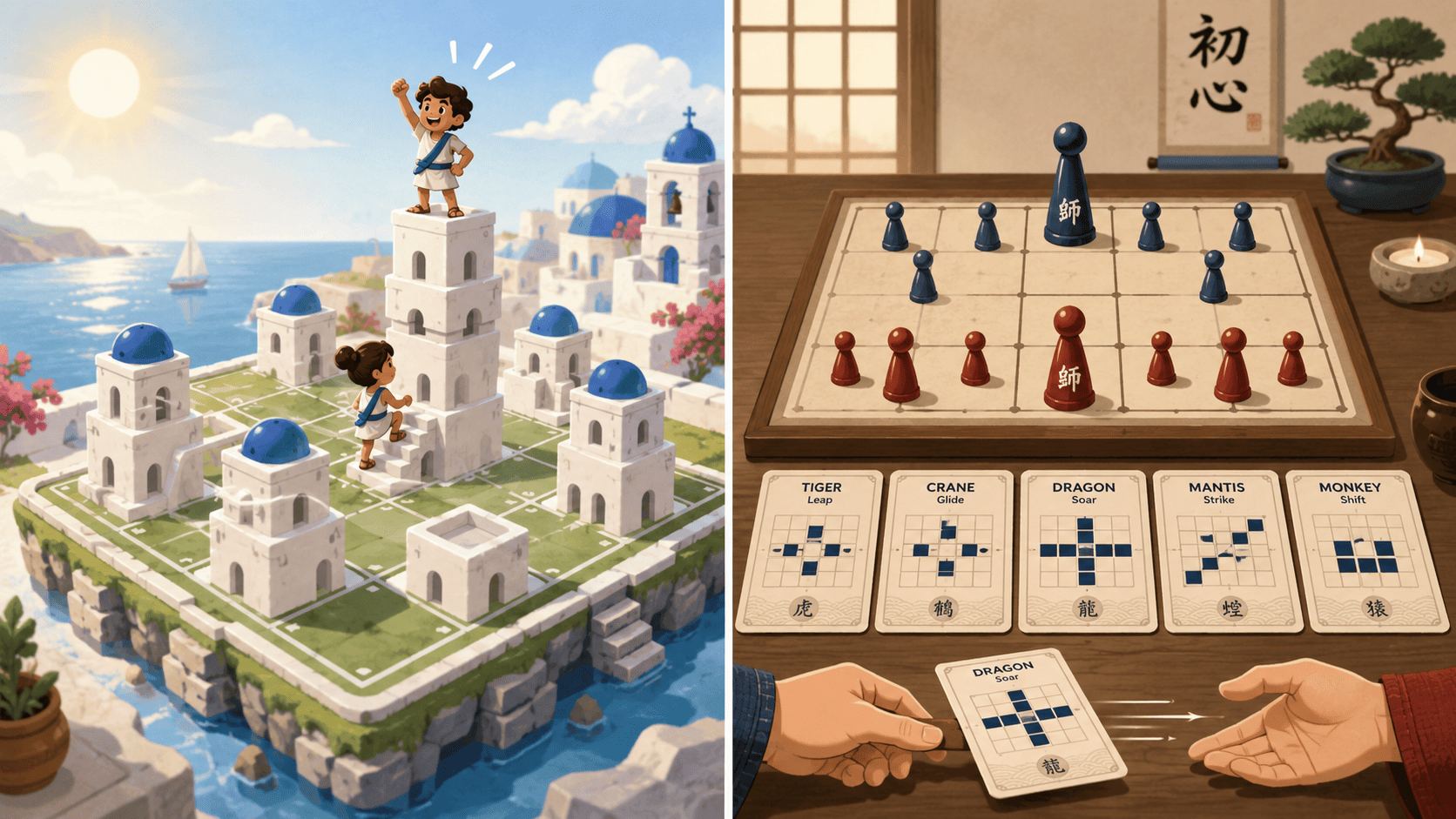
Your turn in Santorini is two acts, always in order: move one of your two builders one space in any direction, then build one level of tower on a space next to where that builder stands. Towers rise through three levels; a fourth build seals the tower with a dome, dead forever. Builders can climb — but only one level up per move, while they may jump down any distance. Win by stepping one of your builders onto the third level of a tower. That's the entire base game.
From those five sentences comes an astonishing amount of game. Every build is double-edged: the tower you raise for your own climb is a tower your opponent might climb first, so construction is always a gift you're trying not to give. Blocking is physical — cap a tower with a dome and the threat is gone; body-block a space and the ladder breaks. And because you must both move and build every turn, there are no quiet passes: each turn hands your opponent new terrain, and the endgame becomes a knife-edge of forced sequences any chess player will recognize by feel.
Then the box adds its famous twist: god powers. Each player can draw a card — Apollo, Artemis, Atlas, dozens more across editions — that bends exactly one rule. Move twice. Build twice. Push an enemy builder. Win from a different condition. One rule each, asymmetric, swapped every game.
Why Santorini works
Two design decisions carry the game. First, verticality makes threats visible. In most abstracts, reading the position is a learned skill; in Santorini the position is literally architecture — a builder standing beside a two-story tower is the threat, visible across the room to someone who's never played. It's the same legibility gift that displacement games get from physics, achieved here with altitude. Beginners read real positions correctly on game one, which is exactly what a gateway needs.
Second, the god cards buy replay without rules weight. The base game stays five sentences; the variety lives in one card per player per match. Each pairing of powers reshapes openings, tempo, even the win condition — hundreds of matchups from a deck of single sentences. It's the modern renaissance's answer to the memorization problem: theory can't calcify when the rules gently change every game. Purists play god-less Santorini and get a tight, chess-like duel; families play with gods and get a different game every night. Same box, both audiences, no chapter of rules added.
Onitama in a breath
Two five-piece teams face off on a five-by-five board: four students and a master each. You win by capturing the enemy master, or by walking your own master onto the enemy master's starting temple square. But here is the twist that makes Onitama Onitama: your pieces have no moves of their own. Five movement cards are dealt from the deck; you hold two, your opponent holds two, and the fifth waits at the side. On your turn, choose one of your two cards, move any one piece exactly as that card's pattern shows — then hand that card to the side as your opponent's incoming card rotates into their hand.
Read that again slowly, because everything lives in it: every card you play travels to your opponent. Use your best move and you arm your rival with it. Hold it back and you're fighting with your weaker option. Five cards, fully visible, circulating forever — the entire vocabulary of the game is public and shared, and it never stops moving.
Why Onitama works
Onitama delivers a strange and wonderful mental state: perfect information about the future's shape. You always know exactly which four moves exist right now and which move is arriving next — so the game isn't about discovering what's possible, it's about sequencing a tiny, fully-known possibility space three beats ahead. The field guide calls this the borrowed-move verb, and it produces calculation unlike anything in the classical family: you plan with moves you don't have yet, against moves you're about to give away.
The deal adds the renaissance's favorite anti-homework medicine. Sixteen-plus cards in the deck, five per game: the combinations run into the thousands, so opening theory can't harden — every match starts with a fresh grammar to read. Yet within one game, nothing is hidden and nothing is random; from the first move onward it's pure open-board reasoning, tight as an endgame study. Ten minutes, wildly replayable, and the best available demonstration that a game's rules can be a resource players fight over.
What the pair teaches together
Play both in one week and a shared lesson surfaces. Neither game gives you many options — Santorini offers a handful of move-and-build combinations, Onitama exactly four moves at most on many turns — yet both routinely out-think their players. Their depth doesn't come from breadth; it comes from tension per option: every choice is double-edged (the tower that helps them, the card that arms them), so a small menu still cuts deep. The small-board depth engine in its purest commercial forms.
They also mark out the renaissance's two great replay strategies, worth naming as a pair. Santorini varies the players (asymmetric powers, same rules); Onitama varies the rules (same pieces, rotating grammar). Both dodge the classical diseases — memorized openings, stale matchups — without a page of extra complexity, and nearly every modern abstract since has borrowed one strategy or the other. When you meet a new duel, it's a fine first question: does it replay by changing who you are or what moves exist — or does it, like the sternest classics and the purest new duels, dare to change nothing and trust its engine?
After these two
The pair leaves players hungry in two directions, and the shelf can feed both. If Santorini's blocking and climbing hooked you, the natural next steps are the tower-and-terrain wing of the family — Focus's traveling stacks, DVONN's collapsing columns in the GIPF project — and, for the purest possible version of "terrain you build yourselves," Hive, where the pieces are the ground. If Onitama's shared-vocabulary tension is what stayed with you, you're ready for the displacement school, where the resource players share is space itself: Abalone and Shobu on the shove shelf, and the 6×6 placement duel where every move rearranges the neighborhood. Either road, the gateway has done its work: you now know, from the inside, that five minutes of rules can hold a month of thinking — and the rest of the renaissance is more of that feeling, tuned to different tastes.
Your first evening with each
Both games teach themselves, but a few pointers turn night one from stumbling into playing. Here's the short course for each box.
Santorini, first games. Teach it in one breath: move a builder one space, build one level beside it, step onto a third floor to win. Then hand over three habits. One: watch their altitude, not yours. The most common beginner loss is admiring your own tower while their builder quietly reaches level two — from there, one climb wins. Two: never finish a ladder you can't guard. A two-story tower next to their builder is a gift; build it one space farther away, or be ready to dome it. Three: use the dome as a weapon. Capping a tower costs you a build, but it deletes their best threat forever. When in doubt, dome. Play the first two games without god powers. Add gods on game three — the moment the base game feels readable, the cards become delicious instead of confusing.
Onitama, first games. Teach the loop: pick one of your two cards, move any piece by its pattern, then the card leaves you. Then hand over three habits. One: read the incoming card before you move. Your next turn's options are already visible at the side of the board — plan with them. Two: count your master's exits. Before every move, glance at the squares your master can flee to. If the number is one, fix that now. Three: give away moves, not power. When both your cards are strong, use the one that helps your opponent least when it rotates across. You're always feeding your rival; feed them the thin soup. Expect your first two games to end in sudden master captures nobody saw. That's normal. By game five you'll see them coming, and the real game begins.
Questions people ask
Which should I buy first? Company decides. Mixed households and families: Santorini — the towers charm non-gamers, the gods keep the table laughing, and the base game hides real teeth for later. Duelists and chess-curious friends: Onitama — sharper, sterner, faster, and the card rotation is the better conversation piece. Neither choice misfires; they're the two friendliest doors in the genre.
Are the god powers balanced? Loosely, charmingly, and it mostly doesn't matter. Some pairings tilt the field, and serious groups draft or ban accordingly — but the asymmetry is the point: you're compensating for your power's weakness with play, which is its own skill. For a perfectly level field, play god-less; that version is as fair as chess.
Is Onitama solved, with so few cards? No. The five-card deal creates thousands of distinct games, and each single deal is already a deep sequencing problem — small possibility spaces multiply faster than intuition expects. Engines play it well; nobody has exhausted it.
What do these two have to do with a push duel like Oustwit? They're siblings in the same design church: one savage constraint each (space upward, rules in rotation, placement that shoves), tiny boards, no luck, twenty minutes. Learn any one and the others get easier to read — the constraint-first instinct transfers whole.