Learn › The modern renaissance › The GIPF project
The GIPF project: six games, one big idea
In the late 1990s a Belgian designer named Kris Burm announced the strangest ambition in the history of abstract games: not a game but a project — six connected two-player abstracts, released over a decade, sharing a universe and even feeding pieces into one another. The result is the genre's equivalent of a great album cycle: uneven in fame, unmatched in influence, and studied by designers the way writers study short-story masters.
The strangest ambition in abstract games
Abstract games are usually solitary achievements — one designer, one ruleset, done. Burm planned a series: six games, each a complete standalone duel, each exploring one mechanism to its bottom, and all six linked by a shared minimalist aesthetic (black and white pieces, hexagonal geometries, no luck anywhere) and by an audacious connective tissue called potentials — special pieces earned in one game that could be carried into another. The project ran from the flagship's release through the mid-2000s, drew tournament scenes across Europe, and settled permanently into the canon: ask serious abstract players to name the modern era's masterpieces and several answers will come from this one shelf.
For this library's purposes the project matters for a cleaner reason: it's the best existing course in the renaissance's core method — isolate one idea, cut everything else, perfect what remains. Six times in a row.
GIPF itself: the flagship
The namesake game distills positional war to a supply problem. On a hexagonal grid, players don't place pieces onto free squares — they push them in from the board's edge, each entry shoving the whole row inward one space (players of a certain 6×6 duel will feel an immediate kinship). Line up four of your color and you harvest: your row returns to your reserve, while any enemy pieces caught in the harvest's extension are captured for good. The endgame condition is the masterstroke: you lose the moment you cannot play — when your reserve runs dry. Material isn't an army; it's fuel, burning a little with every push, and harvesting is your only refinery.
The play experience is a slow tightening you can feel in your chest: every placement spends a piece you may never get back, rows crowd and compress, and the double game — building your own four-in-a-row while starving theirs — runs on alignment instincts the family has trained for millennia, repriced by an economy where every move costs blood. GIPF is the project's statement piece: even the right to keep playing can be a resource.
The siblings, one hook each
Each sequel isolates a different mechanism. In release order, one paragraph of soul apiece:
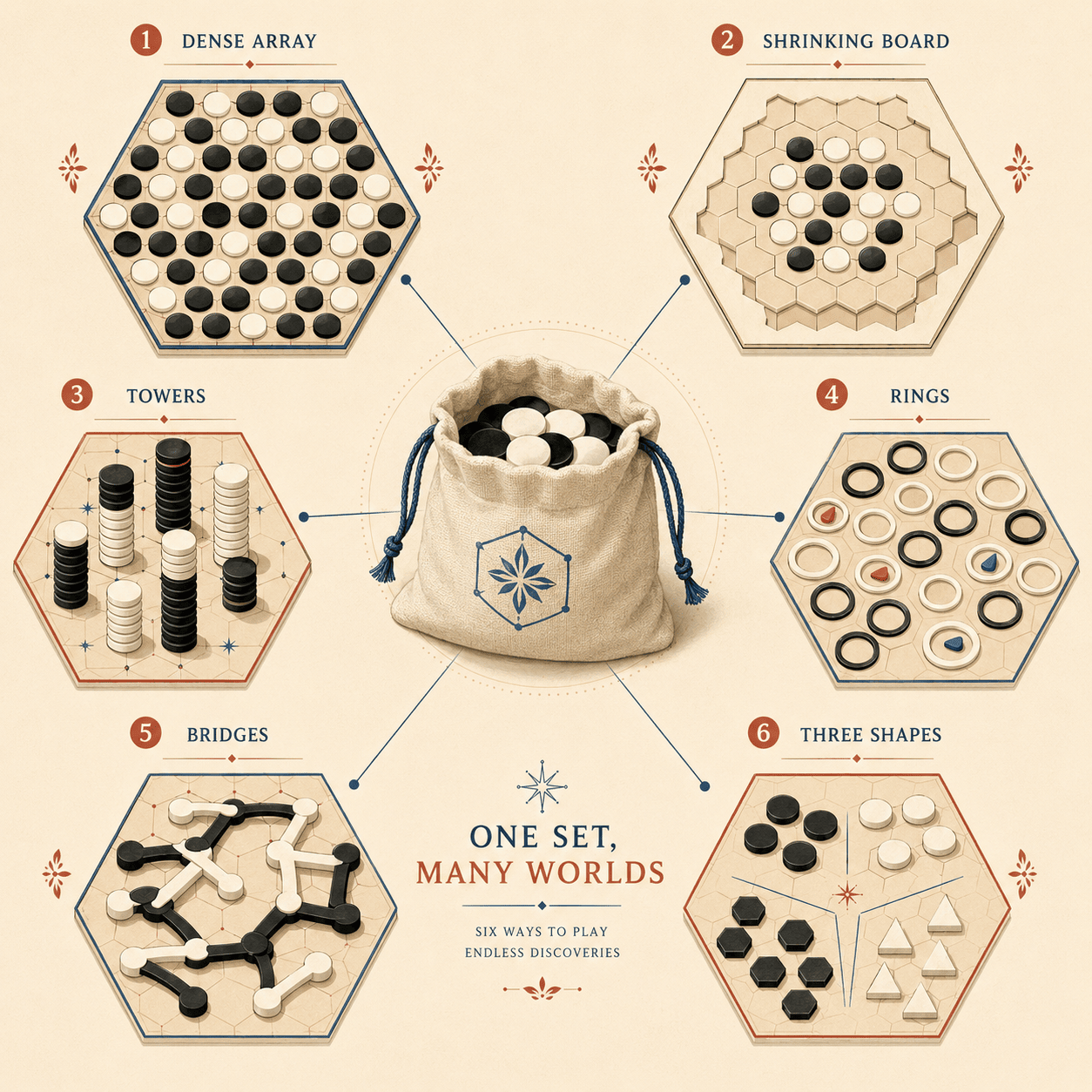
ZÈRTZ — the vanishing world. Nobody owns pieces; both players place shared marbles and remove rings from the board's edge, so the world shrinks every turn. Jump-captures are compulsory (checkers players feel at home), and you win by collecting sets of marbles. The board's disappearance forces the endgame automatically — stalling is geometrically impossible when the floor is being sold from under both of you. The purest anti-draw machine ever built.
DVONN — the collapsing towers. Pieces stack by landing on each other, stacks move by their height, and everything must stay connected to three red DVONN pieces — lose the connection and whole regions fall off the world. The game ends when nothing can move; tallest surviving material wins. Santorini players who loved building upward meet the dark twin: here altitude is captured, not climbed, and the board amputates itself as connections fail.
YINSH — the rings that shrink you. You move rings that flip markers Othello-style as they pass. Make five-in-a-row of your color and you remove one of your own rings — that's progress: first to remove three rings wins. Which means every success makes you weaker, four rings doing the work of five. Winning-by-shrinking is the project's most quoted single idea, a built-in comeback engine with zero added rules. (Players of Othello find the flipping familiar and everything else gloriously upside down.)
PÜNCT — the bridge war. The project's connection game: link two opposite sides of the hexagon with your pieces, which come in shapes that can stack and straddle. The family resemblance to Hex is deliberate; the stacking dimension is the fresh cut. The least famous sibling, and connection-game devotees defend it like a younger child.
TZAAR — the fragile trinity. Your army has three piece types, and you lose instantly if you run out of any one of them. Each turn: capture, then optionally capture again or stack your own pieces (stronger, but fewer). Material diversity as a life bar — army-building instincts from chess turned inside out, since trading down can kill you even while you're ahead.
Potentials: games that plug into each other
The wildest idea deserves its own chapter. Burm designed the flagship with sockets: special GIPF pieces called potentials that carry powers earned from the sibling games — play a ZÈRTZ-flavored potential and a ZÈRTZ-ish event fires inside your GIPF match. In principle the six games form one modular super-game; in practice, most players treat the games as standalones and the potentials as a curiosity — the tournament scene largely plays each game pure. But as a design gesture it was decades ahead of its time: the connected-universe model that video games and expandable card games later monetized, sketched first in wooden abstracts by one stubborn Belgian. The lesson designers actually took wasn't the plug-in system itself; it was the permission it granted — a game can be a body of work.
Why designers study this series
Because it's a curriculum. Six times, Burm asked the same question — what happens if the whole game is this one idea? — and shipped the answer with nothing else attached. Supply as life (GIPF). Board as consumable (ZÈRTZ). Connection as gravity (DVONN). Success as self-reduction (YINSH). Terrain as pieces (PÜNCT). Diversity as survival (TZAAR). Every game in the series passes the one-generative-rule test the design-lessons article holds up as the renaissance's signature, and passes it with unusual severity: there is almost nothing in any GIPF-project box that could be removed. For a designer — professional or kitchen-table — reading the six rulebooks in sequence is the cheapest masterclass in editing that exists. For a player, the same tour installs a taste for elegance that makes every future rulebook easier to judge.
Which GIPF game is for you
A quick matchmaking guide, by appetite. The economist — you enjoy budgets, attrition, the long squeeze: GIPF proper, and bring patience; it's the heaviest sitting. The tactician — you love forced jumps, sharp reversals, games that end in a knife-flash: ZÈRTZ, whose compulsory captures create combination chains worthy of checkers at its nastiest. The architect — towers, territory, dramatic collapses: DVONN. The purist — you want the one everyone calls the series' masterpiece: YINSH, the most decorated and most immediately lovable; if you buy one, buy this. The connector — Hex and Twixt are your people: PÜNCT. The quartermaster — army composition, trading discipline: TZAAR. Availability rotates — the series drifts in and out of print, edition by edition — so treat the hunt as part of the hobby; the games are evergreen even when the stock isn't.
The project's legacy
Trace the fingerprints and they're everywhere on the modern shelf. Winning conditions that shrink or starve the winner's own resources; boards that consume themselves to force endings; compulsory-capture tactics revived for adult duels; the black-and-white minimalist production style that became the genre's default costume; and above all the one-mechanism-perfected discipline that separates the renaissance's keepers from its shovelware. App-era duels inherit the estate directly — a 6×6 game built entirely around one placement-push rule, with dual win conditions engineered against stalling, is playing recognizably Burmian music on a phone screen. The project set the bar the whole genre still clears or misses: ship the idea, and nothing else.
Three moments that teach the whole project
Reading about six games is abstract. Feeling them isn't. Each of the project's stars has one signature moment — a beat of play that teaches its whole idea in a few seconds. Chase these three and you'll understand the series from the inside.
The first harvest (GIPF). Your reserve is down to a worrying handful. You've been spending pieces for ten minutes and the drain is starting to feel like a countdown. Then your row of four completes — and the pieces come back, sliding out of the board and into your supply. Relief hits like air after a long dive. In that moment you understand the whole game: it's not a battle, it's a breathing exercise. Spend, spend, spend, breathe. Players who chase captures learn slower than players who chase that breath.
The forced chain (ZÈRTZ). Captures are compulsory, and you will forget this exactly once. You place a marble innocently. Your opponent points out that you've just created a jump — for them, and then another, and then a third, your careful position dismantled by a chain you built yourself. It stings wonderfully. From then on you see the board the way the game wants: every placement is also a question about what jumps now exist. Checkers players arrive pre-scarred and love it immediately.
The first ring off (YINSH). You make five in a row. You celebrate. You remove one of your own rings, as the rules require — and your next turn feels strangely thin. Four rings now, doing five rings' work. Winning made you weaker, and suddenly the whole game reorganizes in your head: this isn't a race to score, it's a controlled descent, and the player who times their self-reduction best wins. No other game teaches that idea, and YINSH teaches it in one move.
If you remember nothing else from this article, remember the shape of those three moments: supply as breath, placement as capture-question, victory as weight loss. One idea each, perfected. That's the project.
Questions people ask
Do I need to play them in order? No — they're fully standalone, and release order isn't difficulty order. YINSH and ZÈRTZ are the friendliest entries; GIPF proper is the deep end. The shared universe is a bonus for completists, not a prerequisite.
Are the GIPF games solved? No. All six live far beyond exhaustive analysis — the counting article explains why games this interactive balloon so fast — though strong engines exist for several. The tournament scenes never ran out of theory to argue about.
What happened to the potentials idea — why didn't it catch on? Logistics, mostly: it required owning multiple games and agreeing on house tournament rules, and the standalone games were each too good to need the gimmick. The idea survived as influence rather than practice — modular, connected game systems are common now; the wooden-abstract version was simply first and purest.
Six games is a lot — what's the one-sentence takeaway? That elegance scales: one designer proved you can build six different bottomless games by refusing, six times, to include a second idea — and every small deep game since, on tables and phones alike, owes rent to that refusal.