Learn › The modern renaissance › Five design lessons
What modern abstracts teach us about great design
Spend a season with the modern classics — Hive, Onitama, the GIPF series, the best of the app-store duels — and you start noticing they agree with each other. Under wildly different mechanics sits a shared checklist, five lessons the renaissance converged on from every direction. This article writes the checklist down: partly for anyone who tinkers with designs, but mostly because the lessons sharpen your judgment of every game you'll ever consider playing.
Elegance is a measurable thing
Start with the genre's KPI. "Elegant" sounds like taste, but the modern abstract community means something you can almost put a number on: the ratio of depth delivered to rules carried — how much discoverable strategy a game yields per sentence a player must memorize. Depth versus complexity unpacks the two axes fully; the renaissance's contribution was treating the ratio as the design target itself. A folk classic arrives at elegance by centuries of erosion; a modern designer has to engineer it on purpose, in one lifetime, against every temptation to add.
The five lessons below are, at bottom, five strategies for raising that ratio — four ways to cut the denominator and force up the numerator, and one to protect the result from the genre's oldest failure mode. Each comes with its exhibits.
Lesson 1: every rule must earn its seat
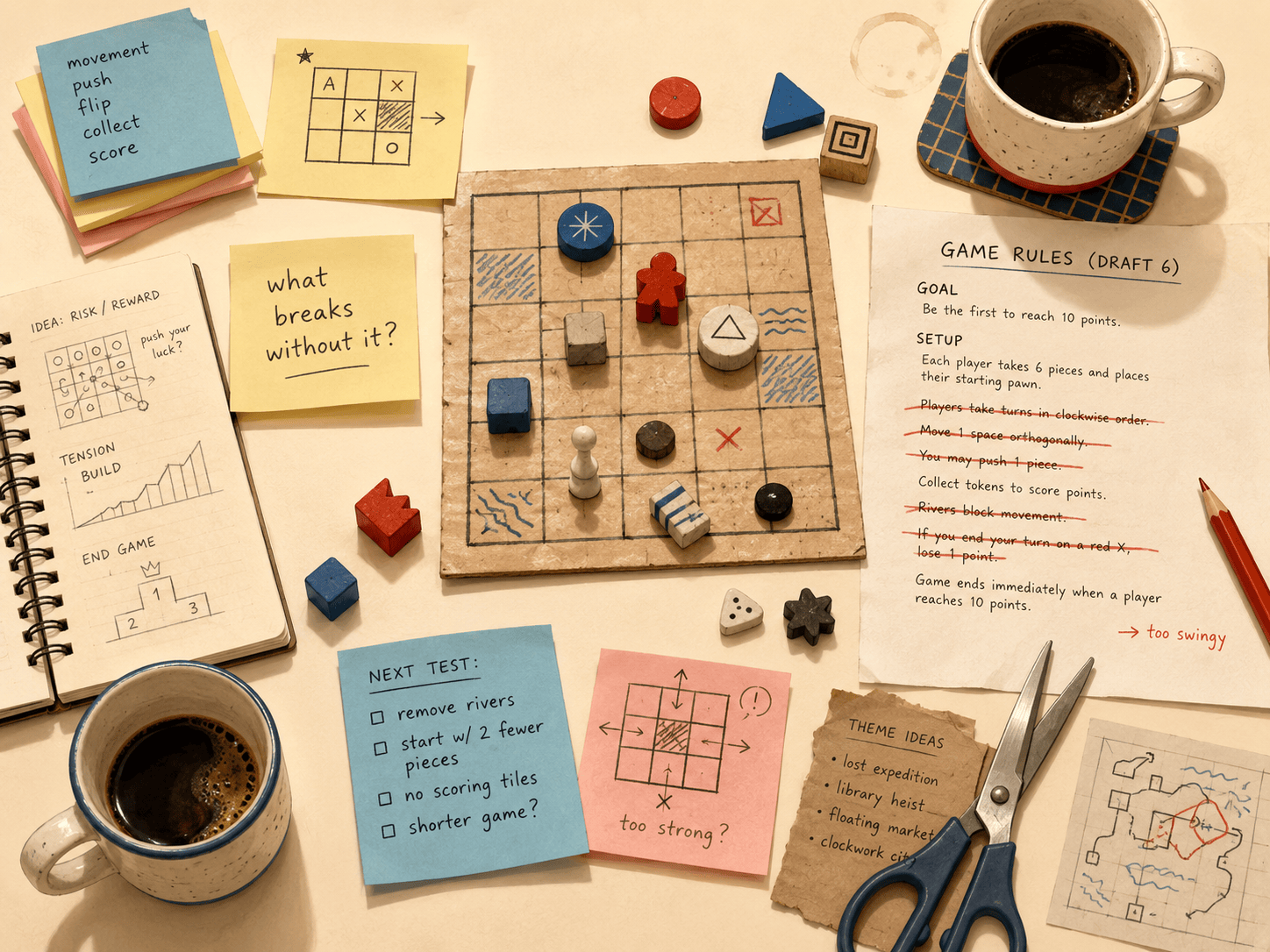
The renaissance's editing discipline is brutal by tabletop standards. The working question isn't "would this rule be nice?" — it's "what breaks without it?", and if the answer is nothing, the rule dies. The exhibits are the games famous for what they lack: Hive shipped without a board — the tiles' adjacency did the work, so the board never earned its seat. The GIPF series shipped six games with essentially no exceptions, no special setup lore, no scoring appendices; TZAAR's entire rulebook is shorter than many games' setup pages. Onitama cut piece-specific movement — the single largest rules category in the classical family — and replaced it with five public cards.
The transferable test is the one-generative-rule check: the keepers almost always have a single constraint doing enormous work (the hive may never split; the passive move must be legal first; a placement pushes all eight neighbors), surrounded by only the minimum scaffolding that constraint needs. When you read any new rulebook, hunt for the engine-rule. If you find one, the game has a spine. If you find a pile of features taking turns, you've found the shovelware.
Lesson 2: force interaction
The renaissance holds a hard line against a specific disease: parallel solitaire — two players optimizing side by side, politely, until the scores are compared. The cure is structural, never advisory. Small boards make avoidance geometrically impossible (the constraints article maps this machinery). Shared resources make every gain a theft — Onitama's traveling cards, ZÈRTZ's communal marbles. And displacement mechanics make contact physical: you cannot ignore an opponent who is literally rearranging your pieces, which is why the sumo school is the lesson's purest wing.
The design insight worth engraving: contact creates stories. A game where your moves don't disturb your opponent generates positions; a game where they do generates narratives — grudges, reversals, revenge arcs, the whole emotional inventory that makes people rematch. Interaction isn't a spice on top of the strategy; it's where the memorability lives. When you evaluate a new duel, count the turns before your choices genuinely collide. The moderns aim for: immediately.
Lesson 3: end before you're done
Classical abstracts can outstay their welcome — the lost-but-grinding chess endgame, the decided-but-unfinished territory count. The moderns engineered the exit. Target lengths dropped to fifteen or twenty minutes; end conditions became cliffs rather than slopes (surround the queen, remove your third ring, land your eighth piece — done, mid-thought, often one move before you expected); and several designs make the ending accelerate: ZÈRTZ's board shrinks, GIPF's reserves drain, DVONN's world amputates itself. Stalling isn't discouraged; it's impossible.
The deep reason is appetite economics: the rematch is part of the design. A game that ends while both players are still hungry converts one sitting into three games, and three games into a rivalry — and rivalry, not victory, is what keeps a duel installed on a phone or a shelf. Watch what the best small games do the instant a match ends: the board resets in seconds, because the designers knew exactly which moment they were building for. It's the moment someone says "again."
Lesson 4: make the state readable
Here's the quietest lesson, and maybe the most humane: a glance should tell you roughly how the game stands. The moderns build for legibility the way architects build for light. Santorini's threats are literal towers; a sumo game's danger is distance-to-cliff; YINSH's score is rings visibly gone from the board; a 6×6 fill-race is countable on one hand. Compare the classical opposite: a mid-game Go position is a masterpiece of information that only trained eyes can read at all — magnificent, and a real cost, paid by every spectator, every learner, and every tired player.
Readability is kindness, but it's also strategy design: what players can see, they can want — visible progress bars (rings removed, pieces landed, marbles ejected) give even losing players concrete sub-goals, and visible danger creates the shared table drama that the displacement school runs on. The modern test: could a stranger walking past your table point at who's ahead? The keepers usually pass. And note what the lesson does not say — readable state, not shallow state: the position should be easy to read and hard to evaluate. That gap between seeing and judging is exactly where the depth lives.
Lesson 5: solve the draw problem
The classical family's oldest embarrassment: play two careful equals and tic-tac-toe always draws, checkers championships drowned in draws, and even chess needed tiebreak bureaucracy. The renaissance treated draws as a design failure with structural cures, and the cures are a tidy taxonomy. Asymmetric goals: when the two players want different things (tafl's escape-versus-capture), symmetrical stalemate has no shape to settle into. Shrinking resources: ZÈRTZ's vanishing rings and GIPF's draining reserves guarantee the music stops. Connection goals: in Hex, one side must connect — a draw is topologically impossible, the century's most elegant impossibility proof hiding in a game. And dual win conditions in tension: give both players two different ways to win, and defense against one feeds the other.
The dual-goal cure deserves its case study, since this site lives with one. Oustwit's pair — complete three-in-a-row or land all eight pieces — is engineered so that pure blocking loses: every turn spent policing lines is a turn not racing, and every racing piece changes the line geometry. The two goals metabolize each other's stalemates, and the game cannot be played to a standstill by mutual caution. That's Lesson 5 executed exactly as the renaissance prescribes: don't punish drawish play with rules — make it self-defeating by structure.
The transferable taste
Now the payoff beyond the workshop. Internalize the five lessons and you own a portable instrument for judging any game — tabletop, app store, the prototype your friend keeps mentioning. Run the audit in a minute: Where's the engine rule, and what's riding free? How many turns before players genuinely collide? Does it end while I'm still hungry? Can a passerby read the state? What stops two cowards from drawing? Five questions, five lessons, and they correlate almost embarrassingly well with which games survive on shelves and phones — it's the same instinct the deep-game field guide trains at the store, given its engineering vocabulary.
The instrument works because the lessons aren't fashions — they're load-bearing answers to permanent problems: attention is scarce (cut rules), stories need contact (force interaction), appetite beats exhaustion (end early), minds love what they can see (readable state), and contests need verdicts (kill the draw). The classics that survived centuries pass most of the audit too, which is the reassuring part: the renaissance didn't invent new virtues. It reverse-engineered the old ones, wrote them down, and started shipping them on purpose.
Try the audit tonight: two games, ten minutes
The checklist becomes yours the first time you run it, so here's the exercise. Pick two games you own: one you keep coming back to, and one that quietly fell off the rotation. For each, answer the five questions fast — first instinct, no overthinking.
One: what's the engine rule? Can you name the single constraint the game grows from? Two: how many turns before the players truly collide? Count from memory of a typical game. Three: does it end while you're still hungry, or after? Think about how often "again?" gets said. Four: could a stranger point at who's ahead? Picture the mid-game state. Five: what stops two careful players from a standstill? Name the mechanism, not the hope.
Now compare the two scorecards. In most households the result is uncanny: the keeper passes four or five, and the shelved game fails one specific lesson — usually two (you never really collided) or three (it overstayed its welcome). That diagnosis is the payoff. You didn't stop playing the shelved game because you're fickle; you stopped because a load-bearing lesson was missing, and now you can name which one. Run the audit on a store shelf or an app-store page and it works nearly as well from the rulebook summary alone — which is the whole trick this article was for: taste, made checkable.
Questions people ask
Do these lessons apply outside abstract games? Startlingly well — they're close to universal interface design. Every rule earns its seat (feature discipline), force interaction (engagement loops), end before you're done (session design), readable state (UI legibility), solve the draw (no dead-end states). The abstract genre just learned them first and hardest, because it has no theme, art, or dice to hide sloppy engineering behind.
Which modern game scores highest on the checklist? Ask five devotees, get five answers — Hive and YINSH collect the most votes, Onitama the most "pound for pound" qualifiers. The honest answer is that the top shelf all pass all five; past that bar, ranking is taste. The interesting exercise is finding a game you love that fails one lesson and understanding what it buys with the failure.
Can a great game break these rules? The giants do: Go fails readability for newcomers and classical chess tolerates draws, and both are immortal — institutions, depth, and history can carry costs a new design can't afford. That's the fine print: the checklist is survival gear for games without a thousand-year head start. New games get no such credit line.
I want to try designing — where do I start? With subtraction. Take a game you know, remove one rule, and playtest what breaks; you'll learn more about load-bearing design in an evening than in a month of adding. Then find your one generative rule and protect it from your own cleverness. The renaissance's entire method, honestly, is that second sentence.