Learn › The modern renaissance › The design revolution
How modern designers reinvented the abstract game
For most of history, nobody wrote abstract games — they happened, anonymously, over centuries. Then, within living memory, the strategy game acquired something it had never had: authors. This is the story of the modern abstract renaissance — the designers who signed their work, the classic diseases they set out to cure, and the new ideas that ended up on your shelf and your phone.
Games used to be anonymous
Nobody designed chess. It drifted west along trade routes for a thousand years, edited by everyone and credited to no one — the pieces changing names and powers as they crossed borders, the rules settling by slow consensus. Go has no author. Mancala has no author. The morris games were scratched into cathedral cloisters by people who'd learned them from people who'd learned them from nobody knows whom. The old abstracts are folk artifacts, like ballads: polished by centuries of transmission, owned by everyone, their histories reconstructed from fragments.
The folk process made masterpieces — slowly. Its editing cycle ran in generations: a bad rule might take a century to die, a brilliant variant might vanish with a village. And it had no ambition. Nobody sat down to ask "what should a strategy game be?" because there was no one to ask; games were weather, not architecture. The revolution, when it came, was exactly that change: the game as a designed object — conceived, tested, signed, and dated like a novel. A designed game can be about an idea. It can solve a problem on purpose. And its editing cycle runs in months, not centuries.
The pioneers: proof that new classics were possible
The modern sensibility has a conventional birthday: the 1940s, when the connection game Hex emerged — invented independently by the Danish polymath Piet Hein and a young John Nash, later a Nobel laureate. Hex was unmistakably a composed abstract: a brand-new goal (connect your two sides), a proof-friendly elegance that mathematicians adored, and authors with names. It announced that the ancient family was still open for contributions.
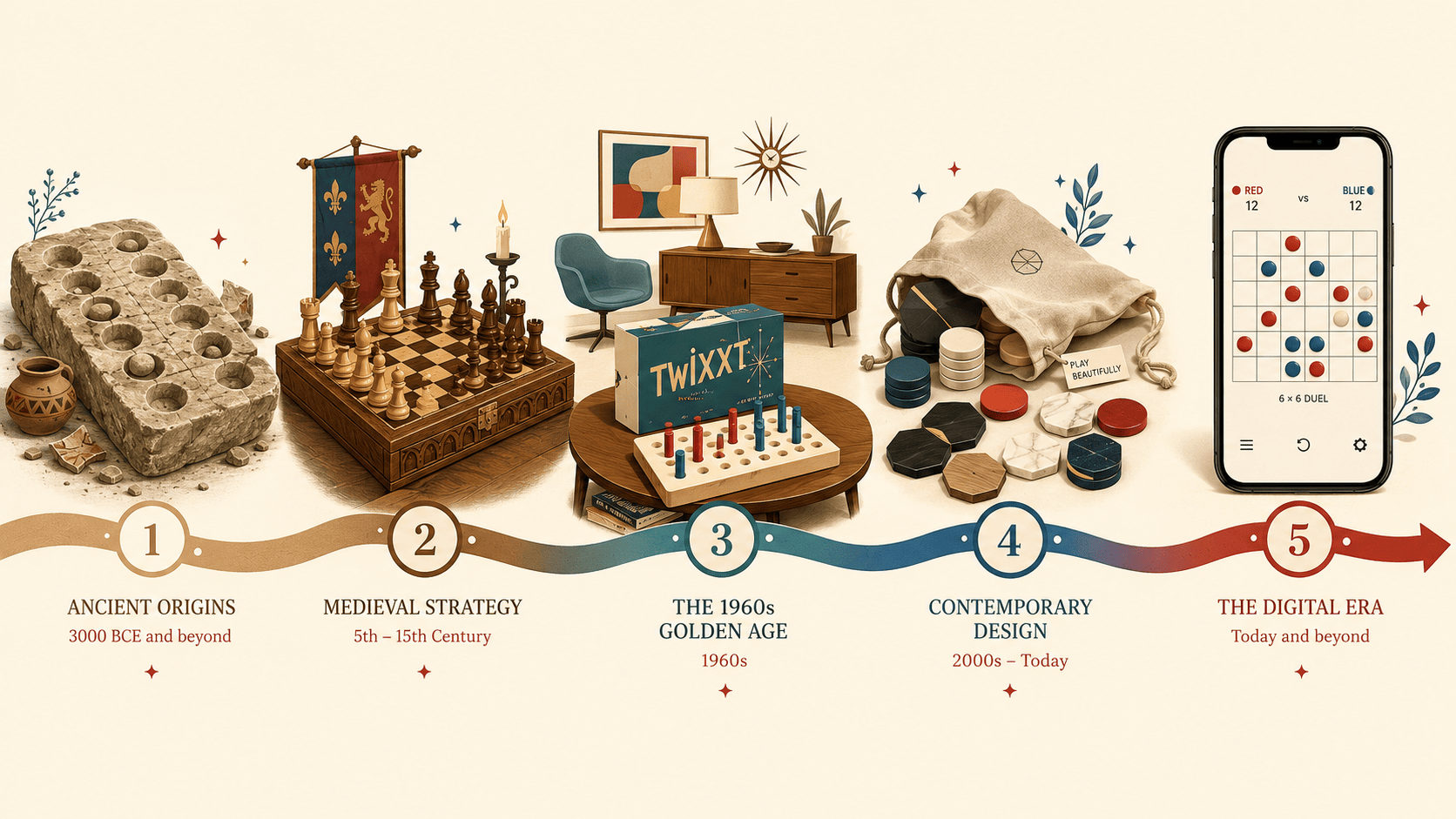
The 1960s turned the announcement into a shelf. Game companies began publishing abstracts as intellectual furniture for adults — handsome bookshelf boxes designed to sit beside literature, not in the toy chest. The era's stars became the first famous game designers: Alex Randolph, whose Twixt made connection strategy a household object; Sid Sackson, whose Focus stacked pieces into towers that captured by traveling. For the first time, a person could be known for designing abstract games — and where there are named authors, there are rivalries, movements, and progress. The renaissance had begun, though it would take computers, cafés, and a few decades more to reach full bloom.
What the moderns fixed
Designed objects can target diseases, and the new designers were remarkably explicit about the four they meant to cure in the classics they loved.
Length. Chess and Go are afternoon games; modern life sells time in twenty-minute slices. The moderns engineered for the slice: small boards, few pieces, decisive mechanics — full strategic arcs that fit between other obligations. The design target that sounds humble and isn't: a real game that ends before anyone needs it to.
Draws. The classic abstracts leak stalemates at high level — tic-tac-toe is all draw, checkers drew its way through championship matches, even chess needed tiebreak systems. The moderns attacked the disease structurally: win conditions that can't stall (someone will connect; the supply will run out), shrinking boards, dual goals in tension. A game that cannot draw is a promise: tonight, there will be a winner.
Homework. Chess rewards memorized openings — centuries of theory as an entry fee. The moderns designed the memorization out: randomized setups, rotating movement cards, dealt starting hands. When the exact position has never occurred before, preparation collapses back into thinking, which is what the whole family was supposed to be about.
Paralysis. Deep games can freeze players — too many options, too much hanging on each. The cures were gentler: smaller option menus per turn, moves that are individually light but cumulatively heavy, and boards readable at a glance. The aim, in one phrase: easy to act, hard to act well.
New goals beyond checkmate
The revolution's most creative work was inventing win conditions — new answers to the oldest question, "what are we even trying to do?" Each new goal births an entire tactics vocabulary, so this list is really a list of new kinds of thinking.
Connect. Hex, Twixt, and their descendants: join your two edges before the enemy joins theirs. Connection can't stall — every move helps someone — and it produced a geometry of ladders, bridges, and blocking walls that no checkmate game had needed.
Surround. Hive's queen bee, besieged from six sides. An intimate, claustrophobic goal that turns every placement into a question about breathing room — its own article tells the full story.
Exhaust. The GIPF project's signature: pieces are a dwindling supply, and running your opponent dry is victory. Material stops being an army and becomes a fuel gauge — a war of attrition with the arithmetic showing.
Displace. Abalone's blunt poetry: push six enemy marbles off the world. The goal every spectator understands instantly, and the founding charter of the whole sumo school.
Race. Get all your pieces somewhere first — the oldest goal in games, rebuilt with modern tension. Oustwit's second win condition is the current of this thinking: land all eight of your pieces and win, a goal that punishes cowardice and keeps every defensive game honest. Pair it with the ancient three-in-a-row and you get dual goals in permanent tension — a very modern cure for a very old stall.
The tile and the tactile
The renaissance also discovered that the components were a design space. The old family assumed board-plus-pieces; the moderns questioned every word of that.
Hexagons replaced squares where diagonal ambiguity annoyed — six neighbors, all equal, no arguments. Pieces learned to stack: Focus and DVONN built towers where captured material travels under the captor, changing the piece's very identity mid-game. Tiles learned to be terrain: Hive threw away the board entirely, letting the swarm itself be the world, infinitely reconfigurable and packable into a bag. Cards learned to carry rules: Onitama's five traveling movement cards mean the game's grammar itself rotates between players. Each material innovation is a rules innovation wearing a costume — the stack is a capture rule, the bag of tiles is a board rule, the card is a movement rule you can hand your enemy.
And then the screen arrived and absorbed the whole toolkit. A phone can host any geometry, animate any physics, and enforce any rule without a referee — which is why the newest wing of the renaissance is app-first: designs born digital, where the push you'd need heavy marbles to feel in wood simply happens, eight neighbors sliding at a tap. The materials stopped limiting the imagination somewhere around the year the app stores opened, and the family is still digesting the freedom.
Where the renaissance lives now
Today the movement has three homes, all thriving. Small-box publishers keep the tabletop wing alive — pocket abstracts with designer names on the tin, sold beside the coffee at game cafés. The print-and-play community runs the experimental wing: rules published as documents, boards drawn by hand, a global workshop where a designer with one good verb can find a hundred playtesters by the weekend. And the app-first wing ships duels straight to phones — the format the small abstract was always waiting for — with AI opponents for practice, ladders for ambition, and async play for friendships in different time zones.
It's worth saying plainly where this site's own game stands, since the lineage is the point of the shelf: Oustwit is a child of this third wing — one compound verb (the placement that pushes), dual anti-stall goals, a 6×6 readable at arm's length, born on a screen. The design choices read like a checklist of the renaissance's lessons, because that's what they are. Every modern abstract is a letter written back to the classics; the good ones say thank you and here's one more idea in the same breath.
Reading a rulebook like a critic: a five-minute exercise
All of this history compresses into a practical skill, and it takes five minutes to try. Pick up any small modern abstract — a box from a café shelf, a duel from an app store. Don't play yet. Just find five answers in the rules.
Find the clock. How long is a game? The moderns almost always answer on the box: fifteen minutes, twenty. If the answer is "hours," you're holding a different tradition.
Find the draw answer. Can this game stall or tie? Look for the cure: a goal that must complete, a supply that must run out, dual win conditions in tension. If you can't find one, veterans will find the stall for you within a month.
Find the homework answer. What stops memorized openings from ruling? Randomized setup, rotating cards, dealt tiles — or nothing, which means theory will accumulate at the top.
Find the goal family. Connect, surround, exhaust, displace, race, align — name which invented win condition this design descends from. Most are proud children of one branch, and knowing the branch predicts the tactics you'll be learning.
Find the one generative rule. The single constraint everything grows from. The hive may never split. A placement pushes all eight neighbors. Equal numbers refuse. If you can find it, the design has a spine. If you can't — if it's all features and no engine — put it back gently.
Five answers, five minutes, and you're reading games the way the renaissance's designers write them. It's the same eye the deep-game field guide trains on the store shelf, pointed here at the rules themselves.
The through-line
Zoom all the way out and the revolution resolves into a single continuity. Every innovation in this article — the signed design, the cured draw, the invented goal, the boardless board, the screen — serves the same promise the family has kept for five thousand years: two minds, equal information, no luck worth mentioning, and the better ideas winning. The moderns didn't overthrow the classics; they joined them, and the shelf holds both without strain — the definition never mentioned a century.
Whether any modern abstract will still be played in five hundred years is a question another shelf takes seriously — the classics earned their immortality the slow way, and history grades hard. But the renaissance already proved the thing that matters for us, now: the ancient form isn't finished. The best new duel you'll ever play may not have been designed yet — and for the first time in history, somebody is definitely, right now, trying to design it.
Questions people ask
What counts as the first modern abstract? There's no clean first — the folk process faded gradually — but Hex in the 1940s is the usual landmark: brand-new goal, named inventors, mathematical self-awareness. If you want a symbol, that's the one the histories reach for.
Are designed abstracts better than the folk classics? Different kind of good. The classics are survivors of a selection process no committee can imitate — a thousand years of players voting with their evenings, the deepest quality filter there is. The moderns are sharper on purpose: shorter, fairer, draw-proofed, tuned for exactly the diseases the classics carry. Play both; they're answering each other.
Why do modern abstracts love hexagons so much? Six equal neighbors and no diagonal arguments — squares make "adjacent" ambiguous (four neighbors or eight?), and every square-board game has to legislate the corners. The hex is the geometry with the paperwork already done. Squares survive where the ambiguity is the point — or where, as on a certain 6×6, all eight neighbors mattering is precisely the engine.
Where should a curious reader go next? Deeper into this shelf: Hive for the renaissance's most beloved single design, then the display case for a matchmaking guide to the whole pocket-sized family. And when a modern design's choices start looking like answers to old problems — that's the reading level this article was for.