Learn › The modern renaissance › Abalone and Shobu
Abalone, Shobu, and the art of the shove
Somewhere between wrestling and chess sits a whole subgenre of abstract games where the goal is gloriously physical: push the other player's pieces off the world. This is a tour of the sumo school's two modern masterpieces — the marble classic that founded it and the four-board beauty that perfected its poetry — and of what the shove does to the brain of everyone who plays.
The sumo subgenre
Most strategy games win by abstraction — checkmates, territory counts, alignments. The sumo school wins by eviction: the board has edges, the edges are cliffs, and victory means putting enemy pieces over them. It's the most ancient-feeling goal in the modern family — instantly legible to spectators, viscerally satisfying to players, and older than it looks in spirit (wrestling rings and shoving matches predate every board) while being, as designed board games go, strikingly young: the school's founding classic arrived only in the late 1980s.
Why so late? Because the mechanic needed materials. Pushing means pieces physically displacing pieces, and that wants heavy marbles in grooved frames, chunky stones on rimmed boards — or, latest and friction-free, screens where the physics animates itself. Once the equipment caught up, the school produced classics fast, and the psychology article explains the reception: displacement is the one game verb every human body already speaks. Here, the two required stops on the tour.
Abalone: line up three, push two
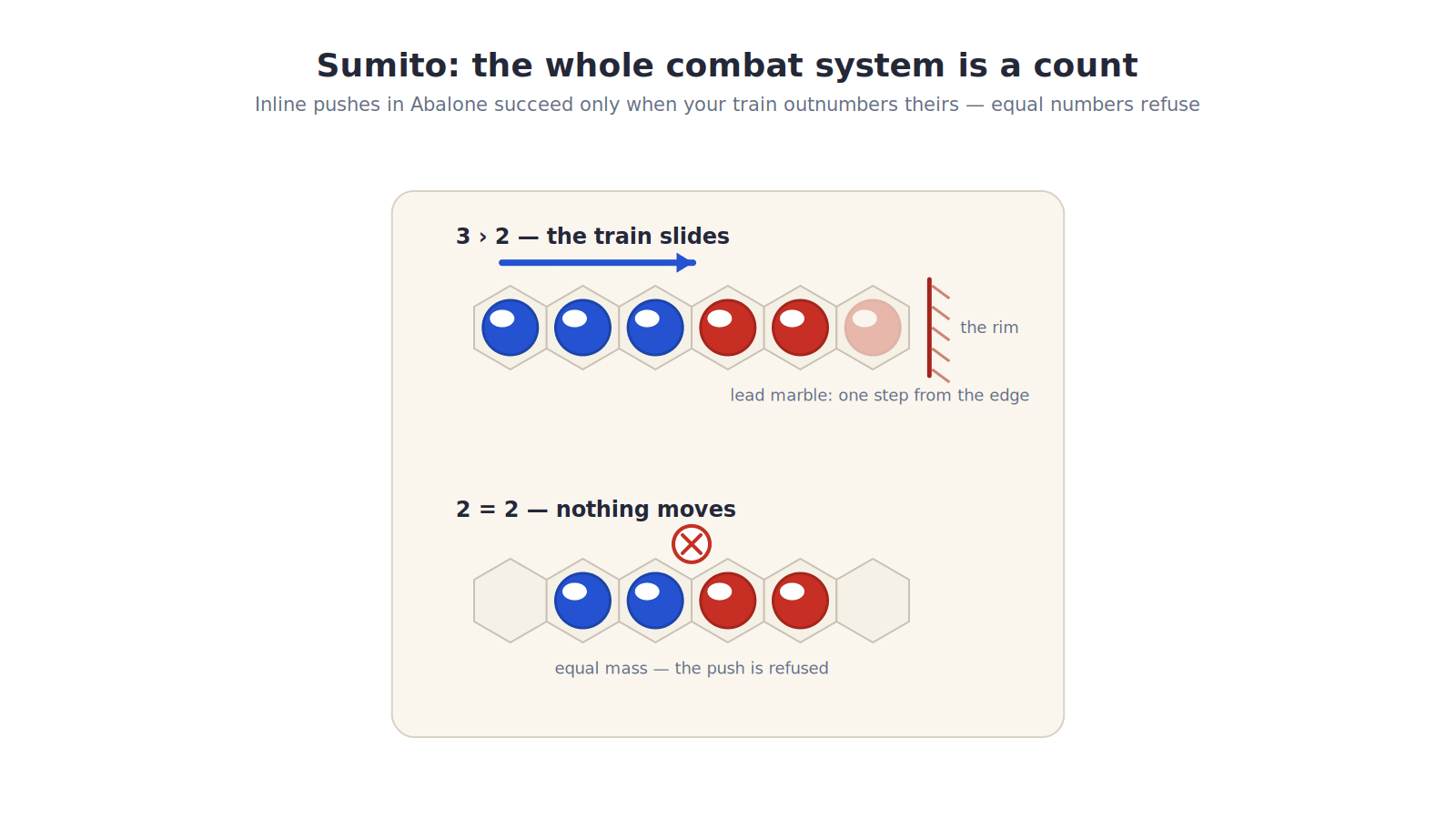
The founder. Two players, sixty-one hexagonal spaces, fourteen marbles apiece; shove six enemy marbles off the rim and you win. The engine is one arithmetic rule — sumito, the inline count: a column of your marbles pushes a shorter enemy column ahead of it (three push two, three push one, two push one), equal columns refuse, and nothing moves more than three. Strength isn't material — both sides keep fourteen almost all game — it's formation, recounted line by line, every single turn.
The play experience is mass warfare in slow motion: compact bodies of marbles grinding for the center, flanks probing for a line where they outnumber, and the rim quietly repricing every exchange — a push that gains one space mid-board kills at the edge. The school's founding lessons all come from here: keep the body whole, fight downhill toward their cliff, count the line and not the army. This shelf gives Abalone a full strategy guide; the figure below is the one rule you need to feel the rest.
Shobu: four boards, two moves
Three decades later, the school got its poem. Shobu — a duel of dark stones and light stones on four small wooden boards at once, two boards per side of the table — looks like an installation and plays like a haiku with teeth. Your turn is two moves welded together, and the weld is the genius.
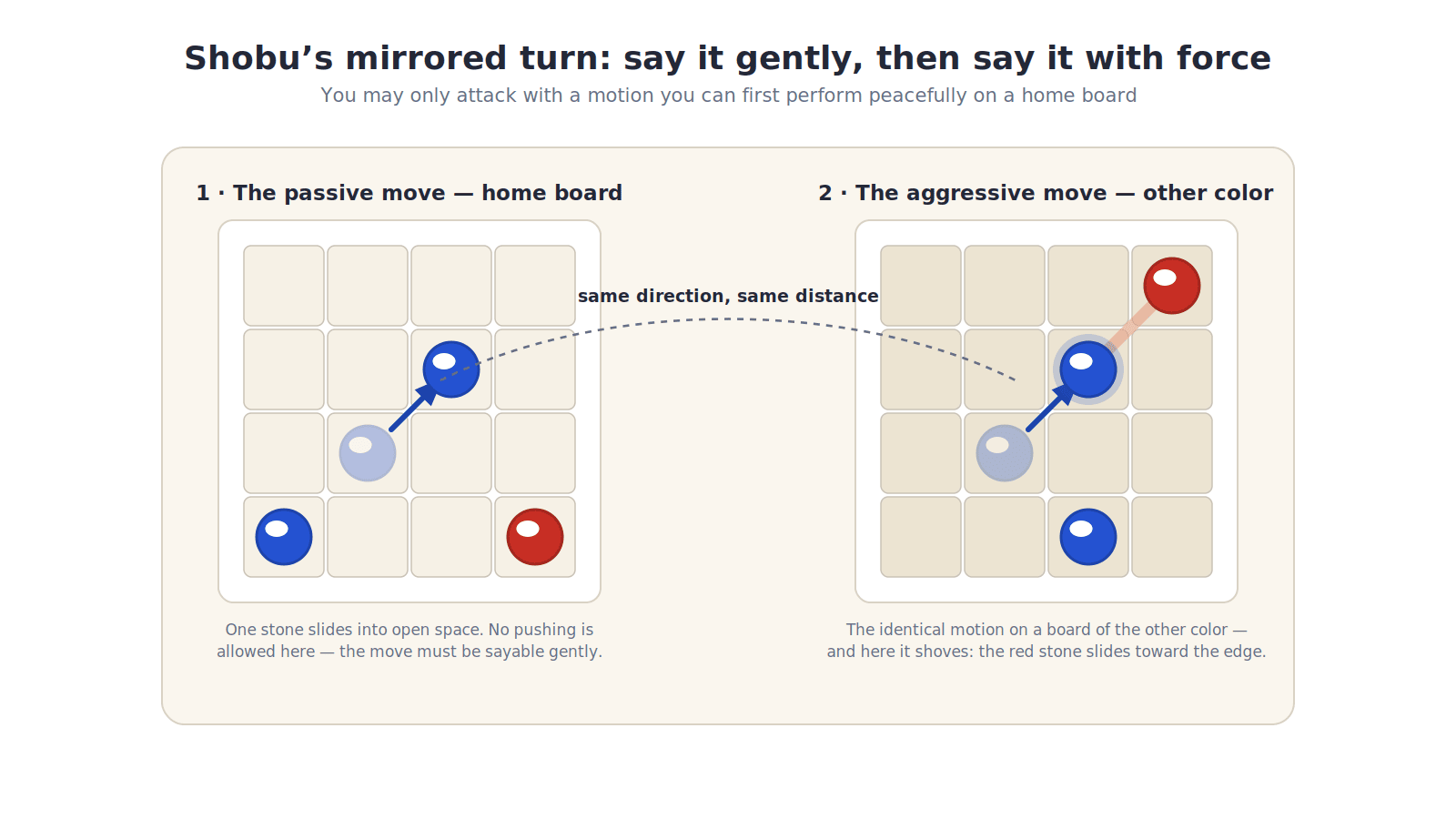
First, the passive move: on one of your two home boards, slide one of your stones up to two spaces in any direction — but this move must be gentle. No pushing. It has to land in open space. Then, the aggressive move: on any board of the opposite color to the one you just used, another of your stones must make exactly the same motion — same direction, same distance — and this mirrored move may shove: one enemy stone in its path gets pushed along, and over the edge if the edge is there. Lose all four of your stones from any single board and you lose the game.
Sit with the constraint, because the whole game lives in it: you may only attack with a motion you can first perform peacefully. Your home boards are the dictionary of legal violence — as they empty and crowd, whole directions of attack become unspeakable. Strong players fight the real war on the quiet boards, shaping their own stones to keep rich vocabularies while wrecking the geometry that the opponent's mirrors depend on. Defense in Shobu is grammar sabotage: make their intended shove unsayable somewhere gentle, and it can't be said anywhere at all.
What push games do to your brain
Different engines, same cognitive weather — and it's worth naming, because it's the school's real signature. In capture games, threat is a calculation; in push games, threat is a direction. Players report thinking in force lines and gradients — where am I outnumbered along this axis, which of my pieces stand in the current, how far is that stone from the cliff — geometry felt almost physically, closer to reading a tide than solving an equation. That's why the school onboards so fast: the analysis runs on spatial intuition every body ships with.
It's also why spectators stay. A bishop's pin is invisible to the uninitiated; a marble teetering at a rim is legible from across a café, and a four-board Shobu crisis reads like theater even to someone who doesn't know the rules. The sumo school is the genre's best spectator sport for exactly the reason it's the genre's best gateway: the danger has an address, and everyone present can point at it.
Design problems of pushing — and each game's answer
Displacement's native diseases are stalling, turtling, and edge-camping — the design-view article dissects them — and the school's classics are each a different cure, which makes them a wonderful comparative exhibit.
Abalone's answer: fix the start. The classic learned the hard way that cautious equals could hug the center forever; the community's cure was interleaved starting positions (the daisy family) that bake contact into move one. A positional fix for a positional disease.
Shobu's answer: multiply the fronts. Four boards mean four places you can lose — a turtle can't shell up everywhere, and the passive-move requirement means even defense must keep moving. The structure itself forbids stasis: attention is a resource, and the game bills you on four accounts at once.
The miniature's answer: make standing still illegal by goal. The school's smallest member — the 6×6 placement duel this site orbits — cures stalling in the win conditions themselves: every turn must place a piece (no passing exists), pieces pushed off return to hand so attrition can't grind to nothing, and the race to land all eight punishes any player who armors instead of advancing. Same disease, three cures: setup, structure, goals — a tidy little seminar in how design problems get solved from different directions.
The push, miniaturized
Which brings the tour home. Oustwit compresses the whole school onto thirty-six squares: the shove becomes radial (a placement pushes all eight neighbors outward at once), sumito's count becomes a binary brace (one piece directly behind stops the push — mass behind mass, minimum edition), Abalone's permanent marble-death becomes return-to-hand, and the four-board sprawl becomes a phone screen with the whole state in one glance. Nothing in it is unfamiliar to a sumo-school graduate; everything is smaller, faster, and welded to the oldest goal in games. If Abalone is the school's epic and Shobu its poem, the 6×6 is its epigram — and the fastest way to drill the school's instincts between sessions of its bigger siblings.
Try the school: a play order
For the curious reader, a sequence that works. Start with the miniature — a phone, five minutes, the shove and the brace learned by finger; you'll have the school's grammar in an evening. Then Abalone for the full sumo education: formations, gradients, the body kept whole — expect the mid-board grind to feel profound after the miniature's speed. Then Shobu, once displacement feels native, because its pleasure is meta: you already know what a shove is worth, and Shobu asks what a shove costs to say. Finish where the school's future clearly lives — back on the small screen, rematching a rival — and you'll have toured, in three games, one of the most coherent bodies of design the modern renaissance produced: one shelf over, the rest of that renaissance is waiting.
A first night with each game
The school teaches fast, but a few pointers save you the standard beginner tolls. Here's the short course, one game at a time.
Abalone, night one. Use an interleaved setup like the daisy if your set or app offers it — contact from move one, no long march. Then three habits. Count before you push: look at the line, yours versus theirs, and only commit when the number favors you after their reply, not just before it. Keep your groups big and few: two clumps good, four clumps dead. And check the gradient every few turns: which of your marbles are drifting toward an edge? A marble one space from the rim with enemies behind it is already lost — spend a turn saving it before it needs saving. Expect to lose your first game to a spread. Everyone does. It's the school's entrance fee.
Shobu, night one. Say the turn structure out loud for the first three games: "gentle move at home, same move with force over there." It sounds silly. It works. Then three habits. Before planning any attack, check it's speakable: is the gentle version legal on a home board? If not, the attack doesn't exist. Watch all four boards between turns — you will lose your first game on a board you forgot, and the lesson sticks better if you know it's coming. And tend your home boards like gardens: they're not just territory, they're your dictionary. A cramped home board is a mouth half-sewn shut. By game four the mirror stops feeling like homework and starts feeling like poetry, which is the moment Shobu is selling.
Either game, every night. One habit transfers to the whole school, the miniature included: after any shove — yours or theirs — pause one second and name what changed. Which line weakened. Who drifted cliffward. What just became sayable. Push games reward that tiny narration more than any calculation, because the ripple always carries one more consequence than your first glance caught.
Questions people ask
Is Shobu harder to learn than Abalone? The rules are equally small; the thinking ramps differently. Abalone's difficulty is positional judgment on one big board; Shobu's is attention across four small ones plus the passive-move legality check, which beginners forget for exactly three games and then never again. Teach either in five minutes; expect Shobu to produce more delighted swearing.
Why do sumo games use marbles and stones instead of flat pieces? Partly physics — heavy pieces make pushing tactile and self-explanatory — and partly theater: the school's legibility depends on the board reading as a place with mass and cliffs. Digital versions keep the weight as animation; the miniature's pieces visibly slide and drop off the world for the same reason.
Do Abalone skills transfer to Shobu and Oustwit? The deep ones do: line-counting becomes brace-reading, rim-gradient sense transfers whole, and body-cohesion discipline maps onto both Shobu's home-board management and the 6×6's cluster play. What doesn't transfer is pace — Abalone rewards patience the small games actively punish. Adjust your tempo, keep your geometry.
One line for the whole school? Push games take the least abstract thing a body knows — shoving — and refine it into some of the most elegant strategy on any shelf: proof that a game can be visceral and cerebral in the same move, which is the modern abstract renaissance's whole thesis in miniature.