Learn › Strategy games around the world › Tafl
Tafl: the Viking game of unfair fights
Every game in this library gives both players the same army and the same goal — except one family, and it belonged to the Vikings. In tafl, one side outnumbers the other two to one, the two sides want completely different things, and the fight is unfair on purpose. Here's the Norse world's favorite game: how it works, how it conquered the northern seas, why it died, and why its strange asymmetric heart still beats in modern design.
A game designed to be unfair
The premise reads like a saga because it is one. A king sits at the center of the board with a small bodyguard of defenders. Around the edges, an attacking army twice their number closes in. The king's side wins by escaping — reaching the board's edge or its corners, depending on the variant. The attackers win by capturing the king. Same board, same pieces, same movement — but different armies, different goals, and no pretense of balance between them.
That asymmetry is the design's whole personality, and it's rarer than it sounds: nearly every great abstract before or since is a mirror-match. Tafl instead stages a situation — a breakout, a last stand — and asks each player to inhabit a role. It's the ancestor of every asymmetric duel that followed, and the Norse world's answer to a question modern designers still argue about: does a fair game need equal sides, or just equal chances? Tafl's answer was the second — with a clever social patch we'll get to.
How hnefatafl works
The family's flagship is hnefatafl — "fist-table," the king's game — and a plain sketch covers it. Boards are odd-sized grids: 7×7, 9×9, 11×11, 13×13 by region and era. The king starts on the central throne square, defenders in a diamond around him, attackers in groups at the four edges. All pieces move like rooks — any distance along rank or file, no jumping.
Capture is the family's signature: custodial — you take an enemy piece by sandwiching it between two of yours (or one of yours and certain special squares). Walk into a sandwich yourself and you're safe; the trap must close on you. The king is sturdier: in most reconstructions he must be surrounded on four sides (or pinned against the throne) to fall. Escape squares vary by variant — the whole edge in some, corners only in others — and that single choice retunes the entire game's difficulty. That's the whole ruleset: rook moves, sandwiches, a throne, a breakout. Two minutes to teach — pantomime-passable, which mattered for where it went.
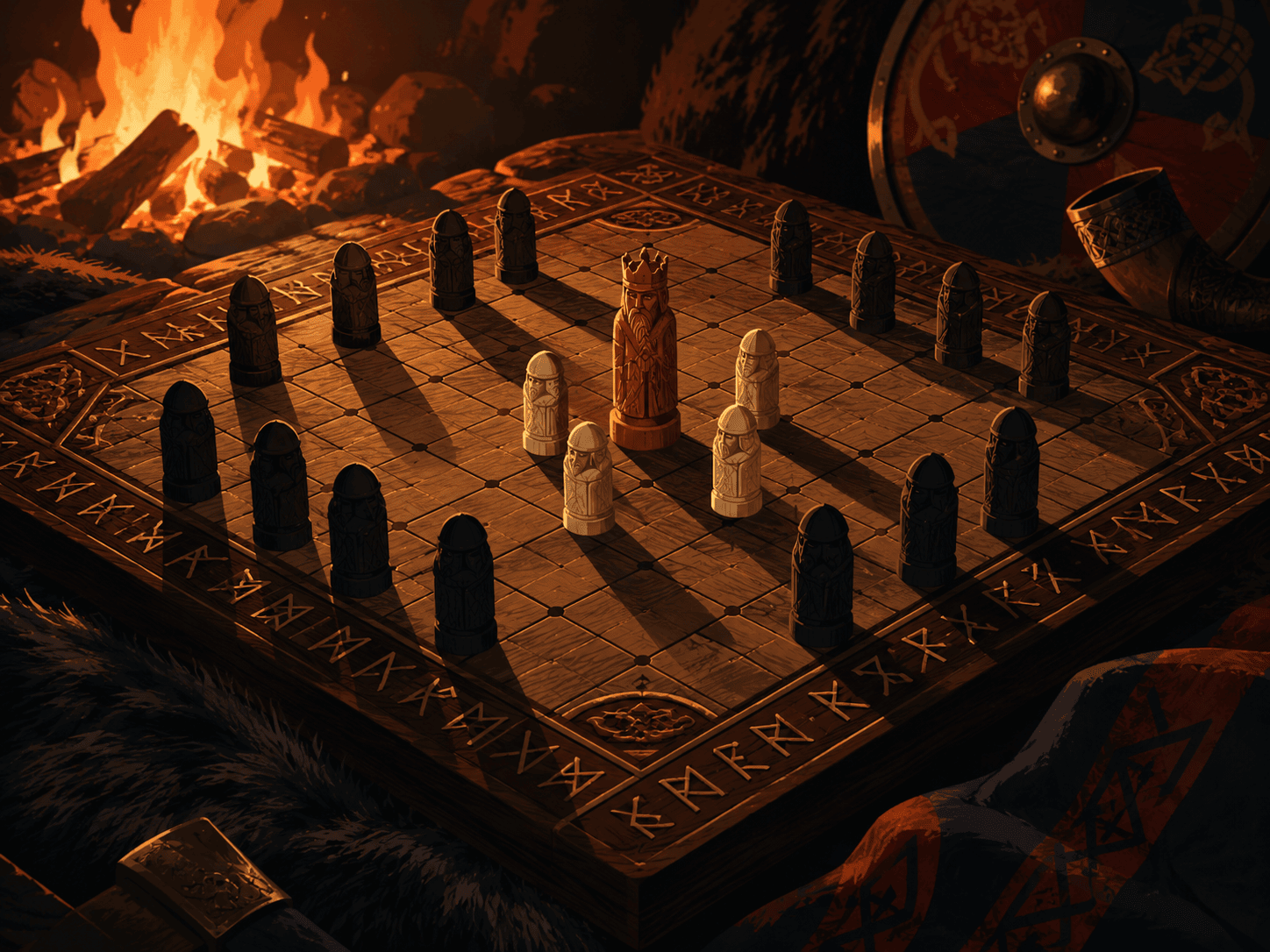
The Viking world's favorite pastime
Tafl's range map is the Norse expansion itself. Gaming pieces — glass, amber, bone, walrus ivory — turn up in Viking-age graves from Ireland to the rivers of Ukraine, along the whole web of longship routes; a warrior's grave kit not infrequently included his game set, play as standard equipment for the afterlife. The sagas treat tafl skill as a gentleman's accomplishment: one famous verse has a hero list board-game mastery first among his nine skills, ahead of runes, rowing, and harp. Boards traveled to Iceland, Greenland, the British Isles, and the eastern trade roads — everywhere the ships went, the unfair fight went too.
And here's the social patch that made the unfairness work: you played both seats. A tafl match was properly a pair of games — each player takes the king once, the army once — so the contest wasn't "which side wins" but who plays both sides better. Asymmetric games solve balance socially, by rotation, and tafl proved the solution a thousand years before modern designers rediscovered it. The real match is the comparison.
Why asymmetric games fascinate
Playing tafl today, the first surprise is psychological: the two seats feel completely different, and each teaches something the mirror-match games can't. The king's seat is desperation management — you are outnumbered, every trade hurts more, and your one advantage is clarity of purpose: you know exactly where you're going, and the army has to guard every door at once. The attacker's seat is the opposite discipline: patience, net-weaving, the slow closing of exits — overwhelming force that loses the moment it gets greedy or leaves one seam open.
That's why the family fascinates: asymmetry converts one board into two different skill exams, and rotation makes you sit both. Modern players will recognize the shape from its descendants — every hidden-movement chase, every one-versus-many duel, every asymmetric-powers design descends from this idea — and the movement field guide's fifth question ("who owns which verbs?") is tafl's question, generalized. The Norse got there first, with rooks and a fist-sized king.
The disappearance
Then it died — and tafl's death is the extinction shelf's cleanest case study of replacement. Chess arrived in the north between roughly the eleventh and thirteenth centuries, carrying courtly prestige, a literature, and a fashionable symmetric contest. Table by table, generation by generation, the newcomer took the teaching hours; tafl retreated to the map's edges — surviving in remote corners, most famously in Lapland, where a traveling naturalist named Carl Linnaeus documented the Sámi variant tablut in 1732, writing down its rules with a botanist's care.
Hold onto that detail, because it's the whole hinge of the family's afterlife: Linnaeus wasn't trying to save a game — he was cataloging everything — but his notes became one of the only near-complete rule records the family ever got. Tafl had lived for a thousand years on oral transmission alone; when the chain finally snapped, one outsider's field notebook was standing there holding a copy. Every modern tafl set descends substantially from that accident of curiosity.
The modern revival
Because tafl is that rarest thing — an extinct game with a rulebook — it got the resurrection most dead games never can. Reconstructors built playable hnefatafl from the tablut record plus archaeology and saga fragments; publishers shipped handsome sets; and online tafl communities now run leagues, rating ladders, and ongoing rules research. The revival even inherited the family's authentic problem: balance. Modern play quickly found that naive reconstructions favor one side (which side depends on board size and escape rules), and the community responded exactly as living game cultures do — patching: tuning escape squares, capture rules, and setups, variant by variant, in public. A game that died of one competition is being rebalanced by another, centuries later. The folk process, resumed after an intermission.
For a curious player, entry is easy: rules and print-and-play boards are free online, any checkers set plus a distinct king piece works, and the two-seat match format is the right first experience — play both sides, compare notes, feel the seats' different educations. It remains one of history's best evenings: two minutes of teaching, a thousand years of atmosphere.
Asymmetry's descendants
Close the loop on tafl's real legacy, which isn't nostalgia — it's a design idea that never stopped working. The insight that a game can stage an unfair situation and balance it by rotation or tuning runs forward into the whole modern asymmetric tradition: one-against-many designs, hidden-mover chases, variable-powers duels, even the asymmetric win conditions this library keeps meeting (escape-versus-capture is tafl; the anti-draw playbook's "different goals per side" is tafl's grandchild). And the family's balance saga — measure, patch, re-measure, in public — is the same living process that gave Go its komi and five-in-a-row its renju restrictions. The Vikings' contribution to game design wasn't a board. It was permission: a great game doesn't need two equal armies. It needs two equal players, and a situation worth fighting over.
Your first tafl night
The revival is one evening away, with equipment you own. Here's the small, fast version — brandub, the 7×7 Irish board — and the proper match format.
Setup. Draw a 7×7 grid. The king — any tall piece — stands on the center square. Four defenders surround him in a plus shape. The attackers, eight of them, stand in groups of two at the middle of each edge, like the points of a compass. Mark the four corners: those are the king's escape squares, and only the king may stand on them or the center throne.
Play. Attackers move first. Everything moves like a rook — any distance, straight lines, no jumping. Capture by sandwiching an enemy piece between two of yours along a rank or file (corners and the empty throne count as your second piece). A sandwiched king is captured the same way in this small version. King reaches any corner: defenders win. King captured: attackers win.
The match. Play twice, switching seats — that's one tafl match, the way the tradition balanced its unfairness. Win both seats and there's no argument. Split them, and count captured pieces or play again. The comparison is the contest.
Three tips per seat. Kings: move early, threaten two corners at once, and remember your defenders are walls, not warriors — spend them to open lanes. Attackers: close the corners first, keep your ring unbroken, and never chase — a greedy capture that opens a lane loses the game. Both seats: the board is small and the game is fast; expect five minutes a game and a strong opinion about which seat is harder by the end of the night. Every tafl player has one. Yours will be wrong, according to your opponent.
Questions people ask
Which side should a beginner take first? The king. The goal is concrete (reach the edge), the army's mistakes are visible, and the seat teaches the family's core skill — seeing escape lanes — fastest. Then switch and learn the harder art: closing all doors at once without opening one behind you. The rotation is the education.
Is tafl actually deep, or just atmospheric? Deep — modern competitive play finds real strategy in both seats (formation theory for attackers, tempo-and-lane play for the king), and the online community's ongoing balance debates are themselves evidence of a live skill ceiling. It's not chess-deep; it's its own thing: shorter, sharper, situational.
Why do sources disagree about the rules? Because the family died with its rules unwritten except for one field notebook, and everything else is reconstruction from boards, fragments, and inference — the standard problem, unusually well-documented here. Treat every modern ruleset as a variant, play the one your set proposes, and enjoy belonging to the game's newest regional tradition: the internet.
One line to keep? Tafl staged history's best unfair fight — twice your enemies, one way out — and its afterlife proves the sharpest point on this shelf: one written page of rules can outlast a thousand years of unwritten ones.