Learn › A short history of board games › Board game archaeology
What archaeologists learn from ancient games
When an archaeologist finds a sword, they learn about war. When they find a game board, they learn about everything else: trade, class, leisure, belief, boredom, cheating, and who was talking to whom across which border. Games are some of the most information-dense objects in the ground — and some of the most human. Here's what the diggers keep finding, and how they read it.
Play is evidence
Why do serious scholars care about ancient fun? Because a game artifact is a bundle of testimony. Materials testify about trade: the lapis lazuli in the Ur boards traveled thousands of miles from Afghan mines — so a board in a grave maps a supply chain. Quality testifies about class: the same game surviving as an ivory luxury set and a grid scratched on a step means a pastime shared across a whole society's ladder — rare and precious data. Distribution testifies about contact: when the same distinctive board shape appears on both sides of a sea, someone crossed it, and carried an evening's entertainment along. And context testifies about meaning: a game in a grave, a game in a barracks, a game on a temple roof — each placement is a sentence about what play meant there.
Best of all, games record ordinary time — the hours between the events history usually keeps. Most monuments commemorate power. A worn game board commemorates two people passing an afternoon, which is exactly the kind of life archaeology struggles hardest to reach.
Boards in the strangest places
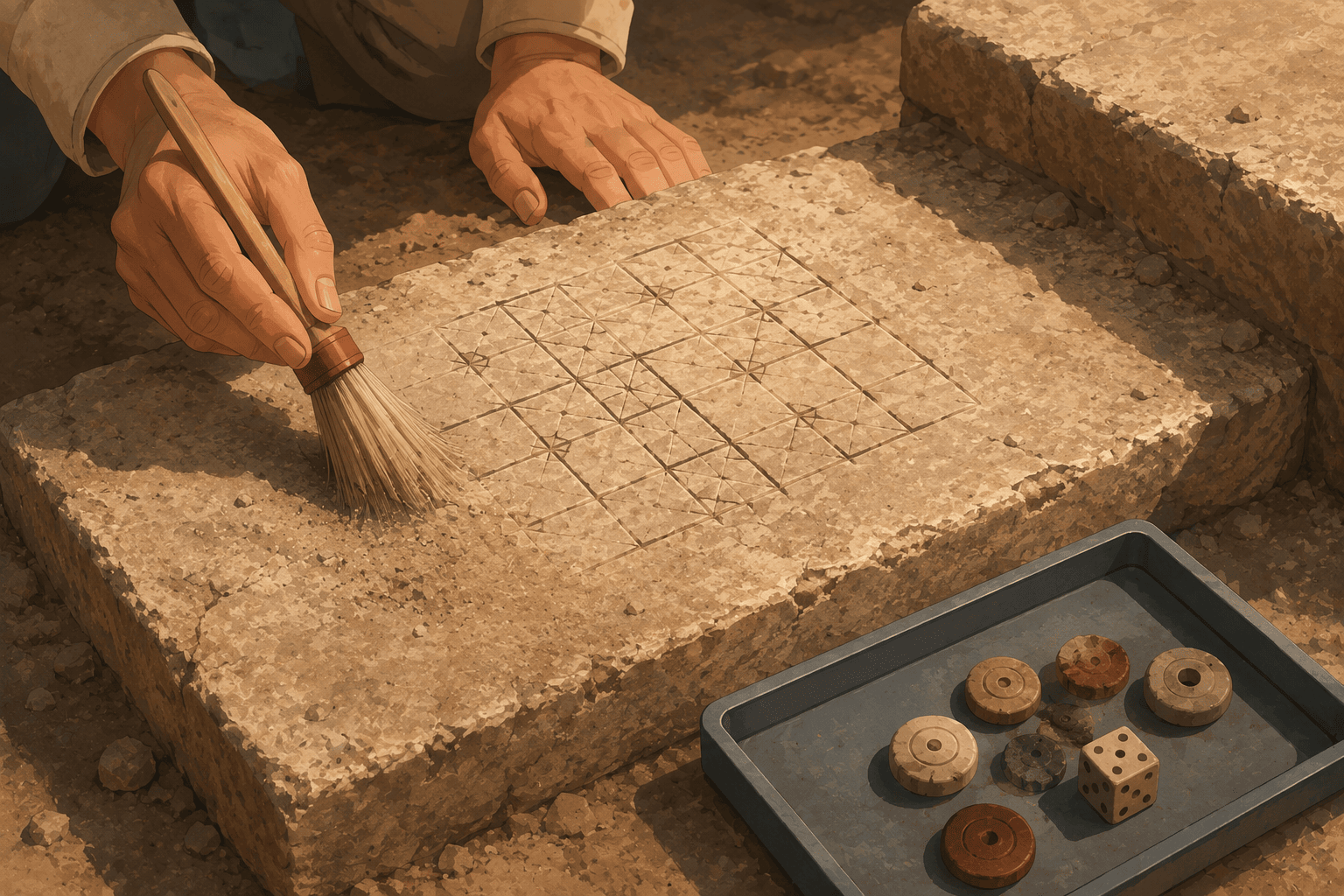
The finds fall into two great families. The first is the formal artifact — boards made as boards: tomb sets, palace games, the museum showpieces. The second family is stranger and, to many scholars, more precious: the graffiti board — game grids scratched or carved directly into architecture by players who wanted a game right here, right now.
They are everywhere the ancient world left stone. Roman soldiers cut game boards into the steps and pavements of fortresses and fora across the empire — garrison boredom, fossilized. Workers and priests scratched grids onto Egyptian temple roofs. Medieval monks carved morris boards into cloister benches, a whole confession in stone. Sailors cut boards into ship decks; masons into the buildings they raised. Each graffiti board is a doubly honest document: unofficial (nobody commissioned it), and site-specific (the game happened here — this step, this bench, this watch post). Formal sets tell us games were treasured. Graffiti boards tell us games were irrepressible — squeezed into the margins of work, worship, and war, by people who couldn't wait for furniture.
Reading dice
The humble die may be antiquity's most eloquent small object. Dig sites across the classical world produce them in quantity — bone, ivory, lead — and each one answers questions. Where they cluster maps leisure: dice concentrate in barracks, taverns, and ports — where waiting happened. How they're made reveals intent, and here's the scandalous part: excavations regularly produce loaded dice — weighted, shaved, or asymmetrically drilled. Cheating is archaeologically attested across the centuries; wherever there were stakes, there were engineers of luck. And what they were before deepens the story: the classical die descends from the astragalus, the ankle bone of sheep and goats, used across many ancient cultures for both gaming and divination — the same object asking "who wins?" at the table and "what do the gods intend?" at the shrine.
That double duty is a genuine insight into the ancient mind: chance was a doorway — sometimes to entertainment, sometimes to the divine, often not entirely either. The modern player who talks to their dice is practicing, in miniature, one of humanity's oldest confusions — and the dig record says the confusion was universal.
The reconstruction problem
Now the discipline's honest heartbreak: boards survive; rules don't. For nearly every excavated game, no rule text exists — rules lived in heads, the oral-transmission constraint, and heads don't fossilize. So scholars triangulate. The board's structure narrows the possibilities (a track implies a race; symmetric zones imply a duel). Wear patterns testify — which squares are polished by centuries of fingers. Piece counts and types constrain the math. Texts help when they exist — passing mentions, poems, the rare miracle like the Ur rules tablet. And parallels with surviving folk games suggest what the missing rules might have been.
The result is always a confidence spectrum, and good scholarship says so plainly: Ur's late rules rest on an actual ancient text; Senet's are educated argument; mehen — Egypt's spiral snake game — remains equipment in search of its game, played for two thousand years and now unplayable, its rules simply gone. The extinction article calls this death by rule loss; archaeology is where you stand at the actual graves. Every museum case labeled "rules unknown" is the reconstruction problem, unsolved and on display.
Famous digs and finds
A short tour of the discipline's greatest hits, for the traveler's list. The Royal Cemetery of Ur (1920s): the excavation that lifted the great twenty-square boards from royal graves — game archaeology's founding treasure. The Egyptian tombs: Tutankhamun's four Senet sets crown a record of boards, paintings, and papyri spanning three millennia of one game's reign. The Viking graves: across the Norse world, warriors buried with tafl pieces — glass, bone, amber — the game as standard grave kit for a cultivated fighter; some pieces still turn up in metal-detector finds today. And the Lewis chessmen: the twelfth-century walrus-ivory chess pieces found on a Scottish island in 1831 — probably carved in Norway, lost in transit along the sea roads, and now the most beloved game artifacts on Earth: shield-biting rooks, a queen with her face in her hand, an entire medieval world's humor and trade routes packed into one hoard. Each find is a chapter of the history shelf with the actual props on stage.
Experimental archaeology: playing the past
The discipline's most charming method: when a reconstruction is proposed, play it. Repeatedly, seriously, with good players. Reconstructed rules that produce broken games — foregone winners, dead choices, interminable slogs — are probably wrong, because three thousand years of players wouldn't have tolerated them. Reconstructions that produce fun — tension, comebacks, real decisions — have passed a real test: they're consistent with the game's actual survival. Fun, in this method, is evidence.
It's how the modern Ur rules earned their confidence — the reconstructed game turns out to be genuinely gripping, race-game drama intact after four and a half millennia. And the method's deeper implication deserves saying: it treats ancient players as what they were — discerning customers with standards — rather than primitives who'd play anything. The past gets more human every time a playtest validates it. Some university courses now run exactly this exercise, and any curious reader can too: the reconstructions are published, the equipment is improvisable, and the evening doubles as fieldwork.
What survives of us
Close by turning the brush around: what will diggers make of our play, a thousand years on? The physical record is odd — plastic lasts nearly forever, so the century's mass-market boards and dice will fossilize splendidly; some future scholar may puzzle over a billion tiny plastic houses. But the era's real play increasingly leaves no object at all: our finest games are patterns of light, running on servers that don't fossilize — a future dig site full of dead glass rectangles, rules nowhere in the soil. We may be the first era whose game boards outlast its games.
Unless, of course, the old insurance holds: rules stored in heads, taught on, improvised onto whatever surface an idle hour offers. The games that live that way — the pantomime-teachable, napkin-sized duels, ancient and modern alike — will greet the future diggers in the only form that ever really survives: still being played. The ground keeps the boards. People keep the games. It was ever thus, and every find in this article is the proof.
Become a board spotter
Here's a habit that upgrades every museum visit and ruin walk for the rest of your life: learn three board shapes, then look down.
Learn the silhouettes. Three cover most of what you'll meet. The morris board: three nested squares joined at the midpoints — medieval Europe's favorite carve. The Roman track games: parallel rows of squares, circles, or letters cut into pavement — barracks and forum classics. And the mancala rows: paired lines of shallow cups ground into stone — the world's most widespread game trace, on several continents. Five minutes with image search and you'll hold all three.
Then hunt. At ruins: check steps, thresholds, colonnade pavements, and anywhere with a bench's worth of flat stone in the shade — soldiers and idlers carved where they waited. At cathedrals and cloisters: window sills and stone seats. At museums: the games case, obviously, but also the "miscellaneous small finds" drawers, where unlabeled gaming pieces hide constantly. Guides often know the boards and love being asked; some sites have famous examples that never make the placards.
Log what you find. Photograph the board, its surroundings, and anything for scale. Sketch the grid. At home, match it against the known types — and consider sending genuinely odd finds to a local heritage contact; uncatalogued graffiti boards still get reported by travelers. You'll never walk a ruin the same way again: every flat stone becomes a possible afternoon, two thousand years old, waiting for somebody to notice the grid.
Questions people ask
What's the most common game artifact found? Dice and casual pieces, by sheer volume — small, durable, and lost constantly. Graffiti boards may be the most under-counted: uncatalogued examples almost certainly outnumber the famous ones, hiding on steps and benches across every ancient site. Look down on your next ruins visit; you may spot one before the guide does.
Could a completely unknown ancient game still be discovered? Very likely yes — new board types and unexplained piece sets surface regularly, and whole regions' play traditions are thinly excavated. The next Ur-class find is plausibly still in the ground. Game archaeology is young; the ancients played more than we've dug up.
How do scholars date a graffiti board? With difficulty and context: the architecture's date bounds it, wear and tool marks narrow it, associated finds refine it. A board on a step laid in one century and buried in another was cut somewhere between — often the honest answer is a range of centuries. The game, at least, is usually identifiable at a glance; the grids barely changed.
One line to keep? Monuments record what rulers wanted remembered; game boards record what people actually did with their afternoons — and the afternoons, it turns out, were remarkably like ours.