Learn › Why great games never die › Why ancient games died
Why some ancient games died
We tell the story of games as a parade of survivors — chess eternal, Go eternal, mancala eternal. But flip the telescope. Most games ever invented are extinct. Some ruled entire civilizations for thousands of years, then vanished so completely that we own their boards and not their rules. This is the other half of the immortality story: the autopsies. They teach as much as the survivors do.
Extinction is the norm
Start by correcting the survivorship bias. When the immortality article lines up the ancient winners, it's showing you the podium — not the race. The full field looks different. Archaeology keeps finding game boards: in tombs, in shipwrecks, scratched onto temple steps and legion fortress stones. The history shelf is full of them. And for most of those boards, nobody alive knows the rules. The games are gone. Played for centuries, loved enough to be buried with, and gone.
That should sharpen your respect for the survivors, and it should raise the real question. These weren't bad games. Some held empires for longer than chess has existed at all. If depth and popularity weren't enough to save them, what actually kills a game? The record suggests four distinct causes of death. The famous extinctions below give us one clean case of each.
Senet: when a game's meaning dies
Senet is the pharaoh of dead games. Played in Egypt for something like three thousand years — longer than chess and checkers have existed combined — it appears in tomb paintings, in temple inventories, in the graves of kings. Tutankhamun was buried with four sets. For thirty centuries it was, as far as we can tell, the game of one of history's great civilizations.
Then it faded. And the leading theory of its death is fascinating: Senet may have died of its own success — as a religious object. Over the centuries, the game became steadily more entangled with Egyptian theology: the thirty squares picked up sacred meanings, the journey across the board became a soul's passage through the afterlife, and playing became something close to ritual. Which was magnificent, right up until the religion itself dissolved in the Roman and early Christian eras. A game that had welded itself to one civilization's cosmology could not outlive that cosmology. The pure contest at Senet's core — likely a race game with luck and real decisions — wasn't the problem. The problem was everything bolted on top.
Autopsy one, then: death by cultural rupture. A game can bind itself so tightly to a context — a religion, a class, a court — that the context's death is the game's. Note the contrast with the survivors: chess crossed from Persia to Islam to Christendom precisely because its core is context-free; the elephants could become bishops. Pure abstraction, it turns out, is a survival trait. The translation article picks up that thread.
Tafl: outcompeted by an invader
The tafl family — the Viking siege games, with their gloriously unfair setup of a king's ragged band against a surrounding army — owned northern Europe for centuries. Norse settlers carried tafl boards to Greenland, Ireland, and the Volga. It was deep, distinctive, and beloved. It died anyway, and we know roughly when and why: chess arrived.
Between roughly the eleventh and thirteenth centuries, as chess spread north through Europe, tafl games retreated everywhere the newcomer landed — surviving longest at the map's edges, in Lapland reportedly into the eighteenth century. The mechanism wasn't conquest; it was fashion and feature-set. Chess arrived with courtly prestige, a literature, and a symmetric contest that may simply have matched the medieval appetite better than tafl's asymmetric chase. Two deep games competed for the same tables, the same teaching hours, the same young players — and the ecosystem picked one. (The full tafl story, including its modern revival, lives on the world-tour shelf.)
Autopsy two: death by replacement. Games compete for finite human attention, and a deeper-or-shinier rival can drive an incumbent extinct without either game being "bad." It's the evolutionary pressure that shaped the whole family — and the reason the survivors are so absurdly good. They're the ones that won every such war for a thousand years.
The Royal Game of Ur: the long fade, and the strangest survival
The game of Ur is the record-holder for documented lifespan: boards from Mesopotamian royal tombs date to around 2600 BCE, and the game was still being played, in evolved forms, thousands of years later. It even left us something almost no dead game has: instructions. A Babylonian clay tablet from the second century BCE, famously deciphered by a British Museum curator, records rules for the game's descendants — the closest thing to a voice from the ancient tables.
Ur's death was not a collapse but an erosion: over centuries it drifted, simplified, merged with successor race games, and faded from the record as newer games took its niche. And then the coda that makes historians grin: in the twentieth century, researchers documented a folk game still played in one Jewish community from Kochi, in southern India, that looks recognizably like a descendant of Ur — a five-thousand-year-old game surviving, unlabeled, in living memory. Whether unbroken chain or remarkable convergence, it's the family's best reminder that extinction has fuzzy edges: games don't die at midnight; they dissolve into their successors.
Autopsy three, from Ur's broader family: death by drift — the slow version of replacement, where a game's own descendants eat its niche. Backgammon's ancestors absorbed the ancient race games so thoroughly that the ancestors disappeared into them.
Death by lost rules
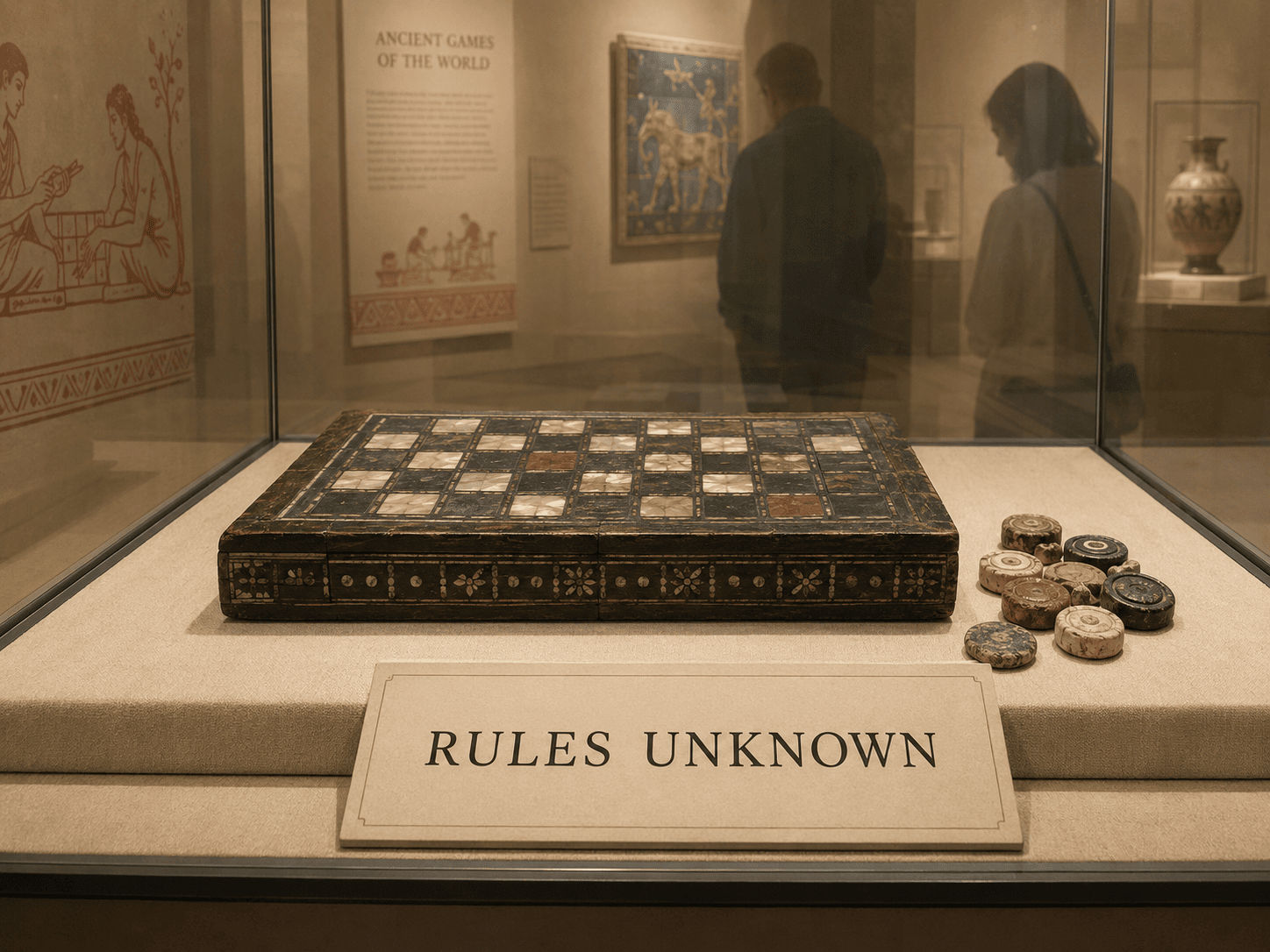
The fourth cause is the eeriest: games that survived as objects but not as play. Mehen, the Egyptian spiral snake game, predates Senet — we have boards, pieces, tomb paintings of people playing. Nobody knows the rules. The game of fifty-eight holes — "hounds and jackals" — spread across the whole ancient Near East; we have exquisite boards, including ones with animal-headed pegs, and only educated guesses about play. Museums are full of this: complete equipment, vanished game.
The mechanism is brutally simple. For most of history, rules lived only in heads — the oral-transmission constraint — so a game died the moment one generation failed to teach the next, even if every board survived in perfect condition. No rulebooks meant no resurrection. Modern reconstructions are scholarship plus playtesting plus honest guesswork; the reconstructed games can be excellent, but they're new games wearing ancient equipment. Autopsy four: death by rule loss — the only cause on the list that modern archiving has arguably cured, a point the digital-preservation article complicates in an unexpected way.
The four causes, on one card
Line the autopsies up and the taxonomy is tidy. Cultural rupture: the game welded itself to a context that died — Senet's theology. Replacement: a rival won the war for attention — chess over tafl. Drift: descendants absorbed the niche — Ur into the race-game family. Rule loss: transmission failed and the knowledge simply ended — mehen, the fifty-eight holes. (Historians add a fifth, prestige collapse — games abandoned when their social cachet inverted — usually as a slow assist to the other four.)
Two things about the list are worth noticing. Every cause is external to the rules: not one famous extinction says "the game wasn't deep enough." And every cause is the shadow of an immortality ingredient: rupture is the flywheel failing, replacement is the depth-and-teachability war lost, rule loss is the improvised-equipment principle inverted. The extinct games are the immortality checklist, photographed in negative.
What death teaches about life
Which is the real payoff of the autopsy room: it explains why the survivors look the way they do. Why are the immortals all pure abstractions? Because the theology-encrusted games died with their theologies. Why are they all trivially cheap to improvise? Because rule loss killed the games that depended on special equipment and specialist teachers. Why are they all so absurdly deep? Because a thousand years of replacement wars culled everything shallower than the winner. The shelf of classics isn't a museum of good taste. It's the fossil record of a five-thousand-year extinction event, and everything still standing is standing for a reason.
For a modern player the lesson lands practically. When you evaluate a game — for your shelf, your phone, your kid — you're asking the extinction questions whether you know it or not. Is this game its rules, or its context and content? If the company behind it vanished, could the game be taught on? Is it deep enough to win its replacement wars? Ancient history turns out to be a surprisingly sharp buyer's guide, and the next article on this shelf — the Lindy effect — turns it into an actual rule of thumb.
Run your own autopsy: a museum exercise
The taxonomy becomes yours the first time you use it, and any museum with an antiquities wing gives you the chance. Find the game case — nearly every collection has one. Then interrogate the object with the four questions.
Was it welded to a world? Look for religious imagery, royal insignia, ritual context in the label. The more sacred the decoration, the more likely cause one: the game's meaning died with its cosmology. Who were its rivals? Check the dates, then think about what else was on tables in that region by the end — was a deeper or more fashionable competitor arriving? That's cause two in motion. Could a child have improvised it? Elaborate boards, specialist pieces, inlay and ivory — beautiful, and a red flag: equipment-heavy games are transmission-fragile. Pebbles-and-scratches games rarely end up as mystery objects, because they rarely needed museums to survive. And does the label say "rules unknown"? Then you're looking at cause four itself — a transmission chain that snapped, with the hardware standing there intact to prove the software mattered more.
Ten minutes of this and the case stops being a cabinet of pretty objects and becomes what it really is: evidence. Bring a child along and teach them mancala with pocket change afterward. It's the best possible footnote — one game surviving the museum visit by the exact mechanism the games behind the glass lost.
Questions people ask
Could a dead game be revived if we found its rules? Yes — and it half-happened. The Ur rules tablet let the British Museum's curators play a genuine ancient game again, and modern editions followed. But a revival is a museum garden, not an ecosystem: without the unbroken chain of players, clubs, and rivalries, a revived game is a new game with a famous ancestor. The rules can be resurrected; the culture stays dead.
Is checkers dying by replacement right now? It's the fashionable worry — attention migrating to newer games, club culture thinning. But the record counsels calm: checkers retains the survival kit (instant rules, improvised equipment, real depth, living institutions), and games this well-armored have weathered fashion cycles before. Watch the teaching, not the headlines: a game dies when parents stop showing children, and that hasn't happened.
What's the biggest myth about dead games? That they died of shallowness. It's almost never in the record. Games die of context, competition, and broken transmission — external causes, all. The uncomfortable corollary: being wonderful is not enough, which is exactly why the wonderful survivors also carry the other four ingredients.
One line to keep? Boards survive in stone and wood; games survive only in people — and every museum case labeled "rules unknown" is the price of forgetting the difference.