Learn › Why great games never die › What makes a game immortal?
What makes a game immortal?
Songs date. Films date. Video games date hardest of all. Yet tonight, somewhere, a teenager will lose a 2,500-year-old board game to a grandmother and demand a rematch — and neither will think anything unusual has happened. A handful of games are effectively immortal, and their immortality isn't luck. Run the survivors through a side-by-side comparison and the same five ingredients appear every time. Here they are.
The five-thousand-year field test
Board games are the oldest entertainment technology still in daily use. Kings were buried with them before the alphabet settled; the history shelf traces boards in tombs, fortress stones, and cathedral cloisters. Which means we're not guessing about what lasts — we're reading the results of the longest consumer test ever run: five thousand years, every culture on Earth, no marketing department, and a brutal elimination rule. Most games that ever existed are gone. The survivors — chess, Go, mancala, backgammon, a short shelf more — passed through every filter a species can apply: wars, migrations, translations, technologies, fashions, centuries of children deciding what to teach other children.
So the question of this article — what makes a game immortal? — has an empirical answer. Line up the survivors, ask what they share that the extinct lacked, and five properties surface with almost boring consistency. Think of them as a checklist; by the end you'll be able to score any game in your pocket against it.
Ingredient 1: rules a child can hold
For nearly all of history, games had no rulebooks. They survived only inside heads, passed by demonstration — a parent showing a child, a soldier showing a soldier, across languages and borders. That's a savage constraint: a game too complicated to teach by showing simply cannot travel through time. Every immortal passes the test. Mancala: scoop and sow, count and capture. Go: surround to capture, more territory wins. Checkers: step, jump, crown. Even chess — the heavyweight of the shelf — compresses to six piece-moves a patient child holds in an afternoon.
Notice the precision of the filter: it doesn't demand shallow rules — it demands holdable ones. The rules must fit in a young memory whole, because for millennia young memories were the only storage medium available. Games that needed manuals died with their manuals; games shaped like folklore traveled like folklore. Any game you can teach in a minute by moving pieces is carrying the first mark of the immortals.
Ingredient 2: depth an adult can't exhaust
Teachability gets a game adopted. Only depth keeps it. A game that's fully understood is finished — shelved not from dislike but from completion, the way a solved puzzle is done. The immortals are never done. Their possibility spaces exceed any lifetime by cosmic margins, so the ten-thousandth game still teaches something new. Mastery stays a horizon, never a destination. Go has been studied for twenty-five centuries and its theory is still moving. Chess wore out neither its players nor, remarkably, its computers' interest.
Pair the first two ingredients and you get the shape every immortal shares: a tiny door, a bottomless interior. This library keeps meeting that shape as the elegance ratio. Minutes to learn, lifetimes to master isn't marketing copy — it's the survival profile. One caveat the record insists on: depth alone saves nothing. History is full of deep games that died anyway, taking their unexhausted interiors with them. Depth is fuel, not armor. The remaining three ingredients are the armor.
Ingredient 3: equipment the poor can improvise
Here's the ingredient modern eyes miss. Every immortal can be built from nothing by anyone: Go is pebbles of two colors on scratched lines; mancala is pits in the dirt and a handful of seeds — plausibly the most-improvised game in human history; checkers is bottle caps on a drawn grid; morris boards are carved into cloister benches across medieval Europe, scratched there by people who owned almost nothing. Cheapness is immortality insurance. A game that requires manufacture ties its life to an economy; a game that can be improvised survives shipwrecks, prisons, poverty, and collapse. It can be confiscated at dusk and rebuilt by noon.
The deep reason: improvisable equipment means the game's true body is the rules, not the object — and rules stored in heads are the one game component no fire can reach. The principle has a sharp modern translation, taken up at the end: for a digital game, the equipment question becomes what happens when the servers close? — and the games with simple public rules are, again, the ones that can't be killed by losing their hardware.
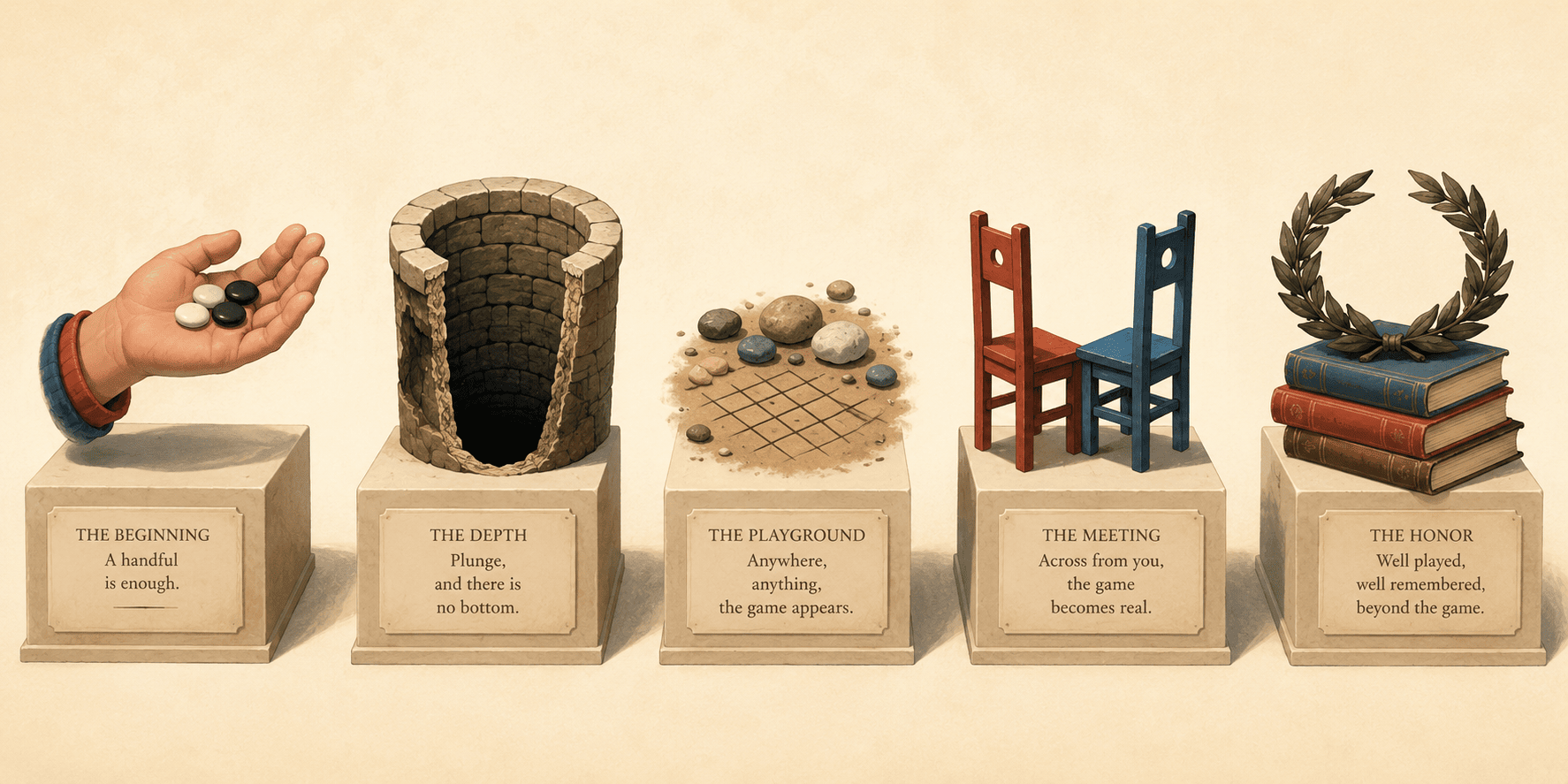
Ingredient 4: another human across the table
Every game on the immortal shelf is a duel — or at minimum, humans against humans. No exceptions. Solitaire pastimes and puzzles come and go by the thousand. The survivors are all social, and the reason is fuel. A puzzle's content is finite: solve it and it's spent. A rival is renewable. They adapt. They improve. They remember last Tuesday's humiliation and arrive tonight with something prepared. Two ordinary minds generate endless fresh content for each other — the same engine the same-opponent test uses to measure depth, running here as a longevity machine.
The social ingredient also does the transmission. Games spread person-to-person, along trade routes and across kitchen tables, because playing one requires recruiting someone. Every match is a small act of evangelism. The extinction record shows the same pattern from the other side: games wired to solitary or ritual experience died when their context died. The duels walked out of every collapsed civilization alive, carried by pairs of players who needed nothing but each other. An opponent, it turns out, is the one game component that upgrades itself.
Ingredient 5: identity and institutions
The last ingredient separates the merely old from the immortal: at some point, a game stops being an activity and becomes a culture. It grows clubs. Rankings. Proverbs. Literature. Professional players, and parents' phrases repeated by children. Chess has centuries of books and a whole ecosystem of titles and federations. Go has academies, a professional class, and proverbs that double as life advice. Even humble mancala carries regional identities, local rules defended like dialects. The chess article calls this the cultural flywheel: institutions create ambition, ambition creates study, study creates literature, and literature recruits the next generation before it can wander off.
The flywheel is the compounding ingredient — the only one that strengthens with age. Rules stay constant, depth stays constant, but the surrounding culture accumulates: every recorded game, every book, every local legend adds mass. That's why the great survivors don't merely persist; they get harder to kill every century — age itself becomes armor, a pattern so reliable it has its own article's worth of implications on this shelf. It's also the ingredient no designer can ship in the box. Institutions must be grown, player by player, decade by decade — which is precisely why they prove so much about the games that manage to grow them.
Scoring modern games against the checklist
Now the fun part: point the instrument at the present. Rules a child can hold? The modern renaissance aces this — Hive, Onitama, and the best app-era duels teach faster than checkers; it was a design goal. Depth unexhausted? The structural tests exist and the strong moderns pass them, though only decades of play convert "structurally deep" into "proven bottomless." Improvisable equipment? Here the moderns split sharply: anything reducible to stones on a drawn grid scores high, while games welded to bespoke components — or to servers — carry a real mortality risk the classics never did. A human across the table? The multiplayer duels score; the solo-content games, whatever their brilliance, are on the puzzle side of the line, and the record is unkind to that side. Institutions? Too early, by definition — though ladders, ranked seasons, and online rivalry communities are recognizably flywheel construction, attempted at unprecedented speed.
Run a favorite through the five and you'll get an honest reading of its odds. A tiny worked example, since this site owes its own game the audit. Teachability: the 6×6 push duel explains itself in forty seconds — pass. Depth: the structural marks are all present, and unproven, as with every young game. Equipment: in principle it's coins on a drawn grid, though its soul lives in the animated push — half credit, with the digital asterisk. A rival: the game is nothing but the duel — pass. Institutions: seedlings only; ladders and rivalries where a culture would need to grow. Verdict: the right anatomy, awaiting the only judge that counts. That's the checklist's final honesty. It can measure whether a game is built like an immortal — but only centuries of children, prisoners, commuters, and grandmothers can vote it onto the shelf. The good news: you don't need the verdict. A game with the five ingredients plays like a forever game now. The immortality, if it comes, is just the receipt.
Try the checklist tonight: score three games in five minutes
The five ingredients turn into a usable instrument the first time you score something with them, so here's the drill. Pick three games: one classic you grew up with, one modern favorite, and one game currently living on your phone. Give each a point per ingredient — half points allowed, honesty required.
Rules a child can hold: could you teach it to a nine-year-old by demonstration, no manual? Depth unexhausted: after all your plays, are you still finding new ideas — or did it finish? Improvisable equipment: stranded somewhere with paper and pebbles, could you rebuild it? A human across the table: is its heart a duel with a person, or content you consume alone? Identity and institutions: does it have a culture — clubs, rankings, sayings, people who'd call themselves players of it?
Read your three scores. The classic probably lands four to five — that's why you still know it. The phone game is the interesting one: most score under three, and now you can see exactly where the mortality lives. Usually it's ingredient three (dies with its servers) or four (no rival, just content). When a phone game scores four-plus — simple public rules, real duels, a rating you care about — take it seriously. You may be holding a young forever game, and the five-thousand-year test says those are worth investing your hours in early, before the flywheel crowds get there.
Questions people ask
What's the oldest game still played essentially unchanged? Depends on the strictness of "unchanged." Mancala's family and Go both reach back over two millennia with their cores intact; backgammon's ancestors are older still but drifted more. Go usually takes the title for deep continuity — a modern player could sit with a player from a thousand years ago after five minutes of table talk about komi.
Why isn't fun on the checklist? Because it's the exam, not an ingredient. Every game that survives a decade is fun; the five ingredients are what let fun keep operating across centuries — teachable enough to spread, deep enough to hold, cheap enough to survive, social enough to refuel, cultured enough to compound. Fun without the five dies fun.
Can immortality be designed on purpose? Four-fifths of it, yes — teachability, depth, improvisability, and duel structure are all engineering choices, and the modern renaissance hits them deliberately. The fifth ingredient only grows in the wild. So designers can build a game eligible for immortality; history holds the only pen for the last signature.
Does digital distribution change the game's odds? Both ways at once. It supercharges ingredients one and four — a game that teaches by animation and matchmakes rivals globally spreads faster than anything in history — while putting ingredient three on notice: servers close. The digital games with immortal ambitions are the ones whose rules are simple and public enough to outlive any platform; the full argument gets its own article on this shelf.