Learn › Why great games never die › Rules that survive translation
Rules that survive translation
Every other entertainment needs translating. Books need translators, films need subtitles, songs carry their language with them. A strategy game needs nothing — hand someone stones and a grid, demonstrate three moves, and you're playing, whatever languages you don't share. This article is about that superpower: why pure-strategy rules cross borders that stop everything else, and what it means for which games conquer the world.
The no-translation game
Consider what a pure abstract actually consists of. No text on the board. No flavor to explain. No cultural references, no jokes, no lore. Just objects, a geometry, and a handful of legal-move rules — all of which can be shown rather than said. Go is stones on lines. Mancala is seeds and pits. Checkers is discs and diagonals. The entire game fits in the visual channel, and the visual channel needs no dictionary.
Now compare the rest of the shelf. A card game with rules text dies at the border until someone reprints it. A trivia game is welded to one culture's knowledge. A negotiation game needs shared fluency to sing. Even themed strategy games carry translation debt — somebody has to explain what the zombie tokens mean. The pure abstract carries nothing. It's the only entertainment format that ships, by its nature, in the one language every human already speaks: watching what happens.
What travels and what doesn't
The border test sorts game components with surgical clarity. Mechanics travel. A capture rule, a push rule, an alignment goal — these are physics, demonstrable anywhere. Geometry travels. Grids, hexes, lines: mathematics has no homeland. Objects travel, provided they're generic — stones, seeds, discs. And that's essentially the complete packing list of the classical abstracts, which is not a coincidence; it's survivorship. Games assembled entirely from travel-proof parts are the games that crossed every border and are still here.
What drowns at the border: text, first and always. Then theme, which travels shallowly — the pieces make it across, but the meaning thins (chess's own pieces changed identities on every frontier: elephants becoming bishops, viziers becoming queens, the paint reapplied while the machine crossed untouched). Then humor, etiquette, and references, which barely travel at all. The rule of thumb: whatever must be explained in words stops at the border; whatever can be shown keeps walking.
The pantomime test
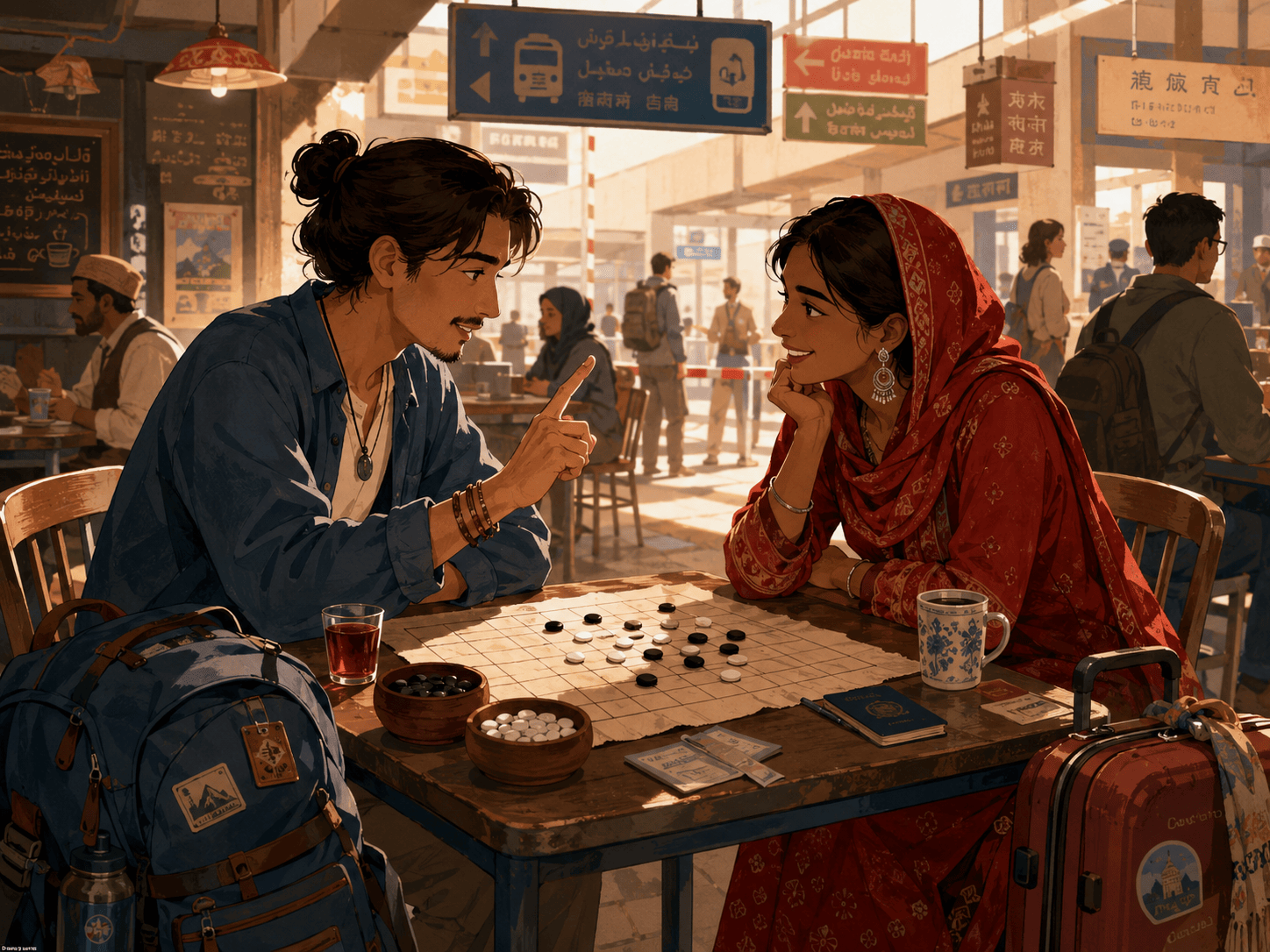
Here's the practical instrument, and it's worth actually running: could you teach this game without a shared word? Sit across from an imaginary stranger. You may point, demonstrate, nod, shake your head, and replay examples. Nothing else. Go passes — place stones alternately, demonstrate a capture, show territory at the end; people learned it exactly this way across a continent. Mancala passes trivially: scoop, sow, show the capture, done. Checkers passes in two minutes. Oustwit passes with something to spare — place a piece, let the push happen, point at three-in-a-row, spread your hands: that's the game. The physics demonstrates itself.
Chess, interestingly, half-passes: the moves demonstrate fine, but castling, en passant, and promotion want words — which is roughly a map of which chess rules arrived late, after the game had already crossed its borders and settled down among people with shared languages and written theory. The test isn't a purity contest; it's a measurement of friction. Every rule that fails pantomime is drag on transmission — a rule that needs a teacher fluent in both the game and the student. The games with zero such rules spread like weather. The games with many spread like literature: slowly, expensively, needing translators. Both can be great. Only one kind ends up in every village on Earth.
History's proof
The historical record reads like a controlled experiment on exactly this. The games that show up at every crossroads of the old world are, without exception, pantomime-passers. Chess's ancestors walked from India through Persia into both the Islamic world and Europe, changing names and piece identities at every border while the movement rules crossed intact — a thousand-year game of telephone in which the mechanics never garbled. Go spread across East Asia and became three countries' shared intellectual heritage. Mancala's sowing engine crossed Africa, the Middle East, and the Indian Ocean trade routes so thoroughly that hundreds of local variants now share one recognizable core. Merchants, soldiers, and pilgrims carried these games precisely because they were carryable: no book, no teacher, no translation — just equipment you could improvise and rules you could show. The history shelf maps the routes; the principle that picked which games rode them is this article's.
Culture still seasons the game
Universal doesn't mean uniform, and the honest chapter says so. The same rules, crossing a border, get seasoned: etiquette, tempo, and table culture differ everywhere the rules don't. Go carries centuries of formal courtesy in one country and cheerful trash talk in another. Mancala is a contemplative pastime at some tables and a blazing-fast reflex sport at others — same seeds, same pits. Chess in a park is a different social organism from chess in a federation hall. The mechanics are the sheet music; every culture plays it in its own key.
This is a feature, and it's worth savoring: it means a traveling player gets to learn the same game twice. The rules you brought are your passport; the local seasoning is the country. Sit down to a familiar game abroad and you'll be fluent in the moves and delightfully foreign in everything else — the speed, the banter, the handshakes, when it's polite to resign. The world-tour shelf is full of exactly this pleasure.
The digital translation layer
Then the screen arrived and built the ultimate pantomime teacher. A well-made digital board game teaches wordlessly by construction: legal moves highlight themselves, illegal ones refuse, consequences animate. Tap a square, watch eight neighbors slide outward, and you've learned the push rule faster than any paragraph could teach it — the app demonstrates the physics the way a village teacher's hands once did, tirelessly, for every player on Earth at once. UI is the first genuinely universal rules language, and it's no accident that the games thriving on phones are so disproportionately the abstract, textless kind: the format rewards exactly the games that were already border-proof.
The same layer dissolved the last practical border — finding an opponent. Matchmaking doesn't care what language your rival speaks; a game with no necessary text is fully playable between two people who couldn't order coffee together. Somewhere right now, that match is happening: two strangers, no shared words, deep in the same thought. The old trade-route miracle, running at planetary scale, every second.
Designing for the whole species
Flip the article into a discipline and you get one of the quiet crafts of the modern renaissance: textless design. Every word a design needs is a border it can't cross unassisted — so the designers of the best small duels edit toward pantomime the way poets edit toward meter. Goals visible on the board rather than explained beside it. Consequences that demonstrate themselves. Icons over labels; physics over prose. Run the five-lesson audit with a border-crosser's eye and you'll notice the overlap: readable state and demonstrable rules are the same virtue, viewed from inside and outside a language.
There's something quietly moving about the standard. A game designed to need no translation is a game designed, whether the designer says so or not, for the whole species — playable by any two humans who can see a board, including pairs separated by every other kind of border there is. The purest games are born world-ready. It's the family's oldest trick, and the newest designs on the smallest screens are still performing it.
Run the pantomime test tonight
Reading about the test is one thing; running it rewires how you see every rulebook afterward. You need one willing person and one game they don't know. The rules of the drill: you may point, demonstrate, nod, shake your head, and replay example moves. You may not speak, write, or mime words. Teach the game.
Start with something from the border-proof shelf — checkers, mancala, or the 6×6 duel on your phone (mute it first; the app will keep trying to help). A rhythm develops fast: demonstrate a legal move, offer the pieces, correct gently by shaking your head and replaying. Most people are playing real turns within five minutes, and the moment is strangely moving every time — you've just reenacted the exact scene by which games crossed every border on Earth, at trade posts and harbors, for five thousand years.
Then notice where you snag, because the snags are the lesson. Captures demonstrate beautifully. Goals demonstrate well — point at three-in-a-row, spread your hands. But conditional rules fight you: castling rights, compulsory captures, exceptions-with-exceptions. Whatever you cannot show in an example is exactly what would have drowned at a medieval border — you'll feel the friction in your own hands. Score the games you own afterward: taught wordlessly in under five minutes, border-proof; under fifteen, seaworthy; anything needing a spoken footnote, literature — fine at home, expensive abroad.
The advanced version is teaching a young child, the ultimate border: no shared strategic vocabulary at all. Every game your family plays across a generation gap already passed this test — you just never scored it.
Questions people ask
Is any game truly universal? The closest candidates are the pantomime-passers with improvisable equipment — mancala and Go are played, recognizably, nearly everywhere humans settle. "Universal" overstates only the seasoning: the rules cross whole; the way people sit, talk, and compete around them stays gloriously local.
Why did chess pick up wordy rules like castling if words are friction? Because by then it could afford them. Late chess evolved among settled communities with shared languages, written theory, and teachers — an environment where friction costs little. Rules acquired in the traveling era stayed demonstrable; rules acquired in the library era got complicated. A game's rulebook is a fossil record of where it lived.
Does the pantomime test matter if everything's an app now? More than ever, just relocated: the app is the pantomime, and games that need paragraphs anyway (tutorials, tooltips, glossaries) still pay their friction — in onboarding drop-off instead of border drop-off. The textless games win the first sixty seconds, and on a phone the first sixty seconds are the border.
One line to keep? Words stop at borders; demonstrations don't — and the games the whole world plays are the ones that never needed the words.