Learn › Why great games never die › The Lindy effect
The Lindy effect on the game shelf
Here's a strange rule of thumb: to guess how much longer a game will be played, check how long it's been played already. The older the game, the longer its expected future. It sounds backwards — shouldn't old things be closer to the end? — but for games, ideas, and books, the arrow points the other way. It's called the Lindy effect, board games are its perfect habitat, and it might be the most useful single heuristic a player can own.
The idea in one line
The Lindy effect says: for things that don't wear out, life expectancy grows with age. A person who is ninety expects fewer years ahead than a person who is twenty — bodies perish. But a book in print for ninety years expects more future than one printed last spring. The old book has proven something the new one hasn't: that it survives fashion cycles, generation changes, and competition. Each year survived is evidence of durability, so the expected future stretches as the past accumulates.
The name, charmingly, comes from a New York deli where comedians once theorized about careers, and the idea was later sharpened by mathematicians into a serious observation about non-perishable things. The key qualifier is non-perishable. Lindy doesn't apply to anything with a body — machines rust, organisms age, technologies get obsoleted by physics. It applies to information that people keep choosing: languages, proverbs, recipes, religions, mathematics. And, as purely as anything on that list — games.
Why games are peak Lindy material
A game has no body to wear out. The equipment perishes; the game is the rules, and rules don't rust. So the only way a game dies is the ways the extinction article catalogs: losing the war for attention, losing its cultural context, losing transmission. Which means every year a game survives, it's re-winning all three wars — beating this year's new rivals, staying meaningful in a changed world, and successfully recruiting another cohort of players to teach the next.
And here's the subtle part: a game's survival test is unusually honest. Nobody is forced to play checkers. No institution compels a grandmother to teach mancala. A game survives only by being, every single evening, someone's freely chosen best option — re-elected daily for centuries, by children who have no reverence for tradition and infinite appetite for the new thing. When something passes that electorate for a thousand years, the evidence isn't sentimental. It's statistical. Age, for a game, is compressed proof of quality — the five ingredients of the immortality checklist, verified by field test rather than argument.
The evidence of the shelf
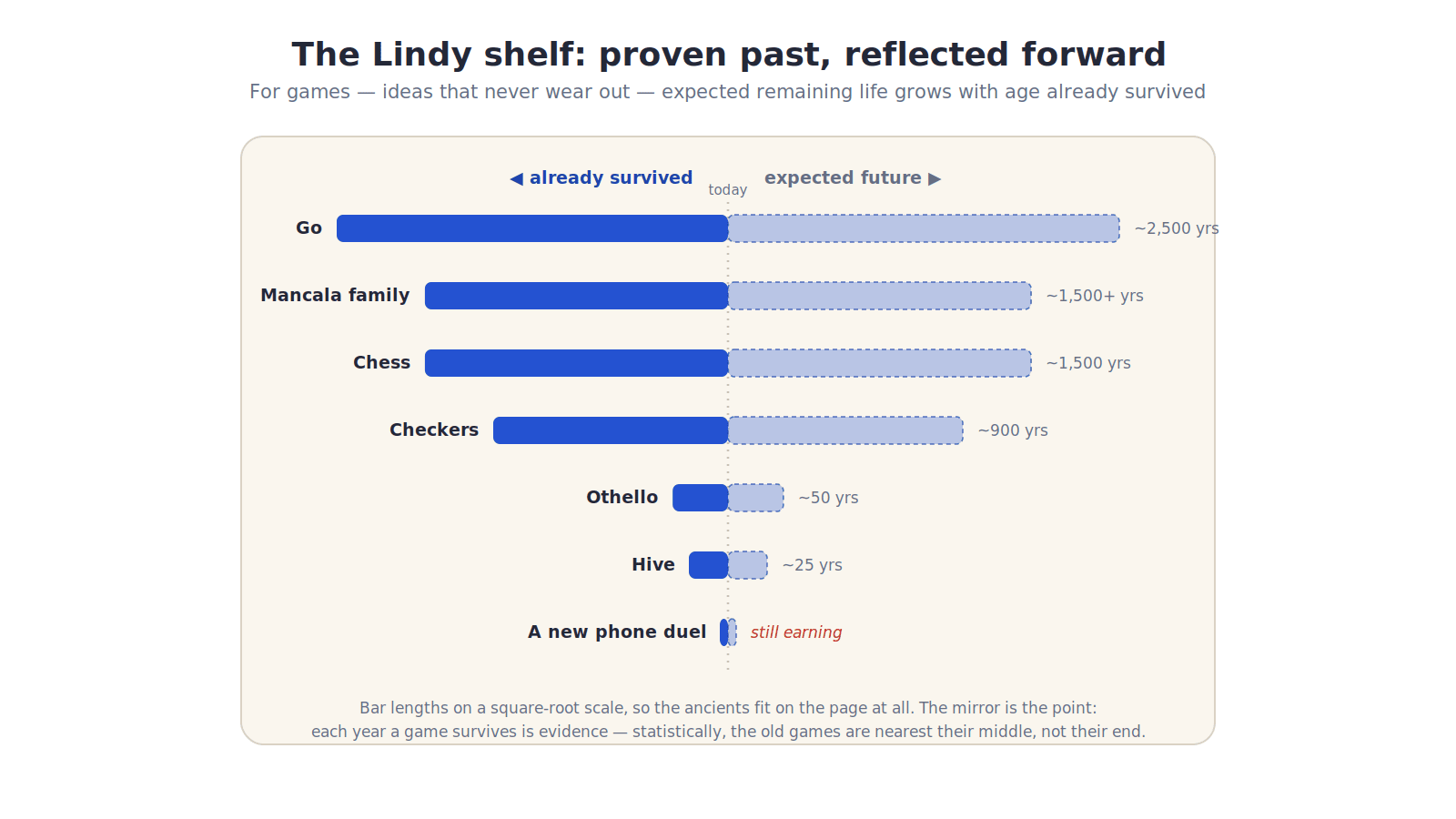
Run your eyes along any well-stocked game shelf and Lindy is just visible. The games with the deepest past are precisely the ones with the most obvious future: Go, twenty-five centuries old, is played professionally on live streams tonight. Mancala, older still by some measures, is being taught to children on three continents this week. Chess survived the printing press, the telegraph, radio, television, and the computer — each supposedly fatal — and emerged from the last one bigger. Checkers, morris, backgammon: every senior citizen of the shelf is, on the numbers, thriving.
Now the falsifiable part, because a heuristic that can't fail is a superstition. Lindy predicts that of today's games, the ones that vanish first will overwhelmingly be the young ones — and that's exactly what the record shows. The attrition rate among games under ten years old is ferocious; among games over a hundred, it's nearly zero. Fifty years of tabletop publishing produced tens of thousands of designs; the handful still widely played from the early decades are the ones that were already standouts by year twenty. Survival curves for games really do flatten with age, which is all Lindy claims. The old games aren't lingering. They're compounding.
Lindy as a buyer's guide
Turn the observation around and it becomes advice. Your gaming hours are an investment; depth pays that investment back over years, and a game that dies takes its unredeemed depth with it. So when you're choosing what to learn deeply — not what to sample, what to study — Lindy says: when in doubt, pick the older game. The centuries have already run the quality test you can't run yourself.
Concretely, the heuristic sorts your options into tiers. The ancient tier — Go, chess, mancala, checkers, backgammon — is the safest intellectual investment on Earth: bottomless, universally known, and statistically immortal within your lifetime. The proven-modern tier — Othello's mid-century synthesis, the decades-old designer classics — has cleared meaningful hurdles: past the fad zone, institutions forming, the flywheel beginning to spin. The new tier is where all the risk and all the discovery lives. Lindy doesn't say avoid it — it says size the bet correctly: sample the new freely, but before sinking five hundred hours of study into anything young, ask what evidence of durability it can show. Which brings us to the honest chapter.
Where Lindy fails
Three real limits keep the heuristic honest. First, survival can be propped. Network effects and institutions can keep a game alive past its natural merit — when everyone already knows a game, knowing it stays useful whether or not it's the best available design. Some of the ancient shelf's dominance is genuine quality; some is incumbency. Lindy can't tell the difference from the outside.
Second, Lindy is a population statistic, not a prophecy. It says old games as a class outlast young ones as a class. It cannot promise that any particular classic survives, or that this year's brilliant newcomer fails — Senet's three thousand years ended anyway. Base rates, not oracles.
Third, the filter has a lag. A genuinely immortal-grade game designed this decade scores terribly on Lindy for its first fifty years — the heuristic is structurally blind to young excellence, which is precisely where the most rewarding early discoveries live. Players who used only Lindy would have missed every classic at the moment it was most exciting to join. The fix isn't to abandon the heuristic; it's to pair it with something that can see quality before time proves it.
Young games with old bones
That something exists, and this shelf already built it: the five-ingredient checklist is essentially a way to spot Lindy-compatible DNA before the centuries weigh in. Age proves durability; the ingredients are what age keeps selecting for. So audit the young game directly: rules holdable by a child? Depth that structural tests — interaction, decision density, the same-opponent test — say won't exhaust? Equipment (or rules) that would survive its publisher? A human duel at its heart? The beginnings of a culture — ladders, rivalries, people who call themselves players?
A young game that passes is what you might call Lindy-eligible: no proof yet, but the same bones the survivors have. The modern renaissance produced a real cohort of these — pocket duels with forty-second rules and unexhausted interiors — and the app era added its own candidates: small pure duels, born digital, whose rules would fit on a napkin if the servers vanished. Betting study-hours on a Lindy-eligible young game is a reasonable risk with a real payoff: you get the early-adopter's decades, and if the game makes it, you were there when the culture was small enough to know everyone in it.
Betting on forever
Here's the quiet reframe the whole heuristic performs: it turns "what should we play?" into "where should a finite supply of evenings go?" — and answers with a portfolio. Hold the ancients as your core position: they're the index fund, guaranteed to still exist when you're old, compounding skill that transfers everywhere. Sample the new freely and joyfully — that's the venture allocation, most of it goes nowhere, and the finds are worth the misses. And when a young game shows old bones, take a real position early, knowing exactly what kind of bet it is.
The deepest thing Lindy says about games isn't about picking them at all. It's what the flat survival curves reveal: play, as a human activity, doesn't obsolete. Five thousand years of technological upheaval and the species is still sitting down across a grid from a rival, thinking hard, for fun. Whatever screens the next century brings, the statistical bet is that somebody on the far side of it is losing a very old game to their grandmother — and demanding a rematch. Which of today's games will be there is this shelf's next question.
The Lindy audit: your own shelf in ten minutes
Like every heuristic on this shelf, Lindy turns real the moment you point it at your own life. The exercise takes ten minutes and two columns.
Column one: age. List every game you actually play — shelf and phone together. Next to each, write roughly how old the game is (not your copy). Be honest about digital ones: the game's age, not the genre's. Column two: hours. Next to that, estimate the hours you've given each in the past year. Rough is fine.
Now read the two columns against each other, and expect one of three patterns. Hours concentrated in the ancient tier: you're already Lindy-aligned — your skill is compounding in games guaranteed to outlive you. Hours concentrated in games under five years old: not wrong, but worth a conscious look — that's venture allocation; is it sized like one, or is your main intellectual investment sitting in an unproven vehicle? Hours scattered thinly everywhere: the sampling life, all sparkle and no compounding — lovely, unless you were hoping to get deep somewhere, in which case pick one lamp and schedule it.
One refinement makes the audit predictive rather than just descriptive. For each young game carrying serious hours, run the five-ingredient check in the margin: holdable rules, unexhausted depth, napkin-rebuildable, human rival, culture forming. Four or five ticks and your bet has bones — hold it with confidence. One or two ticks and you've located the firework in your portfolio. Nothing needs to change tonight. But the next time you're deciding where a season of study goes, you'll decide with the columns in view — which is all a heuristic is for.
Questions people ask
Does Lindy mean new games are worse? No — it means new games are unproven, which is a statement about evidence, not quality. Some fraction of this decade's designs are future classics; Lindy just can't tell you which, because nobody can. That's what the ingredient checklist is for: reading bones before time does.
Isn't this just "old things are good," which is obviously sometimes false? The full claim is narrower: for non-perishable, freely re-chosen things, age predicts remaining life statistically. Old machines and old scientific theories don't qualify (they perish or get disproven); old proverbs, languages, and games do. And it's a base rate, not a guarantee — Senet is the standing counterexample the heuristic itself requires you to remember.
Where does a game like Oustwit sit on the Lindy shelf? Bottom tier by age, honestly marked "still earning" — no digital-era duel has proof yet. What a young game can show is bones: napkin-sized rules, a pure human duel, structural depth, and rules simple enough to outlive any server. The Lindy-aware move with any such game is the early position, sized like the venture bet it is: play it hard now, enjoy the small-culture years, and let the decades vote.
One line to keep? For games, age isn't decline — it's evidence: every century survived is a century of children who could have chosen anything, and chose this.