Learn › A short history of board games › The medieval table
Games of the medieval table
Forget the movie image of the Middle Ages as all mud and plague. Between the feasts and the field work, medieval people played — constantly, everywhere, at every rung of society. We know because they carved their boards into everything that stood still: cloister benches, ship decks, castle steps. This is a tour of what was actually on the table between roughly 800 and 1500 — the Viking blockbuster, the graffiti game, the tavern dice classic, and a strangely slow version of chess.
What people actually played between feasts
The medieval evidence for games is wonderfully democratic. For most medieval life we rely on what literate elites chose to record. But games left physical evidence at every level of society: fine ivory sets in noble inventories, and rough boards scratched by ordinary people into whatever surface an idle hour offered. Monks carved game grids into the stone seats of cloisters. Sailors cut them into ship planks. Soldiers scratched them into fortress steps. Court records, sermons, and law codes fill in the rest — mostly by complaining, which historians treasure, because nobody bans what nobody's doing.
Put it together and the medieval table runs four deep: a siege game from the north, an alignment game from everywhere, a dice-race from the taverns, and a prestige import from the east that was busy mutating. Take them in order.
Tafl: the Viking blockbuster
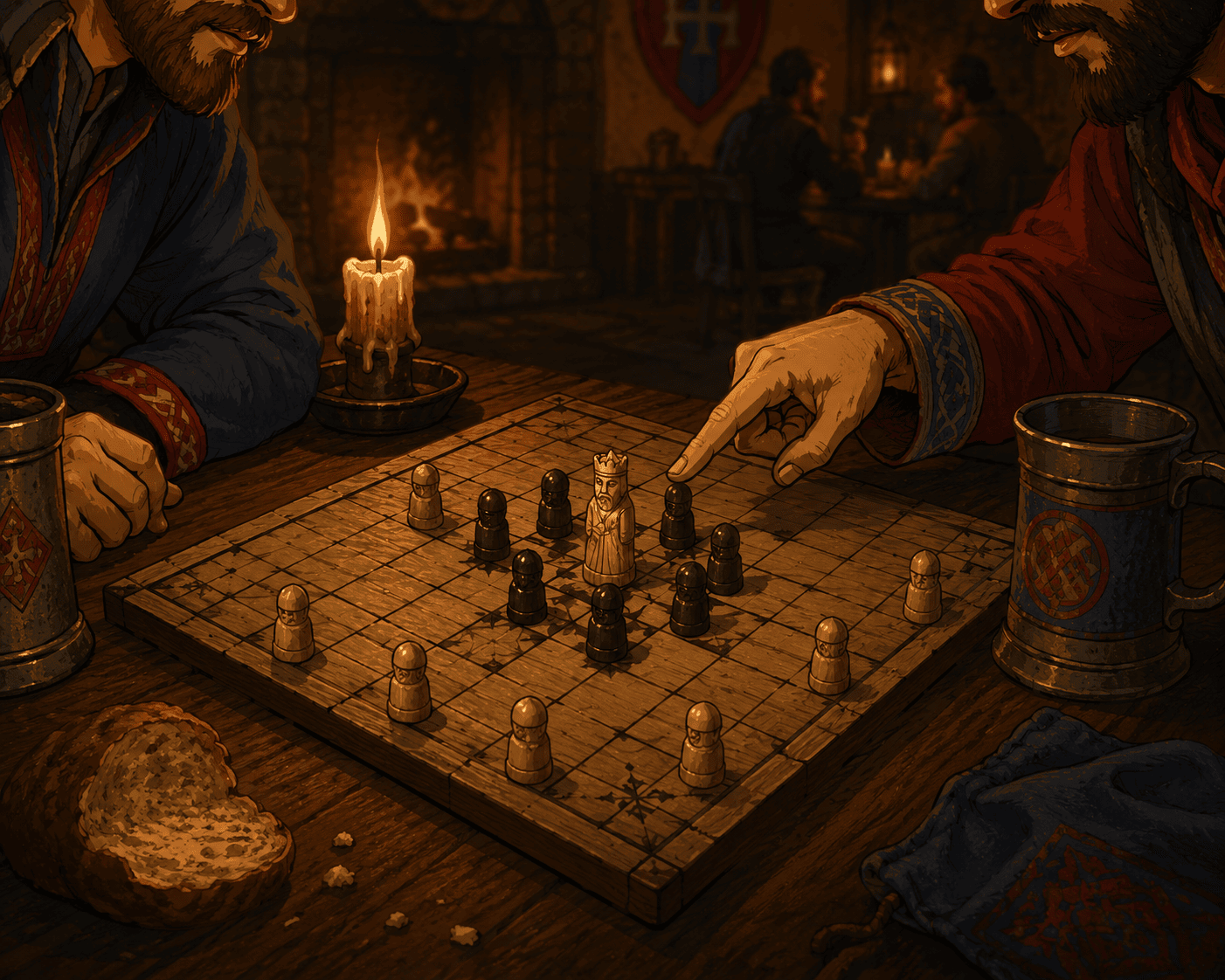
The north's great game was the tafl family — hnefatafl and its cousins — and it was gloriously unfair on purpose. One player takes a king and a small bodyguard, starting at the center; the other takes a surrounding army of roughly twice the size. The king's side wins by escaping to the board's edge or corners; the attackers win by capturing him. Asymmetric sides, asymmetric goals — a genuine rarity in the abstract family, then or now.
Tafl went everywhere the Norse went, which in the Viking age meant everywhere. Game pieces turn up in graves from Ireland to the Volga trade routes. The sagas name the game as a mark of a cultivated warrior. For several centuries it was northern Europe's premier strategy game — the thing you were expected to be good at. Then chess arrived, and tafl lost the head-to-head war for the north's tables, surviving longest at the map's remote edges. It's one of game history's cleanest extinction stories — and its modern revival is a good story too; the full treatment lives on the world-tour shelf.
Merels: the game carved into everything
If tafl was the north's prestige game, the morris family — merels, as the era knew it — was simply everywhere. Nine men's morris and its smaller cousins are the most-carved games in medieval Europe: the distinctive concentric-squares board survives cut into cloister seats in great English cathedrals, into church pews, into castle window sills, into the decks of ships. Monks carved them where the abbot presumably didn't look. Masons carved them into buildings they were paid to be building.
The graffiti record is the point. A carved board is a commitment — evidence not of one game but of a standing habit, a spot where players kept returning. And morris earned the devotion honestly. It's cheap as a scratch and teachable in a minute, yet deeper than its reputation: the placement-then-movement structure, with its mill-breaking rhythm, is real strategy in a pocket-sized rule set. It was the era's universal game — the one a monk, a sailor, and a stonemason all knew. Those scratched grids are the closest thing the Middle Ages had to an install base.
"Tables": the tavern's dice classic
The inns and taverns ran on tables — the family of dice-and-checkers race games ancestral to backgammon, played on the familiar board of long triangular points. Dice for movement, real choices about which runners to advance and when to leave a blot exposed: luck enough for gambling, judgment enough for skill, which is precisely the recipe for a tavern hit in any century — the same blend the luck-and-skill article maps in modern games.
We know tables was huge from two kinds of evidence. The finds: boards in shipwrecks and castles across Europe. And the paper trail of disapproval: sermons against dicing, town rules about play, moralists listing tables among the vices of the alehouse. Prohibition literature is popularity data wearing a frown. When a game gets denounced for three centuries, it isn't dying; it's thriving. And this one outlived every scold: tables refined into modern backgammon and never left the table at all — the medieval survivor with the least drama and the most staying power.
Chess arrives — and plays strangely
Then the eastern import. Chess reached medieval Europe around the turn of the millennium, via Iberia, Sicily, and Byzantium. It quickly became the aristocracy's board game: praised as a knightly accomplishment, gifted between courts in luxury sets. Preachers loved it too, in their own way — whole sermons turned the pieces into a lecture on society, every rank of the realm on one board.
But here's what the movies never show: medieval chess was slow. The queen didn't exist yet — in her place waddled the fers, a one-step diagonal advisor, among the weakest pieces on the board. The bishop's ancestor leaped exactly two diagonal squares. Games opened at a crawl, and impatient medieval players did the human thing: they invented shortcuts — dice variants that randomized which piece moved, pre-arranged opening setups to skip the slow part, gambling formats to raise the stakes. The familiar demon-speed chess of the modern imagination only arrives at the era's very end, when the 1490s queen upgrade lit the whole game on fire. Medieval chess is the great reminder that a classic's rules are a snapshot, not an essence: for its first five European centuries, the royal game was a different, sleepier animal.
Games, class, and the church
Who played what? Broadly: chess wore velvet, tables wore homespun, and merels wore everything — but the borders leaked constantly. Nobles absolutely rolled dice. Clergy demonstrably played everything; the carved cloister boards are signed confessions in stone. And the market for cheap chess sets says the royal game slid down the social ladder fast. Games were one of the era's few genuinely shared cultures — a duke and a dockhand knew the same boards, even if they played them on different materials.
The church's relationship was a long, losing negotiation. Councils and bishops periodically banned dice games, restricted clerical play, denounced the gambling table — and the bans repeated, which is the tell: each new prohibition is evidence the last one failed. Some moralists made peace instead, pressing chess into allegory and praising lawful recreation. The pattern is timeless — play is one of those human constants that authority manages, but never manages to remove — and the failed medieval bans are among history's best proofs of games' sheer refusal to be dislodged: improvised equipment and rules stored in heads make an unconfiscatable pastime.
What survived, and why
Run the medieval table through the extinction lens and the results are tidy. Chess survived spectacularly — the mutating import ended the era mid-upgrade, on its way to owning the world. Tables survived smoothly, refining into backgammon without ever leaving the inn. Merels survived humbly — morris faded from ubiquity after the era but never died, still taught, still carved into playground tables. Tafl died — the one major casualty, outcompeted by chess in its own halls, surviving only at the geographic margins until modern revivalists brought the rules back from old descriptions.
One era, four fates: mutation-to-glory, quiet refinement, humble persistence, extinction-by-rival. It's the whole taxonomy of game death and survival played out on one table, within a few centuries — which is why historians love the medieval shelf: it's the family's story in miniature, with the evidence carved into the furniture.
A medieval game night, reconstructed
You can run the whole medieval table at home, tonight, for nothing. Here's the menu, in the order a tavern might have served it.
Open with merels. Draw the nine men's morris board on paper — three nested squares, connected at the midpoints. Nine coins against nine buttons. Place alternately; three in a row along any line lets you remove an enemy piece; then slide pieces along lines and keep making mills. It teaches in two minutes and gets sharp by game three. You are now playing the most-carved game in medieval Europe, on the same equipment budget as a bored monk.
Continue with tables. Any backgammon set is a medieval tables set — same board, same bones. Play standard backgammon and you're within arm's reach of what the inns played; the dice-plus-judgment blend that scandalized the sermon-writers is fully intact. Wager toothpicks for historical accuracy.
Finish with tafl. Rules and printable boards for hnefatafl are free online, and the game plays beautifully with checkers pieces plus one distinct king. Take the king's side first — escaping to a corner with your little bodyguard against a double-sized army is the medieval north's favorite feeling. Then swap seats and learn why the attackers thought they had the hard job too.
Three games, one evening, zero purchases — and a decent history lesson smuggled in: by candle or lamplight, with improvised pieces and someone across the table talking entirely too much, you'll be closer to a medieval evening than any film has ever gotten. The mud was optional. The games were the point.
Questions people ask
Did medieval people play anything like modern party games? Plenty — forfeits, riddling games, physical games at feasts — but they left thinner traces than board games, which had the good manners to be made of stone and wood. The carved-board record is partly a preservation bias: quiet strategy fossilizes better than laughter.
Was medieval chess really that different to play? Genuinely — modern players who try reconstructed medieval rules report a slower, more positional, almost Go-like patience, with none of the queen's lightning. Worth trying once: it recalibrates how radical the 1490s patch actually was.
Why so many boards in monasteries — weren't monks supposed to be working? Monasteries were full of literate men with scheduled leisure, communal seating, and stone furniture — the perfect fossilization environment for play. The carved cloister boards likely record both sanctioned recreation and quiet rule-bending; either way, they're the era's most charming archaeological confession.
One line to keep? The Middle Ages carved its games into cathedrals, ships, and castle steps — and a habit people cut into stone is a habit no sermon was ever going to stop.