Learn › A short history of board games › How rules evolve
How game rules evolve
Ask who invented chess and the true answer is: about forty generations of players, none of whom knew they were doing it. Classic game rules weren't written — they accreted, edited by centuries of anonymous hands, patched and re-patched like ancient software still running today. This article is about that editing process: the famous patches, the forces that drive them, and how to read any rulebook the way a geologist reads a cliff face.
Nobody invented chess (everybody did)
Think of a folk game's rules as a wiki with no history tab. Every player who ever taught the game was a potential editor: simplifying a rule they found fiddly, tightening one that dragged, misremembering one into an improvement. Bad edits died in one village. Good edits spread — player by player, exactly as fast as games themselves travel — until the edit became the game, and nobody remembered it had ever been otherwise.
That's the folk process, and it has real properties worth naming. It's slow — an edit cycle measured in generations. It's conservative — big changes usually die because they break the game people already know. It's anonymous — the individual geniuses who fixed chess and checkers are utterly lost. And it's relentless — run it for a thousand years and you get rules polished beyond what any single designer could achieve, because a designed game gets one lifetime of playtesting and a folk classic gets forty. The classics aren't well-designed. They're well-evolved, which is stronger.
Case study: the queen, from waddler to warlord
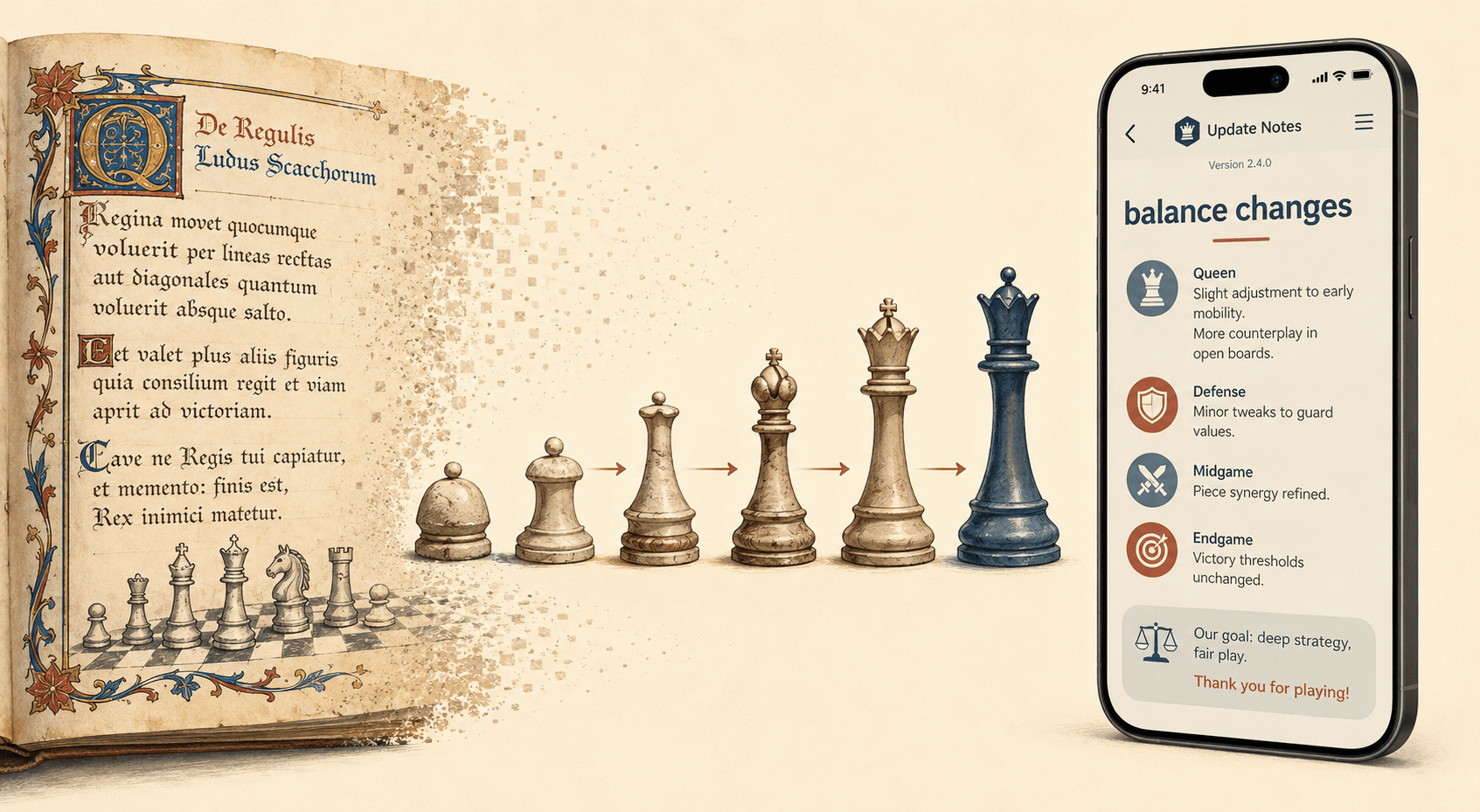
The most consequential edit in game history has a date range and a nickname. For chess's first nine centuries, the piece beside the king was the fers — an advisor who stepped one square diagonally, among the feeblest pieces on the board. Openings crawled; armies took dozens of moves to make contact. Then, in Iberia and Italy in the late 1400s, players began giving the piece the combined powers of rook and bishop — and within a generation the edit conquered Europe. Contemporaries called the new game "mad queen chess," which tells you they knew exactly how radical it was.
The patch transformed everything: openings became sharp, early blunders became fatal, the game's whole tempo modernized — medieval chess theory was obsolete overnight, and the chess we play is, precisely, the post-patch build. Note the timing: the edit landed just as printing presses arrived to standardize it continent-wide, the first rules change in history with mass media behind it. And note the enduring mystery — one popular theory ties the super-queen to the age of powerful ruling queens like Isabella of Castile; charming, contested, unprovable. The editors, as always, left no signature. (The full story of the game the patch built lives in the chess article.)
Patches with visible seams: castling, en passant, komi
Once you know rules evolve, you can spot the scar tissue — rules whose oddness records the edit that made them. Chess carries two famous seams. Castling is a convenience patch: as the game sped up, the slow multi-move process of tucking the king safe got compressed, over centuries of regional variants, into one strange combined move — the only one in chess where two pieces move at once. Its weirdness is its history showing. En passant is a patch for a patch: when pawns gained their two-square opening lunge (a speed edit), the lunge let pawns sneak past enemy pawns untouched — so a capture-in-passing rule was bolted on to close the loophole. An exception protecting a speedup: you can read the whole edit sequence in the rule's shape.
Go's great seam is komi — compensation points given to the second player to offset first-move advantage. It's barely a century old in formal play, and it's still being tuned: the standard value has stepped upward over the decades as professional results revealed the first player still winning too often. A three-thousand-year-old game, live-balancing itself in modern tournaments — proof the folk process never actually stops; it just gets institutions. (Renju's whole existence is the same story writ large: five-in-a-row so favored the first player that an entire rules-fork evolved to restrain them.)
Why rules drift: the three pressures
Trace any famous edit to its motive and you find one of three pressures, over and over. Speed: players want the good part sooner. The pawn's double-step, the mad queen, compressed castling — all acceleration patches; across every era, the mass of players votes for faster contact, and the rules comply. Fairness: symmetric games leak first-move advantage, and the edits chase it — komi in Go, renju's restrictions, tournament rules pairing games in mirrored pairs. The deeper a game's community, the more precisely it measures its own imbalance and the more surgically it patches. And drama: rules evolve to kill draws and dead positions — stalemate's shifting treatment across chess history, scoring tweaks in territory games, the whole modern arsenal of anti-draw design. Speed, fairness, drama: the three winds that have been blowing on every ruleset for five thousand years. A rule that survives them all for centuries has earned its seat in the deepest possible way.
House rules: evolution in your living room
Here's the delightful part: the folk process is still running, and you're in it. Every family's Monopoly is different — money under Free Parking, house-ruled auctions, mercy rules for bankrupt children — and nobody looked those up. They evolved, at your table, under exactly the three pressures: speed (skip the auctions), fairness (help the losing kid), drama (jackpot on the corner). Playground games fork by schoolyard. "We always play that..." is the sound of a rules edit propagating.
House-ruling deserves respect as literacy, not corruption: knowing what to change and why is rules-fluency of the highest order. One craft note from the record, though — the classics' successful edits are overwhelmingly subtractions and tightenings: ban a move, shrink a board, compress a procedure. Additions — new powers, extra content — usually bloat and die. When your table tinkers, subtract first; forty generations of anonymous editors agree.
Digital changes the mechanism
Then the rules moved into software, and the evolution mechanism itself mutated. A digital game's rules are enforced by code and updated centrally: a balance patch ships overnight, worldwide, versioned and logged. Compare the queen's upgrade — decades to cross Europe, carried mouth to mouth — with a modern changelog: balance changes, effective immediately, everywhere. The folk process ran on generations; the digital process runs on release cycles.
The trade is real on both sides. Gained: precision (patches informed by millions of logged games — komi-style tuning with actual data), speed, and perfect consistency — no more arguing about which village's rules apply; the server is the rulebook. Lost: the local dialect. House rules can't evolve inside an app that enforces one build; the drift, the regional variants, the family Monopoly effect — the whole undergrowth of folk editing — has nowhere to grow. Digital rules evolve faster and narrower: one official branch, professionally gardened, no wild forks. Whether that produces better games than forty generations of chaos is a genuinely open question — the classics say chaos has a fine track record.
Reading a rulebook like a fossil record
Once you have the lens, every rulebook becomes a dig site, and the skill is spotting the layers. The core stratum is the generative rule — simple, load-bearing, probably ancient in spirit: place stones, jump to capture, push what you touch. The patch stratum is the exceptions — every weird special case (castling, en passant, komi, compulsory-capture priority rules) marks a spot where the community fixed something; ask what problem does this oddity solve? and you're doing rules-archaeology. The polish stratum is tournament scaffolding — clocks, tiebreaks, notation — institutions leaving sediment.
Run the reading on anything. Chess: ancient core, five centuries of visible patches, thick modern polish. Go: enormous ancient core, almost no patches (komi stands nearly alone — astonishing), deep polish. A modern designed duel reads differently: all core, no patches, because a designer edited before shipping — the strata compressed into one lifetime. When a young game's rules read seamless, that's not the absence of evolution; it's evolution's greatest hits, studied and pre-applied. And when you find a seam anyway, you've found the interesting part: the place where play outran the plan, which is where the next edit always begins.
Three digs to run tonight
The fossil-reading skill installs fastest by doing. Three quick excavations, each a few minutes.
Dig one: find the seam. Open the full rules of any classic you know — chess is perfect. Hunt for the strangest rule, the one a clean-sheet designer would never write. Now ask the archaeologist's question: what problem is this patching? En passant answers in one step (the two-square lunge needed policing). Castling takes two. Stalemate-as-draw is a genuinely deep dig. Every answer you work out is a century of game history recovered from one odd rule.
Dig two: audit your house rules. Pick the family game your household plays "wrong." List your deviations from the box rules — then tag each one: speed, fairness, or drama. You'll find every house rule answers one of the three pressures, which means your living room has been running the folk process all along. You weren't playing it wrong. You were maintaining it.
Dig three: read a changelog as history. Open the update notes of any digital game you play and read the balance changes with this article's eyes: each entry is a komi — a fairness patch informed by thousands of logged games, shipped at a speed the mad queen's editors couldn't have dreamed of. Same three winds, new weather station. Once you've done all three digs, rulebooks stop being instructions and become what they actually are: strata. It's a better way to read them, and it never switches off.
Questions people ask
Are any major games' rules still changing today? Constantly, at the edges: Go's komi keeps stepping, chess bodies tinker with draw and tiebreak rules, checkers federations maintain opening-restriction formats. Cores freeze; margins evolve forever. A living game is never quite finished — that's what living means.
Were the old versions worse? Mostly slower, and "worse" is presentism — medieval chess suited a different tempo of evening. But the direction of drift isn't random: across every game and era, edits trend toward faster contact, fairer starts, and fewer draws, which suggests those preferences are close to human constants, not fashions.
If someone rewrote a classic's rules today, would the edit spread? Only through the modern equivalent of the old machinery: a community adopting it match by match. Most proposed "fixes" to chess die exactly as most medieval edits died — insufficient uptake. The bar was never merit alone; it's merit times momentum, and incumbent builds have five centuries of momentum.
One line to keep? Classic rules are ancient software still in production — patched by forty generations of anonymous editors, and every strange exception in the rulebook is a commit message from someone history forgot.