Learn › A short history of board games › How chess and Go spread
How chess and Go conquered the world
Two games own the planet. One left India as a war game and reached every court in Europe with new pieces and a new soul. The other left China as a scholar's art and became three nations' shared obsession before conquering the rest. Their journeys took a thousand years each, moved at the speed of caravans and monks, and explain more about why games survive than any theory could. Here are the two great migrations, side by side.
Two rivers from two mountains
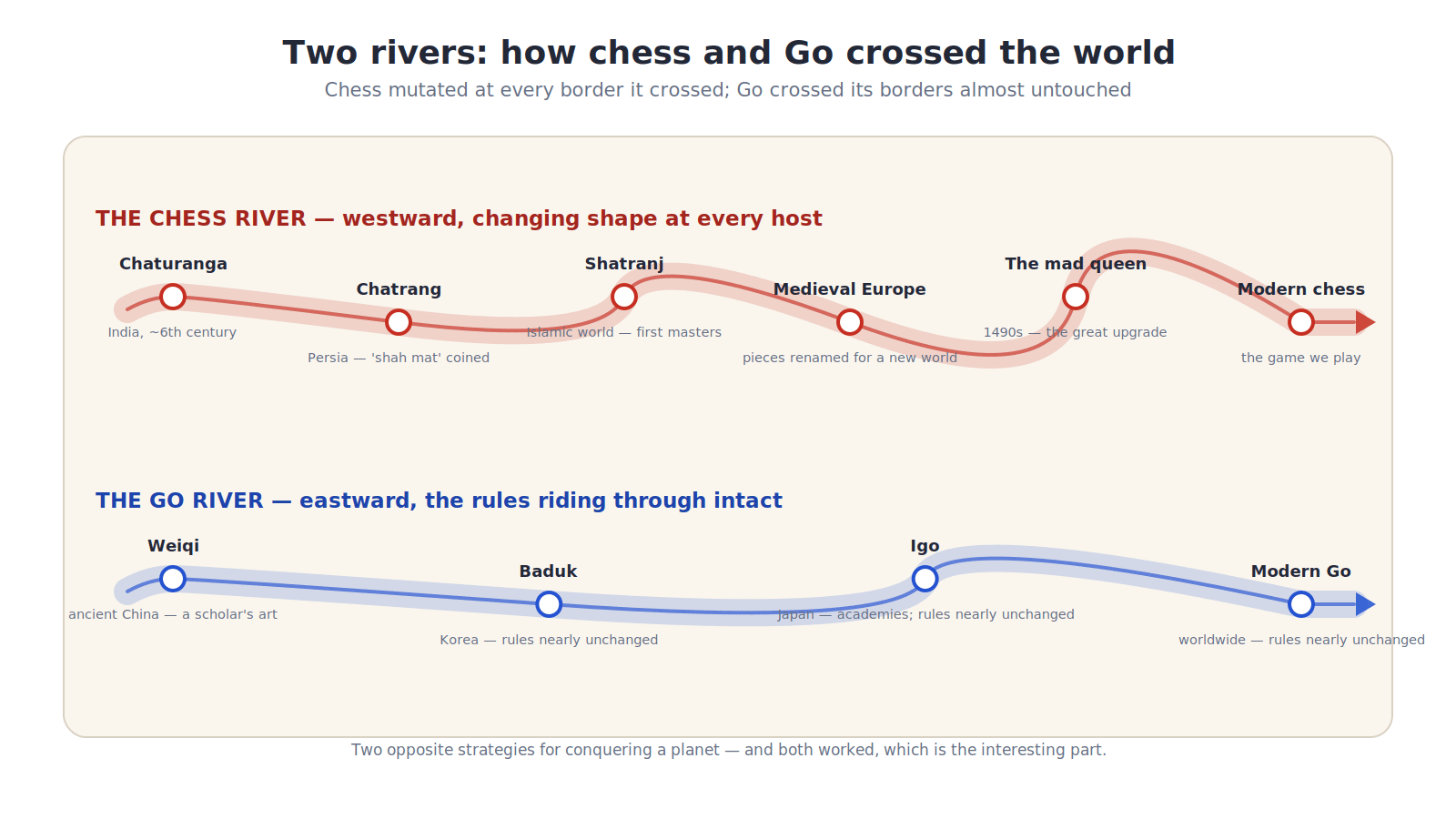
Picture the map of the old world with two rivers of play flowing across it. One rises in northern India around the sixth century: a battlefield game of four arms — infantry, cavalry, elephants, chariots — that will change names and personalities in every land it crosses on its way west. The other rises in China, centuries earlier: a game of stones and territory that will flow east with startlingly little change, refining rather than mutating as it goes.
The two rivers barely touch. They cross different terrain, travel with different carriers — one with merchants and conquerors, one with monks and courtiers — and arrive carrying different lessons about how a game wins the world. Together they're the best natural experiment in game history: same era, same continent, two opposite strategies for immortality, both of which worked.
Chess's caravan route: a game changed by every host
The western river begins as chaturanga in India — the four-division army game. Persia adopts it as chatrang, and gives it the vocabulary that still ends every game: shah, king; shah mat, the king is helpless — checkmate. When the Islamic conquests absorb Persia, the game becomes shatranj and hits its first golden age: the medieval Islamic world produces professional masters, opening studies, composed problems, and the first true chess literature — centuries before Europe could spell the game's name.
Shatranj enters Europe around the turn of the first millennium — through Iberia, Sicily, and the Byzantine frontier — and Europe does what every host had done: it renames the army after itself. The vizier becomes a queen. The elephants, unknown in Europe, become bishops. The chariots become castles. And then, in the 1490s, Europe does something no host had dared: it rewrites the physics. The queen — until then a one-step waddler — suddenly gains her modern powers, the strongest piece ever put on the board, and the bishop stretches to full diagonals. Contemporaries called the result "mad queen chess." The game sharpened overnight: faster openings, earlier violence, whole medieval opening theory obsolete. That patch — the most consequential rules change in game history — is the chess we play. The river's lesson: chess conquered by adapting. Every culture that carried it repainted the pieces and eventually retuned the rules; the game's genius was surviving its own translations.
Go's monastic route: refinement without mutation
The eastern river could not be more different. Go — weiqi in China — is already ancient when the historical record picks it up: mentioned in chronicles well before the common era, and by the classical age established as one of the four accomplishments of a Chinese gentleman, alongside calligraphy, painting, and the lute. A game as self-improvement; a board as a mirror for character. That framing — Go as cultivation, not combat — is the river's cargo, and it shaped everything downstream.
The game reaches Korea (baduk) and then Japan (igo), carried by envoys, monks, and courtiers rather than armies. And in Japan, something happens with no parallel in chess's story: the state adopts the game. In the Edo period, the shogunate endows hereditary Go houses — four great academies whose professional players study, teach, and contest formal castle games under official patronage. Go becomes a career, with ranks, salaries, and centuries of accumulated master games — a professional infrastructure chess wouldn't build until the modern era. And through all of it, the rules barely move. Stones, liberties, territory: a Chinese player of a thousand years ago would recognize tonight's game in a glance. The river's lesson is the mirror of chess's: Go conquered by not changing — its rules were so minimal, so close to mathematics, that no host culture needed to retune them. Culture wrapped around the game; the game itself passed through untouched. (The Go article tells the depth side of that story.)
Games as passengers
Neither game moved itself. Zoom in on the carriers and the migrations become human-sized. Merchants taught shatranj at caravanserais because a board is the world's best icebreaker between strangers who share no language — the pantomime superpower, working every night for a thousand years. Soldiers carried games in packs and left boards scratched into fortress stones. Monks and envoys carried Go between courts as a refined gift. Colonial ships, much later, carried both games to every remaining continent. Rules travel with people; games spread at exactly the speed and along exactly the routes that people did. Which is why game history is such good history: map where a game went, and you've mapped who met whom. The two rivers are trade-route maps drawn in play.
Why these two?
Hundreds of games rode the same routes. Why did these two conquer? Stack their shared traits and the answer assembles itself — and it will look familiar to readers of the immortality checklist, because this pair basically wrote it.
Portable equipment: both reduce to cheap pieces on a drawable grid — improvisable anywhere, confiscation-proof. Bottomless depth: both repay lifetimes; carriers never wore them out and neither has anyone since. Prestige economies: both attached themselves to elites — chess to courts, Go to scholar-officials and shogunal patronage — so learning them signaled cultivation, and ambition recruited every generation's brightest. And literature: both developed notation and written study — Islamic chess treatises, Japanese game records — which let mastery accumulate across generations instead of dying with each master. That last one is the quiet decisive edge: rivals without a literature had to rediscover themselves every century. Chess and Go compounded. Over a thousand years, compounding wins.
The world family today
The conquests are complete, and you can inspect the results tonight. Chess: a world federation, national styles debated on every continent, super-tournaments streamed live, and more games played per day online than in whole past centuries combined. Go: professional systems across East Asia, international title matches, and a global online scene that made the game's deepest students household names in three countries at once. Both games survived their computer moments — the matches where machines surpassed champions — and emerged more popular, their mystique converted into curriculum. And both now live primarily on screens, where the last two hundred years of format churn ended up delivering them: every phone a board, every player connected to the whole world family at once.
Worth pausing on what that means historically: the two migrations took a millennium each to cross one supercontinent. The online era finished the job — every remaining border, both games — in about a decade. The rivers reached the sea.
The next migration
Which frames the present moment properly: distribution is no longer the contest. For a thousand years, a game's fate hung on reaching players — the right caravan, the right patron, the right port. Today every game reaches everyone instantly; the app stores are the silk road with zero travel time. What remains is the other half of the old formula, the half chess and Go actually won on: being worth carrying. Depth that doesn't exhaust. Rules that survive translation — or better, need none. A reason to return tomorrow. The two rivers prove there's more than one way to do it — mutate like chess or crystallize like Go — but no way to skip it. Every new duel on every phone is standing at the same trailhead the four-armed battle game stood at fifteen centuries ago, with the same question ahead: will strangers keep teaching this to strangers? Everything else is logistics, and the logistics are solved.
Trace the routes from your chair
A thousand years of migration is more fun to feel than to read. Three small exercises put your hands on the history.
Say the fossils out loud. The journey survives inside the words. "Checkmate" is Persian: shah mat — the king is helpless. "Rook" descends from the Persian chariot, rukh. The bishop is an elephant in India, a runner in Germany, a fool in France — each name a customs stamp from a different border. Every time you announce check, you're speaking the caravan route. Once you know, you never unhear it.
Play the old build once. Set up a chess board, but replace the queen's powers with the medieval fers: one step, diagonally only. Play twenty minutes with a friend. Feel how slow the armies close, how the game crawls where it now sprints. That crawl is what Europe played for five centuries — and the shock you feel is the exact size of the 1490s patch. There's no faster way to understand why contemporaries called it the mad queen.
Watch the two rivers meet in your pocket. Open any major chess or Go server and check the flags in the lobby. Persia to Iberia took chess four centuries; your first match tonight might pair you with both endpoints at once. The migration this article describes isn't history in the finished sense — you're standing in its newest mile, and the lobby list is the map.
Questions people ask
Did chess and Go ever compete head to head? Remarkably little, historically — the rivers crossed different terrain, and by the time they shared territory, each was institutionally entrenched at home. The modern online era is their first true shared habitat, and the verdict so far is peaceful coexistence: they occupy different appetites (drama versus contemplation) more than they trade players.
Why did Europe change chess's rules when Asia never changed Go's? Partly the games themselves: chess carried cultural theme (armies, courts) that invited localization, while Go's near-mathematical rules offered nothing to repaint. Partly timing: the queen's upgrade landed in a Europe of printing presses, which could standardize a rules change continent-wide — the evolution article digs into that machinery.
Which conquest strategy do modern games follow? Both, knowingly. Games that localize aggressively — themes, names, regional content — are running chess's playbook. Minimal abstracts that ship identically everywhere are running Go's. The 6×6 duels of the app era are pure Go-strategy travelers: rules too small to need translating, culture free to grow locally around them.
One line to keep? Chess conquered by changing at every border and Go by never changing at all — proof that the only non-negotiable in world conquest is being worth carrying.