Learn › A short history of board games › Parlors to phones
From parlors to phones: the last 200 years
For most of history, board games moved at the speed of caravans and carving tools. Then the industrial revolution picked them up, and the last two hundred years compressed more change into the family of games than the previous five thousand: mass printing, the living-room canon, a designer renaissance, and finally the screen in your pocket. This is the short, fast final chapter of the history shelf — how the ancient pastime got from the Victorian parlor to your commute.
The parlor century
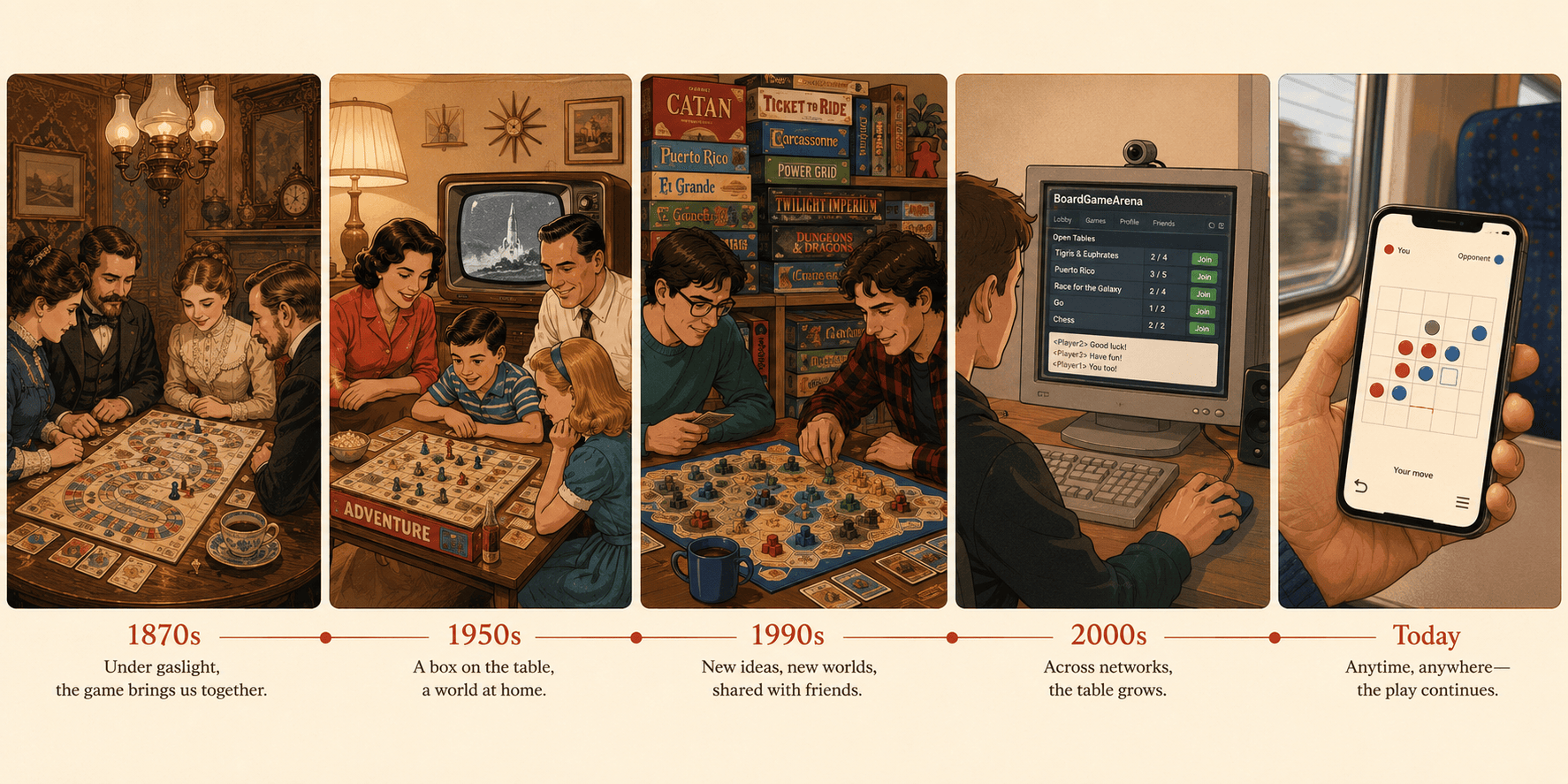
The nineteenth century industrialized play. Color printing — chromolithography — made boards cheap, bright, and mass-producible for the first time, and a new middle class with parlors and free evenings bought them by the million. The era's signature genre tells you everything about its self-image: the moral instruction game — race tracks where virtuous squares advanced you and vices sent you backward, self-improvement disguised as an evening's fun. (The century's famous checkered life-journey games began exactly this way, sermons you could roll dice at.)
Two lasting inventions came out of the parlor era. First, the game as product: named, boxed, branded, mass-marketed — after five thousand years of folk transmission, games suddenly had publishers and price tags. Second, the family audience: games designed for mixed ages around one table, a design target the ancient duels never had. The parlor century built the commercial machinery every later era would run on — and, in its moralizing way, established the idea that a game box could carry intent: a worldview, an argument, a lesson. Designers have been smuggling ideas into boxes ever since.
The living-room era
The twentieth century moved games from the parlor to the living-room shelf and stocked the canon everyone still recognizes: the Depression-era property-trading titan, the crossword game of the postwar years, the world-conquest map game, the deduction manor mystery. These became furniture of family life across huge parts of the world — the games everyone's household owned, the default vocabulary of a rainy Sunday.
Viewed from this library's angle, the living-room canon has a fascinating profile: heavy on luck, theme, and social friction, light on the pure-strategy virtues this shelf usually celebrates — dice and cards everywhere, drama engineered through trading and table talk rather than depth. That wasn't a failure; it was the design brief: a game for a family of mixed ages and appetites needs luck as a leveler and theme as an invitation. But it created the vacuum the next two eras would fill — players who outgrew the canon and wanted decisions. The abstracts kept their corner through it all (chess boomed mid-century; checkers and backgammon never left), waiting for the pendulum.
The hobby big bang
The pendulum swung in the century's last decades, and it swung from Germany. A tradition of elegant family strategy games — clean rules, meaningful choices, less luck, an hour or less — matured into what the world now calls the designer game. It carried the era's revolutionary habit: the designer's name on the box. A famous annual German prize made design quality a household criterion. A mid-1990s island-trading game became the movement's global ambassador. And by the millennium a full-blown hobby existed: conventions, review culture, thousands of new titles a year, and shelves in ordinary homes that would have looked like specialist libraries a generation earlier.
The big bang mattered to this shelf for one reason above the rest: it re-legitimized depth as a mainstream pleasure. The hobby proved a mass audience would learn real rules for real decisions — and inside that permission, the abstract family got its own revival: the bookshelf-era classics found new editions, and the modern abstract renaissance — Hive's bag of tiles, the GIPF project's austere hexagons, the gateway masterpieces — built the genre's best new games in centuries. The ancient duel, rebranded as contemporary design, was suddenly cool again.
The screen arrives
Meanwhile, on a parallel track, the board game was learning to live without the board. Chess led the whole migration. Postal chess had already proven games could survive separation: moves mailed on postcards, matches lasting years, newspaper columns carrying famous correspondence games to the whole reading public. Whole friendships were conducted at one move per week. Then home computers arrived, and chess programs made the machine itself an opponent — for the first time in five thousand years, you could lose a game with nobody else in the house. Then networks turned every classic into an online lobby. By the turn of the millennium, the ancient duels had crossed onto servers, and distance died. For all of history, a game had required two people in one place — the single oldest constraint in play. It ended quietly, sometime between the modem and the browser, and every era of this shelf's history funnels through that moment.
The early screen era solved presence but kept the desk: you played where the computer lived, in sessions you scheduled. The last constraint — place itself — had one more fall coming.
The phone in your pocket
It fell with the smartphone. A phone is a board that is always with you, always connected, and always stocked with opponents — and it changed the texture of 1v1 strategy more than any object since the printing press. Asynchronous play fit games into real lives: a move at the bus stop, a reply at lunch, rivalries running for months in the gaps of two schedules. AI ladders gave every player a tireless sparring partner at every strength — the practice gym the small-game article celebrates. Replays and ratings gave ordinary players the study tools that once belonged to masters. And worldwide lobbies finished what the caravans started: any player, any rival, any hour, every border already crossed.
The format found its perfect tenants fast: small deep duels, readable on a hand-sized screen, playable in stolen minutes — the exact profile of the abstract family, ancient and modern. A game like Oustwit is this whole chapter in present tense: a 6×6 born directly onto the phone, built for the commute-length match and the standing rivalry, its one-rule physics animated by the very screen that carries it. Two hundred years of format churn, and the last delivery vehicle turned out to fit in a pocket — carrying, of all things, the oldest kind of game there is.
Two hundred years, one constant
Now stand back from the whole strip — parlor, living room, hobby shelf, desktop, pocket — and notice what actually changed: everything except the thing itself. Production changed (carving to printing to code). Distribution changed (peddlers to toy aisles to app stores). The business changed (products to hobbies to services). The room changed five times. And at the center of every era, unchanged: two people, a shared board, alternating turns, a winner, and the demand for a rematch. The industrial centuries revolutionized the carrier of games while leaving their core untouched — which, after the tomb boards and the carved cloisters, should feel familiar: it's what games always do. Formats are weather. The fair fight is climate.
That's the note the history shelf ends on, and it hands the question forward to the immortality shelf: if two hundred years of upheaval couldn't dent the core, the interesting question about the next hundred isn't whether people will still sit down across a grid from a rival. It's which games will be on the grid — and that one has an article of its own.
Your family's own strip: a two-generation inventory
The five-panel history isn't abstract — a version of it is standing on shelves in your own family, and reading it takes one evening. The exercise has three steps.
Inventory the shelves. List the games in your home. Then your parents' home, from memory or a phone call. Then your grandparents', if anyone can testify. Sort each list by era: parlor-style classics, living-room canon, hobby-era designer boxes, and what's installed on the phones. Most families hold three eras of the strip without knowing it — the canon on the top shelf, the hobby games at eye level, the duels in pockets.
Interview the eldest player. Ask a grandparent or elder what was on their childhood table, who taught it, and who the house champion was. You'll get the living-room era firsthand — and usually a rivalry story that's been waiting decades for an audience. Write the champion's name down somewhere. That's family history in this article's units.
Close the loop. Teach the eldest player something from the newest panel — a quick duel on your phone works perfectly — and let them teach you their canon game back. One table, four eras, everyone both teacher and student. It's the whole two hundred years, reenacted over one pot of tea — and it demonstrates the chapter's thesis better than the chapter can: the formats never mattered. The table did.
Questions people ask
Did video games hurt board games? The record says the opposite: the board game hobby's biggest boom decades overlap the video game era, and the digital screen became board games' best distribution channel ever. Screens competed for evenings and then, characteristically, the board game colonized the competitor. It's what five thousand years of practice looks like.
Why did family games carry so much luck compared to the classics? Design brief, not decay: a mixed-age family table needs the six-year-old to sometimes beat the parent, and luck is the great leveler. The pure duels serve a different contract — the fair fight — and the two traditions have coexisted, serving different rooms, for two centuries.
Is the physical board game dying now that phones exist? Sales and shelves say no — physical and digital settled into different occasions: the table for company and ritual, the phone for practice, distance, and stolen minutes. Most serious players of any duel now live in both. The formats specialized; neither died. They never do.
One line to keep? Two hundred years replaced every single thing about how games reach us — and not one thing about why we play them: the fair fight found its way from the parlor to your pocket intact.