Learn › A short history of board games › The oldest games
Senet, Ur, and the oldest games in the world
Before the alphabet had settled into its modern shapes, people were already losing board games and demanding rematches. The oldest boards we've found are around five thousand years old — older than most things humans still do for fun. This is the story of the first games: the tomb boards of Egypt, the royal race game of Mesopotamia, the clay tablet that let us play it again, and what the very beginning of games reveals about everything that came after.
Buried with their games
Start with the strangest fact in game history: the oldest games we know survived because people were buried with them. Egyptian tombs, Mesopotamian royal graves, burial sites across the ancient world — again and again, alongside the weapons and the jewelry and the food for the afterlife, there's a game. Board, pieces, throwing sticks, complete and ready to play.
Sit with what that means. Grave goods were not decoration; they were the things a person could not be imagined without — the essentials for eternity. And in grave after grave, one of the essentials was a game. Five thousand years ago, play was already so woven into a human life that eternity without it seemed incomplete. Whatever else the ancient boards teach us, they teach this first: games were never trivial. The people who built the first cities took them to their graves, which is more than most of us will manage for anything we own.
Senet: three thousand years of one game
Egypt's game was Senet, and its runtime beggars belief: boards and tomb paintings span roughly three thousand years of continuous play. For comparison, chess has existed for about half that. A single game held one civilization's tables from before the pyramids until after Cleopatra.
The equipment is elegant: a grid of thirty squares in three rows of ten, two teams of pawns, and throwing sticks for movement — a race game at heart, with real decisions layered on the throws. Tomb paintings show everyone playing it: laborers on breaks, nobles at leisure, queens at fine tables. Tutankhamun was buried with four sets, including a beautiful ebony-and-ivory one that survives. And over the centuries something remarkable happened to Senet: it got promoted. The thirty squares acquired religious meanings, and by the later dynasties the game had become a symbol of the soul's passage through the afterlife — some boards are inscribed with squares for waters and gods and final judgment. A pastime had become a sacrament. It's the most successful game of all time by sheer duration — and, as the extinction article tells it, that promotion into theology is also the leading suspect in its eventual death. Glory and doom in the same career: the first great game is also the first great cautionary tale.
The Royal Game of Ur
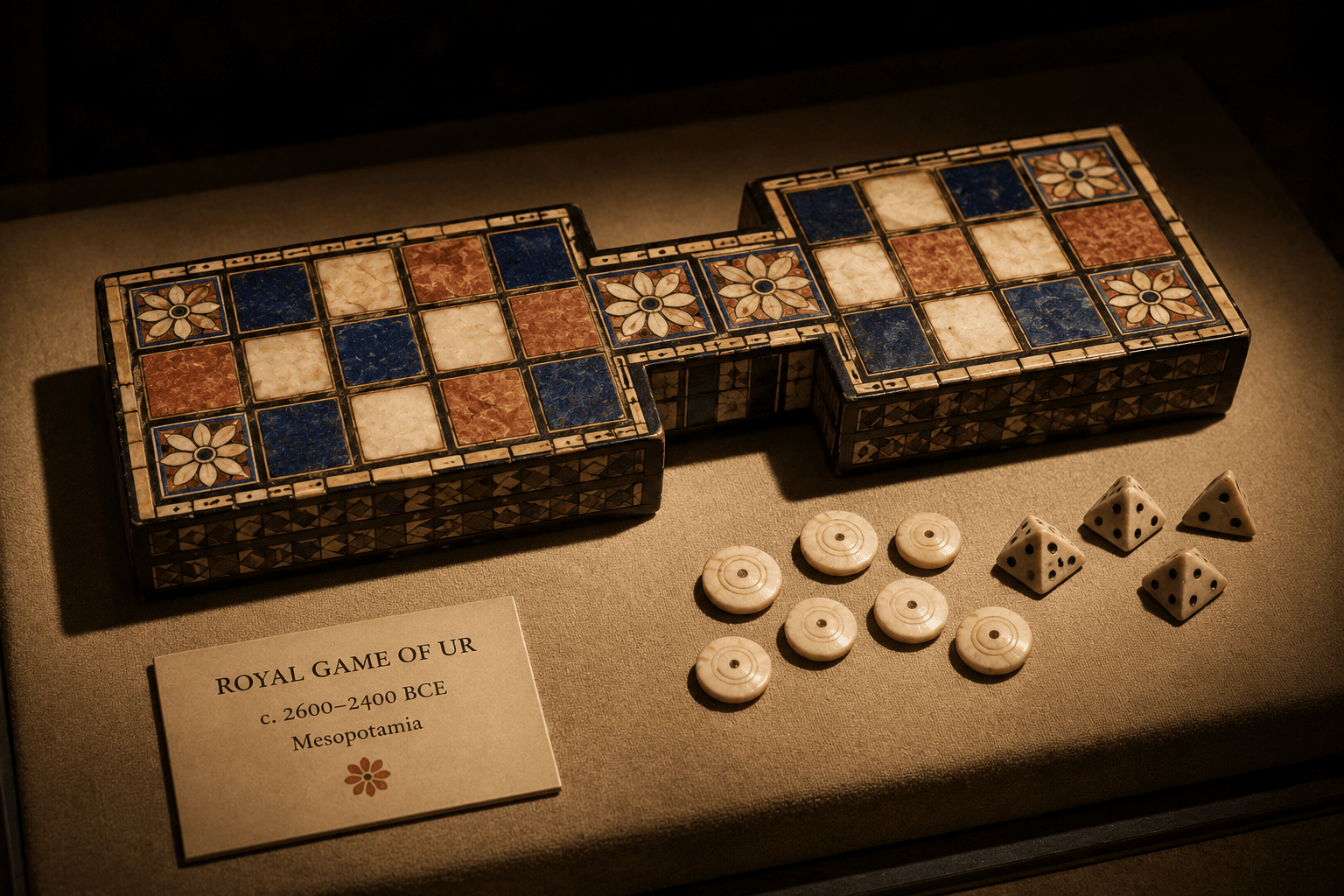
Mesopotamia's masterpiece surfaced in the 1920s, when archaeologists excavating the Royal Cemetery at Ur — one of the great digs of the century — lifted several game boards out of graves nearly 4,600 years old. And they are gorgeous: twenty squares of shell and lapis lazuli and red limestone, arranged in a distinctive bridged shape, five squares blooming with rosette flowers. The materials alone tell a story — lapis traveled thousands of miles to be in that board, which means games sat high enough in the culture to deserve imported luxury. (More on what boards tell archaeologists one article over.)
The game itself is a race: two players, seven pieces each in the classic form, tetrahedral dice, opposing teams sprinting along a shared track to bear their pieces off first. The rosette squares grant second throws and safety — the oldest known version of the lucky square, still with us on every modern race board. Boards in the same family kept turning up across the ancient Near East for thousands of years, scratched onto palace doorways and carried along trade routes: a genuine ancient blockbuster.
The tablet that taught us the rules
Here's where the story turns miraculous. For most ancient games, the rules are gone forever — boards survive, play doesn't. Ur got lucky twice. First, a Babylonian scribe around 177 BCE wrote a clay tablet describing how a late version of the twenty-square game was played — squares, throws, fortunes and all. Second, more than two thousand years later, a British Museum curator named Irving Finkel — a cuneiform specialist with a storyteller's soul — recognized what the tablet was and deciphered it, reconstructing playable rules for a game whose players had been dust for millennia.
The result is the oldest game on Earth whose rules rest on an ancient written source. You can play the Royal Game of Ur tonight, by rules with a cuneiform pedigree, and thousands of people do — the museum has staged matches, and modern editions and apps followed. The tablet even preserves the game's fortune-telling flavor: squares associated with omens — luck, power, fine beer — so that a race down the board doubled as a tour of your prospects. Every game this library covers survives by unbroken teaching, person to person. Ur is the great exception: a game that died and was resurrected by scholarship — one clay tablet standing in for the ten thousand teachers it never had. It's the exception that measures how much the teaching chain matters.
Playing the ancients today
So what are they actually like at a modern table? Reports are remarkably consistent. Ur is genuinely fun — fast, tense, full of race-game drama: knockouts, safe squares, lucky escapes. Modern players describe it as instantly familiar, because it is: its DNA runs straight into the whole race-game family that followed. Senet is fun with an asterisk — its rules were never written down, so modern Senet is a scholarly reconstruction (several compete), and which one you play changes the game's sharpness. The honest label on every Senet box would read: an excellent guess.
The asterisk matters less than you'd think. Playing either game does something no book can: it collapses five thousand years into a turn. You throw, you groan at the throw, you block a rival's runner, they land on a rosette and grin — and you realize with a small shock that the feeling in the room is identical to the feeling around any modern table. The equipment aged. The experience didn't age a day.
What the oldest games had in common
Line up everything we've found from the deep past and a clear pattern emerges: the first games were races, and the races ran on luck plus judgment. Senet, Ur, and their relatives all share the shape — throw for movement, choose which piece moves, fight for safe squares. Real decisions, but dice at the core. What's missing from the earliest record is just as striking: the pure-strategy duel — no luck, nothing hidden — hadn't been isolated yet. That refinement came later, with games like Go and the morris family: the slow discovery that you could remove the throws entirely and the game would not only survive but deepen.
Which gives the whole history of games a lovely arc, worth stating plainly. Humanity's first move was to bottle fate: the earliest boards are little theaters of luck and fortune, right down to Ur's omen squares. The second move — the one this whole library descends from — was to bottle thought: strip the dice out and let two minds meet with nothing between them. Both bottles are still on the shelf, five thousand years later. But every pure duel on your phone is a descendant of that second discovery, made by anonymous players somewhere between the tomb boards and the classical age.
Standing at the very start
Close with the long view, because this article is the trailhead of the whole history shelf. A person who plays a quick strategy duel on a phone tonight is doing something with an unbroken five-thousand-year provenance: two people, a board of marked spaces, pieces that move by rules, the winner decided and the loser demanding one more. The medium has changed past recognition — river clay to shell and lapis to printed cardboard to glass and light. The activity has not changed at all.
That continuity is the deepest fact in game history, and the rest of this shelf traces it forward: how two games walked out of Asia and conquered the world, what medieval taverns played, how rules mutate across centuries, what diggers keep finding, and how two hundred years of industry carried the whole inheritance into your pocket. It starts at the tombs. It hasn't ended anywhere yet.
Play the oldest games tonight
This history is playable, which is the best thing about it. Here's how to sit where the ancients sat, with modern convenience.
The Royal Game of Ur, in five sentences. Two players, seven pieces each, race along the track and bear them all off first. Move by dice throw. Land on an enemy piece and it goes back to the start. The rosette squares are safe — no knockouts there — and grant another throw. Exact roll needed to bear off. That's a playable version of the museum's published reconstruction, and it teaches in two minutes. Digital versions exist; print-and-play boards are a search away; and in a pinch, twenty drawn squares and some coins work fine. The game is quick, mean, and full of groans — you'll understand immediately why it lasted millennia.
Senet, with the honest asterisk. Buy or print any modern set and you'll get one of several scholarly reconstructions. Pick one, play it as written, and don't fret about authenticity — you're playing an excellent guess at a great game, which is the best anyone alive can do. The five-throwing-sticks rhythm and the fight for the final squares come through in every version.
Make it an evening. One good format: Ur first — fast and fierce — then Senet's statelier race, then finish with any modern duel on a phone. Three games, five thousand years, one table. The point of the exercise lands by itself somewhere in game two: nothing essential has changed. The throws, the groans, the grins are original equipment.
Questions people ask
What is THE oldest board game? Depends on the strictness. Oldest famous games with known equipment: Senet and Ur, both around 5,000 years old, with Egyptian finds arguably edging older. Older still are enigmatic rows of drilled holes and mancala-like pit arrangements whose game status is debated — the honest answer is "about five thousand years, and the first chapters are missing."
Did the ancients play anything without luck? By the classical era, certainly — pure-strategy games appear across several old cultures, and Go's roots are ancient. But in the oldest stratum, dice and throwing sticks are everywhere: the luckless duel seems to be a later refinement, not the starting point. Fate first, thought second.
Are the modern rules for these games authentic? Ur: substantially yes for its later form — a real ancient rules text underpins it, uniquely. Senet: no; every version is reconstruction, some better argued than others. Treat Senet sets as playable scholarship and enjoy them exactly that way.
One line to keep? Five thousand years ago people already loved games too much to be buried without them — everything since, including the duel on your phone, is one long rematch.