Learn › Strategy games around the world › Chess's world family
Shogi, xiangqi, and chess's world family
The chess you know is one dialect of a much older language. From a single Indian ancestor, chess-like games spread across Asia and Europe — and every culture that adopted the family rewrote it. China added a river and artillery. Japan made captured pieces switch sides. Thailand kept the ancient slow queen, like a living fossil. This is a tour of the world's chess dialects, what each one fixes, and why a chess player who learns a second one comes back changed.
One ancestor, many dialects
Start from the trunk. Chaturanga — the four-armed battle game of first-millennium India — is the common ancestor, and its westward river produced the chess Europe standardized. But the same trunk branched east and south, and those branches grew into full games with their own masters, literatures, and centuries of refinement: xiangqi in China, shogi in Japan, janggi in Korea, makruk in Thailand, sittuyin in Myanmar. Same recognizable soul everywhere — royal piece to corner or kill, armies of differentiated movers, no luck — wearing profoundly different bodies.
The family framing matters because it upgrades every member. Western chess isn't the original (it's a late, heavily patched branch), and the others aren't variants of it — they're siblings, each one a thousand-year experiment in what the ancestor could become. Reading them side by side is the closest thing game studies has to comparative anatomy.
Xiangqi: rivers and cannons
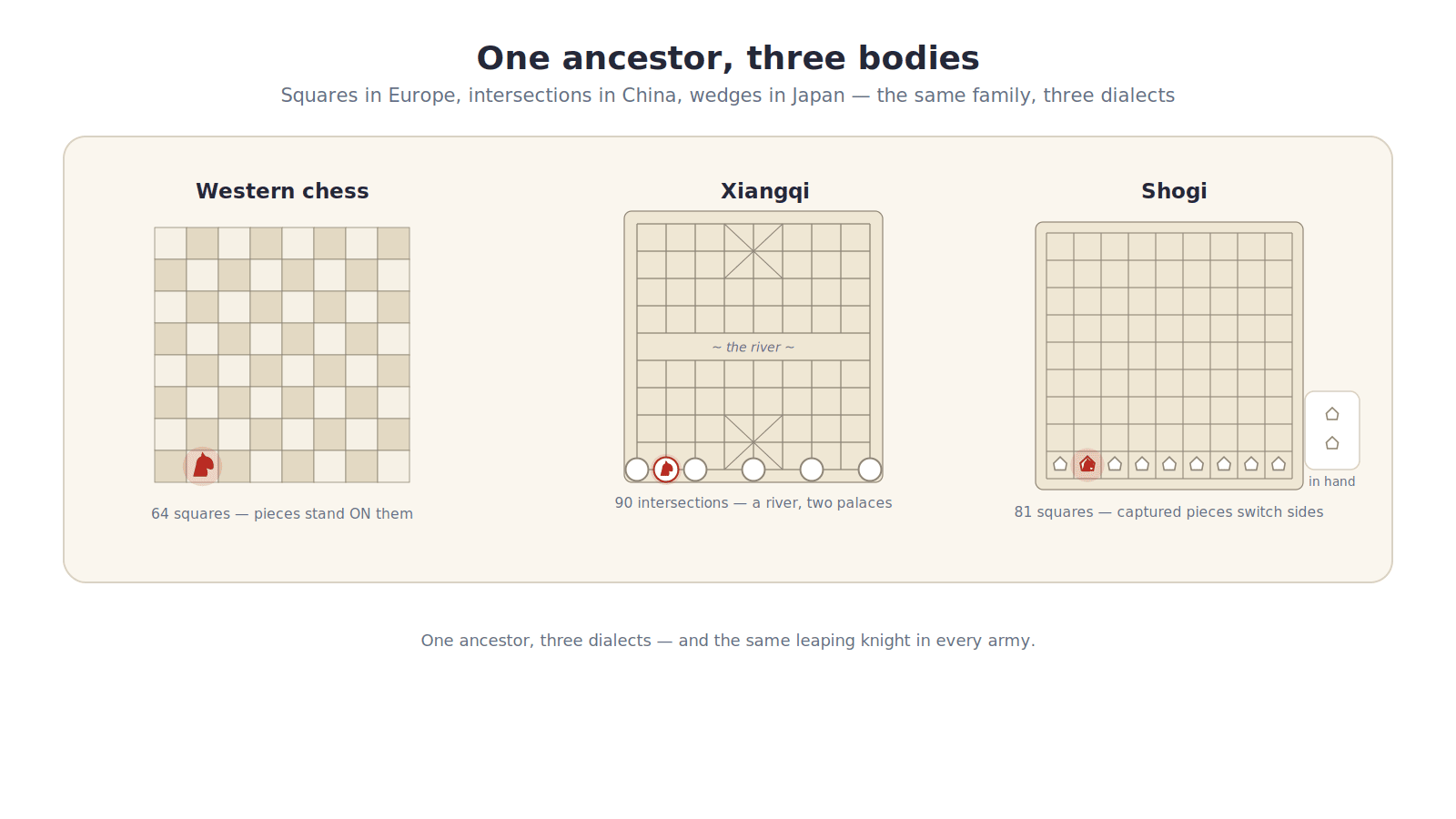
China's branch — xiangqi, likely the most-played form of chess on Earth by sheer player count — redrew the battlefield itself. Pieces stand on intersections, not squares. A river crosses the board's middle: soldiers promote modestly upon crossing it, elephants may not cross at all. Each general is confined to a 3×3 palace with his advisors — kings that can never roam — and a special rule forbids the two generals from facing each other on an open file, a standing laser that decides endgames.
And then the family's most original piece: the cannon, which moves like a rook but captures only by leaping over exactly one intervening piece — friend or enemy — to strike what lies beyond. The cannon makes crowded boards dangerous in a way no western piece does: screens form and dissolve, batteries aim through traffic, and the opening fight is partly a battle over what stands between the artillery and its targets. The whole game runs faster and more openly than western chess — palace-bound kings make mating attacks the constant currency — and its street culture matches: xiangqi is played fast, loud, and public, on park tables and shop stoops across China and Vietnam, usually with a crowd calling the moves.
Shogi: the game that recycles
Japan's branch made the family's most radical single edit: captured pieces change sides. Take an enemy piece in shogi and it joins your hand; on a later turn, instead of moving, you may drop it back onto almost any empty square — as your own soldier. The pieces are flat wedges, ownership shown by which way they point, because any piece may serve either army before the game ends.
Consider what the drop rule does. Material never leaves the game, so attrition can't produce the drained, drawish endgames of the western branch — shogi draws are famously rare. Defense can never rest, because threats arrive from the hand: the fortress you built against the pieces on the board must also hold against the pieces in your opponent's palm. Every capture is double-edged — weakening them arms you. The economy churns with invasion and counter-invasion, and promotions (most pieces upgrade in the enemy camp) pour fuel on it. Shogi is the family's perpetual-motion machine. It solved the draw problem five centuries before modern designers named it, by refusing to let the armies shrink. And its professional culture — title matches, prodigies, a beloved commentary tradition — rivals Go's institutions on the same islands.
Janggi, makruk, sittuyin: three more voices
The family's other living branches deserve more than a footnote, so here's a respectful paragraph each. Janggi, Korea's chess, resembles xiangqi at a glance — palaces, intersections, cannons — but retunes nearly everything: no river, generals that move on palace diagonals, cannons that must leap even to move (and can never take each other). It's a sharper, trap-rich game with its own professional scene and televised play.
Makruk, Thailand's chess, is the family's living fossil — and precious for it. Its queen-equivalent steps one square diagonally, its bishops move like the ancient elephant, and the whole game runs at the patient positional tempo the entire family shared before Europe's mad-queen patch. Playing makruk is the closest a modern player can come to sitting at a medieval chess table — except makruk's tradition is unbroken and thriving, complete with its own counting rules that force endgames to a verdict. Sittuyin, Myanmar's chess, opens with the family's most creative idea: no fixed starting position — players deploy their armies behind their pawn lines in a free setup phase, so the battle begins with a duel of army design. Every game starts from a position no book has analyzed.
What each dialect fixes
Line the branches up and something wonderful appears: each one reads as design commentary on the shared ancestor — a different answer to the family's old diseases. Bothered by draws and drained endgames? Shogi's drops make material immortal and defense mortal. Bothered by slow openings? Xiangqi's cannons and open files, and the mad queen's raw speed, are two independent acceleration patches. Bothered by memorized opening theory? Sittuyin abolishes the fixed start — the same cure the modern renaissance rediscovered with dealt cards and variable setups. Prefer the deep positional slow-burn the speed patches destroyed? Makruk kept it, on purpose, for centuries.
One ancestor, five standing answers to "what should chess be?" — which is why designers study the family the way linguists study dialects: the variations map the design space. Every complaint you've ever had about your chess has already been fixed by somebody's grandmother's chess. The fixes just live on different continents.
Western chess's world tour
So why does one branch — the European dialect — sit on the world's default board? Not because it's the deepest; the family has no agreed champion. It's the story the chess article catalogs: this branch got the printing press, the shipping lanes, the first international federations, standardized notation, and eventually the internet's first great game servers. Western chess won the infrastructure war — clocks, ratings, olympiads, literature. Infrastructure compounds; it's the fifth immortality ingredient wearing a rating system. The other branches held their homelands, and xiangqi may still hold the raw numbers. But the European dialect became the family's lingua franca — the version any two players from anywhere are likeliest to share. That's a historical outcome, not a quality verdict. Worth remembering each time the family's map gets mistaken for a ranking.
Traveling the family
For a chess player, learning a sibling dialect is the cheapest profound experience in games, because the transfer is real but incomplete — and the gaps are the lesson. What transfers: tactical pattern-sight (forks, pins, and skewers exist everywhere), tempo sense, king-safety instincts, endgame discipline. What doesn't: your opening book (useless everywhere), your material values (a shogi piece's worth includes its value in their hand — captured-piece arithmetic that breaks western trading instincts), your draw sense (shogi barely has them), your castle shapes (shogi's fortress theory is its own deep literature).
Practical path: apps and online servers exist for every major branch with AI opponents and tutorials — start with xiangqi if you want speed and artillery, shogi if you want the drop economy's full strangeness, makruk if you're curious what your own game felt like five hundred years ago. Give any of them ten games and your home game changes too: you return seeing western chess as one voice in a choir — a chess, not the chess — which is the souvenir this whole shelf keeps handing out.
A ten-game passport
The family tour works best as a concrete plan, so here's one: ten games, three countries, about a week of evenings. Free apps with AI opponents exist for every stop.
Games one to three: xiangqi. Play at the easiest level and give yourself one job: watch the cannons. Notice how a screen piece appearing or vanishing turns a quiet file into a loaded one. By game three, check the open-generals rule before every king move. You'll lose all three games. You'll also start seeing artillery lines in your sleep, which is the point.
Games four to seven: shogi. One job again: use your hand. Beginners hoard captured pieces like trophies; the game wants them spent. Drop a piece somewhere rude at least once per game. Around game six, the double vision arrives — you start reading the opponent's hand as part of the board, and defense stops meaning "guard the pieces I can see." That's the drop economy installing itself.
Games eight to ten: makruk. Now slow all the way down. The queen barely walks; nothing explodes; advantage accumulates in millimeters. Your job here is patience — play three games without a single premature attack. This is the ancestor's tempo, alive and well, and it recalibrates everything: when you return to western chess after makruk, the modern queen feels like a sports car someone parked in a chapel.
Then come home. Play one game of your own chess and enjoy the strangest effect of the passport: home feels different. You'll see the mad queen as a patch, the fixed setup as a choice, the draws as a solvable disease — one dialect's answers among five. Ten games is all it takes to hear your native game with an accent.
Questions people ask
Which branch is the hardest? No agreed answer — each is bottomless by any counting. Shogi's drops give it the largest practical game tree of the family; xiangqi's masters calculate razor-sharp forced sequences; makruk's patience punishes different muscles. "Hardest" mostly measures which skills you're missing.
Are there other branches? Many — historical dialects across Central and Southeast Asia, plus the enormous modern hobby of invented chess variants. The five here are the major living traditions with unbroken cultures and professional or organized play. The family keeps budding; it always has.
Could the branches ever standardize into one world chess? They almost certainly won't, and shouldn't: each branch's differences are load-bearing culture, not noise — and the family's actual shared standard already exists underneath: one ancestor's soul, crossing every border in five bodies. Unity was never the family's trick. Translation was.
One line to keep? Chess isn't a game with variants — it's a family of answers to one ancient question, and the version on your board is simply the answer that got the best shipping routes.