Learn › Strategy games around the world › Go in East Asia
Go in East Asia: art, sport, philosophy
Every culture plays games. Only one game, in one part of the world, became a discipline on the order of music or calligraphy — with academies, professional dynasties, televised title matches, newspaper sponsorships, and proverbs that double as life advice. This is a tour of Go's extraordinary cultural standing in China, Japan, and Korea: how a board of lines and stones became art, sport, and philosophy at once — and how a curious outsider can visit that world from a couch.
A game treated like a discipline
Start with the claim, stated plainly: nothing else in gaming compares. Chess has prestige. Poker has money. Esports have crowds. Go, in East Asia, has something different — reverence. Children enter formal academies before age ten. Professionals hold ranked titles that newspapers have sponsored for generations. A single well-played move can be discussed for a century. The game appears in poetry, painting, film, and political metaphor. Across three countries, "he plays Go seriously" carries roughly the weight "she plays concert violin" carries elsewhere.
The Go article covers why the game itself earns this — bottomless depth from four rules. This article is about the culture that grew around that depth: three countries, three different relationships with the same board, and a set of habits worth stealing whatever you play.
China: the scholar's art
Go is Chinese by birth — weiqi, ancient enough that its origin dissolves into legend. And China set the game's original social position: not a pastime but a cultivation. Classical tradition counted it among the four arts of the cultivated scholar, alongside the qin (music), calligraphy, and painting. Sit with that placement. The other three are creative disciplines with masters and lifetimes of study. The board game sat beside them as an equal. Weiqi was understood as a mirror for character — patience, balance, restraint, ambition, all visible in how a person placed stones.
That framing survived dynasties, upheavals, and centuries of changing fashion. Then modern China built a competitive engine on top of it: state-supported training, professional leagues, and a national resurgence that returned Chinese players to the game's summit in recent decades. The scholar's art became also a national sport — the old reverence and the new rigor, sharing one board. When international team matches are broadcast, the framing is unmistakable: this is a discipline the culture considers its own, being defended.
Japan: the institution
Japan received Go from the mainland more than a millennium ago, and did something no culture had done for any game: it institutionalized it. In the Edo period, the shogunate granted hereditary stipends to four great Go houses — academies that trained disciples, contested formal castle games before officials, and turned mastery into a salaried, ranked career. The most famous line, the Honinbo house, gave its name to a title contested to this day. For roughly 250 years, being a Go professional in Japan was a government-recognized occupation — centuries before "professional gamer" was conceivable anywhere else.
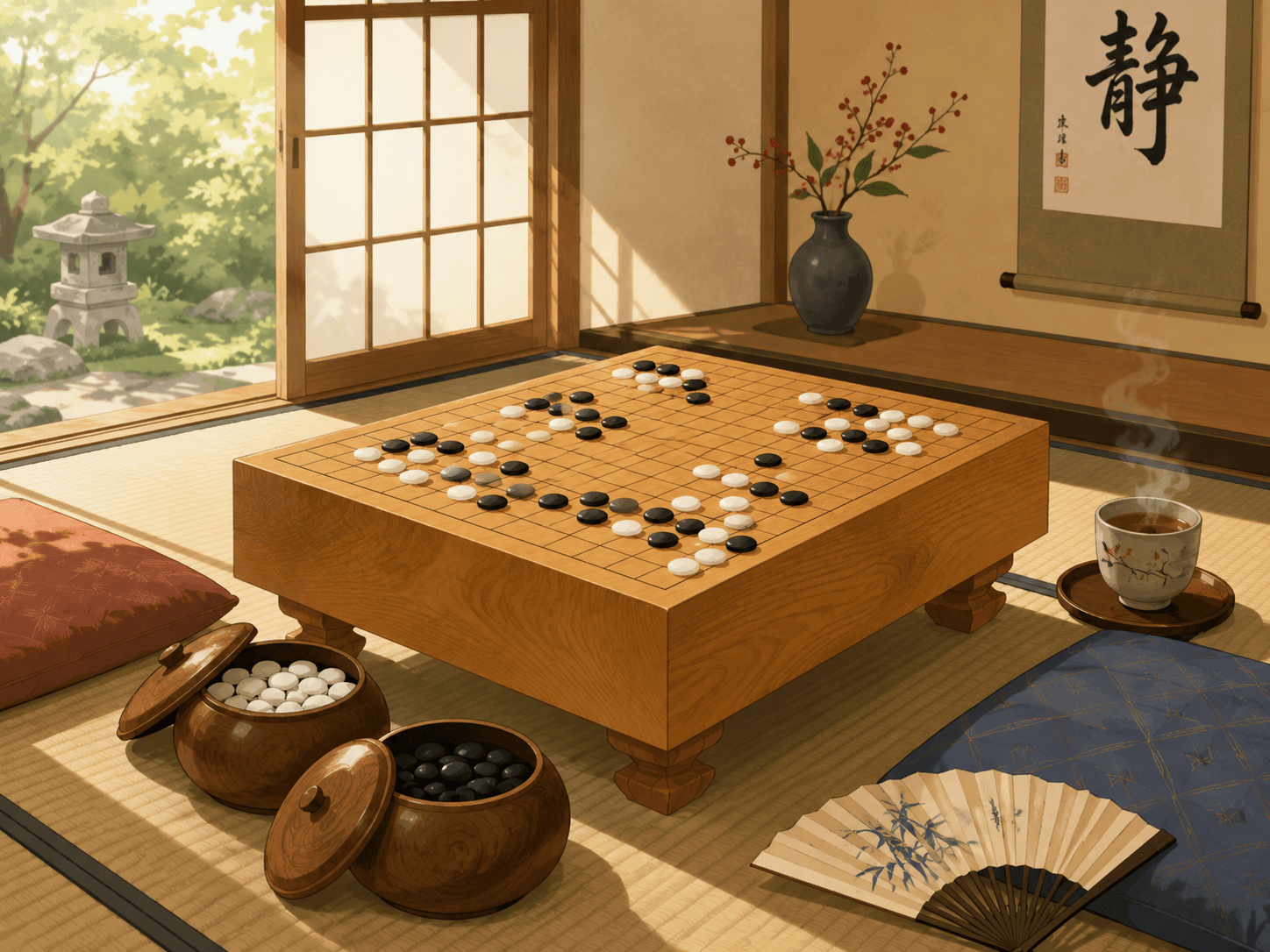
The modern version kept the architecture and swapped the patron. Newspapers took over sponsorship in the twentieth century, funding the great title matches — Kisei, Meijin, Honinbo — whose finals run over two days, with sealed moves and live commentary. Aspiring professionals still live the insei life: teenage trainees in intensive study, competing for a handful of professional slots a year. It is one of the most demanding apprenticeships in any field. And Japan gave the game its global iconography — the thick floor goban, the ritual politeness, the aesthetic of quiet intensity. It supplied the famous cultural exports too, from Kawabata's novel The Master of Go to the comic that sent a generation of children worldwide hunting for Go clubs. Institution, aesthetic, story: Japan built the game's cathedral.
Korea: the powerhouse
Korea — where the game is baduk — turned reverence into velocity. Long a Go-playing culture, Korea exploded competitively in the late twentieth century. Private training academies — dojangs — drilled young talents with athletic intensity. Television channels devoted themselves to the game. And a generation of players dominated so thoroughly that the older Go nations had to modernize their own training in response. For a stretch of years, the world's strongest players were overwhelmingly Korean, and the country treated their matches the way others treat cup finals.
The Korean chapter matters for what it proves about game cultures: they can accelerate. Baduk fever built a competitive infrastructure of astonishing efficiency — talent found in childhood, trained in cohorts, promoted through cutthroat leagues. It built a public, too: people who watch games as spectator sport, commentary and all. Where China frames the game as heritage and Japan as institution, Korea frames it as competition at the summit. The three framings feed the same worldwide player pool — which is why the game's top level has never been stronger than now.
The etiquette layer
Around the rules, East Asia built a second rule set — etiquette — and it's not decoration; it's transferable wisdom. The customs are specific: nigiri, the graceful randomization for who plays black. Placing the first stone in the upper-right corner as a courtesy to your opponent's reach. Stones played with a quiet click, not a slap. Resigning by saying so plainly — often with thanks — because playing on in a lost position wastes a teacher's time. And above all, the post-game review: winner and loser rebuilding the game together, hunting the losing move as colleagues rather than rivals.
Steal that last one whatever you play. The review ritual reframes every match as a lesson jointly produced — the opponent as co-author instead of enemy. It's the deepest reason Go cultures improve their players so fast. A rivalry with reviews compounds like the best study habit. A rivalry without them is just repetition. The etiquette layer, at bottom, encodes one belief: how you play is part of what you're playing for. Every game culture has a version of this. Go's is simply the most developed on Earth.
Go in art and story
No other game has generated a comparable literature. The proverbs alone are a genre: hundreds of compressed strategy lessons that read as life advice. "Lose your first fifty games as quickly as possible." "The enemy's key point is your key point." They migrate off the board fluently, quoted in boardrooms and dojos alike. The game anchors classic novels — Kawabata's elegy for the old master's last title match foremost — and appears across film and television whenever a story needs two minds meeting in silence.
And the culture's most distinctive contribution: the idea of the divine move — kami no itte — the perfect play, pursued across a lifetime as an artistic ideal rather than a competitive one. That concept, that a board game contains a horizon of beauty worth chasing for its own sake, is Go's deepest cultural gift. It reappears every time a commentator, in any language, calls a move beautiful — a way of talking about games that this shelf uses constantly, and that East Asia's Go tradition licensed for everyone.
Visiting the culture from your couch
The remarkable news: all of this is visitable, tonight, without a passport. Three itineraries, in ascending commitment.
Watch. Title matches and top tournaments stream with live commentary, including excellent English-language coverage; search any current title name and settle in. Watch for the culture as much as the moves: the pacing, the courtesy, the review afterward. A two-day title match, checked in on across a weekend, is one of sport's stranger and calmer pleasures.
Play. The online Go servers are the culture's global embassy: ranked games at every level, teaching games from stronger players (a Go tradition, alive and well), and communities that take the etiquette with them. Start on a 9×9 board — the ocean, bottled — and the ladder will meet you where you are.
Adopt. Even if Go never becomes your game, take the review habit across the whole family: after any serious match, in anything, rebuild it with your opponent and find the turning point together. One imported ritual, and every rivalry you have becomes a curriculum. That's the souvenir this culture offers — and unlike most souvenirs, it appreciates.
A first month inside the culture
Reading about reverence is one thing. Living in it for a month is better, and it costs nothing. Here's a four-week visit, from your couch.
Week one: learn and lose. Learn the rules — they take ten minutes — and play daily on a 9×9 board against an easy AI. Your only goal is reps. The proverb for this week is the culture's kindest: lose your first fifty games as quickly as possible. It means losing is the tuition, so pay it fast.
Week two: watch one great match. Find a title match or top tournament with commentary and watch an hour. Don't try to follow the whole board. Watch the players: the pacing, the courtesy, the tea. You're learning what the game looks like when a culture takes it completely seriously.
Week three: play people. Join an online Go server and play ten ranked 9×9 games. Say hello. Say thanks. Ask a stronger player for a teaching game — it's a normal request in this culture, and most will say yes. Handicap stones exist so that unequal players can have an equal game. Use them without shame; that's what they're for.
Week four: adopt the review. After each game this week, ask your opponent: review? Rebuild the game together and find one turning point. One is enough. This is the week you're actually visiting the culture — the habit of treating every rival as a co-teacher is the thing the academies, the titles, and the proverbs all exist to protect. Keep the habit and the month never really ends.
Questions people ask
Why did this happen to Go and not to other games? A conspiracy of fit: a game deep enough to reward lifetime study, simple enough to read as pure principle, arriving early into cultures that prized scholarly cultivation and were building institutions anyway. Chess gathered prestige on the same recipe; Go's institutions were just older, longer-funded, and framed around art as much as war. The full comparison runs through the immortality ingredients — Go simply maxed the fifth one.
Do China, Japan, and Korea play by different rules? Minor scoring differences exist (area versus territory counting), plus small procedural variations — but games between the three countries' players proceed without friction, and the differences rarely change results. One game, three accents: the mechanics crossed intact; the cultures seasoned everything else.
Is the reverence intimidating for a beginner? From outside, sometimes; at the table, almost never — Go culture's actual norm is generosity toward learners (teaching games, handicap stones, patient review). The bowing is optional. The kindness is traditional.
One line to keep? East Asia looked at a grid and two colors of stones and decided it deserved academies, dynasties, and a concept of the perfect move — the strongest statement any culture has ever made about what a game can be.