Learn › The language of strategy › Sente and gote
Sente and gote: what Go teaches every player
Go players carry a pair of words the rest of the gaming world quietly envies: sente, for a move your opponent must answer, and gote, for a move that ends with you answering. Two syllables each, and between them they audit every exchange in every turn-based game ever made. Here's the lens, in plain English, ready to bolt onto whatever you play.
Two words for the oldest question
Every move you make in a duel ends in one of two states, and only two. Either your opponent must respond to what you just did — you kept the pen, you'll choose the next topic — or your move completed something and now they're free to play anywhere they like, and you'll be the one responding. Go's tradition named the states centuries ago: sente (roughly, "preceding hand") for the first, gote ("following hand") for the second.
If you've walked this shelf in order, you'll recognize the territory — tempo counts the coins and initiative names who holds the pen. What sente and gote add is the missing bookkeeping unit: they classify each individual exchange, the way an accountant classifies each transaction rather than just eyeballing the year. A move "ends in sente" (you're still free) or "ends in gote" (you're now committed to having spent your freedom). String a game together and the ledger reads like a story: sente, sente, gote — there, that's where the agenda changed hands.
The Japanese terms have spread far beyond Go — chess commentators borrow them, abstract-game designers discuss their designs in them — because no Western gaming word does the same precise job. "Forcing" comes close to sente but misses the accounting flavor; "initiative" describes the war, not the transaction. Sometimes a tradition simply builds the best tool, and everyone else eventually borrows the toolbox.
The politeness framing (and why it clarifies everything)
Here's the mental model that makes the pair unforgettable. A sente move says, with perfect courtesy: "Excuse me — you must deal with this before you do anything else." A gote move says: "I've finished something here; please, go ahead." Every move in every game is one of these two sentences, and strong players hear the conversation running under the moves the way musicians hear chord changes under a melody.
The framing exposes the crucial subtlety immediately: sente is a claim, and claims can be refused. Your "excuse me" only works if ignoring it genuinely costs your opponent more than answering. Strong players constantly test each other's sente — coolly ignoring the demand, playing elsewhere, accepting the local damage as a fair price for stealing the agenda. Whole layers of Go strategy revolve around this brinkmanship: is that threat really sente, or is it a politeness I can decline? Every game has the same layer. The Oustwit player who shoves your piece toward the rim believes they've played sente; whether they actually did depends on a cold calculation only you can make — is saving that piece worth more than the placement you'd rather make? Declining false sente is one of the most profitable habits in all of gaming, and having a word for it is what makes the habit teachable.
Keeping sente: the compound interest of freedom
Watch a strong player dismantle a weaker one and the ledger usually shows the same pattern: the strong player's exchanges keep ending in sente, and each ending-in-sente means another free choice, another exchange begun on their terms. Freedom compounds. Three consecutive sente exchanges is three topics in a row chosen by one mind, and by the fourth the weaker player's position is a collection of answers — locally correct, globally shapeless. (It's the answering corridor seen through the accountant's window.)
The craft of keeping sente comes down to move selection inside each little battle. Most local situations offer a spectrum of resolutions: a way to finish that seals things completely but ends with your opponent free (gote), and a lighter touch that leaves matters nearly settled while preserving your freedom (sente). The pro habit is always asking: can I get ninety percent of this while keeping the pen? Take the whole biscuit and hand over the turn, or take most of it and keep choosing — game after game, the second option wins wars while losing crumbs.
But the compounding has a famous failure mode, and Go teaches it with a proverb-level warning: chasing sente into worthlessness. Players addicted to the feeling of forcing will fire off every "excuse me" on the board — tiny threats, nearly-empty demands — just to stay the asker, spending real position on sequences that gained nothing but rhythm. The word for what they're burning is, once again, tempo: forcing moves that force but don't profit are decorations with a bell attached. Sente is only valuable for what you do with the freedom it preserves.
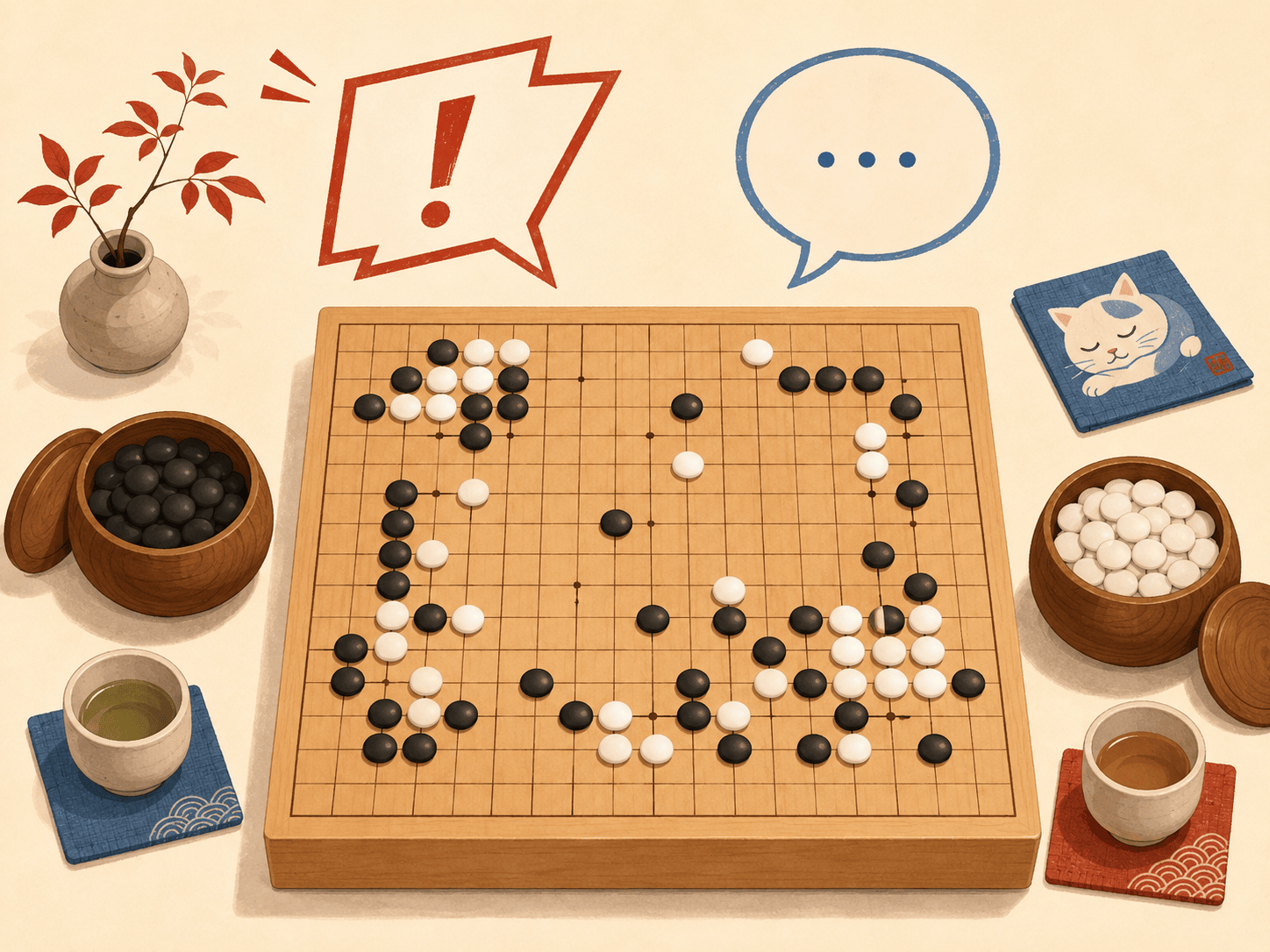
Choosing gote on purpose: the biggest-point wisdom
Everything so far flatters sente, so here's the counterweight — the piece of Go endgame wisdom that most changes how you'll play everything: sometimes the correct move is gote, chosen with open eyes, because it's simply worth more.
Go's endgame makes the arithmetic explicit. Every remaining region of the board is worth points, and each can be played in sente or gote. The naive rule — always play sente moves first — is genuinely good, and then genuinely wrong: when your biggest sente demand is worth two points and a quiet gote move is worth eleven, the eleven wins. You take the huge point, hand over the pen, and let your opponent enjoy their little forcing sequence; you'll still be ahead when the music stops. Strong endgame play is a constant auction between freedom and size, and the discipline is refusing to let the feeling of forcing outbid the value of the move.
The transfer to other games is immediate. The Oustwit player who declines a flashy shove to quietly land and brace a seventh piece — gote, and enormous, because it arms the cross-condition fork — is playing the eleven-point move. So is the chess player who ignores a check-able king to complete development, and the Connect Four player who banks the right-parity threat instead of making noisy fours that get blocked. The vocabulary gives the maneuver its dignity: you didn't "lose the initiative" — you sold it, at eleven for two.
Five everyday moments, classified
The lens installs fastest through examples. Here are five moments every duel player knows, run through the two-word audit.
The check (or the rim shove). You attack their king, or shove their piece to one square from the edge. They must respond now. Sente — and the purest kind, because the rules or the geometry do the compelling for you.
The forced jump. In checkers, you offer a capture. The rules require them to take it. That's sente by law — the strongest claim in gaming, no refusal possible. It's why checkers players are the world's most fluent forcing-sequence thinkers.
The quiet brace. You reinforce your own line. Nothing demands an answer. Gote — and often correct anyway. You handed over the pen to buy a wall.
The big fill placement. Late in an Oustwit game, you land your seventh piece somewhere safe. No threat, no noise. Gote — and possibly the biggest move on the board, because the eighth placement now looms. The eleven-point move, wearing work clothes.
The threat they can shrug at. You "attack" a piece they were happy to abandon. You believed it was sente. It was gote with a costume on — and they answer by taking the agenda somewhere that hurts. False sente: the most expensive misclassification in games.
Run five of your own recent moves through the same sorting. The habit takes thirty seconds and never really stops paying.
Try it tonight: two small drills
The lighter-touch hunt. One game against the AI with a single rule: every time you're about to settle a local situation, pause and look for a resolution that keeps your freedom — the ninety-percent version that ends in sente. Take it when it exists. Count how often it existed. (Most players find two or three per game they'd never have looked for.)
The deliberate eleven. Once per game, choose a big quiet move over a small forcing one — on purpose, with a one-sentence justification spoken silently: "this gote is bigger." You're training the auction instinct: freedom versus size, priced consciously. The players who never learn this drill spend whole games forcing their way, exquisitely, to smaller totals.
Reading your own games in S and G
The lens becomes yours the day you annotate with it, and the exercise is almost absurdly simple. Take one replay of a close loss — open games keep perfect records — and letter your own moves: S if the move ended with your opponent compelled to answer, G if it ended with them free, and honestly mark the false sente — moves you believed were forcing but a cool opponent could've ignored.
Three diagnoses fall out of the string almost every time. Long unbroken runs of G in the middlegame: you kept completing little projects and handing the pen back — look for the lighter touch you missed. Clusters of false S: you've been buying the forcing feeling at full price — the tempo audit's decoration problem in new letters. And the most instructive find: the one huge G move you didn't play because a two-point S felt more urgent. Every player has a personal ratio of these three diseases, and one annotated replay reveals yours faster than a month of unexamined games.
Then flip the letters and read your opponent's string. The move where their S's started outnumbering yours is the game's true turning point — usually several moves before whatever you'd been blaming.
One exchange, spoken in both voices
A last worked miniature, to hear the words in motion. Mid-game, 6×6 duel. You place beside their forming line, shoving its middle piece out of alignment — "excuse me: your line is broken; deal with it." Sente. They rebuild with a placement that re-anchors the piece — an answer, pure gote from their side. You now hold a free choice, and here's the hinge the vocabulary exposes: you could shove the same piece again — more sente, another forced rebuild, the forcing player's favorite loop. But say the audit out loud: each shove-and-rebuild trades your coin for theirs, one for one, and buys you nothing new — rhythm without profit, the false economy of decorations with a bell attached. So instead you take the eleven-point gote: a quiet placement that lands your sixth piece, braced. "Please, go ahead." They're free — and behind on the race that now matters. Two exchanges, four moves, and every decision in it was just the two words, priced correctly. That's the whole lens at match speed.
The culture that comes with the words
Borrowed vocabulary carries borrowed manners, and sente/gote arrive from a tradition with a particular attitude worth importing whole: exchanges are negotiations, not battles. A Go player who answers your sente isn't retreating — they're paying a fair price, and expects you to pay theirs in turn; the politeness framing isn't decoration, it's genuinely how the game's culture thinks. Post-game reviews in that tradition dwell lovingly on exchange boundaries — "here I should have taken gote" is a sentence said with the satisfaction of a solved puzzle, not an apology.
That attitude travels beautifully to five-minute duels. Thinking in sente and gote makes you calmer, not sharper-elbowed: you stop resenting the turns you spend answering (they're purchases, not humiliations), stop overvaluing the turns you spend forcing (they're claims, not victories), and start seeing the whole game as one long trade negotiation in which the best deal — not the loudest voice — wins. Two words, one lens, every game you'll ever play: the best exchange rate on this entire shelf.
Questions people ask
Sente versus initiative — same thing? Same phenomenon, different zoom. Initiative is the standing state of setting the agenda; sente/gote classify each exchange's ending. You hold the initiative because your recent exchanges ended in sente. Think initiative = climate, sente = today's weather reading.
Is answering sente always obligatory? That's the brinkmanship: genuine sente, yes, by definition — but claimed sente should be audited every single time. The refusal ("tenuki," Go's word for playing elsewhere, and yes, players borrow that one too) is among the strongest moves in any game precisely because over-forcers never expect it.
Do these words apply to games with luck or hidden information? Anywhere turns alternate. A backgammon threat that demands a response is sente with dice attached; a bold poker bet is a sente claim whose refusal is called "calling." The accounting is fuzzier under uncertainty, but the grammar survives — which is a good sign you've found one of gaming's load-bearing ideas.
What's one habit to adopt tonight? Before finishing any local exchange, ask the ninety-percent question: is there a resolution that keeps my freedom? And once per game, deliberately choose a big gote move over a small forcing one, and notice that the sky doesn't fall. Those two habits are the entire lens, installed.